Podcasting since August 2005! Listen to our latest podcast here:

Podcasting since August 2005! Listen to Latest SolderSmoke

Friday, August 26, 2011

Beautiful Homebrew Gear from Italy

We may have had Fabio Bonucci's rigs on the blog before, but they are so nice I thought it would be OK to feature them again. Bravo Fabio!

http://nuke.ik0ixi.it/Autocostruzione/Ricetrasmettitori/tabid/484/Default.aspx
....................
Our book: "SolderSmoke -- Global Adventures in Wireless Electronics"http://soldersmoke.com/book.htmOur coffee mugs, T-Shirts, bumper stickers: http://www.cafepress.com/SolderSmokeOur Book Store: http://astore.amazon.com/contracross-20

Thursday, August 25, 2011

Get SolderSmoke Daily News by e-mail

We have a new feature on the blog: You can easily arrange to get an e-mail whenever I post something new. You can get early notification on new podcast episodes. Just enter your e-mail address in the box to the upper right of the blog page.

Our book: "SolderSmoke -- Global Adventures in Wireless Electronics"http://soldersmoke.com/book.htmOur coffee mugs, T-Shirts, bumper stickers: http://www.cafepress.com/SolderSmokeOur Book Store: http://astore.amazon.com/contracross-20

Homebrew Microphone Using Cream of Tartar (NOT Tartar Sauce)

Podcast listeners will recall that this year's April 1 edition featured a story about my (supposed) efforts to cure long-standing audio problems by "chemically tailoring" home-made microphone elements. I asked for listener suggestions on which kitchen ingredients I should add to the mix. Very few listeners fell for it. But now -- as often happens -- somebody out there has completed the project that we were using as our annual hoax. Check it out. Very interesting:
http://leafcutterjohn.com/?p=1518
And I think he has a follow-up post.

Our book: "SolderSmoke -- Global Adventures in Wireless Electronics"http://soldersmoke.com/book.htmOur coffee mugs, T-Shirts, bumper stickers: http://www.cafepress.com/SolderSmokeOur Book Store: http://astore.amazon.com/contracross-20

Wednesday, August 24, 2011

Radio Drama about RADIO!

Dale, W9DKB, alerts us to a radio drama from 1973 that is all about mysterious radio signals from space. Very cool. Thanks Dale.
.....................................

Hi Bill,


I've enjoyed your podcast for the past 2 years, never miss it. And I enjoyed your book, Global Adventures.

Last night I listened to a free radio show from Jim French Productions and thought of you. It's a story that involves computerized data signal processing, communication with aliens, radio noise analysis, NASA, Apollo, Skylab, deciphering codes based on chemical specific gravities, neat jazz music ... all the th
ings a knack victim like yourself would enjoy. And here's the kicker - the production was made in 1973! You can hear the old 500 series Bell telephones used for sound effects and all that. Give it a listen. I think you'll like it.

This is an episode of "Dameron". If you like listening to radio dramas, this is a great site to visit as they post a new
show on their "Listen Now" page each week. The Harry Nile adventures are great. But so are the Adventures of Sherlock Holmes. Of course all of them are available for download at a modest cost. (No, I have no affiliation with Jim French Productions.)

http://jimfrenchproductions.com/zc137m/index.php?main_page=page&id=2&chapter=0
is the link. Scroll down the page. The show you want is titled WEEK 804, Dameron, "Earth is Ours". Just click the blue "Listen Now" label.


73,
Dale
W9DKB
River Falls, WI

Our book: "SolderSmoke -- Global Adventures in Wireless Electronics"http://soldersmoke.com/book.htmOur coffee mugs, T-Shirts, bumper stickers: http://www.cafepress.com/SolderSmokeOur Book Store: http://astore.amazon.com/contracross-20

Tuesday, August 23, 2011

German Tanks and Drake 2-Bs: We Have the Number!


Hi Bill,

Finally getting back to you. I crunched the numbers...
I saw a total of 23 serial numbers reported. The important thing is that these numbers be reported somewhat randomly with no biases etc. I think this is the case, and the fact we have 23 numbers is very very good in terms of the power of this experiment. The highest number reported was 12955. Let m = 12955. The number of reports was 23 so let k = 23. The equation to use (from wikipedia) is below...
\hat{N} =m(1 + k^{-1}) - 1\,
Simply applying this equation we get an estimate highest serial number of 13517. So we can estimate that between 13000 and 14000 Drake 2Bs where made. I think I remember someone mentioning that the Drake 2B serial numbers did not start at zero. This is not really a problem. You just need to know at what number they did start, then subtract that number from 13517, and that would be the number of Drake 2Bs ever manufactured.

The lowest serial number reported to SolderSmoke was 2008, so you wouldn't need to subtract more than that.
You can think of this equation intuitively (a very SolderSmoke thing to do!). Imagine what happens when we have a single observation. k = 1, so our estimate is about 2 times what our highest observation is. This makes sense because you would guess your observation is most likely to be about half way between 0 and the true top number. If k = 2, then our estimate is about 1.5 times our highest observation. If k = 3, then our estimate is about 1.333 times our highest observation.... as we observe more numbers, we are more likely to have observed the top number so as k goes to infinity, our estimate moves towards our top observed number, which it should.

I hope my explanation made sense. Anyway I highly recommend SolderSmoke listeners who want to know more, to read the wikipedia page. Its quite well written and offers a lot for people who like hard formal explanations and an intuitive description. Keep up the good work!

I love the podcast - hopefully we may catch each other one day on the bands.


73
Scott (K6AUS)


Our book: "SolderSmoke -- Global Adventures in Wireless Electronics"http://soldersmoke.com/book.htmOur coffee mugs, T-Shirts, bumper stickers: http://www.cafepress.com/SolderSmokeOur Book Store: http://astore.amazon.com/contracross-20

Sunday, August 21, 2011

FT-817 Remote Access and The Perils of PC Board Etching

Mike is looking for some beta testers for his FT-817 remote control system, and for someone who is proficient on VB6 who can help him clean up the code.

....................

Bill,

Hello I am a 47 year old ham from Pittsburgh,Pa and my call is WA3O. I felt compelled to write you after my Kindle purchase of your Solder Smoke book. I don't usually read books cover to cover but, this book is different I can not seem to put it down. This is the first time I can personally relate to a book. Like you, I started ham radio at the early age of 13 and have built and struggled with the same projects you have. So I wanted to say thanks!...I am half way through the book and I am dreading finishing it because I probably will never find another book I can relate to so well.

My latest project is some software I wrote for the FT817 and Icom radios. I am not a programmer but, I taught myself VB6 so I could write this remote software. After reading in the book about your Iphone “link”I thought you might like it and I wanted your opinion on it. The software is DTMF control of your radio from any phone. With Skype (and a Skype-in phone number) and my software, you can call your radio from ANY phone (not just a smart cell phone). You dial your number and after a security number the program turns your radio on via the printer port and you have pretty much full control of all the functions of your radio with the voice announcer on the radio (Icom) or the voice out on Microsoft computers it can announce frequency, signal, mode etc. you can even TX. The software even has a time out timer just in case of say a cell phone “drop call”. The software has many features like 50 memory recall, selective scanning, band scanning,direct frequency input. If you have a radio like a IC-7000 or a FT-817 and a auto tuner you have access to all HF,VHF and UHF. I brought the software idea up to some local hams and it sounded like it was a bad idea. I use it every day to listen to 160M while I drive to work in my truck without a BIG 160 antenna on it! I also thought it would be great for guys who just like to see what band conditions are on lunch break. Let's face it we all carry a cell phone. So I would really appreciate your opinion on this.


One last comment...while I was reading about your struggles with etching your own board it reminded me of my first experience with etching solution. My buddy etched boards before and told me all you had to do was draw what you wanted with a Sharpie on a copper PC board and throw it in some solution and “rock it back and fourth a bit and it works like magic. So unknowingly we put the solution in a pie tin and palced the board in. It immediately started boiling and put off an orange smoke! I said NEAT! And before my buddy could tell me it was NOT supposed to do that it ate thru the bottom of the pie tin...What a mess! And mom wasn't happy! LOL

So best of 73's and keep up the good work

Mike Lamanna WA3O

.......................................
Our book: "SolderSmoke -- Global Adventures in Wireless Electronics"http://soldersmoke.com/book.htmOur coffee mugs, T-Shirts, bumper stickers: http://www.cafepress.com/SolderSmokeOur Book Store: http://astore.amazon.com/contracross-20

Tuesday, August 16, 2011

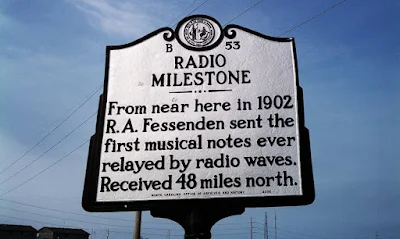
Fessenden's Music from the Outer Banks

George, KB3ODH, found this about 1/2 mile from the Cape Hatteras Lighthouse.

Our book: "SolderSmoke -- Global Adventures in Wireless Electronics"http://soldersmoke.com/book.htmOur coffee mugs, T-Shirts, bumper stickers: http://www.cafepress.com/SolderSmokeOur Book Store: http://astore.amazon.com/contracross-20

Monday, August 15, 2011

Bike Radio II

Thanks for all the suggestions on the bike radio. I googled around a bit and found a schematic that seems very similar to the little receiver I'm working with. I almost certainly would be better off starting anew (perhaps keeping the AF circuitry). But it is interesting to see how a simple AM receiver works. That first transistor is an autodyne circuit -- both a mixer and a oscillator.

Our book: "SolderSmoke -- Global Adventures in Wireless Electronics"http://soldersmoke.com/book.htmOur coffee mugs, T-Shirts, bumper stickers: http://www.cafepress.com/SolderSmokeOur Book Store: http://astore.amazon.com/contracross-20

Sunday, August 14, 2011

Bike Radio

As I mentioned on the podcast, I've been riding my bike to work lately. I really enjoy it. We have great bike trails in this area. They use paths of defunct railroad lines -- I ride Washington and Old Dominion Trail.

My bike is a bit of a boatanchor. It was made in Japan. I bought it 22 years ago when I was in Spain. I've used it in Spain, The Dominican Republic, the UK, Portugal, Italy, and in the U.S.

Of course, my thoughts have turned to putting some sort of HF radio on the bike, probably just a receiver. I still have a little handle-bar AM radio that I added shortly after I bought it. The handle bar mount is still good. See above. I'm pleased to see that it looks very simple, with discrete components. The AF amps are obviously off to the left of the speaker. To the right of the speaker we obviously have the RF and IF circuits. There are some nice tuned transformers there (from the "Chop Shing" company), and three transistors and a diode. What would the standard lineup be for a simple AM radio of this type? Maybe just an RF amp in the front end, a local oscillator, one stage of IF amplification and the diode as the detector?

What do you guys think? Make use of some of the existing circuitry? Start over?

Our book: "SolderSmoke -- Global Adventures in Wireless Electronics"http://soldersmoke.com/book.htmOur coffee mugs, T-Shirts, bumper stickers: http://www.cafepress.com/SolderSmokeOur Book Store: http://astore.amazon.com/contracross-20

Thursday, August 11, 2011

Alarm from Space

So I was sitting in the shack yesterday morning, drinking coffee and listening to IGY by Donald Fagen on Pandora, when I heard what I thought was an alarm. I thought it might have been a smoke detector going off (always a real possibility in the N2CQR shack!). It took me a moment to realize that what I was hearing was the device pictured above. I'd left my 2 meter HT tuned to 145.950 MHz, and Arissat-1 was breaking squelch with SSTV tones. Very cool.

Later, I was thinking about this as I pedaled along on my bike. I remembered our recent discussion of Copthorne MacDonald, inventor of SSTV. Way to go Cop!

It is easy to join in the fun. Just tune you two meter gear to 145.950 and leave it there. You'll soon be alarmed just as I was.

Our book: "SolderSmoke -- Global Adventures in Wireless Electronics"http://soldersmoke.com/book.htmOur coffee mugs, T-Shirts, bumper stickers: http://www.cafepress.com/SolderSmokeOur Book Store: http://astore.amazon.com/contracross-20

Wednesday, August 10, 2011

Shack Background Music from Pandora Radio

Billy alerted me to Pandora. Very cool. You just give it an indication of the kind of music you'd like to listen to. They do the rest. I started out with Creedance Clearwater Revival, and Pandora proceeded to send me a stream of sort-of similar rock. Streaming audio through the web. And it is apparently all legal (you listen to a commercial every once in a while). This is great for background music in the shack. After all, you can only listen to so much SolderSmoke, and 75 meter SSB chatter is not good for you. I'm not sure if it is available outside the USA. I hope it is.
www,pandora.com


Our book: "SolderSmoke -- Global Adventures in Wireless Electronics"http://soldersmoke.com/book.htmOur coffee mugs, T-Shirts, bumper stickers: http://www.cafepress.com/SolderSmokeOur Book Store: http://astore.amazon.com/contracross-20

Big Book Sale

Our book: "SolderSmoke -- Global Adventures in Wireless Electronics"http://soldersmoke.com/book.htmOur coffee mugs, T-Shirts, bumper stickers: http://www.cafepress.com/SolderSmokeOur Book Store: http://astore.amazon.com/contracross-20

Monday, August 8, 2011

The Picture You Heard in SS 136 -- FROM SPAAAACE!

In the last podcast I played a recording of some 2 meter signals picked up by my handheld transceiver from the new amateur radio satellite ArisSat-1. Included in the transmission were some tones that were obviously SSTV. Mike, K2MTS, ran the audio through some SSTV software and got this! Pretty good! From space to my HT, across the room to the SolderSmoke mic, out over the internet in podcast form, back to me in an e-mail, and now, on the blog. Thanks Mike!
Our book: "SolderSmoke -- Global Adventures in Wireless Electronics"http://soldersmoke.com/book.htmOur coffee mugs, T-Shirts, bumper stickers: http://www.cafepress.com/SolderSmokeOur Book Store: http://astore.amazon.com/contracross-20

Sunday, August 7, 2011

SolderSmoke Podcast #136

http://soldersmoke.com/soldersmoke136.mp3
August 7, 2011
Travelogue: New York City
A Stroke of Luck: Lightning strikes Rome HB DC DSB WSPR rig
It's an IGY thing: Recreating the Sputnik Transmitter
ArisSAT-1 deployed. Audio Clip (Can anyone decode the SSTV in this clip?)
Summertime SPRAT -- ZL2BMI rig and the mysteries of the '602
A writer for "The New Yorker" builds a radio
June Smithsonian Magazine has a lot of Knack
Electric Radio on AM selectivity, Japanese, and the sibilant S problem
Gathering Drake 2-B Serial numbers for use with German Tank Equation
Amazon breaks into oscillation on "Atoms to Ampere" prices
MAILBAG

Our book: "SolderSmoke -- Global Adventures in Wireless Electronics"http://soldersmoke.com/book.htmOur coffee mugs, T-Shirts, bumper stickers: http://www.cafepress.com/SolderSmokeOur Book Store: http://astore.amazon.com/contracross-20

Saturday, August 6, 2011

Big Nick's Awesome Homebrew Tube Radios

Eddie, KC4LVV, alerted me to the web pages of Nick, KC9KEP. What beautiful craftsmanship! Inspirational stuff! Check out the homebrew capacitors. And the coils! And the coil winder. It's almost too much!
http://www.bignick.net/TubeRadio.htm

Our book: "SolderSmoke -- Global Adventures in Wireless Electronics"http://soldersmoke.com/book.htmOur coffee mugs, T-Shirts, bumper stickers: http://www.cafepress.com/SolderSmokeOur Book Store: http://astore.amazon.com/contracross-20

Thursday, August 4, 2011

ARISSat Deployed


I just got back from a vacation trip to New York City (amazing place!) and found out that yesterday Russian cosmonauts launched the ARISSat amateur radio satellite. This one looks like lot of fun. It has a two meter downlink. I'll be doing some listening, and my try to get some of the SSTV signals.

Uh oh.... Just read a post from Mark over on Brainwagon reporting on some problems with the deployment:
http://brainwagon.org/2011/08/03/arissat-1-is-off-to-a-bumpy-start/

Details on how to use the satellite can be found here:
http://www.amsat.org/amsat-new/ARISSat/ARISSatHowTo.php

............................................

Our book: "SolderSmoke -- Global Adventures in Wireless Electronics"http://soldersmoke.com/book.htmOur coffee mugs, T-Shirts, bumper stickers: http://www.cafepress.com/SolderSmokeOur Book Store: http://astore.amazon.com/contracross-20

Friday, July 29, 2011

Amateur radio at PAR (W4OP)

An e-mail exchange on QRP-L this morning about using ceramic resonators in 455 kHz filter circuits (great idea Grayson!) led me to the ham radio corner of the PAR electronics web site. PAR is the company run by Dale Parfitt, W4OP.
http://www.parelectronics.com/par-amateur-radio.php.
That's a nice looking 2-B Dale! Please send us the serial number! Even more impressive is Dale's award-wining homebrew solid state version of the 2-B (on the far right). Visit his web site for more info (on his site you can hover your mouse above the pieces of gear for more info).


I'm proud to say that I have a piece of gear in my shack that was built by Dale Par
fitt. The story is told in SolderSmoke The Book: I'd built my own version of Doug DeMaw's Barebones Superhet and had liked it a lot. When I saw another one (this one built on a FAR circuits board) for sale on e-bay, I bought it. It stayed on the shelf for a while. Years later when I started working on it, I turned to QRP-L for help and this fellow named Dale Parfitt came to my rescue. It was only after a long series of e-mail exchanges did we realize that the receiver we were discussing had been built (and sold to me) by... Dale Parfitt.

Our book: "SolderSmoke -- Global Adventures in Wireless Electronics"http://soldersmoke.com/book.htmOur coffee mugs, T-Shirts, bumper stickers: http://www.cafepress.com/SolderSmokeOur Book Store: http://astore.amazon.com/contracross-20

Wednesday, July 27, 2011

Walford Electronics' "QRP In the Country"

A stiff wind and occasional drizzle did not put off the large attendance of QRP and home building enthusiasts who attended QRP in the Country on July 17th. Hundreds of people from all over England and Holland found their way to Upton Bridge Farm, Somerset where the farm barns provided cover. About 25 stalls and displays showed off or sold everything from components to large construction projects. Apart from a few traders selling components, most displays were from Clubs publicising their activities or of ancient domestic and wartime radios, with a few individuals selling items to make space for new projects! There were also practical construction projects to be seen as ‘students’ built their Cary RXs with occasional help from the Bath Buildathon team led by Steve G0FUW. The catering team led by Tony G0GFL cooked a prodigious amount of special local burgers and sausages from the host Tim G3PCJ’s farm served in rolls baked locally that very morning, and washed down by village beer and cider, under the careful eye of Robert PA9RZ!

A raffle raised £200 for those suffering in East Africa; the main prize being a year’s subscription to PW kindly donated by Rob G3XFD which was won by Graham G4DPH. George G3RJV was asked to select a couple of displays that ‘appealed’ to him for two other prizes. The GQRP Club had kindly donated a special edition of Drew VK3XU’s latest project book which was also won by G4DPH for his PW Sprat project; a Walford Electronics Radlet CW TCVR kit went to Colin G3YHU for his valved superhet. A years subscription to BYLARA was won by SWL Mike Jones who is about to take his Foundation licence course.

After the event Tim G3PCJ said he was said delighted with the increased attendance and wished to thank everybody whose hard work had made the event so successful. He urged all Clubs within reasonable distance to plan their displays for next year! Watch the press for announcements of the date!


Any questions to:-
Tim Walford G3PCJ
walfor@globalnet.co.uk
WALFORD ELECTRONICS
www.users.globalnet.co.uk/~walfor


Designers & suppliers of kits for radio enthusiasts

Proprietor Tim Walford BSc MIEE CEng G3PCJ

-----------------
Our book: "SolderSmoke -- Global Adventures in Wireless Electronics"http://soldersmoke.com/book.htmOur coffee mugs, T-Shirts, bumper stickers: http://www.cafepress.com/SolderSmokeOur Book Store: http://astore.amazon.com/contracross-20

Tuesday, July 26, 2011

How Curiosity Will Land on Mars


Our book: "SolderSmoke -- Global Adventures in Wireless Electronics"http://soldersmoke.com/book.htmOur coffee mugs, T-Shirts, bumper stickers: http://www.cafepress.com/SolderSmokeOur Book Store: http://astore.amazon.com/contracross-20

Regens: A Complex Relationship; AA7EE's WBR


Bill -
I've been following your blog for a while now and am moved to let you know of my recent experience with regens, a subject that I know is dear to your heart or perhaps, more accurately, the basis of a complex relationship!
Anyway, the last time I built and owned a regen was as a teenager in the UK in the late 1970's when I had a one-tube HAC Model DX one tube regen. Recently I've been looking for a fairly simple receiver to build that would
receive CW and SSB on 40M, as well as AM. I'm developing an interest in AM on 40, a rather impractical mode in some ways, but one that I have an attachment to. A regen seemed an obvious choice, so after seeing the
reprint in "More QRP Power" of the QST article describing N1BYT's WBR regen, I decided to have a go at it.
In short, I'm so glad this was the first regen of my adult life. It is sensitive, suffers no hand-capacitance effects, has very little radiation from the antenna port due to the oscillator tank circuit being in a Wheatstone Bridge arrangement,
no microphony and to make things even better, is very stable in frequency. I can set it to a net or long-winded CW QSO and it stays there with no easily discernible drift (after a short warm-up period of course).
I know you're probably aware of this receiver, but have you tried building one? I think you'd be pleasantly surprised.
The blog post about my version of this great little receiver is here:
Yours,
Dave Richards
AA7EE

Our book: "SolderSmoke -- Global Adventures in Wireless Electronics"
http://soldersmoke.com/book.htm
Our coffee mugs, T-Shirts, bumper stickers: http://www.cafepress.com/SolderSmoke
Our Book Store: http://astore.amazon.com/contracross-20

Saturday, July 23, 2011

The Dish

Our man in Dayton, Bob Crane, W8SX, sent us a really beautiful picture of my favorite antenna (not the one above). Check it out: http://apod.nasa.gov/apod/ap110721.html

We talk about "The Dish" from time to time on SolderSmoke. That's the name of the movie about the role of this antenna in the reception of the TV signals for the Apollo 11 moon landing. This is -- without a doubt -- the best movie ever made about an antenna.

You can get the movie at the Gadgeteer Book Store:
http://astore.amazon.com/contracross-20?_encoding=UTF8&node=8

Check out "SolderSmoke -- Global Adventures in Wireless Electronics"
http://soldersmoke.com/book.htm

Friday, July 22, 2011

Steve "Snort Rosin" Smith: Silver-Tongued Devil! Dual-band "Vlad the Inhaler" RX

You'll see in the comments attached to my last blog post that our man on the left coast, Steve Smith, gave that cute little Doug DeMaw/Vlad Polyakov receiver a name that might set American-Russian ham relations back a bit: He called it "Vlad The Inhaler." Good one Steve! (But you might want to stay out of the diplo game!)

It occurred to me that with the installation of one little switch in the diode part of the circuit, we could turn this into a dual-band RX. Take a look here:

http://soldersmoke.blogspot.com/2010/03/polyakov-plus-dual-band-receiver-with.html

Check out "SolderSmoke -- Global Adventures in Wireless Electronics"
http://soldersmoke.com/book.htm

Wednesday, July 20, 2011

Doug Demaw and Vlad Polyakov

I was looking through W1FB's Design Notebook the other day and I came across the above schematic for a direct conversion receiver (page 111). Note the Polyakov detector. One strange thing though: Doug was running the oscillator at the operating frequency. I thought the big advantage of the Polyakov design was that you ran the oscillator at half the operating frequency (that's why it is sometimes called a "subharmonic" detector). Any ideas on why Doug did it this way?

Check out "SolderSmoke -- Global Adventures in Wireless Electronics"
http://soldersmoke.com/book.htm

Tuesday, July 19, 2011

Royal Order of the Sputnik Clone Chasers

Kettering Group, UK

From the Chief Designer (AA1TJ):

Fellas,

I came across an online blurb for the recent book, Sputnik: The Shock of the Century, by Paul Dickson; a worthwhile read, judging from the introduction and first chapter.

http://www.sputnikbook.net/intro.php

"Someone brought out a shortwave radio, and soon a beeping noise filled the room. A Russian scientist, Anatoli Blagonravov, confirmed it was Sputnik. "That is the voice," he said dramatically. "I recognize it." John Townsend Jr., one of the scientists at the party, recalled watching Blagonravov: "I knew him quite well, and I could tell that he was a little surprised and quite proud. My reaction was 'Damn!'"

And so an abstraction now had a voice. It also had a name - Sputnik.

Many of those at the party adjourned to the Soviet Embassy's rooftop, attempting to view Sputnik with the naked eye. Several of the American scientists drifted over to the American IGY headquarters in Washington, where they began speculating on what impact the satellite would have. They feared that the American people would be disappointed.

It also dawned on them that they had better start tracking the satellite's orbit. They got in touch with the American Radio Relay League in West Hartford, Connecticut, asking its 70,000 members-all "ham" radio operators-to lend a hand and help track the Sputnik. In less than twenty-four hours, reports on the satellite were coming back to the National Science Foundation, where a temporary control room had been established. Eventually, these hams and other amateur and professional trackers would consider themselves part of a great international fellowship known as ROOSCH, or the Royal Order of Sputnik Chasers."

That's right guys...ROOSCH...the Royal Order of Sputnik Chasers. And to think that fifty four years later a second great international fellowship would rise from the ashes...ROOSCCH, or the Royal Order of Sputnik Clone Chasers! ;o)

(BTW, October 4, 1957 is an important date in American history for a second reason. On that evening the first episode of Leave it to Beaver made its debut.)

...............................................

I thought we should also at this point remember the intrepid lads of the Kettering Group, pictured above. (Some of those dudes look like they would have been right at home in "Leave it to Beaver.") For more info on their amazing Sputnik adventures go here:
http://www.svengrahn.pp.se/trackind/getstart/oldcyts.htm
and here
http://www.svengrahn.pp.se/trackind/trackin1.htm#KEttrack


Check out "SolderSmoke -- Global Adventures in Wireless Electronics"
http://soldersmoke.com/book.htm

Monday, July 18, 2011

Sputnik QSL from the Soviet IGY Committee

I like the reminder of Sputnik's IGY connection. This is from an article by John Foley. W7ETS, in the October 2007 issue of QST. Be sure to read the translation in the caption.

Yesterday Billy and I were at the Smithsonian Air and Space Museum's Dulles Airport center. (We volunteer to take visiting relatives to the airport IF we get to go to the Smithsonian afterwards.) We checked for Sputniks. Nyet. I think they have one on display in the main Air and Space building.

I was thinking that listening to a signal from a spacecraft should be part of the Sputnik event. The packet 2-meter signals from the International Space Station are probably the easiest to receive these days.

Check out "SolderSmoke -- Global Adventures in Wireless Electronics"http://soldersmoke.com/book.htm

Saturday, July 16, 2011

Australian Antarctic Antenna Archeology

Macquarie Island
Bill,

I caught half of a report on “The 7:30 Report” on Australia’s public broadcaster ABC TV. Not knowing the full Mawson expedition story, I found this interesting. A conservation group is working to conserve the old halfway point radio repeater mast and whatever other bits have survived on Macquarie Island.

The links are to the transcript and the actual report video.

Story Transcript:

http://www.abc.net.au/7.30/content/2011/s3268909.htm

Vodcast videos. They are about 26MB in size. Theyr’e both the same video. Just two different formats.

http://mpegmedia.abc.net.au/730report/video/podcast/r799754_7027600.m4v

http://mpegmedia.abc.net.au/730report/video/podcast/r799754_7027588.wmv

John Dowdell

Yet to do the test

Sydney Australia

Friday, July 15, 2011

Cutting Edge Spectrum Analyser Video


From Alan, W2AEW. That's some great test gear! We'll have to watch our steps with Alan around -- he can ID us from the moment we hit the PTT! I hate to think what some of my creations would look like on that screen. I'd probably be immediately arrested by the FCC!

"The Early Days of SSTV" by Copthorne MaDonald

The Early Days of Amateur Radio Slow-Scan TV

by Copthorne Macdonald

I got my ham license in 1951 at age 15, and like many hams of that era, the bug hit hard. I worked my way through the University of Kentucky's engineering school, taking 5 years to go through, working nights and weekends out at the transmitter of a local 5 kW AM station. Naturally, I was hamming on the way to and from work in my oil-guzzling 1948 Chrysler. The rig was a 15 watt surplus WWII AM rig that took up most of the leg room under the dash.

One day in 1957 I was in the engineering school's library, thumbing through the Bell System Technical Journal, when I came across an article on some Bell Labs signature transmission experiments using ordinary phone lines. For the first time I realized that picture transmission didn't necessarily mean extremely wide bandwidth. And being the ardent ham I was, I instantly wondered if some sort of practical SSTV system could be worked out for ham radio.

I spent my spare time during the next few months looking into the feasibility of the idea. What sort of display tubes were available? (Ans: P7 phosphor.) How did you get frequency response down to DC if ham rig audio response cut off at 300 Hz? (Ans: Modulate an audio subcarrier.) I kept waiting for the fatal flaw to appear, but I saw none. The idea looked feasible.

I took my paper feasibility study to the head of the EE Department, and asked him if I could design and build such a system as part of an independent problem course. (This would give me a few credits as well as legitimize my use of school facilities for the project.) He agreed, and I ordered surplus CRTs and power transformers and such from surplus houses like Fair Radio Sales in Lima, Ohio. During the next 6 months I designed the unit stage by stage, built a "tank" of a flying-spot scanner in the school's machine shop, and put it all together. I still kept waiting for the fatal flaw to appear, but it never did. The system worked!

What is now the Citizen's Band was at that time the 11 meter ham band. All sorts of strange emissions were allowed on 11 meters then, and the first on-air tests were conducted on that band. Since only one set of SSTV equipment existed, audio tape recordings of the SSTV signal were transmitted on the air by one ham station. At the receiving station we listened to this weird sound coming out of the receiver's loudspeaker as we watched the transmitted pictures being painted in light on the screen of the P7 (long-persistence phosphor, radar-type) cathode ray tube.

I wrote a paper describing the system, and entered it in the American Institute of Electrical Engineers (now IEEE) student paper competition in 1958. It won national first prize that year. The ham community first heard about the system in articles that appeared in the August and September 1958 issues of QST magazine.

Shortly thereafter we hams lost the 11 meter band to CB, and had no long-distance HF frequencies on which to use SSTV. I spent the next 10 years working with hams like Don Miller, W9NTP, and Robert Gervenack, W7FEN in specially authorized on-air tests to convince the FCC that slow-scan would cause no problems to regular ham activities and should be permitted in the 75- to 10-meter voice bands as a regular operating activity. In 1968 the FCC finally authorized SSTV operation on a regular basis in the HF bands. In the 1970s my interests shifted to the USES of ham radio -- to "New Directions Radio" -- ham radio for personal growth and social change. Since 1985, I've been spending most of my time writing -- some of it for rent and food money, some on dear-to-my-heart subjects like the development of wisdom, and strategies for living the most effective life possible.

Thursday, July 14, 2011

Sputnik Madness! But was it CW? or AM?

Our worldwide team of Sputnik enthusiasts continues to seek out the elusive schematic diagram of the spacecraft's 20 MHz transmitter. American, Cuban, Russian and German radio amateurs are involved. Recently Bruce, KK0S, visited the Kansas Cosmosphere in an effort to get a look at the innards of Sputnik's "flight spare." The picture above is his -- it shows the Sputnik antenna connection. (More pictures from Kansas here: http://s747.photobucket.com/albums/xx120/trader_vic/Kansas%20Cosmosphere/)
There was bad news and good news from the visit: The bad news was that the spacecraft on display was a hollow sphere. The good news is that the internal parts --including the transmitter -- might be in storage someplace, just waiting for our reverse engineering. Stay tuned (to 20 MHz!).

Speaking of which, I have a question: OK so the crafty Soviets picked 20.oo5 MHz for some good reasons: Being so close to the WWV freq, it would be easy for hams and SWLs to find it with precision. In the November/December 2007 issue of "Break In" (from NZ -- thanks Jonathan-san!) ZL3DW notes that this frequency selection would allow a receiver set to exactly 20 MHz to "produce an audio tone plus or minus the Doppler shift without ever going through zero beat." But zero beat with what? Most of the receivers out there would not have had BFOs, right? So the Soviets wouldn't have been using ordinary CW, right? Were they using AM, with the beeps produced by an audio oscillator modulating the carrier?

Here is a update from our Chief Designer, Comrade Mike, AA1TJ:

I currently have a prototype for a simple "Sputniker" transmitter on the bench using a 1sh29b in the oscillator and a 1p24b working as the PA. As in the original, the input
DC PA power is 1watt. The crystal-controlled oscillator uses an inexpensive ESS 21.060kHz xtal. So far, all systems are GO.

BTW, here's an example of how inexpensively these lovely little tubes may be purchased. Oleg, RV3GM, and his pals might be able to do even better.

Although there are only so many ways one can build a two-tube, crystal-controlled MOPA transmitter, we'd still very much like to nail down the original transmitter circuitry. Bruce, KK0S and Peter, DL2FI are following up leads to that end.

Once we're a bit further along I'm hoping that someone will step-up to produce a kit. Actually, last evening someone raised their hand to ask if a kit were already available.

Dasvidania,
Mike, AA1TJ

Wednesday, July 13, 2011

Please Put Drake 2-B Serial Numbers Here!

Let the count begin! Folks have been sending in Drake 2-B serial numbers. They've been coming in via the blog, via e-mail, twitter tweets, Facebook messages, carrier pigeons, etc. I'm afraid I might miss some precious numbers. So let's put them here. If you have some, and I don't have them below, you can post them as a comment to this blog post. When we get enough, we'll turn them over to Scott, K6AUS, for analysis using the same mathematics used to determine the number of German tanks during WWII.

Mine: 11976
Aramand's three (scandalous to have THREE!):
2599, 5149, and 12038
WB4NCT's:
8682
From Rogier's e-bay search: 8069
Another from Rogier: 5153
More from Rogier: 11222, 9041, 9180
From WB4HFN's web site (thanks Rogier!): 2008, 4025, 9289, 11059, 12060
WA5DJJ's:
5254
N5JKY's: 10616
Stephen NM7J / HS0ZHB 12955, 10328
Pete, VE2XPL's: 8873
WA5BDU's:
4950

Armand's 2-B (X3)

Good morning Bill!,

Let me start of by letting you off the hook (a little anyway), by saying that I no longer hold you responsible for the escalating values of the Drake 2B. After acquiring one, cleaning it , recapping and tweaking it, it's pretty clear that the 2B doesn't need anyone to sing its praises. It sings pretty well all on its own! Having said that, I really have to thank you for nudging me into finally getting one for myself. After a lot of searching I finally found one that was in not too bad shape for its age. I also found two others that were in less than working condition. For a while I was troubled as you were about having more than one Solid State Design. Is it really ethical for someone to have more than one 2B? Fortunately I can rationalize with the best of them. It's obvious that I will only own them for a while and am saving them from the scrap heap. Maybe we could start a 2B rescue organization?
Also thanks for the WARC and 160M tuning template - much appreciated!
The serial numbers for these sets are

2599, 5149, and 12038

Will be neat to get an estimate for the final count. Good luck!

Also wanted to mention that I really enjoyed SolderSmoke "the book". Will there be a second volume? Enough for now.

Keep the solder flowing and the podcasts and blogs comming.
Thanks again,
73's
Armand WA1UQO
p.s. If you have an extra set of crystals for a 2B that you would be willing to part with, let me know.

Sale on Books 20% Off!

Save 20% on SolderSmoke -- The Book. http://soldersmoke.com/book.htm

Saturday, July 9, 2011

More on Merrill Budlong, W1MB


K1KT's recent e-mail alerted me to the interesting life story of Merrill Peckham Budlong, W1MB. Wow! What a guy! Killed a Great White Shark with a spear gun! Homebrewed his own diving gear! Insisted that the hams he was Elmering actually UNDERSTAND the circuitry! And -- most importantly -- he was obviously a very good person.


We don't run many obits here on SolderSmoke, but even though he passed away four years ago, we thought it would be a good idea to reprint W1MB's. His story can be an inspiration for us all.


Bob, W1YRC, wrote this about him: He was responsible for launching a great many Amateur Radio careers in Rhode Island. He was uncompromising in his teaching and demanded that all his students understood why a circuit performed its function or why it was essential to know how to solder correctly. He was respected and loved by hundreds of hams that knew him.

Here is a para from his obituary:

An active, athletic man, as a teenager Mr. Budlong made his own surfboards and sailing kayaks. In high school and college he was on the wrestling teams, played trumpet in dance bands, and was a lifeguard at Bonnet Shores. He graduated from Cranston High School in 1931 and from the University of Rhode Island in 1935 with a bachelor's degree in business. He was a member of Phi Mu Delta fraternity and Phi Kappa Phi honor society. During World War II, he held a second job at Kaiser Shipyard in Providence. As an avid amateur radio operator (call letters W1MB) and proficient Morse Code operator, he enjoyed contacting radio hams throughout the world. He founded the Fidelity Amateur Radio Club, which met for more than thirty years at his home. He was a Major in the R.I. Civil Air Patrol and a director of the New England Wireless and Steam Museum. Mr. Budlong was an alumnus of Fidelity Chapter DeMolay in which he was a Chevalier. He was a member of the Narragansett Bay Wheelmen and, into his 70s, participated in bicycle races and 100-mile rides. He was often seen riding his bicycle around Edgewood and Pawtuxet Village. He was a pioneer skin diving and spear fishing enthusiast. In the 1940s he built much of his own equipment before it was commercially available. In 1964 he speared a ten foot great white shark in Narragansett Bay. He was also a frostbite sailor, member of the Edgewood Yacht Club, and member of the Coast Guard Auxiliary.

Read the comments that people attached to his obituary:
http://www.legacy.com/guestbook/providence/guestbook.aspx?n=merrill-budlong&pid=91256424&cid=full

Thursday, July 7, 2011

Merrill Budlong's Drake 2-B

Hi -
I just listened to Soldersmoke 134 and was delighted to hear the reading from Peter Doherty, W1UO.

I first met Peter just before his transcendent 2-B experience. He joined the Fidelity Amateur Radio Club, then K1NQG, of Cranston, RI, which was started by Merrill Budlong (SK), then W1QLD, later W1MB, in 1958. Merrill had a 2-B at that time, so I am almost certain Peter was referring to Merrill's receiver.
Peter received a bachelor's degree in English from the University of Rhode Island. He was an adventurer. After college, we briefly worked together at Merriam Instruments, which was owned by Robert Merriam,W1NTE. (Bob is the founder and curator of The New England Museum of Wireless and Steam in East Greenwich, RI.) Peter soon got wanderlust. He loaded his backpack and took a 1 year trot around the globe. I was astouded when I got a Nepalese postcard from him! Since then he helped deliver vessels from the east coast to Seattle via the Panama canal, worked at the Voice of America, worked in marine electronics in Port Townsend, Washington, and has worked for at least two communications equipment manufacturers. I'm sure he had many other adventures.

The Fidelity Amateur Radio Club is still alive and doing well. Some of the original members are still active with the club, but most of us are gray/bald, fatter, and move slower, but we still love the hobby and appreciate what Merrill did to get so many of us started in our careers. Since Merrill's passing his callsign was transferred to the club and we used it this past Field Day.
Keep up the good work! We ARE listening!
73,
Ken Tata
K1KT

Tuesday, July 5, 2011

Beautiful Shot of Three of Saturn's Moons

(Photo from NASA, text from New Scientist)

A study in contrasts, this photo captures three illuminated moons as a darkened Saturn looms in the shadows. Only the planet's rings are visible but its shape can be traced from the way it partially obscures its rings and one of its moons.

The large foreground moon is Rhea at 1528 kilometres across. Nearly a third of Rhea's size, sunny Enceladus is on the right. Dione, at 1123 kilometres wide, rounds out the trio to the left with a night-cloaked Saturn obstructing part of it.

The photo was taken by NASA's Cassini spacecraft in April. Cassini has been exploring Saturn's 62 known moons since it reached the ringed planet in 2004.

Sunday, July 3, 2011

Copthorne's Heathkit HW-8

Here's evidence that I am moving ever further along the ham radio hippie trail: This week as I was browsing through the 1970's era columns of Copthorne MacDonald, I came across this gem about our beloved Heathkit HW-8. (The photo is of Cop's rig.)

http://infoark.org/InfoArk/Sustainability/Mother%20Earth%20News/70/MEN_CD/mendemo/dcd/047/047-040-01.htm

Inspired, I connected mine to my salvaged and solar-charged gel-cell battery and made a number of contacts on 40 meters. It was all really groovy.

Peace, Bill

Saturday, July 2, 2011

WOW! The Reverse Beacon Network


In the European dispatches of Mike AA1TJ I saw mention of this new thing called the Reverse Beacon Network. Then SPRAT shows up in my mailbox (HOORAY!) and I see mention of the RBN there. So this morning I figured I'd give it a little test: I called CQ on 40 meters using my Heathkit HW-8. WOW -- it didn't take RBN long to get me! See above. That's after only about 3 minutes of CQing.

This is a really amazing and innovative development. The network makes use of "skimmers" that use Software Defined Radios connected to the net to search for CQs. When they hear one, they automatically post the info on the web. It is sort of like WSPR, but it is aimed at ordinary CQ calls. Fantastic. Check it out. You will like it!

Big T-Shirt, Coffee Mug, and Bumper Sticker Sale!