Podcasting since August 2005! Listen to our latest podcast here:

Podcasting since August 2005! Listen to Latest SolderSmoke

Wednesday, September 21, 2011

Mike, KL7R's HW-8 DSB Mod

The HW-8 rehab project of Ed, WA3WSJ, has led to a nice discussion on QRP-L about the possibility of using the HW-8 as a DSB rig. Mike, KL7R, did such a mod on his HW-8 many years ago and used it successfully in the field in Alaska. Read his story here:
http://kl7r.ham-radio.ch/hw8/hw8story.html

Nick, WA5BDU, and I have been discussing the possible need for an additional mod to put the HW-8's final in linear mode. The picture above is of Mike's rig, with the finals unbiased. Check out the scope. Looks pretty good to me!

Here's the e-mail exchange:

Re: [QRP-L] WA3WSJ Heathkit HW-8 Rebuild Status

Monday, September 19, 2011 7:32 AM
From:
To:
"Bill Meara"
Cc:
qrp-l@mailman.qth.net, sigcom@juno.cm
I had the same thought regarding amplifier class, and Steve, WB6TNL also emailed the same observation.

The balanced modulator is inserted between the driver and final amplifier, which has no fixed bias and has its emitter grounded, so it's definitely class-C. I do note that the balanced modulator is passive and probably has 6dB or more of loss, so you're getting a pretty good drive reduction. And Mike said he adjusted the audio while watching the RF output until there was minimal flat topping on a scope. So I wonder if it's possible to keep things fairly linear if the power is kept quite low?

At any rate, I love the idea. Here's Mike in the 70s. He has an HW-8 he's familiar with, and he's reading SSDRA. Going over the simple DSB generation examples, he thinks -- why not stick this in the RF train of my HW-8?

72-

Nick, WA5BDU


On 9/19/2011 4:36 AM, Bill Meara wrote: Nick: I enjoyed reading about your HW-8 adventure, especially the part about Mike's work with this rig. I remember talking to him about it, and I've since come across some articles describing similar DSB mods. One thing that all of these plans lack, however, is a modification to the PA. It is Class C in the HW-8, and would need to be made linear for DSB service, correct? 73 Bill N2CQR

--- On Sun, 9/18/11, Nick-WA5BDU wrote:

From: Nick-WA5BDU
Subject: Re: [QRP-L] WA3WSJ Heathkit HW-8 Rebuild Status
To: qrp-l@mailman.qth.net
Date: Sunday, September 18, 2011, 9:44 PM

Sounds like a great project (or projects!) Ed.

I'm working on an HW-8 also. Bought it at a hamfest this Spring at a
good price, but suspected it might have some issues. When I started
playing with it I noted that transmit power was down, the loading
control was stuck, and there was no sound from the receiver.

The receiver issue was the most challenging and I eventually tracked it
to a leaky transistor in the T/R circuit which was activating the mute
function even when key up. I suspect that the transistor's problem may
have been due to the lack of a de-spiking diode on the T/R relay's coil
so I added one.

So far I'm not keen on modifying the rig and am even keeping the RCA
connector (spent an outrageous $5 for a RCA to BNC adapter from Radio
Shack). Well, maybe not outrageous, but I'm pretty cheap. Other than the
diode, I did add a 1A fuse and a reverse polarized diode downstream of
it for reverse-polarity protection.

After going thoThe HW-8 rehab project of Ed, WA3WSJ, has led to a nice discussion on QRP-L about the possibility of using the HW-8 as a DSB rig. Mike, KL7R, did a mod on his HW-8 many years ago and used it successfully in the field in Alaska. Read his story here:
http://kl7r.ham-radio.ch/hw8/hw8story.html

Nick, WA5BDU, and I have been discussing the possible need for an additional mod to put the HW-8's final in linear mode. The picture above is of Mike's rig, with the finals unbiased. Check out the scope. Looks pretty good to me!

Here's the e-mail exchange: ugh most of the alignment procedure (I don't have a tool
that will reach the bottom coils of the dual-coil adjustable inductors),
the VFO looks good and the power output seems about right.

It was nice that QRP Afield and the Washington Salmon Run were going
right after I did my repairs, so I was able to make ten or so QSOs to
try it out. It also reaffirmed the idea that QSOs can come pretty easily
at 1 or 2 watts out -- you don't need the full pentawatt. I had my first
QSO with the rig the night before, when it was fitting that I worked a
guy running a HW-101 who said he also had a HW-8. Heath to Heath at
random -- what are the odds?

I find that if I buy a used rig and have to work on it to get it going,
I develop a greater appreciation for it. If the repair is successful,
that is.
The HW-8 rehab project of Ed, WA3WSJ, has led to a nice discussion on QRP-L about the possibility of using the HW-8 as a DSB rig. Mike, KL7R, did a mod on his HW-8 many years ago and used it successfully in the field in Alaska. Read his story here:
http://kl7r.ham-radio.ch/hw8/hw8story.html

Nick, WA5BDU, and I have been discussing the possible need for an additional mod to put the HW-8's final in linear mode. The picture above is of Mike's rig, with the finals unbiased. Check out the scope. Looks pretty good to me!

Here's the e-mail exchange:
The HW-8 has an interesting mixture of modern and semi-vintage (70s)
features. Some things I found interesting were -

It uses a LM3900 quad Norton op-amp for the active audio filter, one
stage of audio amplifier, and the sidetone oscillator.

The final amplifier is a 2N4427 with a small heat sink. According to the
data sheet it is rated for 1W output at 175MHz and has GWB of 500MHz.(I
assume that's original -- I was sort of surprised it wasn't "house marked".)

It has a direct conversion receiver but has a heterodyne frequency
generation system. The product detector is an MC1496 balanced modulator IC.

The VFO tunes the same linear scale 250kHz on each band, 8.645MHz to
8.895MHz with a reduction drive. Pretty state of the art for the 70s.

Heath rates power the old way with power /input/ of 3.5, 3.0, 3.0 and
2.5 watts input from 80 through 15.

Bandswitching, covers 80, 40, 20, 15 meters.

The audio output stage is a small transistor in a common emitter
configuration with a 1kΩ resistor in the collector lead.So it can only
put out a small amount of AF power and into a high impedance (1k)
load.Has a mono ¼ inch phone jack and no speaker.

Keying is by pulling 12V to ground like in a modern transceiver.There’s
a keying offset of 750 Hz and you tune to the HIGH side to get on frequency.

Antenna switching is done by a relay with adjustable drop-out time for
semi-QSK.

Relative power output meter, not used on receive.


While doing web searches on the HW-8, I came across the web site of
Mike, KL7R (SK), late co-host of Solder Smoke.

http://kl7r.ham-radio.ch/hw8/hw8story.html

The idea that he put the HW-8 on DSB with such a simple mod really
impressed me. I think I'm going to fool with some DSB stuff in the
future, although I'm not sure I'll try it with the HW-8.

72,

Nick, WA5BDU


Our book: "SolderSmoke -- Global Adventures in Wireless Electronics"http://soldersmoke.com/book.htmOur coffee mugs, T-Shirts, bumper stickers: http://www.cafepress.com/SolderSmokeOur Book Store: http://astore.amazon.com/contracross-20

Tuesday, September 20, 2011

The (much maligned) HW-7 Receiver

My HW-7 benefactor, Mike, WA3O, sent me some files related to this rig. Above, the original receiver. Very simple. Note the 40673 dual-gate MOSFET (often used by Doug DeMaw). The 40673 was implicated in quite a bit of square law detection of shortwave broadcast signals. I don't seem to be having much trouble with this -- could this be the result of the demise of many of the powerful SW broadcast stations? Perhaps the old, standard HW-7 receiver should be given another chance... As I type, I'm listening to 40 meters with this circuit and signals are just pouring in. It works just fine.

Here is one of the many mods recommended for the receiver in this rig. I like this one too -- those SBL-1 devices are very nice. They look like ICs, but they are REALLY simple and you can crack them open and see their innards.


Our book: "SolderSmoke -- Global Adventures in Wireless Electronics"http://soldersmoke.com/book.htmOur coffee mugs, T-Shirts, bumper stickers: http://www.cafepress.com/SolderSmokeOur Book Store: http://astore.amazon.com/contracross-20

Big Satellite Coming Down

I remember seeing this satellite as it passed overhead. It was one of the brighter birds (it is BIG) and it had a distinctive red color to it. NPR reports that the odds of it hitting someone are in the area of 1 in 3800. Steve "Snort Rosin" Smith tells me he has his catcher's mitt on:

http://www.space.com/12859-nasa-satellite-falling-space-debris-uars.html

I've always wanted a piece of space debris ever since SkyLab crashed.

Waiting and watching on the Left Coast......I've got it! I've got it!".......-THUD-.

73.......Steve Smith WB6TNL
"Snort Rosin"


Our book: "SolderSmoke -- Global Adventures in Wireless Electronics"http://soldersmoke.com/book.htmOur coffee mugs, T-Shirts, bumper stickers: http://www.cafepress.com/SolderSmokeOur Book Store: http://astore.amazon.com/contracross-20

Monday, September 19, 2011

Sunday, September 18, 2011

Shack Rehab

Every once in a while we all need to attack the clutter that grips our radio shacks. That's what I was doing this weekend. I got rid of a lot of junk. And I reorganized the operating position. On the left is the HQ-100. I plan on putting the K2ZA DX-100 underneath the HQ-100. To the right is the famous Drake 2-B/Hallicrafters HT-37 combo. Next we have the roadkill Ubuntu computers. The laptop used in the production of the podcast is right behind the keyboard. To the right of the computers I have the HW-7 that we recently discussed. Next to it is my Ne-602-based 20 meter DSB transceiver. I plan to us the shelf above the HW-7 (where the clock is) for experimental rigs. To the right of the operating table I have some shelves that hold the beacon gear.

I have all the rigs on the operating table hooked up to an old MFJ coaxial switch, so it is easy to get them connected to the ether. I'm listening to 40 meter AM now. I did some Spanish language SW listening this morning: Radio Havana Cuba, Radio Marti, CBC Canada, Radio Japan, WWV...

Cleaning up proved very fruitful. I found an old portable DVD player -- Elisa's Mom now has a way of watching the many hours of family video that we have accumulated. I also found and rehabilitated some "family radio service" handi-talkies -- the kids are using these to communicate with friends across the street. And I dusted off my old 2 meter Radio Shack HT. It works! I almost clipped it onto my belt as we were heading out today, but my kids would never allow me to be so techno-retro in public.

FIGHT ENTROPY!

Our book: "SolderSmoke -- Global Adventures in Wireless Electronics"http://soldersmoke.com/book.htmOur coffee mugs, T-Shirts, bumper stickers: http://www.cafepress.com/SolderSmokeOur Book Store: http://astore.amazon.com/contracross-20

Saturday, September 17, 2011

Homebrew Hero: John Rollins, W1FPZ

Ted, AJ8T, alerted me to the life and work of John Rollins, W1FPZ. As you can see from the text below, John was definitely part of the International Brotherhood of Electronic Wizards. I especially like the bit about his taking license exams in foreign languages, and about winding his own transformers in Madagascar. Great stuff. The videos about John and his workshop are really encouraging and inspirational. I laughed out loud when I heard John admit that he was surprised when one of his rigs worked the first time he fired it up. He said that he usually had to spend 3-4 months struggling to get his creations to work! Be sure to listen to the story about how John caught a Navy helicopter with his Vee beam. Thanks Ted, and thanks to Bruce, W1UJR, who took the time to make these wonderful videos.

Here are videos:

http://youtu.be/EV9ljdHLqLg


From John's QRZ listing. This was written by Tim, W1GIG. (Thanks Tim!):

John passed away on March 18, 2008. It was 11 years ago that Bruce Kelly asked John to take over the Amateur Radio column in the OTB as Bruce himself was winding down. John was a man of many talents and had a most interesting life. Because he was always so busy helping others, he rarely took time to talk about himself, so I am going to take this opportunity to tell you a bit more about him.

John was born in Guatemala of American parents where his father worked for United Fruit Company (think bananas). At an early age, his father died of malaria and his mother moved the family back to New England. He also lived with an Aunt and later with his much older brother, an airline pilot, who lived on Long Island. As a teenager John discovered radio and his brother bought him a $5.00 two tube regenerative radio kit to build. John built the kit, but it was another 6 months before he got another kit for the power supply. With the help of a ham who lived nearby, he got the radio working which opened up a whole new world for him. John was in High School when his brother went with him into NYC to test for a ham license at the FCC Field Office. For the next couple of years he was active on 40 M. CW using the regen receiver and a Hartley oscillator.

At this point, WW II got in the way. John enlisted in the Army and was trained in radio repair, shipped off to New Guinea, and assigned to be a telephone lineman. The Army moved John steadily North to the Philippines and then to Japan where he was finally sent back to the States for discharge. John enrolled at the University of New Hampshire where he discovered his love of geology. He liked it so much he went on to get a Masters at the University of Nebraska and several years later, a Doctorate also from the University of Nebraska. He continued to work for Chevron exploring for oil in Africa, Madagascar, Spain, Denmark and many other countries including the US.

While he was in college, John remembered his love of radio, but unfortunately his ham license had expired, so he went back in 1954 to test again receiving the call W1FPZ which he held ever since. Later, he tested for his ham license in Madagascar (in French) and in Uruguay (in Spanish). Not many of us have tested for our licenses in three languages! While he was in Madagascar he built many of the transmitters that are still in use at his home. He even wound his own power and filament transformers to get the voltages he wanted.

John also discovered that he was an excellent pistol marksman, but that his results could be substantially improved by reworking the guns themselves, so he taught himself to be a gunsmith. His skills at woodworking, carving, machining, precision casting of bullets and loading target shells were such that this became a major hobby business for him which he pursued right up to recent months.

John was a survivor. While in the Army he survived a major brush with a 3,300 volt power line and later a plane crash while in Africa. Since small planes were the only way for John to get to his job sites, he decided that he’d rather trust his own skills as a pilot than rely on the brush pilots that the oil company had hired. Back in the States, recuperating from his injuries, he got a private pilot’s license, then went on to a multi-engine commercial license with full instrument ratings. Just before he retired, he was working out of Denver and flying his own twin engine Queen Air to Maine to work on his retirement home. He even flew from Maine to the AWA conference one year picking up Marshall Etter, W2ER from Long Island on the way.

Preparing for retirement, John and his wife Liz doubled the size of their new home in Maine. As part of the project, John wanted reliable ham communications with his friends around the world. Limited by normal power regulations, he decided to build a BIG antenna. His final choice was a horizontal V beam aimed at the Southeast. The beam legs were 1,100 feet long and supported on three 100 foot towers. Looking for wire strong enough to span the distance he ran across an ad for #6 phosphor bronze wire run by Marshall, W2ER who had salvaged the wire when he was closing the RCA site at Rocky Point. The two men became fast friends and co-conspirators. Marshall provided quality parts left over from RCA and John, using his metal and woodworking skills, customized the parts to suit his projects. The result was a long series of radio projects that he gave to friends with the caveat that they were required to use them on the air in AWA events.

John always had a fascination with the products of Jerry Gross of NYC. He built a Gross replica transmitter for Marshall who used it for many years. Parker Heinemann, W1YG found an original Gross and had John restore it along with the receiver, station monitor and antenna tuner. They set up an entry in the 1991 AWA contest that exactly duplicated a Gross add from the 30’s and took first place. After the conference, John got a call from Bill Orr who offered John his Gross if John would restore it. That transmitter is part of John’s home station.

Not satisfied with the Hartley oscillator, John discovered that if he used the Colpitts circuit with a split stator condenser and grounded rotor, he could eliminate the hand capacity effect. One of his last projects was to set up the tuned circuit for me and share several of his other construction secrets. The circuit is rock stable on 40 meters.

Thanks for the opportunity to fill you in on some of the less well known aspects of John’s life. It was an honor to know him and he will be missed by all.


Our book: "SolderSmoke -- Global Adventures in Wireless Electronics"http://soldersmoke.com/book.htmOur coffee mugs, T-Shirts, bumper stickers: http://www.cafepress.com/SolderSmokeOur Book Store: http://astore.amazon.com/contracross-20

Friday, September 16, 2011

An MFJ Cub and a Piper Cub

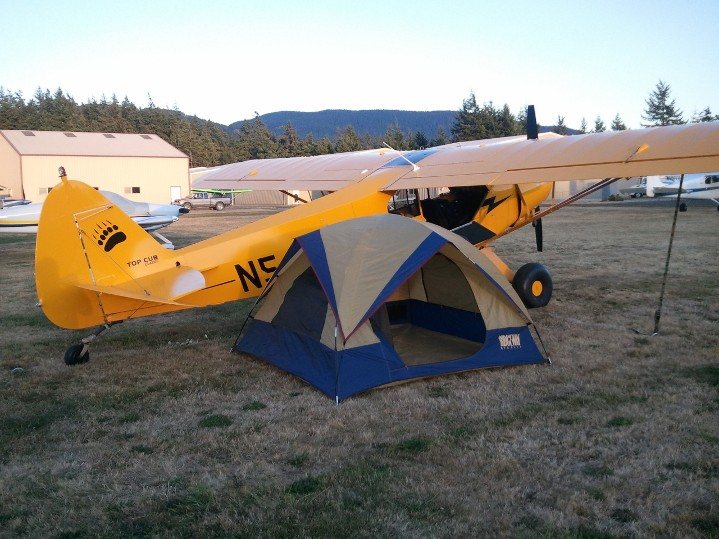
I was very happy to get this e-mail from Jeff, KO7M. Jeff has been using his Cub transceiver with his Piper Cub airplane. Very nice.
-------------------------------------------------
Hi Bill,
Long time no see! A while back I picked up a Kindle and have really enjoyed having an electronic way to tote around my Sprat PDF files and books. I decided to download a copy of Soldersmoke on the Kindle and re-read it and have enjoyed that very much. I am now reading your other book (just started) Contra Cross and look forward to enjoying that one as well.
Not much happening in the melting solder department, but I am working with an old National SW-3 regen receiver that I picked up on eBay. I am building a power supply for it and hope to have it on the air soon. Yeah, I know... I am from the dark side and enjoy regens. :)
We are having a stretch of nice weather out west and I have been flying as much as I can get away with as a result as it only lasts so long, eh? I flew up to the San Juan Islands and took the "Cub" transceiver with me up to Orcas Island camping a few weeks ago and had fun shunt loading a chain link fence. Made a few local contacts on 40 CW.
The cloud formations off the south end of San Juan Island the next morning were really cool! Check out the photos attached.
Hope all is well with you and your family. Take care, my friend.
73's
Jeff Whitlatch - ko7m


Our book: "SolderSmoke -- Global Adventures in Wireless Electronics"http://soldersmoke.com/book.htmOur coffee mugs, T-Shirts, bumper stickers: http://www.cafepress.com/SolderSmokeOur Book Store: http://astore.amazon.com/contracross-20

Thursday, September 15, 2011

9 Volt Superhet with Russian Sputnik Tubes

Wow! Now that's what I call a Manhattan breadboard! Joe Sousa has an excellent article on a broadcast band superhet that he built with Russian rod-type tubes, the same kind of tubes that flew in Sputnik.
http://www.radiomuseum.org/forum/sputnik_9v_superheterodyne_tube_radio.html
Lots of other great homebrew projects on this site also. Thanks to Bob, WA1EDJ, for alerting us to this.
Joe's research may be of use to those radio fiends among us who are feverishly building their Sputnik transmitters. October 4 is almost upon us! Onward Fellow Travelers!

Our book: "SolderSmoke -- Global Adventures in Wireless Electronics"http://soldersmoke.com/book.htmOur coffee mugs, T-Shirts, bumper stickers: http://www.cafepress.com/SolderSmokeOur Book Store: http://astore.amazon.com/contracross-20
Wednesday, September 14, 2011

Bud Waite, W2ZK, Antarctic Ham Hero

I really blew it in SS137, and in the original version of yesterday's blog post. I can't believe I actually reported that McMurdo Base was named for McMurdo Silver! This is like some weird self-inflicted payback for all my April 1 hoaxes. Sorry guys. McMurdo base is unfortunately not named for McMurdo Silver.

OM Armand, WA1UQO, came to my rescue! He provides a wonderful story (a TRUE story) about a ham who actually did have some Antarctic terrain features named for him. And deservedly so. Be sure to read the story of W2ZK in the links below.

By the way, we see here two additional examples of strong, distinctive names in the radio world: Armand Hamel and Amory H. Waite. Thanks to Steve "Snort Rosin" Smith for reminding me of another one: Philo T. Farnsworth. (Billy and I have long had plans for a kids novel built around a character named Excelsior G. Whiz --- the G stand for GADZOOKS!)

Hi Bill!
Listened to Soldersmoke #137 Sunday evening and was intrigued by the McMurdo Silver piece. It immediately brought to mind another Ham that was associated with Antarctica and had a Point of land and four islands named in his honor. His name was Amory "Bud" Waite (W2ZK). There was a nice write up about him in the November 2009 QST Vintage Radio Column by K2TQN. There is also a wealth of information about him on the Antarctican Organization website. I have a fond spot for Bud even though I never met him. As a novice in 1975 I responded to an advertisement in QST for a used Heathkit TX-1. My first transmitter! Bud was selling it as a favor for the widow of a SK. Had a really nice conversation with him one evening and he mentioned that he had once been on an expedition with Admiral Byrd! WOW! Little did I realize then that he had been one of the three men that had rescued Byrd from a forward camp. The story is amazing and can be found on these links. The first link is a video of a presentation that he gave to a New Jersey radio club in 1974. It's a little long but well worth the effort. You can see what McMurdo Sound looked like when he revisited it during the IGY (knew you would love that!). Anyway thought you would like to read about someone who really had the Knack. If you are looking for nominees for the Soldersmoke Ham Heros Hall Of Fame, I nominate Bud Waite ( and Doug DeMaw and Wes Hayward and Jean Shepherd). By the way, I still have the Heathkit Apache and hope to get it back on the air. As always keep the solder flowing and smoking and the podcasts comming.
73's
Armand (WA1UQO)

......................................

Our book: "SolderSmoke -- Global Adventures in Wireless Electronics"http://soldersmoke.com/book.htmOur coffee mugs, T-Shirts, bumper stickers: http://www.cafepress.com/SolderSmokeOur Book Store: http://astore.amazon.com/contracross-20

Tuesday, September 13, 2011

McMurdo Silver -- A Man with The Knack

In the latest podcast I talked about McMurdo Silver. I noted that many radio pioneers (and many modern-day radio wizards) have very strong and distinctive names. This guy's name is clearly in that category. Here is a 1929 bio on OM McMurdo:
http://durenberger.com/resources/documents/MCMURDOSILVER0629.pdf

And here is some additional info. From http://hhscott.com/e_h_scott_2.htm:


E.H. Scott had several competitors. The most significant among them was a dashing young genius named McMurdo Silver. Silver was a continuous contributor to technical articles to Radio News magazine (the predecessor of Popular Electronics) throughout the 1930's. He was a polo player, gun collector, and is said to have been quite a bon vivant. Formerly the president of Silver-Marshall, Inc., he set up the McMurdo Silver Corp. and began building custom high-fidelity receivers in competition with Scott.

While good, his receivers were never quite the equal of Scott’s. One of Silver’s most famous owners was Dr. Lee DeForest, inventor of the vacuum tube. DeForest owned a Silver Masterpiece V and praised it in the final chapters of his autobiography. Throughout the 1930s, Scott’s and Silver’s advertisements would do battle trying to “one up” the other’s in technical achievement. Features were stolen and lawsuits initiated. Finally, Scott won the battle and bought out the failing Silver in 1940. Scott then introduced a new, bottom-of-the-line receiver and designated it as the Scott Masterpiece. I do not know if the gesture was meant as a tribute to his archenemy or to rub salt in the wounds. Silver eventually committed suicide in 1947.

Our book: "SolderSmoke -- Global Adventures in Wireless Electronics"http://soldersmoke.com/book.htmOur coffee mugs, T-Shirts, bumper stickers: http://www.cafepress.com/SolderSmokeOur Book Store: http://astore.amazon.com/contracross-20

Sunday, September 11, 2011

Jupiter In the Morning

Jupiter is high in the early morning sky now, and the weather is starting to cool off a bit here. Here is the configuration of the Galilean moons that I saw on September 11. This is from the Sky&Telescope on-line Jovian moon display.

I've even been able to do some "sidewalk astronomy" in the style of guru John Dobson: I have the telescope set up on my driveway, and I offer the pre-dawn dog walkers a look at Jupiter and Galileo's moons. They are always very pleased. It is a nice way to start the day!

Our book: "SolderSmoke -- Global Adventures in Wireless Electronics"http://soldersmoke.com/book.htmOur coffee mugs, T-Shirts, bumper stickers: http://www.cafepress.com/SolderSmokeOur Book Store: http://astore.amazon.com/contracross-20

Saturday, September 10, 2011

SolderSmoke Podcast #137


http://soldersmoke.com/soldersmoke137.mp3

10 September 2011


Earthquake! Hurricane! Tropical Storm!

The Heathkit HW-7 -- An Undeserved Bad Reputation

Over-the-counter saltpeter
Movie review: Green Hornet, Captain America
How many 2-Bs? (11,571)
Ubuntifying dead laptops
Get the SolderSmoke blog by e-mail

Replacing a diode ring mixer with a diode...

...then trying the NT7S MOSFET detector
Where is boatanchor wizard Walt Hutchins KJ4JV ?
GREAT NAMES IN RADIO: MCMURDO SILVER
Sputnik update
Lew McCoy wrote about one of my projects
MAILBAG (with mail from Farhan and Wes)


Our book: "SolderSmoke -- Global Adventures in Wireless Electronics"http://soldersmoke.com/book.htmOur coffee mugs, T-Shirts, bumper stickers: http://www.cafepress.com/SolderSmokeOur Book Store: http://astore.amazon.com/contracross-20

Some Encouraging Graffiti

Spotted on a picnic bench in Falls Church, Virginia. Billy's eighth grade science course is focused on physics, so we took this as a good sign.

Our book: "SolderSmoke -- Global Adventures in Wireless Electronics"http://soldersmoke.com/book.htmOur coffee mugs, T-Shirts, bumper stickers: http://www.cafepress.com/SolderSmokeOur Book Store: http://astore.amazon.com/contracross-20

Thursday, September 8, 2011

Pale Blue Dot


I'm reading Carl Sagan's "Pale Blue Dot." I found this beautiful video:
http://www.youtube.com/watch?v=2pfwY2TNehw

Our book: "SolderSmoke -- Global Adventures in Wireless Electronics"http://soldersmoke.com/book.htmOur coffee mugs, T-Shirts, bumper stickers: http://www.cafepress.com/SolderSmokeOur Book Store: http://astore.amazon.com/contracross-20

Take a look through the Chromoscope!

On this site you start out with a 360 degree image of the Earth's night sky. You move around using the mouse and you can zoom in and out. (I've zoomed in a bit on Orion in the image above.) Then the fun begins: You can look at the sky in different frequency ranges -- from radio to gamma ray. Very nice: http://www.chromoscope.net/

Our book: "SolderSmoke -- Global Adventures in Wireless Electronics"http://soldersmoke.com/book.htmOur coffee mugs, T-Shirts, bumper stickers: http://www.cafepress.com/SolderSmokeOur Book Store: http://astore.amazon.com/contracross-20

Monday, September 5, 2011

Climbing a REALLY Tall Tower


This is the kind of thing that causes me to stick with sling shots and wire antennas. The comments added to the YouTube video were kind of funny -- most were in the vein of "Dude, not for a billion dollars!"

Our book: "SolderSmoke -- Global Adventures in Wireless Electronics"http://soldersmoke.com/book.htmOur coffee mugs, T-Shirts, bumper stickers: http://www.cafepress.com/SolderSmokeOur Book Store: http://astore.amazon.com/contracross-20

Friday, September 2, 2011

Carl Sagan on Ham Radio and Extraterrestrial Communication

"Stars" by M.C. Escher

I read this on the train this morning and immediately wanted to share it with my fellow radio amateurs:

"And what if we receive a message? Is there any reason to think that the transmitting beings -- evolved over billions of years of geological time in an environment vastly different from our own -- would be sufficiently similar to us for the message to be understood? I think the answer must be yes. A civilization transmitting radio messages must at least know about radio. The frequency, time constant, and bandpass of the message are common to transmitting and receiving civilizations. The situation may be a little like that of amateur or ham radio operators. Except for occasional emergencies, their conversations seem almost exclusively concerned with the mechanics of their instruments: it is the one aspect of their lives they are certain to have in common."

From "The Dragons of Eden" by Carl Sagan.

Our book: "SolderSmoke -- Global Adventures in Wireless Electronics"http://soldersmoke.com/book.htmOur coffee mugs, T-Shirts, bumper stickers: http://www.cafepress.com/SolderSmokeOur Book Store: http://astore.amazon.com/contracross-20

Thursday, September 1, 2011

The Oldest 2-B? (I say it's a 10!)


Harv: Wow, that's a beautiful 2-B OM. I give it a 10. If you compare it to mine, it's a 20! I checked our collection point for 2-B serial numbers and see that we have a couple that may be rivals in the title "Senior 2-B." Thanks for pointing out that they started at #2000.
................................
Hi Bill,

What makes a radio a 10 out of 10?

Good question. A real 10 to me means the radio is flawless, clean, not repainted and the best example possible based upon age and general appearance.

Here is one of my Drake 2B Communication Receivers with the matching Speaker/Q Multiplier.

This one has the S/N 2532 which, places the production of this radio close to early Spring 1961. The radio is not flawless. It has very minor metal edge dings in the paint.

I have the original Owners Manual and lots of special notes. At best my pictured radio above is a 9.5.

In my collection is also; S/N 4226 which was built near the end of 1961. I rate S/N 4226 as a 9.8 radio.

I’m impressed with the AVG recovery, general receiver sensitivity and the combination selectivity afforded by the Q-Multiplier.

I believe the Drake web site is spot on with the dating of the production runs for Drake equipment.

From talking to other Hams, it looks like the 2B started with S/N 2000 on their first full run of production in early April 1961.

It would be interesting to see if others find radios with a serial number less than mine still out there pulling duty.

I’m sure some pilot radios are out there in private collections. Let me know if someone finds an earlier serial number.

Keep up the great work Bill!!!

ENJOY

HARV -=WA3EIB=-

Albuquerque, NM.

-------------------------------------------------------

Our book: "SolderSmoke -- Global Adventures in Wireless Electronics"http://soldersmoke.com/book.htmOur coffee mugs, T-Shirts, bumper stickers: http://www.cafepress.com/SolderSmokeOur Book Store: http://astore.amazon.com/contracross-20

Wednesday, August 31, 2011

Another Treasure Trove Discovered

Our man in Ankara, Grayson, KJ7UM, sent me links to the truly amazing web site of Dr. J.B. Calvert, Professor Emeritus of Engineering at the University of Denver. Great stuff!
Sorry about the Istanbul/Ankara mix-up Grayson. I must say, Istanbul sounds cooler and more exotic. Good luck with the beer OM.
...............................................
Hi Bill,

Thought I would pass along the web site of quite an amazing fellow. While not a ham, he is a homebrewer, experimenter, and total scientist.
Guys like this amaze me!
http://mysite.du.edu/~jcalvert/index.htm

This is the site of Dr. James Calvert. On his site are hundreds of "papers" (articles?) on hundreds of scientific topics, history optics, astronomy, etc. I have read quite a few and I am damn impressed with the guys style, and curiosity.
Check out his paper on vacuum tubes. I learned a hell of a lot from this about a subject I though I know pretty well.

Check out this link
http://mysite.du.edu/~etuttle/electron/elecindx.htm
and the section on tubes:
http://mysite.du.edu/~etuttle/electron/elect27.htm
It is excellent. Enough to keep me reading for years.

Thanks for the plug in your last podcast.
BTW, I live in Ankara (the capital). If i did live in Istanbul, parts would be much easier to get. Actually I have found a source of parts, but what I REALLY need is a good source of decent beer! TUrkey only has one beer and it sucks. Anyone want to send me a good beer I would be most appreciative (then I can homebrew much better!)!

Take care and keep poding

Grayson
KJ7UM/TA2 - Ankara, Turkey
........................................

Our book: "SolderSmoke -- Global Adventures in Wireless Electronics"http://soldersmoke.com/book.htmOur coffee mugs, T-Shirts, bumper stickers: http://www.cafepress.com/SolderSmokeOur Book Store: http://astore.amazon.com/contracross-20

Tuesday, August 30, 2011

Russia, Vermont, Sputnik, Old Parts

When I heard of the terrible floods in Vermont, I thought immediately of OM Michael, AA1TJ (aka Comrade Mikhail, the Chief Designer) and his underground hamshack. I heard this morning that Michael is high and dry, up at his mountain top lair (the TV transmitter). Here is an update on the Sputnik project:

Fellas,
This morning DL3PB was kind enough to bring Peter, DL3JIN's recent work to my attention.
I think you will agree that Peter has made a beautiful job of it! He not only used Russian tubes (valves), he even had a 21.060MHz Russian-made quartz crystal on-hand. Many of the passive components appear to be ex-Soviet surplus as well. His front panel really shows great spirit. With 96Vdc on the PA anode he's seeing an RF output power of 650mW.
It should be great fun come October 4!
73/72,
Mike, AA1TJ

Our book: "SolderSmoke -- Global Adventures in Wireless Electronics"http://soldersmoke.com/book.htmOur coffee mugs, T-Shirts, bumper stickers: http://www.cafepress.com/SolderSmokeOur Book Store: http://astore.amazon.com/contracross-20

Saturday, August 27, 2011

Natural Disaster Report

We have battened down the hatches and are enjoying a quiet evening at home as Hurricane Irene approaches. The radar image from Norfolk Virginia describes the current situation quite well. You can see the eye about 150 km south-east of us. We currently have moderate rain and wind. I don't think it is going to be bad for us. Best wishes for all those under this storm.

As for the earthquake, well, most everyone has their earthquake story (those who don't are said to have Earthquake Envy). I was at poolside with Billy and Maria. It was quite a jolt here, stronger than anything we felt in Italy. When we got home, the only noticeable impact was that Maria's ET doll had fallen from a shelf in the shack. More details in SolderSmoke 137.

Our book: "SolderSmoke -- Global Adventures in Wireless Electronics"http://soldersmoke.com/book.htmOur coffee mugs, T-Shirts, bumper stickers: http://www.cafepress.com/SolderSmokeOur Book Store: http://astore.amazon.com/contracross-20

Friday, August 26, 2011

Beautiful Homebrew Gear from Italy

We may have had Fabio Bonucci's rigs on the blog before, but they are so nice I thought it would be OK to feature them again. Bravo Fabio!

http://nuke.ik0ixi.it/Autocostruzione/Ricetrasmettitori/tabid/484/Default.aspx
....................
Our book: "SolderSmoke -- Global Adventures in Wireless Electronics"http://soldersmoke.com/book.htmOur coffee mugs, T-Shirts, bumper stickers: http://www.cafepress.com/SolderSmokeOur Book Store: http://astore.amazon.com/contracross-20

Thursday, August 25, 2011

Get SolderSmoke Daily News by e-mail

We have a new feature on the blog: You can easily arrange to get an e-mail whenever I post something new. You can get early notification on new podcast episodes. Just enter your e-mail address in the box to the upper right of the blog page.

Our book: "SolderSmoke -- Global Adventures in Wireless Electronics"http://soldersmoke.com/book.htmOur coffee mugs, T-Shirts, bumper stickers: http://www.cafepress.com/SolderSmokeOur Book Store: http://astore.amazon.com/contracross-20

Homebrew Microphone Using Cream of Tartar (NOT Tartar Sauce)

Podcast listeners will recall that this year's April 1 edition featured a story about my (supposed) efforts to cure long-standing audio problems by "chemically tailoring" home-made microphone elements. I asked for listener suggestions on which kitchen ingredients I should add to the mix. Very few listeners fell for it. But now -- as often happens -- somebody out there has completed the project that we were using as our annual hoax. Check it out. Very interesting:
http://leafcutterjohn.com/?p=1518
And I think he has a follow-up post.

Our book: "SolderSmoke -- Global Adventures in Wireless Electronics"http://soldersmoke.com/book.htmOur coffee mugs, T-Shirts, bumper stickers: http://www.cafepress.com/SolderSmokeOur Book Store: http://astore.amazon.com/contracross-20

Wednesday, August 24, 2011

Radio Drama about RADIO!

Dale, W9DKB, alerts us to a radio drama from 1973 that is all about mysterious radio signals from space. Very cool. Thanks Dale.
.....................................

Hi Bill,


I've enjoyed your podcast for the past 2 years, never miss it. And I enjoyed your book, Global Adventures.

Last night I listened to a free radio show from Jim French Productions and thought of you. It's a story that involves computerized data signal processing, communication with aliens, radio noise analysis, NASA, Apollo, Skylab, deciphering codes based on chemical specific gravities, neat jazz music ... all the th
ings a knack victim like yourself would enjoy. And here's the kicker - the production was made in 1973! You can hear the old 500 series Bell telephones used for sound effects and all that. Give it a listen. I think you'll like it.

This is an episode of "Dameron". If you like listening to radio dramas, this is a great site to visit as they post a new
show on their "Listen Now" page each week. The Harry Nile adventures are great. But so are the Adventures of Sherlock Holmes. Of course all of them are available for download at a modest cost. (No, I have no affiliation with Jim French Productions.)

http://jimfrenchproductions.com/zc137m/index.php?main_page=page&id=2&chapter=0
is the link. Scroll down the page. The show you want is titled WEEK 804, Dameron, "Earth is Ours". Just click the blue "Listen Now" label.


73,
Dale
W9DKB
River Falls, WI

Our book: "SolderSmoke -- Global Adventures in Wireless Electronics"http://soldersmoke.com/book.htmOur coffee mugs, T-Shirts, bumper stickers: http://www.cafepress.com/SolderSmokeOur Book Store: http://astore.amazon.com/contracross-20

Tuesday, August 23, 2011

German Tanks and Drake 2-Bs: We Have the Number!


Hi Bill,

Finally getting back to you. I crunched the numbers...
I saw a total of 23 serial numbers reported. The important thing is that these numbers be reported somewhat randomly with no biases etc. I think this is the case, and the fact we have 23 numbers is very very good in terms of the power of this experiment. The highest number reported was 12955. Let m = 12955. The number of reports was 23 so let k = 23. The equation to use (from wikipedia) is below...
\hat{N} =m(1 + k^{-1}) - 1\,
Simply applying this equation we get an estimate highest serial number of 13517. So we can estimate that between 13000 and 14000 Drake 2Bs where made. I think I remember someone mentioning that the Drake 2B serial numbers did not start at zero. This is not really a problem. You just need to know at what number they did start, then subtract that number from 13517, and that would be the number of Drake 2Bs ever manufactured.

The lowest serial number reported to SolderSmoke was 2008, so you wouldn't need to subtract more than that.
You can think of this equation intuitively (a very SolderSmoke thing to do!). Imagine what happens when we have a single observation. k = 1, so our estimate is about 2 times what our highest observation is. This makes sense because you would guess your observation is most likely to be about half way between 0 and the true top number. If k = 2, then our estimate is about 1.5 times our highest observation. If k = 3, then our estimate is about 1.333 times our highest observation.... as we observe more numbers, we are more likely to have observed the top number so as k goes to infinity, our estimate moves towards our top observed number, which it should.

I hope my explanation made sense. Anyway I highly recommend SolderSmoke listeners who want to know more, to read the wikipedia page. Its quite well written and offers a lot for people who like hard formal explanations and an intuitive description. Keep up the good work!

I love the podcast - hopefully we may catch each other one day on the bands.


73
Scott (K6AUS)


Our book: "SolderSmoke -- Global Adventures in Wireless Electronics"http://soldersmoke.com/book.htmOur coffee mugs, T-Shirts, bumper stickers: http://www.cafepress.com/SolderSmokeOur Book Store: http://astore.amazon.com/contracross-20

Sunday, August 21, 2011

FT-817 Remote Access and The Perils of PC Board Etching

Mike is looking for some beta testers for his FT-817 remote control system, and for someone who is proficient on VB6 who can help him clean up the code.

....................

Bill,

Hello I am a 47 year old ham from Pittsburgh,Pa and my call is WA3O. I felt compelled to write you after my Kindle purchase of your Solder Smoke book. I don't usually read books cover to cover but, this book is different I can not seem to put it down. This is the first time I can personally relate to a book. Like you, I started ham radio at the early age of 13 and have built and struggled with the same projects you have. So I wanted to say thanks!...I am half way through the book and I am dreading finishing it because I probably will never find another book I can relate to so well.

My latest project is some software I wrote for the FT817 and Icom radios. I am not a programmer but, I taught myself VB6 so I could write this remote software. After reading in the book about your Iphone “link”I thought you might like it and I wanted your opinion on it. The software is DTMF control of your radio from any phone. With Skype (and a Skype-in phone number) and my software, you can call your radio from ANY phone (not just a smart cell phone). You dial your number and after a security number the program turns your radio on via the printer port and you have pretty much full control of all the functions of your radio with the voice announcer on the radio (Icom) or the voice out on Microsoft computers it can announce frequency, signal, mode etc. you can even TX. The software even has a time out timer just in case of say a cell phone “drop call”. The software has many features like 50 memory recall, selective scanning, band scanning,direct frequency input. If you have a radio like a IC-7000 or a FT-817 and a auto tuner you have access to all HF,VHF and UHF. I brought the software idea up to some local hams and it sounded like it was a bad idea. I use it every day to listen to 160M while I drive to work in my truck without a BIG 160 antenna on it! I also thought it would be great for guys who just like to see what band conditions are on lunch break. Let's face it we all carry a cell phone. So I would really appreciate your opinion on this.


One last comment...while I was reading about your struggles with etching your own board it reminded me of my first experience with etching solution. My buddy etched boards before and told me all you had to do was draw what you wanted with a Sharpie on a copper PC board and throw it in some solution and “rock it back and fourth a bit and it works like magic. So unknowingly we put the solution in a pie tin and palced the board in. It immediately started boiling and put off an orange smoke! I said NEAT! And before my buddy could tell me it was NOT supposed to do that it ate thru the bottom of the pie tin...What a mess! And mom wasn't happy! LOL

So best of 73's and keep up the good work

Mike Lamanna WA3O

.......................................
Our book: "SolderSmoke -- Global Adventures in Wireless Electronics"http://soldersmoke.com/book.htmOur coffee mugs, T-Shirts, bumper stickers: http://www.cafepress.com/SolderSmokeOur Book Store: http://astore.amazon.com/contracross-20
Tuesday, August 16, 2011

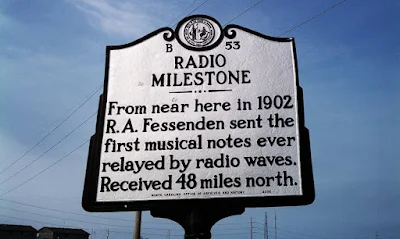
Fessenden's Music from the Outer Banks

George, KB3ODH, found this about 1/2 mile from the Cape Hatteras Lighthouse.

Our book: "SolderSmoke -- Global Adventures in Wireless Electronics"http://soldersmoke.com/book.htmOur coffee mugs, T-Shirts, bumper stickers: http://www.cafepress.com/SolderSmokeOur Book Store: http://astore.amazon.com/contracross-20

Monday, August 15, 2011

Bike Radio II

Thanks for all the suggestions on the bike radio. I googled around a bit and found a schematic that seems very similar to the little receiver I'm working with. I almost certainly would be better off starting anew (perhaps keeping the AF circuitry). But it is interesting to see how a simple AM receiver works. That first transistor is an autodyne circuit -- both a mixer and a oscillator.

Our book: "SolderSmoke -- Global Adventures in Wireless Electronics"http://soldersmoke.com/book.htmOur coffee mugs, T-Shirts, bumper stickers: http://www.cafepress.com/SolderSmokeOur Book Store: http://astore.amazon.com/contracross-20

Sunday, August 14, 2011

Bike Radio

As I mentioned on the podcast, I've been riding my bike to work lately. I really enjoy it. We have great bike trails in this area. They use paths of defunct railroad lines -- I ride Washington and Old Dominion Trail.

My bike is a bit of a boatanchor. It was made in Japan. I bought it 22 years ago when I was in Spain. I've used it in Spain, The Dominican Republic, the UK, Portugal, Italy, and in the U.S.

Of course, my thoughts have turned to putting some sort of HF radio on the bike, probably just a receiver. I still have a little handle-bar AM radio that I added shortly after I bought it. The handle bar mount is still good. See above. I'm pleased to see that it looks very simple, with discrete components. The AF amps are obviously off to the left of the speaker. To the right of the speaker we obviously have the RF and IF circuits. There are some nice tuned transformers there (from the "Chop Shing" company), and three transistors and a diode. What would the standard lineup be for a simple AM radio of this type? Maybe just an RF amp in the front end, a local oscillator, one stage of IF amplification and the diode as the detector?

What do you guys think? Make use of some of the existing circuitry? Start over?

Our book: "SolderSmoke -- Global Adventures in Wireless Electronics"http://soldersmoke.com/book.htmOur coffee mugs, T-Shirts, bumper stickers: http://www.cafepress.com/SolderSmokeOur Book Store: http://astore.amazon.com/contracross-20

Thursday, August 11, 2011

Alarm from Space

So I was sitting in the shack yesterday morning, drinking coffee and listening to IGY by Donald Fagen on Pandora, when I heard what I thought was an alarm. I thought it might have been a smoke detector going off (always a real possibility in the N2CQR shack!). It took me a moment to realize that what I was hearing was the device pictured above. I'd left my 2 meter HT tuned to 145.950 MHz, and Arissat-1 was breaking squelch with SSTV tones. Very cool.

Later, I was thinking about this as I pedaled along on my bike. I remembered our recent discussion of Copthorne MacDonald, inventor of SSTV. Way to go Cop!

It is easy to join in the fun. Just tune you two meter gear to 145.950 and leave it there. You'll soon be alarmed just as I was.

Our book: "SolderSmoke -- Global Adventures in Wireless Electronics"http://soldersmoke.com/book.htmOur coffee mugs, T-Shirts, bumper stickers: http://www.cafepress.com/SolderSmokeOur Book Store: http://astore.amazon.com/contracross-20

Wednesday, August 10, 2011

Shack Background Music from Pandora Radio

Billy alerted me to Pandora. Very cool. You just give it an indication of the kind of music you'd like to listen to. They do the rest. I started out with Creedance Clearwater Revival, and Pandora proceeded to send me a stream of sort-of similar rock. Streaming audio through the web. And it is apparently all legal (you listen to a commercial every once in a while). This is great for background music in the shack. After all, you can only listen to so much SolderSmoke, and 75 meter SSB chatter is not good for you. I'm not sure if it is available outside the USA. I hope it is.
www,pandora.com


Our book: "SolderSmoke -- Global Adventures in Wireless Electronics"http://soldersmoke.com/book.htmOur coffee mugs, T-Shirts, bumper stickers: http://www.cafepress.com/SolderSmokeOur Book Store: http://astore.amazon.com/contracross-20

Big Book Sale

Our book: "SolderSmoke -- Global Adventures in Wireless Electronics"http://soldersmoke.com/book.htmOur coffee mugs, T-Shirts, bumper stickers: http://www.cafepress.com/SolderSmokeOur Book Store: http://astore.amazon.com/contracross-20