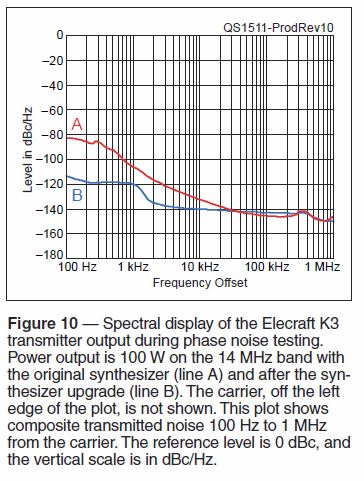
Wayne Burdick, N6KR, of Elecraft let us know that there was an error in the QST article about the KSYN3A Synthesizer Upgrade. The original graph in the QST article showed an improvement in phase noise at close-in frequencies, but it also showed a significant worsening of the phase noise beyond 10 kHz. THIS CHART WAS INCORRECT. The Upgrade does, in fact, improve the phase noise performance as shown in the corrected graph above. A corrected version of the article appears here:
Thanks for letting us know about this Wayne. We have long been big fans of Elecraft and are proud that a picture of your KX3 appears on all of our blog pages under the headline "One of the Best Receivers in the World."
Pete and I will continue our study and discussion of phase noise; as synthesizers make their way into more and more of our hombrew rigs it is important for us to understand the significance of this parameter.
Page 33. I know this may come as a surprise, but in spite of my admitted Ludite tendencies, I found the article on High-Speed Wireless Networking to be very intriguing.
Page 38. Hey! Mike Aiello N2HTT has an article about an Arduino-based CW recorder. FB Mike!
Page 54. Review of LNR LD-5 QRP Transceiver. "The LD-5 is actually an SDR in a box with switches and knobs..." They give a phase noise graph.
Page 58. Review of Synthesizer upgrade for the Elecraft K3. Uh-oh. Phase noise again. The review says the upgrade results in a reduction of phase noise, but the graphs seem to show an increase in transmitted phase noise on 20 meters as soon as you go 10 kHz from the transmit frequency. I guess this is a tradeoff for a larger decrease in close-in (less than 1 kHz spacing) phase noise? But if the objective on the transmit side is to deal with "a major problem with multiple operators in the same band segment in close proximity" resulting from transmitted phase noise, is this a good trade-off? Also, it would have been interesting to know if the reviewer could detect -- by ear -- any improvement in the received signal.
Wayne Burdick, N6KR, of Elecraft e-mailed us to let us know that there was an error
in this QST article. The original graph in
the article showed an improvement in phase noise at close-in frequencies,
but it also showed a significant worsening of the phase noise beyond 10 kHz.
THIS CHART WAS INCORRECT. The Upgrade does, in fact, improve the phase noise
performance. A corrected version of the
article appears here:
Page 71. My nightmare. The WristRig. The Apple Watch on 40 meters. Sorry Steve, Dick Tracey did not have The Knack, and tackling the "Apple Watch challenge" is not an indication of "homebrew chops." Software coding chops yes, but homebrewing is, for me, a different thing. (But, as we always say, too each his own... And thanks to Steve for the interesting article. )
Page 82. Ross Hull. Very interesting article, especially the part about OM Ross's untimely death by electrocution.
Page 100. "The Cosmophones" by Joe Veras. Cool pictures (as always) from Joe. And I loved the first lines: "What in the world is a bilateral transceiver? Byron Goodman, W1DX, posed that question in his June 1958 QST review of the Cosmophone 35."Wow, four months before my birth By Goodman was writing about BITXs in QST!
Hackaday has an article today that is, for me, very timely. In our last podcast, Pete and I were discussing the meaning of the word "homebrew" in the world of Software Defined Radio. As always, Pete was closer to the cutting edge, while I remain mired in Ludite (one D please!) curmudgeonism, committed to RADICAL FUNDAMENTALIST HOMEBREWING. No chips and no menus for me please.
Today, the Hackaday guys came to my rescue with a blast from the past. Homebrew computers! Not that simple "buy a mo-bo and plug in some boards" stuff. No, REAL homebrew, so HB that they even made their own components. 1968. I can dig it! I should have gone down this road. I had the C.L. Stong book "The Amateur Scientist" IN MY HANDS. It had some great articles about relay-based computers. I could have been rich!
In those dark days of February 2015, when all the members of the SDR ESSB Panoramic Spectral Police were on my case over some imperfections in my 40 meter homebrew SSB signal, Rick, N3FJZ came to my rescue by sending me a great YouTube video of his reception of my new rig. Rick was using a wonderful homebrew Direct Conversion receiver with a really cool PTO. Here is my blog post on Rick and his receiver:
After 32 years as a ham, I finally had my first ever HF QSO on October 16, 2015, and on a homebrew rig no less! Oh the Joy of Emission!It was on 7.242MHz, 8:00 a.m. eastern on the "Woodpecker net". - Rig was based on the Bitx, using ZIA bidirectional amps. - 20 Watts into a 80 meter full-wave loop up at 20 feet. - 600 ohm homebrew open wire ladder line. - Balanced antenna coupler inspired by the Annecke and Johnson matchbox units. - and most importantly, the Arduino controller software and use of the Nokia display were derived and inspired from Pete's "Let's Build Something" code presented on his website, and the carrier oscillator(BFO) & L.O. are generated by an Adafruit SI5351 clock generator board. Thank you Pete.
See my N3FJZ look-up on QRZ.com for photos of my homebrew rig. I have also put links to the SolderSmoke blog and to Pete's web page and blog.
I just want to tell you both that your podcasts, websites, circuit diagrams and stories were a huge part of my success. They were the inspiration I needed on many dark days when my amplifiers would oscillate, and my oscillators would simply smoke. At times I thought I would never get on the air, but an hour listening to SolderSmoke podcast would give me the drive venture on. Thank you!
***VERY IMPORTANT!!!!
Bill, during my first QSO, I was getting 5x8 and 5x9 signal reports (with 20 watts!)from North Carolina, up-state New York, Michigan, and Indiana, and I know we are only about 50 miles apart (I'm in north central Maryland), so I believe we could probably achieve a successful HB2HB contact if you want to try.
If you want to, and have the time, you could join me on the Woodpecker net any Friday, Saturday or Sunday on 40 meters 7.242MHz 8:00 a.m. eastern, or we could set-up a prearranged contact on a General class 40 meter frequency of your choosing. Let me know - making an HB2HB contact with you would mean the world to me.
Pete, I also extend this invitation to you as well, but with only 20 watts on my end, it may be a stretch, but we could try.
Thank you both again for the joy you have given me with your pod-casts. 73 Rick - N3FJZ
.................
Rick and I got together on 7.288 MHz yesterday evening. It was a really amazing QSO. Rick made a video of it (see above) and I recorded the audio on my side. My old tape recorder didn't do Rick's signal justice -- it sounded better than this. But here is the full QSO:
Be sure to listen closely at around 21 minutes when Rick describes a software feature that allows him to switch -- with the touch of a button -- from high side VFO to low side VFO. The BFO frequency also changes to account for the resulting sideband inversion. Very cool.
-- Our audience IGNORES Pete's guitar intro! -- Pete on QSO Today Podcast. -- Part 97, The Radio Art and International Goodwill. BENCH REPORTS: -- Pete connects his new beam to the KX3. -- Pete puts the Bell-thorn on 20. -- Simple-ceiver update. -- Pete's new drum machine: http://makezine.com/2015/10/15/learn-electronics-worlds-oldest-drum-machine/ -- Bill fights noise in the DIGI-TIA. -- Bill fights power-line noise (and wins!). -- Drake 2B, skirts, reduction drives, and tuning rates. -- Warming up (with!) the DX-100.
-- N2CQR -- N6QW First Ever HB2HB QSO.
-- On 40 AM with an HT-37 -- Listening to Chinese CubeSats. -- SDR Dongle as a bandwidth checker.
-- SDR and the Future of Homebrew Radio.
-- Bryan's LBS Receiver. -- Dean's First Ever QSO with his HB rig.
-- 32 Mighty Mites Completed
-- The Martian -- Did Mark Watney REALLY have the Knack?
-- MAILBAG: Peter Parker's New Book Sparks from Ron Sparks Armand's 1Watter Rogier's pyro machine BIG boxes from Tim KI6BGE Mikele's ZIA and N6QW rig collection SPRAT 141 and SPRAT 164