Serving the worldwide community of radio-electronic homebrewers. Providing blog support to the SolderSmoke podcast: http://soldersmoke.com
Podcasting since 2005! Listen to Latest SolderSmoke
Thursday, January 1, 2026
Let's Start the New Year with... THE KNACK!
Tuesday, October 21, 2025
"Rig Here is Homebrew" -- The Joys and Sorrows of Building your own Rigs
-------------------
Dean KK4DAS asked me to speak to our local radio club, the Vienna Wireless Society. It was a lot of fun. I talked about my evolution as a homebrewer, some of the rigs I made, the moments of joy, and the tales of woe. You can watch the presentation in the video above.
I was really glad to be able to explain in the presentation the importance of people like Pete, Dex, Farhan, Wes, Shep and even Dilbert.
I was also pleased to get into the presentation the N2CQR sign that Peter VK2EMU made for me. Thanks Peter!
Here is the URL to the YouTube video (also above):
https://www.youtube.com/watch?time_continue=3414&v=VHSr-v4QO7Q&feature=emb_logo
And here are the PowerPoint slides I used:
https://viennawireless.net/wp/wp-content/uploads/2020/06/VWS-presentation-Rig-here-is-homebrew.pdf
Sunday, August 3, 2025
Paul K9ARF -- SolderSmoke and a Knack Story
Bill:
Having been an occasional Solder-Smoke listener, I recently purchased your book "Solder Smoke Adventures" to read during vacation. Previously I limited reading material to technical material, but I retired two years ago and can now allow myself to read stuff just for fun. I devoured your book.
I found you and I to be kindred spirits, seeking to understand the mysteries of electricity and electromagnetic waves as we follow life's path. We're close to the same age, you're a couple years my senior.
My fascination with electronics began as a boy when my Dad and I put together a crystal receiver as a Cub Scout project. I fondly remember my father scrambling up on the roof to string a long wire as an antenna, and then listening to the Cubs ballgame in the earpiece. No batteries required!
I exhibited "knack" tendencies later as an early teen. At a local estate sale I picked up some magazines teaching basic TV repair, and a box of parts that previously was a portable B/W TV. My family was amazed when I resurrected that little TV set.
My career path went into audiovisual interests - I heard broadcast engineers made a lot of money, so I went to Milwaukee Area Tech College electronics communications program. The students there ran UHF channel 36 alongside the professionals running TV channel 10 (both pbs affiliates). On the way to getting your 1st class "phone" license, we learned 2way radio (2nd class). I found that repairing things was far more fun than pushing buttons in Master Control, so I ended up working in 2way.
While attending MATC, I met some guys who were hams - and they invited me to my first-ever hamfest. Wow. A gathering of electronics enthusiasts, many who also have "the knack". I purchased a couple of old books cheap, not knowing this would steer my life in the future: the antenna book and a 1970s radio amateur handbook, both from ARRL. Reading these books, I was intrigued by people who design and build their own equipment - the ultimate in coolness!
I guess what really kept me interested in reading your book is your desire to understand the basic building blocks of electronics - how does it work? This mirrors my personal experience. Though I have formal electronics training, my schooling was aimed mostly at troubleshooting, finding the malfunction. The understanding of why the components in a circuit are the values specified and how they produce the desired output was, like you, a lifelong learning process I still work on today.
My adventure into Amateur Radio was delayed by life activities: marriage, a house, and a child. It didn't help that I never met any hams in rural north Wisconsin. I finally met an amateur who was a VE, and Radio Shack study materials had me on the way in 1990-91.
I tested in early '91 and passed the Novice, Tech, and 5 wpm code - the VE knew that I was a career radio tech, and at his urging I passed the General written test too. My initial call was N9KQX (a horrible cw call). The next months had me work on my code speed and study the Advanced material, and later I became KF9GQ.
At that test session, I sat alongside a gentleman who was taking his 20 wpm code test (wow). A few months later he was one of my interviewers as I applied for a new job - Radio Tech for the Electric & Gas utility in Green Bay. I believe my ham radio hobby helped me land that position, which I held 30 years to retirement.
When the vanity call sign program started, I changed my call to K9ARF "amateur radio fun" (yes, I like dogs...) or "analog radio fan" - life must include a sense of humor.
In my years as a ham, I have done quite a bit of homebrewing, from repeaters and accessories for my station, to test gear and complete transceivers. My proudest projects were building W7ZOI's spectrum analyzer and a multiband KK7B based phasing transceiver using AA0ZZ's DDS synthesizer kits.
I want to thank you and the other solder smoke guys for what you do. Hopefully I will someday have an opportunity to meet you in person to share a cold beverage, laugh and tell stories of molten solder variety. Keep up the good work!!
73 de K9ARF Paul, Green Bay, Wisconsin
Saturday, May 17, 2025
MIT's Haystack Observatory and Dr. Herb Weiss
He spent the bulk of his career developing radar when there was none in the United States. He joined the Radiation Lab at MIT, which was just being established to support the war effort during World War II, designing radars for ships and aircraft. In 1942, when England was in the throes of its air war with the Nazis, Herb went to England and installed radar in planes with a novel navigation system that he and a team had designed for the Royal Air Force. He later spent three years at the Los Alamos, New Mexico, laboratory improving instruments for the A-bomb. After seeing the need for a continental defense network against the Soviet missile threat, he returned to MIT to build it. If not for Herb, there also likely would be no MIT Haystack Observatory, a pioneering radio science and research facility."
Okay. I was born in New Jersey, and my first acquaintance with electronics was about the age of 12 or 13. We had a battery-operated radio, which didn't work, and I asked around about what do we do about it. They referred me to a man two blocks away, who was a radio ham it turned out. So I carried this monster with the big horn and, I guess, the dog sitting on the speaker to his house. We went down in the basement, and I was just fascinated. I was hooked right then and there. A year later I became a radio ham at the age of 13, 14 and literally have been in the field ever since, until I retired. I was fortunate enough to go to MIT as an undergraduate, and most of the people I ran into of that vintage didn't really have a hands-on feeling for electronics. By the time I got to MIT, I had built all kinds of things, including a TV set. Then it turned out that NBC was just trying to get their TV set on the air in New York on top of the Empire State Building."
Phil Erickson
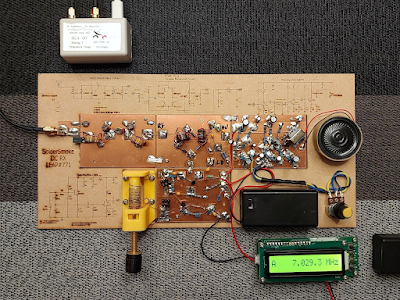
Paul 9V1/KM7ABZ's FB SINGAPORE SolderSmoke Direct Conversion Receiver
I used the laser cutters at our local library to cut and etch a custom base. The library is a great resource: it’s also where I printed the PTO former.
To get on the air from my apartment in Singapore, I’m using an MLA-30 Active Loop antenna, with a PLJ-1601 frequency counter attached to the PTO to take some of the guesswork out of tuning.
KM7ABZ
from 9V1 landJoin the discussion - SolderSmoke Discord Server:
Documentation on Hackaday:
https://hackaday.io/project/
SolderSmoke YouTube channel:
Wednesday, February 26, 2025
Scott KQ4AOP Built the SolderSmoke Direct Conversion Receiver, and Listened to his FIRST EVER Ham Signals with it
Join the discussion - SolderSmoke Discord Server:
Documentation on Hackaday:
https://hackaday.io/project/
SolderSmoke YouTube channel:
Thursday, February 15, 2024
More Inspiring Mail! Another "First Ever Receiver was Homebrew"
It was great to hear from someone else who, like Scott KQ4AOP, heard his very first signals on a homebrew receiver. That is a really wonderful way to start. Frank's first receiver was built around the NE602 chip. I had trouble understanding this IC but I finally cracked the code:
https://soldersmoke.blogspot.com/2021/11/how-to-understand-ne-602-and-gilbert.html
The picture that Frank sent is of a more recent project, this one a Lowfer receiver that picks up signals from beacons.
-------------------------
Hello Bill,
I just wanted to message you and tell you I really enjoyed your book Soldersmoke. I've been listening to the podcast as well. On the latest one you mentioned a fellow who heard his first ham radio signals on a homebrew receiver, and that's how it was for me as well! There were lots of articles about using the NE602 in the electronics magazines back in the day. I put one of the circuits together and it worked pretty smoothly... I eventually got my ham radio licence (KC8JJL) sometime in the 90's. The first time I met a ham was when I showed up to take the test!
Tuesday, January 2, 2024
Long-time SolderSmoke supporter Ramakrishnan VU2JXN Interviewed on QSO Today
Tuesday, December 5, 2023
The Beginning of MY Radio Life...
-- April 27, 1973. Novice Ticket becomes effective. WN2QHL. Age 14.
-- July 19, 1973. First contact (with Elmer WN2NEC). Age 14.
-- February 1 and 2 1973. A grumpy old-timer calls -- during the Novice Roundup! -- to tell me that I'm putting harmonics onto the 20 meter band. I get scared and go off the air. Geez! I probably just needed to retune the tank circuit. Age 15.
-- February 23, 1974. I go back on the air with a DX-100. Age 15.
-- March 5, 1974. I take the General Class exam at the FCC office in New York City. I pass. Age 15.
-- April 11, 1974. I buy the Drake 2-B from WN2NEC. This revolutionizes my radio life. Fifteen meter contacts become possible. Age 15.
-- April 13, 1974. I work ZL2ACP on 15 meter CW. I wake up my parents to tell them. Age 15.
-- April 21, 1974. END OF NOVICE OPERATION. Apparently we were still working under a one year limitation on Novice operation. Could the expiration date have been marked on the license?
At this point the FCC screwed up and sent me a Technician License instead of a General Class License. My father got on the phone to Gettysburg and straightened this out. Thanks Dad. So I was only a Technician for a few weeks.
-- April 9, 1974. General Class License effective. I become WB2QHL, a man of substance. Age 15.
-- May-June 1974. I acquire a Heathkit HW-32A 20 meter SSB transceiver from the Crystal Radio Club. But I have to build the power supply from an old TV. Somehow, I survive. Age 15.
-- June 11, 1974. First contact with the HW-32A. Age 15.
-- November 9, 1974. Last contact with the HW-32A . Age 16.
-- March 15, 1975. First contact with my Hallicrafters HT-37. Age 16.
Saturday, December 2, 2023
"My Radio My Life" A Film about Radio Enthusiasts
My Radio My Life | Trailer | 4K from Makarand Waikar on Vimeo.
Wow! VU2DTR is presenting a film about radio made by her mom VU2RBI. They are showing it in Bethesda, Maryland today.
Trailer above, summary below: This looks really great. I hope we can see the whole film on-line soon!
--------------------------------------------
Set in the 21st century, the film revisits the golden era of radio in, when it was the dominant, popular, and only source of entertainment, news, and knowledge.
Being a medium that is heard across national borders, the radio has been instrumental in expanding horizons and enriching the lives of generations. Besides giving companionship to individuals, the radio brought families together and inspired people to make life choices.
Radio continues to enthrall people with its evolving nature and the sentiments associated with it.
Tuesday, November 21, 2023
Mr. Carlson's ART-13 Transmitter (with Dynamotor)
Thursday, October 5, 2023
A Cuban Knack Story, and a Pandemic (SITS!) SSB version of the DSB Jaguey Rig -- Viva el Cacharreo!
First, the Knack Story. Andy CO2AFV clearly has The Dilbert Disease:
Hello my name is Andy. I had an interest in Ham radio before knowing that existed. While I was a child my entertainment was building quartz oscillators that later I tried to receive on neighbors' and friends' radios. One day I succeeded in modulating two of them and I finally established a conversation with a friend about 200 meters from my home!!!
Monday, October 2, 2023
"Sunburst and Luminary" author Don Eyles was a Ham, a Hacker, and a user of Plywood who Understood Juju
-- As a kid, Eyles took a summertime shop class with W4LRO. Eyles himself went on to get his ham license -- he was K4ZHF and was active for a while on the 40 meter and 6 meter bands.
-- He writes of how the Apollo software acquired more "juju as labor and logic were poured into them." Juju.
-- He describes the electronics lab in the MIT Instrumentation Laboratory: "If you had a private project you could sometimes get some simple milling done for a smile, and you could scrounge the odd resistor or capacitor... On the second floor there was a small "hackers shop" with a drill press, metal shear, a bending brake, and a few hand tools which was open to anyone, including software engineers. That was the first use of the term "hack" in a technical context, that I can recall hearing. I took the term as referring to the sometimes messy process by which perforations of suitable sizes were made in the aluminum boxes, or chassis, that were used for constructing electronic devices." Indeed. We hack.
-- After describing the first integrated circuits, Eyles looks back at high school and notes that he and a friend, "after learning about truth tables, James Chambers and I had experimented with similar devices composed of relays mounted on a piece of plywood." Plywood.
More to follow on this book.
Sunday, September 24, 2023
The Art of Electronics #7 -- Paul Horowitz on Ham Radio, and on SETI (audio)
Above is a seven minute audio podcast in which Paul Horowitz talks about ham radio and SETI.
Saturday, August 19, 2023
Valveman -- The Story of Gerald Wells
Monday, December 26, 2022
A Blast from the Past: TR on Homebrewing (sort of)
"It is not the critic who counts; not the ham who points out how the homebrewer stumbles, or where the builder of rigs could have built them better. The credit belongs to the ham who is actually at the workbench, whose hands are scarred by solder and metal and glue; who strives valiantly; who errs, whose amp oscillates again and again, because there is no effort without error and shortcoming; but who does actually strive to build his rigs; who knows great enthusiasms, the great devotions; who spends himself in a worthy cause; who at the best knows in the end the triumph of homebrew achievement, and who at the worst, if he fails, at least fails while daring greatly, so that his place shall never be with those cold and timid operators who neither know victory nor defeat.”
Saturday, July 2, 2022
A Double Sideband Transmitter from France -- F4IET's "Master Robert"
Friday, May 27, 2022
"Hobby High" from the Lamarkaan Radio Club and The Hindu magazine
Friday, May 20, 2022
500 WYKSYCDS IBEW Stickers Arrive in Europe! Order yours today! Free!
Lex PH2LB in the Netherlands has gone the extra kilometer for the IBEW. When he saw the stickers that had been placed in New York City, he asked for the design. I sent him the files that Jesse N5JHH (designer of the stickers) had sent to me. Very quickly, Lex had 500 of these stickers printed up and ready to go (see above). His shack now serves as a veritable beachhead in Europe for the IBEW and the CBLA. Thank you Les!
Les has even set up an on-line order form for those who seek to assist in the noble campaign to spread the word about our cause: