Podcasting since August 2005! Listen to our latest podcast here:

Podcasting since August 2005! Listen to Latest SolderSmoke

Showing posts with label Israel. Show all posts

Friday, October 16, 2026

Spies On The Air? Israel's Spy in Syria: Eli Cohen and HF CW in the 1960s -- Cohen's Antenna and Thermatron QRP Transmitter

 
Eli Cohen in 1959

This week I watched the Netflix show about the Israeli intelligence agent Eli Cohen:    https://www.netflix.com/title/80178151  I thought it was pretty good.  The sequences about his use of CW to communicate with Tel Aviv were really interesting.  I asked AI (Gemini) for more details.  See below. 

Cohen's story is also interesting Here is the Wikipedia on Eli Cohen:  https://en.wikipedia.org/wiki/Eli_Cohen

Here is what AI reports about him in response to my questions:

Eli Cohen’s CW (Morse code) transmissions were heavily encrypted, and the underlying plaintext language of his messages was French.

1. Encryption Method: One-Time Pad (OTP)

  • The Cipher System: Eli Cohen (operating as Mossad Agent 566 under the cover identity Kamel Amin Tha'abet) used a One-Time Pad (OTP) cipher system. Plaintext characters were encoded using single-use, pre-shared key sheets that were destroyed immediately after use.
  • Over-the-Air Format: Before transmitting over High Frequency (HF) CW, the encrypted text was converted into standardized 5-character groups (either 5-letter or 5-number blocks).
  • Cryptographic Security: The Syrian military’s radio intelligence division (Signal Company 134) regularly intercepted his daily CW signals from his apartment in the Abu Rummaneh district of Damascus. However, because proper OTP encryption is mathematically unbreakable without the key pad, Syrian and Soviet cryptanalysts were completely unable to decipher the content of his transmissions.

2. The Underlying Language

  • French Plaintext: Prior to enciphering the messages into 5-character blocks, Eli Cohen drafted his intelligence reports in French.
  • Why French? Raised in Alexandria, Egypt, Cohen was natively fluent in French, Arabic, and Hebrew. During the early 1960s, Mossad’s clandestine unit handling deep-cover foreign agents (Unit 188 / Aman prior to Mossad’s consolidation) frequently used French as the primary operational language for field reporting and code sheets.
  • Reception in Israel: His encrypted Morse transmissions were picked up by Israeli receiving stations (including a unit where his own brother, Maurice Cohen, worked as a cryptographer/radio operator decoding incoming agent transmissions). Once received, the operator applied the corresponding one-time pad page to decrypt the 5-character blocks back into French plaintext, which was then translated into Hebrew for intelligence evaluation.

How He Was Detected

Syrian authorities did not bust Cohen by breaking his cipher. Instead, they used Soviet-supplied Direction Finding (DF) vehicles during a forced power blackout in Damascus, locating his apartment by tracking his active  /  HF radio signal while he was physically transmitting.

During his deep-cover mission in Damascus (1962–1965), Eli Cohen transmitted covert High Frequency (HF) CW (Morse code) signals directly to Mossad receiving stations in Israel over a path distance of approximately 220 kilometers (135 miles).

Frequencies & Operating Bands

Cohen used pre-arranged HF utility frequencies in the 7 MHz to 14 MHz range, selecting specific frequencies based on time-of-day ionospheric propagation:

  • 7 MHz Region (40-Meter Band Equivalent): Used primarily for early morning and late night transmissions (e.g., his daily 07:00 AM window). At night and early morning, lower HF frequencies provided the ideal Near Vertical Incidence Skywave (NVIS) and short-skip regional propagation required to span the ~220 km distance over the Anti-Lebanon mountains into Israel.
  • 11 MHz – 14 MHz Region (20-Meter / Upper HF Utility Bands): Used for daytime scheduled bursts when higher D-layer ionospheric absorption attenuated lower frequencies.
  • Frequency Agility: To evade routine fixed-frequency monitoring, Mossad assigned multiple pre-set crystal-controlled frequencies. Cohen changed frequencies according to a strict calendar matrix provided on his one-time pad signal sheets.

Antenna Design & Disguise

In the crowded Abu Rummaneh district of Damascus, hanging an obvious transmitting antenna would have invited immediate suspicion. Cohen utilized a stealth end-fed thin-wire antenna:

  • Rooftop Wire Element: A thin copper wire element strung across the roof of his top-floor apartment building.
  • Visual Disguise: The wire was masked alongside the dense maze of commercial TV receiving antennas and broadcast radio long-wires ubiquitous on Syrian rooftops at the time.
  • Feedline & Entry: A thin black lead-in cable ran from the rooftop wire element down through the window frame into his bedroom, hidden inside a wooden curtain valence/box where he concealed his Morse key and miniature transmitter.

How the Antenna Led to His Capture

When Syrian military signals intelligence (Signal Company 134) brought in Soviet-supplied direction-finding (DF) equipment, they narrowed the signal down to the Abu Rummaneh neighborhood but could not identify the exact apartment.

The breakthrough occurred when investigators inspected the building's roof and spotted an unmarked black feedline cable connected to a rooftop wire that did not route to a standard television set or broadcast radio. Tracing the black cable down the exterior wall directly into the window of apartment "Kamel Amin Thabet" gave them the exact location. Syrian security forces then cut power to his specific apartment circuit during his scheduled 07:00 AM transmission window on January 18, 1965, confirming the transmission ceased simultaneously before raiding the room.

Eli Cohen used a custom-built, subminiature High Frequency (HF) CW spy radio set developed by Israeli technical intelligence (IDF Signal Corps / Mossad).

The equipment was vacuum tube-based (using subminiature "pencil" tubes) and operated at a QRP power level of approximately 3 to 5 watts (with a maximum output around 10 watts peak).

Technical Breakdown

1. Tube-Type vs. Solid-State Construction

During Cohen's operational period in Damascus (1961–1965), high-frequency power transistors capable of generating several watts of RF output at 7 MHz and 14 MHz were not yet reliable or commercially viable for clandestine agent sets.

The set relied on subminiature vacuum tubes (similar to the American 1AD4, 5678, or 3B4 series originally engineered for military proximity fuses and portable field radios):

  • Rugged & Compact: These tiny, wire-leaded glass tubes consumed very little filament current, generated minimal heat, and could withstand physical transport.
  • AC Mains Powered: His primary set ran off standard  wall power, utilizing a miniature transformer and silicon/selenium rectifiers disguised inside the chassis of household appliances.

2. Power Output & Path Dynamics

  • Power Level: Operating at 3 to 5 watts CW, the set was a classic QRP (low power) transmitter.
  • Path Distance: The distance from his apartment in the Abu Rummaneh district of Damascus to Mossad receiving stations in northern and central Israel was only about 220 kilometers (135 miles).
  • Propagation: On the 7 MHz (40-meter) band during early morning/evening and 11–14 MHz during the day, 3 to 5 watts into a simple end-fed wire provided a strong, reliable skywave/NVIS signal across the Anti-Lebanon mountain range into Israel without requiring a massive, power-hungry transmitter.

3. Physical Packaging & Concealment

Because custom spy sets could not be purchased off the shelf, Mossad's technical workshops built the transmitter and receiver into everyday consumer goods that a wealthy import-export businessman like "Kamel Amin Tha'abet" would naturally own:

  • Primary Set: The core transmitter components and power supply were built into the false bottom of an electric kitchen blender and an electric razor. The razor's power cord double-buffered as part of the power feed/ground lead.
  • Backup Set: Syrian security forces also recovered a secondary backup CW transmitter concealed inside a green leather-bound desk set/box.
  • Keying: He used a compact, hand-held micro-key (a miniature CW hand key) that could be quickly stowed inside a wall cavity or curtain rod assembly.
INFORMATION ON COHEN' S RIG (FROM AI GEMENI) 

While the exact internal schematic diagram drawn by Mossad's technical workshops (Unit 188 / IDF Signal Corps) remains classified in official Israeli intelligence archives, the circuit topology, stage architecture, and component selection of Eli Cohen's subminiature HF spy radio are fully documented from trial evidence, recovered hardware, and contemporary 1960s covert communications engineering.

Transmitter Circuit Architecture (~3–5 Watt CW)

The transmitter was a compact, two-stage Master Oscillator Power Amplifier (MOPA) vacuum tube circuit optimized for high efficiency, low heat dissipation, and minimal footprint.

                  +-----------------------------------+

                  |      Transmitter RF Chain         |

                  +-----------------------------------+


   +-------------+       +-------------------+       +-------------------+

   | FT-243      |       | Oscillator Stage  |       | Power Amplifier   |

   | Quartz      |------>| Subminiature      |------>| Subminiature      |------> Pi-Network

   | Crystal     |       | Triode/Pentode    |       | Beam Pentode      |        Matching

   +-------------+       | (e.g., 1AD4/5678) |       | (e.g., 3B4/3A5)   |        (Low-Pass)

                         +-------------------+       +-------------------+

                                   |                           |                   |

                                   +------- Cathode Key -------+                   v

                                           (Hand Key)                       End-Fed Antenna Wire

1. Crystal-Controlled Master Oscillator (MO)

  • Active Element: A single subminiature "pencil" tube (wire-leaded glass pentode/triode such as the 1AD4 or 5678) configured in a grid-controlled Pierce or Colpitts oscillator topology.
  • Frequency Control: Utilized miniature FT-243 or HC-6/U crystal sockets. Cohen swapped pre-cut quartz crystals corresponding to his assigned operational schedule in the 7 MHz (40m) and 11–14 MHz (20m) bands.
  • Output: Delivered  to  of stable RF drive to the grid of the power amplifier, preventing frequency pull or chirp when keying.

2. Class C Power Amplifier (PA) Stage

  • Active Element: A subminiature filamentary beam power pentode (such as the 3B4 or dual-triode 3A5 operating in parallel/push-push).
  • Bias & Efficiency: Biased strictly into Class C operation using a grid-leak resistor/capacitor combination (, ). Class C provided over 65–70% DC-to-RF conversion efficiency, critical for keeping tube heat low inside a concealed chassis.
  • Anode / Tank Circuit: The plate circuit used a parallel LC resonant tank tuned to the operating band via an adjustable ceramic trimmer capacitor and a slug-tuned toroidal coil wound on a carbonyl iron powder core (e.g., T-50-2 / T-50-6 type).

3. Output Antenna Matching Network

  • Pi-Network (L-C-C): The PA plate was coupled through a high-voltage blocking capacitor to a low-pass Pi-network matching filter.
  • Impedance Matching: Transformed the high plate load impedance () down to match the variable reactive input impedance of his random-length, end-fed rooftop wire antenna ().
  • Harmonic Suppression: Provided  attenuation of second and third harmonics to prevent interference with local broadcast services in Damascus.

4. Cathode/Grid Keying & Power Supply

  • Morse Keying: Direct switching of the cathode/filament return line to ground via a subminiature micro-key. A small  ceramic capacitor and choke across the key contacts suppressed key clicks and sparking.
  • Power Supply Circuit: Powered from standard  mains. The internal power supply utilized a compact step-down/step-up multi-tap iron core transformer with silicon/selenium diode rectifiers:
    •  (Plate Voltage):  to , smoothed by a subminiature multi-stage LC filter choke and electrolytic capacitor block.
    •  (Filament Voltage):  to  regulated filament supply to preserve subminiature tube cathodes.

Receiver Circuit Architecture

The receiving set accompanying the transmitter was a high-sensitivity, subminiature Regenerative Receiver (or 3-tube Superheterodyne depending on the specific backup set revision):

  • RF Preamplifier Stage: A single 1AD4 subminiature tube isolated the antenna from the detector to prevent local oscillator radiation (which could be detected by direction-finding equipment) and improved weak-signal selectivity.
  • Regenerative Detector: A subminiature pentode operated at the verge of oscillation for maximum CW sensitivity. A panel-mounted potentiometer adjusted the screen-grid voltage () to control regeneration depth and beat-note frequency for Morse code reception.
  • Audio Amplifier Stage: A low-frequency audio amplifier tube drove high-impedance () magnetic earphone inserts concealed in standard pens or desk items.

Mechanical & Physical Implementation

  • Point-to-Point Wiring: Components were mounted on phenolic miniature terminal strips using point-to-point wiring to minimize stray capacitance and physical volume.
  • Concealment Modularization: The circuit was split across functional sub-assemblies small enough to fit inside the false bottom of a leather-bound desk stationery set and an electric kitchen blender chassis, with the AC power cord serving as a multi-conductor umbilical.


Friday, August 7, 2026

Will N5OLA (the HW-101 Guy) Interviewed by Eric 4Z1UG (Please comment!)

 https://www.qsotoday.com/podcasts/n5ola

This interview was a lot of fun.  I too was smitten at an early age by the HW-101.  I still have one on my operating table.  We are all lucky that Will is working in an innovative way on these old rigs.  Who can forget his shocking water and soap (followed by South Texas sunshine) approach to cleaning these often cruddy old rigs?  Thanks Will and thanks Eric for doing this interview.  

Please post your comments below.   

Wednesday, October 2, 2024

4Z4GE's Homebrew Tube SSB Transmitter from Israel, 1974


https://www.nzeldes.com/Miscellany/SSB-rig.htm 

Very cool. I like his description of how he found parts for this transmitter:  

The power amplifier tubes needed ventilation as well as shielding; that was always a challenge because I had no good source of perforated metal. The black sheet with the round holes actually came from the cover of a car air filter that I found in the trash.

There is a lot more interesting stuff on Nathan Zelde 4Z4GE's site: 

https://www.nzeldes.com/possiblyinteresting.htm

Thanks Nathan! 


Tuesday, January 2, 2024

Long-time SolderSmoke supporter Ramakrishnan VU2JXN Interviewed on QSO Today


I think we got our first e-mail from Ramakrishnan way back in 2006.  At the time he was VU3RDD. On June 22, 2008 in SolderSmoke #86 we reported on the birth of Ramakrishnan's new harmonic.  In this interview with Eric 4Z1UG we hear of Ramakrishnan's daughter (the same harmonic) getting her ham license and working with her dad on electronic projects.  Ramakrishnan has been with us for a long time!  

It was very cool to hear Ramakrishnan talk about the Lamakaan convention, the BITX 40, and the book The Electronics of Radio.  There was a nice mention of SolderSmoke and Pete. 

Listen to the interview here:  https://www.qsotoday.com/podcasts/vu2jxn

Thanks Ramakrishnan!  Thanks Eric! 

Friday, December 29, 2023

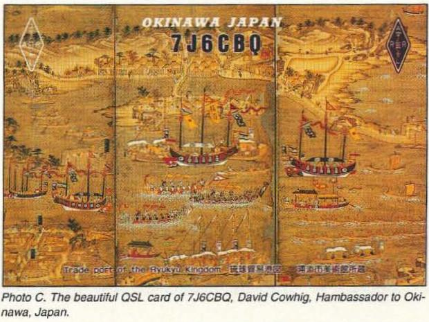
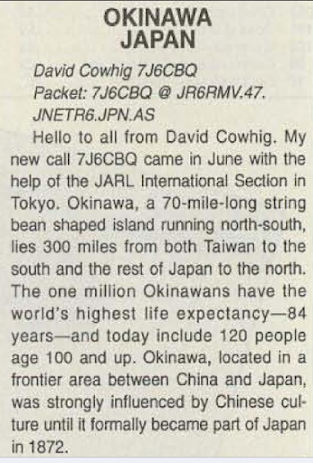
7J6CBQ on Okinawa -- And a Translation of a Science Fiction Novel about Ham Radio in China


The article about Sergeant Malik Pugh USMC on Okinawa brought back memories from the 1990s. David Cowhig was 73 Magazine's Hambassador on Okinawa -- I had the same "position" in the Dominican Republic.  David and I were both in the Foreign Service;  we joked that 73 had afforded us our only chances to be ambassadors of any kind.  David's Okinawa QSL and the opening from his initial report to 73 magazine appear above.  You can see more here: 


A couple of my own "dispatches" as Hambassdor to the Dominican Republic appear here: 

Back in the 90's David sent me an old QST Magazine.  I wrote about this on the SolderSmoke blog: 

Later, I learned about another "Hambassador" who was still active as a radio amateur: Ron Gang 4X1MK:  

Finally (and this is really cool):  David Cowhig has been putting his language skills to good use, translating Chinese written material.  He sent me his translation of the opening chapters of a Chinese science fiction novel about ham radio.   Readers of the SolderSmoke Daily News will like this: 


We Live in Nanjing 《我们生活在南京》

Thanks David! 

Friday, December 9, 2022

R-390s, KWM-2s, Airplanes, and Magnetic Loops -- A Really Interesting Interview with Ted Robinson K1QAR


Eric Guth 4Z1UG has a really interesting interview with Ted Robinson K1QAR.  

I really enjoyed hearing Ted's inspiring story: 

https://www.youtube.com/watch?v=SUUzlKMMANg

https://www.qsotoday.com/podcasts/K1QAR

Listeners will like the discussion of the R-390 and the KWM-2.  And his talk about airplanes.  And the joy of repair.  


Here is Ted's QRZ.com page:  https://www.qrz.com/db/K1QAR

Thanks Eric!  Thanks Ted! 

Sunday, November 7, 2021

JPL, Mars Helicopter, Cube Sats, Ham Radio and more: N5BF talks to Eric Guth 4Z1UG


This morning Eric Guth has a really interesting interview on his QSO Today podcast.  
Courtney Duncan N5BF had a full career at JPL and is the current president of the San Bernardino Microwave Society.  There is a lot of interesting stuff in this interview, much of it about space exploration.  Courtney tells us about how experience with re-purposing radio gear came in handy at JPL.  For example, the helicopter that they have been flying on Mars has a very cheap and light off-the-shelf Zigbee transceiver.  He also talks about the origins of the Cube Sats.   

Here is Eric's page on this interview, with useful show notes: 

https://www.qsotoday.com/podcasts/n5bf

I like to listen to Eric's shows on YouTube -- here is the YouTube recording of the N5BF interview: 

https://www.youtube.com/watch?v=Fbr4jE11vfg

Here is N5BF's ham radio web site: 

http://cbduncan.duncanheights.com/HamRadio/HamRadio.html

Here is the club page of the San Bernardino Microwave Society:

http://www.ham-radio.com/sbms/

Thanks to Eric and Courtney! 


Sunday, May 3, 2020

QSO Today -- Episode 300 -- Panel Discussion


Congratulations to Eric Guth, 4Z1UG for reaching episode #300 on his QSO Today podcast.  To commemorate the event, Eric organized a panel discussion.   It was a real pleasure and honor to participate.   


Thanks again Eric! 

Tuesday, April 7, 2020

ZL2CTM Charlie Morris on "QSO Today" with Eric Guth 4Z1UG


Eric Guth 4Z1UG had a really nice interview with our friend Charlie Morris ZL2CTM.  Charlie shared with Eric a lot of wisdom about how to homebrew radio gear.  I especially liked Charlie's comments on keeping most of his rigs on the wooden prototype boards.  He said something important when he talked about the benefits of taking a break from a difficult problem, then coming back to it with a rested and refreshed mind. I noted, however,  that he said most of these frustrating problems have to do with software.  

I got got several chuckles out of Charlie's comments on the difficulty of building stable analog LC VFOs (here he seemed to be channeling our good friend Pete Juliano).  I chuckled because as I listened I was happily building the analog LC VFO for my Q-31 Quarantine receiver.  The centerpiece of this project is a variable capacitor that Pete gave me;   Pete took it out of an old  Galaxy V transceiver.   Believe me guys, no rotary encoder could possibly look as nice or have as much soul as that capacitor from Pete, with all its gears, reduction drives, and anti-backlash mechanisms.  It even smells of machine oil.  Call me a Luddite, but I will stick with the coils and capacitors.  

Listen to the interview here: 

https://www.qsotoday.com/podcasts/zl2ctm

Thanks to Charlie and Eric. 

Saturday, March 31, 2018

Yet Another Household Item Useful to Homebrewers: Toilet Bowl Cleaner for PC Board Fabrication

Picture

We have already been using Desitin ointment for heat sink compound, kitchen breadboards for radio breadboards, Scotchbrite pads for polishing, nail polish varnish for toroidal core coating and Olive oil as a field-expedient lubricant. (Am I forgetting anything?)   But I must say I was a bit taken aback by KV4QB's mention of his innovative use of the dilute hydrochloric acid in toilet bowl cleaners in his PC board fabrication process.   Good one DuWayne!   Eric Guth went the extra mile be suggesting a recycling of the liquid. 

This was a really interesting QSO Today interview.  Listen here: 

Saturday, January 6, 2018

Steve Murphy N8NM on QSO Today

Picture
It was really nice to sit back and listen to Eric's talk with Steve Murphy. 
Don't miss this one.  Listen here: 

https://www.qsotoday.com/podcasts/N8NM  

My notes: 

-- On  a Stingray bicycle patrol on garbage night, looking for radio parts.  FB Steve! 
-- Started with SWL.  A fine radio pedigree. 
-- Had an R-390A at age 16.  
-- Uses an LC meter to check on toroid windings. 
-- Steve:  Thanks for the kind words about inspiration. 
-- Manhattan And Ugly.    Mugly!
-- Planker!  Better on a Board!
-- Form Factor First, but then it never fits! Al Fresco! 
-- Packages arrive from China faster than they go across Israel. 
- - E-bay as a really good source for parts. 
-- Oh god, not an S-38E.  Stop torturing yourself Steve. 
-- N8NM: Radio Renaissance Man:  Runs a 2 meter repeater network.  Thinking of 900 MHz. 
-- Papa Legba -- I got it from a W9SCH via SPRAT.  He got it from Voodoo.
N8NM is chickenkiller.com   FB. 
-- Moderation?  Ha!  Good luck with that! 
-- An Electromagnetic Playground where Failure has No Consequences.  Well put. 

-Happy New Year Eric and Steve!  Thanks to  both of you. 

Monday, January 1, 2018

Jeff Damm WA7MLH on QSO Today


Happy New Year!    

There was so much wisdom and tribal knowledge in Eric Guth's interview with Jeff Damm WA7MLH. It was almost overwhelming. 

You should all listen to it.  Twice. At least twice: 

https://www.qsotoday.com/podcasts/WA7MLH
  
My notes:

-- I sympathize with Jeff's decision to go solid state and give up on high voltage after an encounter with an undischarged 600 volt capacitor.  
-- I really like the 1700 kHz IF with a 5 MHz VFO for an 80 and 40 meter receiver. 
-- Interesting that EE degree didn't help much in his efforts to understand ham gear.  Better to read Wes's books and Doug's. 
-- Tek Spectrum Analyzers were specially made to fit down a submarine hatch.  
-- Building and measuring just as important as studying the theory.  Inked-up text books. 
-- Learned ugly from Wes as a teenager. 
--Searched for old commercial gear to gut and use as homes for homebrew solid state gear. The enclosures,  panels and controls are very useful.   Great way to avoid metal work.  These rigs are no longer boatanchors!  Again, I sympathize.  I've sacrificed many Heath Lunchboxes and QF-1s.  
-- Jeff Builds the VFO first.  My preference too. But he understands Pete's AF-first approach. 
-- Finger on the input of the AF amp!  Buzz!  Yea! Step your way back to the front end.
-- ALWAYS one stage at a time.  
-- Osh Park Boards for standard circuit modules.  Like Legos. 
-- Cubic Feet of air variables.   Jeff has a lifetime stash.   
--Thinking about what was and should have been his section of EMRFD. Go for it Jeff. PLEASE! 
-- Hesistant about chips. Analog guy.  Would have been a huge time sink.  Analog guy.  
-- Buying parts on e-bay.  Fewer and fewer RF parts at hamfests. 
-- People reading QST Tech Articles for entertainment. Editor apprach: "Nobody will build it anyway." Handbooks giving priority to entertainment and less to information and education. 


Sunday, October 29, 2017

Ron Gang, 4X1MK on "QSO Today" Podcast: Knack Story, Satellites, Quads, Philosophy


Wow, Eric Guth's interview with Ron Gang 4X1MK really resonated with me: 

-- Asked about how he got is start in radio, Ron went back further than many of us do in response to this question.  He cited his early experiments with "two tin cans and a string." Yes, of course!  I'd forgotten all about it, but in retrospect this might have been a very early indication of THE KNACK.  (I'll bet many of our readers were also active on the String and Can band.) 

-- Ron used a DX-100.  FB. 

-- Ron was active on the satellites.  In his voice you can hear the joy and the burst of enthusiasm that resulted from those early satellite contacts.  He also mentions the untimely demise of Oscar 13.  Bummer. 

-- Ron was the Israel correspondent for 73 Magazine.  I held a similar position in Dominican Republic.  My friend David Cowhig was at the same time correspondent from Okinawa, Japan.  We should have a reunion of "73 Magazine Hambassadors."

-- Ron mentions John Tait EI7BA.  John was a regular contact of mine when I was in the Azores.  He appears in the SolderSmoke book.  He was the one who introduced me to an important Irish accolade:  John told me that WD-40 is "the Pope's pee." 

-- Toward the end, Ron discusses the wonder of ham radio conversations, and provides a good suggestion on how to get beyond the all-to-common "hello-59-goodbye" contacts. 

Ron's comments on the spiritual or philosophical aspects of the hobby were just the thing for a quiet Sunday morning. 

Thanks to Eric and to Ron for a great interview.   
    
Listen here: 

http://www.qsotoday.com/podcasts/4X1MK

Saturday, January 28, 2017

SolderSmoke Podcast #193: BITX 40, OLEDs, KWM-4, Noise Abatement


SolderSmoke 193   28 Jan 2017


Report from Pete on BITX 40 Session with California radio club.

Update on the BITX40 Module Revolution
-- Check out the BITXHACKS page.  Send in contributions.
-- BITX20 mailing list very active.
-- Raduino!
-- Interview with Farhan with W5KUB --   Eliminating the commercial gear.
-- BITX 40s on the beach in Australia.  FB

Bench Reports:

Pete:
-- Color Displays!
-- KWM-4
-- OLED MADNESS!

Bill: 
-- Fixing up the old HT-37   HT37 to HT37 QSO with W1ZB
-- Dabbling in VHF with Ramsey Aircraft band receiver.  NOT FUN.
-- Going all IC with Si5351 OLED NE602 rig.
-- BANDSWEEP
-- OLED Noise and the Active Decoupling solution.

Using LTSPICE as a diagnostic or understanding tool.

Of Waterfalls, Homebrew Rigs and Casual Critics on 40 meters. Words of Wisdom from W8JI.

LEXICON:  HAYWIRE   TOMBSTONE    BIKESHEDDING from Todd K7TFC

Some great recent interviews by Eric 4Z1UG:
Ian G3ROO  Origins of ROO   Regen at age 8
Hans Summers G0UPL     Balloons!   NO COMMECIAL GEAR
David White WN5Y          ELECTROLUMINESCENT  RECEIVER EXPLAINED
Rob Sherwood NC0B 

MAILBAG: 

Chris KD4PBJ's BITX 40 with improved stability
Jerry W0PWE built a DIGITIA!  Very nice.  Worked Keith N6ORS and heard me! TRGHS
Mike AB1YK's Al Fresco Scratch built BITX.  But give that LC VFO another chance Mike!
Steve N8NM 30 meter rig with salvaged CB LC VFO. FB
Keith N6ORS Franken SDR rig with parts from the 1980s.  FB
SKN Bandscan from Mike WA6ARA  I worked W1PID Jim!
What is Mikele up to?
Rocking Johannesburg and Kirghizstan via local repeaters: