
Showing posts with label military radios. Show all posts
Showing posts with label military radios. Show all posts
Monday, August 24, 2026

Saturday, July 18, 2026
Why is AM on 3885 kHz?

It is Saturday morning, 0500 EDT. I am tuned to 3885 kHz, listening to the Old Military Radio Net. It is on 3885 kHz. Why this frequency?
Wikipedia: https://en.wikipedia.org/wiki/SCR-536
Gemini explains:
The frequency 3885 kHz is inextricably tied to one of the most iconic military radios of World War II: the BC-611 Handie-Talkie (part of the SCR-536 radio set).
Manufactured by Galvin Manufacturing Corporation (which later became Motorola), the BC-611 was the world’s first ubiquitous handheld, two-way AM transceiver. It was the "walkie-talkie" you see clamped to the ears of infantrymen in every classic WWII movie.
The technical marriage between this specific radio and 3885 kHz came down to how the military deployed them and what happened immediately after the war:
1. The Channels Were Commandeered
The BC-611 could operate anywhere from 3.5 to 6.0 MHz by swapping out internal plug-in coils and quartz crystals. Because the U.S. government temporarily shut down all civilian amateur radio operations "for the duration" of WWII, the military freely assigned tactical frequencies right inside what used to be the ham bands.
For company and platoon-level communications, 3885 kHz became a standard assigned military channel.
2. The Great Surplus Avalanche
When WWII ended, the military had hundreds of thousands of BC-611 units, along with mountains of spare FT-243 crystal units, sitting in warehouses. The government liquidated them to the civilian market for pennies on the dollar.
Hams returning from the war snapped them up. Because these units were strictly crystal-controlled (you couldn't just spin a dial to change frequency), you were locked onto whatever crystal was inside.
3. A Lasting Living Tradition
Even though a BC-611 only pushed out a fraction of a watt of AM power (using a tube filament battery and a 108-volt B+ battery), hams quickly realized that if they gathered on 3885 kHz, they could hear each other locally.
That specific frequency choice was entirely forged in the surplus markets of 1945 and 1946. Eighty years later, the tradition is so deeply ingrained that military radio collectors and vintage AM operators still hold a massive, synchronized check-in on 3885 kHz every year during the Dayton Hamvention weekend.
Thursday, May 21, 2026
School for Danger -- the SOE, and Radio, in Nazi Occupied France
Hack-a-Day had a link to this film. It is really good. There is some stuff about radio, and especially the S-Phone system. But the bigger message of the film is the danger faced by the heroic teams who parachuted into occupied France. As shown in the film, many of these people were young women who risked it all in the most dangerous of airborne operations. It is a reminder of how ridiculous the focus on masculine valor in airborne and special operations really is. Three cheers for the SOE. For all of them.
Saturday, May 2, 2026
The TW-100 "Fly Away Transceiver" --- A CW-SSB Rig I Never Heard of Until Today
I was listening to the Old Military Radio Net this morning. Rhett KB4HG checked in on Upper Sideband. He was using a loaner TransWorld TW-100 "Fly Away" CW-SSB transceiver. I had never heard of this rig. It is very interesting. See the W7UUU YouTube video above for more details.
OM John W3JN called into the net and commented on Rhett's rig. John noted that the State Department had sold at auction a number of these rigs. John reported that the ROM had been removed from MOST of these rigs. But one of them still had the memory. This allowed all the other TW-100s to be put back on the air. FB.
BTW: W7UUU has a very FB YouTube channel. Check it out:
Thursday, December 25, 2025
The AN/PRC-74 -- A Covert Contact, An Analog Synthesizer, A Benefit of Channelization, and a Good Thing about Band Noise
I have a sentimental tie to this older military transceiver, for several reasons:
-- This was probably the transceiver that we hauled into the Uwharrie national forest when I was in the army in 1983. I made one 40 meter CW contact with it. It was interesting for me to see Ray tune the rig up on 40 meter CW.
-- I like the crude, early, non-digital synthesizer.
-- This is a good example of the use of an old military rig on 5357 kHz in the 60 meter band. This is the only one of the chanelized frequencies on that band that is on a whole interger of kHz frequency. It fit well with the 1 kHz tunability of the transceiver. Thus we had the "Moose and Squirrel" net on 5357 KHz.
-- I like how Ray uses the band noise to peak the receiver. Band noise, you see, has its uses.
Saturday, March 29, 2025
Checking in to the Old Military Radio Net, March 29, 2025
This was a fairly typical session of the Old Military Radio Net. 3885 kHz AM 0500 local on Saturday mornings. (Distant listeners can tune in via WebSDR.) This clip shows W3EMD, N2CQR (me) and, N1SNG. Buzz W3EMD from the Hudson Valley of New York was on with his KWM-1. Normally he uses a BC-348 powered with a Dynamotor. Last week he told the group that someone had COMPLAINED about the noise that his mic was picking up from the Dynamotor. Geez! I told Buzz that we had been commiserating with him about this on the SolderSmoke podcast. Later in this morning's session I heard WU2D, WA1HLR, AJ1G, and others. I reported on an emergency De-Oxit spraying of my HQ-100's band switch, just minutes before net call up. I also noted that I had found a crystal for 3885 kHz; the radio gods have spoken (TRGHS).
Tuesday, February 4, 2025
Mr. Carlson Restores a BC-348 -- But 40 Meters Sounds Very Weak. Why?
Mr. Carlson mentions that he is a ham radio AMer. He is also on SSB, but AM is, he says, his preferred mode. FB.
I got a real chuckle about the MVC switch position on the front panel. "Manual Volume Control" like "Manual Gain Control." I thought I had invented this term. You know, "real hams control their gain manually." This is why Farhan never put AGC in the BITX20. But it seems the Army Air Corps was way ahead of me with the BC-348.
Mr. Carlson makes it sound (!) like the Dynamotors are a thing of the past. Not true. Every Saturday morning I listen to the Old Miltary Radio Net and hear a number of Dynamoters spinning in the background. One belongs to Buzz W3EMB who uses a BC-348. Buzz has an SDR attached to the IF of his BC-348, which I think is an admirable mix of the old and the new. Those BC-348s are, after all, quite old. WWII old -- like 85 years old. And still working.
Paul has a good discussion of the importance of short lead length, and of mounting shielded capacitors properly, and of the usefullness of a good groundplane under the capacitor. Go Manhattan boards! Paul's presentation on how to identify the outside foil of a capacitor was very good, but I was wondering if you could also find out by using a file to remove some of the yellow insulation, then test with a DMM to see which terminal is connected to the foil.
"Lots of times you have to add solder to remove solder." Indeed.
The importance of testing for BOTH capacitance and leakage. Yes.
But why bother with "period correct" internal wiring harnesses, when you have already put a bunch of modern caps in there? I mean, I'm in favor of the re-capping, but this seems inconsistent with the need for "period correct" internal wiring harnesses.
When Paul first fired up the receiver, I was hoping he would disconnect the antenna to see how much band noise was getting through.
When Paul got to the IF alignment, he spoke of the dangers of working on energized high-voltage gear. I had been thinking about getting a BC-348 myelf, but Paul's comments reminded me of why this is probably not a good idea for me. Paul's comments about "knowing where your hands are" is on target. "One hand behind the back, " is a good rule for this kind of energized testing -- this will help prevent current from a mishap from flowing through your chest.
I may have more comments later. Off to the beach now.
Back from the beach:
"Contrary to popular belief, the simpler the receiver, the better they hear." Amen Mr. C.
Paul's heroic cleaning of the 915 kc crystal made me feel like a wimp for not having tried to do this with some "bad" 455 kc rocks I was given while trying to build the Mate for the Mighty Midget receiver. I may go back to those crystals and try to clean them as Mr. C did.
The grand finale of this 2.5 hour video was, as expected, a demonstration of how good it sounds. But unfortunately it did not sound good. Paul tuned through the 40 meter band and I heard NO CW signals. I didn't even hear FT8. There were a few anemic SSB signals and, as he reached the upper portion of the band some very weak AM broadcast signals. I didn't even hear CHU Canada's time signal. Huh? Why? Our very simple homebrew Direct Conversion receiver sounds a LOT better than that. I mean look at the sweep of 40 meters that I did using only a simple dipole: https://soldersmoke.blogspot.com/2024/12/an-evening-bandscan-on-40-meters-using.html Why is there such a big difference in performance?
Could it be the antenna that Paul was using? He was on what he calls the 369 antenna. Could there be a problem in the receiver? Could it be band conditions?
Friday, August 30, 2024
Mr. Carlson Makes a Thermatron Power Supply for a BC-348
When I was 14, I had to make a power supply for a Heath HW-32A. Mine ended up working, but it was nowhere near as nice as Mr. Carlson's BC-348 supply (shown in the video above). I didn't have a sand blaster, nor a drill press, nor much of anything else, really.
But hey, don't real boatanchor hams use Greenlee chassis punches? What's with the drill press and the hole saws?
Note that Mr. C takes care to make sure that the rectifier tube is in the proper angle FOR OPTIMAL VIEWING. That's some serious attention to detail OM. And whoa, DELICATE SURFACE MASKING TAPE from 3M? Respect! Also, era-specific looming material.
His point about the importance of the cardboard washers in the power transformer was really useful. I hadn't thought about that.
Here are the two previous BC-348 videos:
Thanks Paul!
Monday, May 13, 2024
Ragnar LA1UH's Wonderful Museums in Norway
Here are two more great museum visits by Helge LA6NCA. In these two he visits Ragnar LA1UH.
Ragnar has a lot of maritime experience, so we see a lot of older ships' radios. But his interest in the radio art is much broader and we also see a lot of other kinds of gear:
-- Wow, a "travel radio" in a suitcase from 1927. Was this the idea that later lead to the Parasets of WWII?
-- Lots of "Stay Behind" gear from the Cold War. That "Africa" receiver (that never made it to Africa!) is very interesting.
-- We see an ART-13 with autotune, ANGRC-9s, several ARC-5 command sets. I was hoping Raganar would fire up a Dynamotor, but no.
-- I spotted a Galaxy V transceiver. I have the VFO reduction drive from one of these in my homebrew 15/10 rig.
-- We see several variometers in the emergency (500kc?) maritime transmitter. I used a variometer in my super-simple ET-2 transceiver (with an N0WVA receiver).
-- Lots and lots of tubes.
Ragnar says he himself is of 1944 vintage. I hope some "stay behind" provisions have been made for these amazing museums.
Thanks to Helge LA6NCA and to Ragnar LA1UH.
Tuesday, November 21, 2023
Mr. Carlson's ART-13 Transmitter (with Dynamotor)
Here we have a really cool video from Mr. Carlson. In it he reveals (admits!) to what we already know: HE IS A HAM RADIO OPERATOR. FB Mr. C!
You can see that he is a true ham, with a true case of THE KNACK, when you see his reaction to the inside view of the ART-13. He seems to gasp as he notes that there is a lot of "RF goodness" in that box. There is a vacuum relay, a bread-slicer capacitor, there is even a variometer. And lots of good, big THERMATRONS. Only a true ham, a true Knack victim can recognize this RF goodness.
The Dynamotor that goes with this transmitter is really interesting to me. I have been hearing these things whining in the background (audible noise, not a signal defect) on many early morning (Saturday 3885 kHz) of the Old Military Radio Net. I can often hear the dynamotor of Buzz W3EMD as he transmits from Rhinebeck, New York. It was great to see the inside of this device.
Back in 2017, Hack-A-Day took a look at Dynamotors:
There are several good ART-13/BC-348 pictures on W3EMD's QRZ page:
I was especially taken by the handwritten frequency chart on the front panel of the ART-13. This reminded me a lot of the handwritten readout that I have been using on various rigs, including (most recently) the 15-10 SSB transceiver. I hope Paul focuses on this paper-and-pencil frequency chart; it is nice to step away a bit from the glowing numerals of San Jian.
Mr. C points out that the ART-13 was the transmitter that was paired up with the BC-348 receiver. He will be working on both in the weeks ahead.
Thanks Mr. Carlson. 73 OM.
Thursday, February 24, 2022
Old Military Radios at the Air and Space Museum Udvar-Hazy Center, and Autogyros

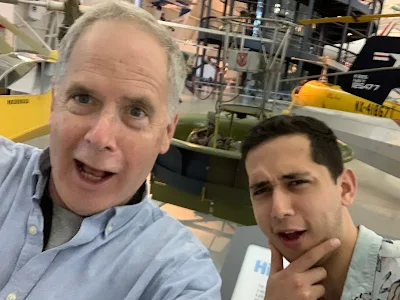
My son Bill and I were out at the National Air and Space Museum's Udvar-Hazy Center (out near Dulles Airport, where they display the really big stuff). We spotted these old military radios. The ARC-5 Command sets caught my eye. Of course I was thinking about the great VFO parts inside those boxes... The acknowledgement of the ARC-5's contribution to ham radio (on the card) was nice.
They also have an ART-13 on display.

We had a lot of fun looking at all the planes. We were especially impressed by the Autogyros.
The Bensen B-6 Gyroglider seemed to be really pushing the envelope (of good sense!). This was a an Autogyro with NO MOTOR. It was towed! No license required as long as you didn't release the tow line. Note that it was designed in 1954 to introduce teenagers "to the thrills of flight at minimal cost." The headgear and goggles were key. And the kit was only $100!


Saturday, December 4, 2021
A Great Morning on the Old Military Radio Net: AB9MQ's Central Electronics 20A, W3EMD's Dynamotor, WU2D

Just a portion of Masa's shack
I usually try to listen in on the Old Military Radio Net on Saturday mornings (3885 kc). Lately I listen with my Mate for the Mighty Midget receiver.
This morning's session was especially good. For me the highlight was when Masa AB9MQ called in from Normal, Illinois using his Central Electronics 20A (see below). That was one of the earliest SSB rigs. A phasing rig, it also ran AM (which was what Masa was using this morning). He had it paired up with a Central Electronics 458 VFO. You folks really need to check out Masa's QRZ.com page:
Buzz W3EMD called in from Rhinebeck, NY. I could hear his dynamotor in the background. Buzz said hello to Masa in Japanese. FB.
Always great to hear Mike WU2D.

Saturday, August 21, 2021
W2EWL's "Cheap and Easy SSB" Rig -- And The LSB/USB Convention Myth

In March 1956 Tony Vitale published in QST an article about a "Cheap and Easy" SSB transmitter that he had built around the VFO in an ARC-5 Command Set transmitter. Vitale added a 9 MHz crystal-controlled oscillator, and around this built a simple phasing generator that produced SSB at 9 MHz. He then made excellent use of the ARC-5's stable 5 - 5.5 MHz VFO. His rig covered both 75 meters and 20 meters. Here is the article:
Because it used the 9 and 5 frequency scheme, over the years many, many hams have come to think that Vitale's rig is the source of the current "LSB below 10 MHz, USB above 10 MHz." This is wrong. An example of this error popped up on YouTube just this week (the video is otherwise excellent):

First, Vitale's rig had a phasing SSB generator. All you would need to switch from USB to LSB was a simple switch. And indeed Vitale's rig had such a switch. Pictures of other Cheap and Easy transmitters all show an SSB selection switch. So with a flip of the switch you could have been on either USB or LSB on both 75 and 20. With this rig, you didn't even need sideband inversion to get you to 75 LSB and 20 USB.
Second, even if hams somehow became so frugal that they wanted to save the expense of the switch, leaving the switch out (as suggested above) would NOT yield the desired "75 LSB 20 USB" that the urban legend claims that W2EWL. As we have been pointing out, a 9 MHz SSB generator paired with a 5 MHz VFO (as in the Vitale rig) will NOT -- through sideband inversion -- yield LSB on one band but USB on the other.
W2EWL's rig could not have been the source of the LSB/USB convention. I still don't know where the convention came from. I am still looking for the source.
But leaving the LSB/USB convention issue aside, Tony Vitale's rig is an excellent example of early SSB homebrewing, and of a very clever use of war surplus material. In the January 1992 issue of Electric Radio magazine, Jim Musgrove K5BZH writes of his conversations with Vitale about the Cheap and Easy SSB. Tony told Jim that this rig came about because the Central Electronics exciters required an external VFO -- they recommended a modified BC458. B&W had recently come out with a phase shift network. Vitale went ahead and built the whole rig inside a BC458 box. FB Tony!
In the December 1991 Electric Radio, Jim K5BZH reports that Tony was recruited into the ranks of SSBers when he watched a demonstration of SSB by Bob Ehrlich W2NJR in November 1950. Tony very quickly started churning out SSB rigs. His daughter Trish Taglairino recounted that when her father had "done something great again" there would be a parade of hams to the basement shack. About 30 guys showed up when Tony put his first SSB rig on the air -- they sent out for beer.
Thanks to Jim for preserving so much SSB history.
Tuesday, July 20, 2021
Mythbuster Videos 8 and 9 -- The Old Military Radio Net plus "Zero Beat and The Vertical Skirts"
I like to listen to the Old Military Radio Net on Saturday mornings. This week I was listening with the Mythbuster receiver. The AM carriers provided a good opportunity to observe the effects of the steep skirts of the 10 pole crystal filter. We start at zero beat, with the BFO exactly on the carrier frequency. If I turn the VFO dial in one direction, I in effect move the passband in a way that puts the carrier in the passband. And it is no longer zero beat with the BFO, so we hear the heterodyne (the beat!). But if I turn the VFO dial in the other direction, the carrier is now outside the passband. Even though the BFO would produce a tone, we don't hear a tone, because those steep filter skirts are keeping the carrier out. We do continue to hear some of the sideband frequencies, because they remain in the passband. The very sharp drop-off of the carrier tone is a good indication that the steep skirts of the crystal filter are doing the job.
"Zero Beat and the Vertical Skirts" Sounds like the name of a Punk Rock band, doesn't it?
Anyway in this video I explain what happened in Mythbuster Video #8 (above). I explain why we can hear the Old Military Radio Net carriers when I tune the VFO in one direction, but not in the other.
Tuesday, March 9, 2021
Straight Key Night 2021 at SA2CLC in Sweden
Wow, check out the FB gear of Tommy SA2CLC in Sweden, in use on Straight Key Night 2021. There is some German WWII gear, a BC-348, a homebrew transmitter, and some FB QRP kits.
More on Tommy SA2CLC here: https://www.qrz.com/db/SA2CLC
The culvert under the road for coax to the antennas is very cool.
FB Tommy! A belated HNY to you OM.
Monday, February 22, 2021
LA6NCA's German Military WWII Receivers, and a Luftwaffe Receiver with FAST QSY
Discussions of old military radio gear are dominated by talk of U.S. radios. Yesterday in the comments section of the SWLing Post I found two interesting videos about German WWII equipment. Above you can see LA6NCA's receivers. Below there's a video of a Luftwaffe receiver with an amazing capacity for really rapid frequency change.
Subscribe to:
Posts (Atom)