Podcasting since August 2005! Listen to our latest podcast here:

Podcasting since August 2005! Listen to Latest SolderSmoke

Showing posts with label 2 meters. Show all posts

Thursday, July 16, 2026

The 43.333 MHz Crystal in my Nuvistor Converter was Bad. But WHY did I Find Another One in my Junkbox?

Gemini explains why: 

As a radio amateur, you have likely run across these crystals in countless parts bins, swap meets, and vintage schematics. The reason 43.333 MHz crystals are so common comes down to a classic, elegant piece of frequency math that bridged the gap between early VHF operation and standard HF rigs: the 2-meter to 20-meter transverter/converter.


The 2-Meter to 20-Meter Magic Number

Historically, amateur radio operators wanted a way to receive and transmit on the 2-meter band (144–146 MHz) using their highly sensitive, existing 20-meter HF receivers (14 MHz) as a tunable Intermediate Frequency (IF).

To mix a 144 MHz signal down to a 14 MHz IF, you need a highly stable 130 MHz local oscillator (LO):

144 MHz (RF) - 130 MHz (LO) = 14 MHz (IF)

Creating a stable, fundamental-frequency quartz crystal at 130 MHz was physically impossible for decades because the quartz wafer would have to be sliced microscopically thin and would easily shatter.

Instead, designers utilized a robust, lower-frequency third-overtone crystal operating at 43.333 MHz. When you multiply 43.333 MHz by three in a simple tripler stage, you get exactly the 130 MHz LO signal needed:

43.333 MHz times 3 = 130 MHz


Why They Flooded the Market

Because the 2m-to-20m conversion was the gold standard for VHF operation in the 1960s, 70s, and 80s, these crystals were mass-produced. They were the heart of legendary gear like the Drake SC-2 receiver converter and dozens of homebrew transverter designs featured in the ARRL Handbook and 73 Magazine.

If a ham wanted to monitor the popular 146.94 MHz repeater frequency of the era, they would use a 2-meter converter with this exact crystal, allowing them to tune their HF dial to precisely 16.94 MHz.

Other Multiplier Matches

Additionally, 43.333 MHz has convenient harmonics for other bands. For instance, multiplying it by 10 yields 433.33 MHz, which sits perfectly inside the 70-centimeter amateur band and the widely used 433 MHz ISM band (common for low-power key fobs, weather stations, and remote controls).

Whenever you see a strangely specific, non-integer crystal frequency like 43.333 MHz, 38.667 MHz (used for 2m to 10m conversions), or the famous 3.579545 MHz color burst crystal, there is almost always a legacy of mass-production and clever math behind it! 

Saturday, July 11, 2026

My Parks 2 meter Nuvistor Converter, a QST review, and Bio Info on the Tektronix Hams who Designed It (Who is W7UHF now?)


Denton E. Nelson (amateur radio callsign W7UHF) was an electronics engineer and a notable figure in mid-century amateur radio history, best known for co-founding Parks Electronics alongside fellow operator Loren Parks (K7AAD) [3.1.3].

Tektronix Background

Nelson spent part of his career in the 1950s working at Tektronix in Oregon, where he moved through various roles from assembly into test and production engineering [1.2.2, 3.2.3]. During his time there, he was also an active member of the Tektronix Employees Radio Amateur Club [3.1.2].

Parks Electronics and VHF Converters

In the 1960s, Nelson (W7UHF) and Parks (K7AAD) partnered to build high-performance VHF (Very High Frequency) converters, initially starting their production in Parks's garage [3.1.3]. At the time, amateur radio operators who wanted to operate on the VHF or UHF bands often relied on outboard converters to shift those higher frequencies down so they could be tuned on standard shortwave communication receivers.

Leveraging their rigorous professional backgrounds at Tektronix, Nelson and Parks applied strict commercial test-equipment standards to their amateur gear [3.1.3]. Parks Electronics quickly became famous for its superior "little black boxes" [3.1.3]. Unlike much of the consumer equipment of the era, every converter Nelson and Parks produced was individually tested for precise gain, bandwidth, and low noise figure before it was shipped [3.1.3]. This commitment to quality made their equipment highly sought after by VHF and UHF enthusiasts worldwide [3.1.3, 4.1.6].

-----------------------------------------

One question about W7UHF:  If you go to QRZ.com, you will see that there is still a listing for W7UHF, under the name of Denton E. Nelson.  But it is for a Technician license.  And it lists a previous call as KD6EFF.  Who is that?  Could that be OM Nelson's son?  The holder is in Silicon Valley, and the license seems like it is about to expire. 

-----------------------------------------

Loren Parks (1926–2023), who operated under the amateur radio callsign K7AAD, was a man of three distinct legacies: he was a skilled electronics engineer who built highly respected amateur radio gear, and a pioneering manufacturer who made millions in the medical device industry. [3.1.1, 3.1.6].

Tektronix and Amateur Radio (K7AAD)

After serving in the U.S. Navy and earning a degree in psychology, Parks moved to Oregon and took a job in the 1950s with Tektronix, the pioneering test equipment manufacturer [3.1.1, 3.1.6]. He was heavily involved in the local amateur radio scene and the company's ham radio club [3.2.1].

Recognizing that operators needed better ways to tune into the VHF and UHF bands, Parks partnered with his Tektronix colleague Denton Nelson (W7UHF) to build outboard receiving equipment [3.2.2]. What started as a garage project became Parks Electronics [3.2.2]. By applying rigorous commercial test-equipment standards to their amateur gear, their VHF converters became famous for their high performance and exceptionally low noise figures. Parks was also a dedicated supporter of the wider ham community, at one point stepping in to purchase and run the VHF'er magazine to ensure the publication survived [2.3.2, 3.2.2].

The Medical Device Fortune

While his amateur radio converters were a critical success among hobbyists, Parks found his vast fortune in the medical field. In 1961, he founded Parks Medical Electronics in Aloha, Oregon [3.1.1, 3.1.7].

Pivoting his electronics expertise, Parks designed some of the world's first impedance plethysmographs and Doppler ultrasound systems [3.1.1, 3.1.7]. These devices are used by doctors to measure blood flow in vascular studies, detect faint pulses, and monitor patients during surgery [3.1.1, 3.1.5]. His company became a global pioneer in vascular diagnostics—making Parks a multi-millionaire in the process—and it remains one of the oldest manufacturers of Doppler systems in the world today [3.1.5, 3.1.7].

Saturday, March 21, 2026

Space Hints from the Dominican Republic in 1994

Check out the article in the link below.  I too got a QSL from RS-10! 

https://www.gadgeteer.us/SPAHINT.HTM

The 2 meter portion of the Ray-Gun appears below.  I still have the elements. 

Thursday, January 29, 2026

Attempting 2 meter contact, Dominican Republic to Puerto Rico


It is about 100 miles across the Mona Channel.  That is a longshot on 2 meters, but I got the idea when, this past summer, I regularly heard WIDI 99.5 FM in the Dominican Republic from western Puerto Rico.  So over the fall I gathered 2 meter gear, and got a directional antenna and sent all of this gear to the DR.  

Here is the antenna.  Seven elements. I got it through Amazon.  It came kind of incomplete and without any written or on-line instructions.  AI told me to do exactly the WRONG thing with what they assumed was a reflector.  Fortunately I ran into this YouTube video and learned that it was in fact a "ZL Special" antenna, and that it has, in fact, TWO driven elements.  It was through that video that I learned how to assemble this thing.  

My "station" consists of a Heathkit HM-2109.  It is a VHF wattmeter/SWR meter that I bought by mistake.  But I kept it, and it proved very useful in this 2 meter Mona Channel project.  There is a Baofeng UV-5R (boo! hiss!) and a Yaesu FT-470 that KD4EBM gave me.  I have a Communication Concepts 2 meter amplifier -- I must have picked this up at a hamfest.  It promises 35 watts with 5 watts of drive.  The old CCI amp gives the rig good juju. 


This morning I wrote to the hams of western Puerto Rico: 

--------------------------------------------------------

Saludos desde el otro lado del canal de la Mona! 

Soy radio aficionado:  Hi7/N2CQR.   Vivimos en República Dominicana en Cap Cana seis meses cada año.

He notado que puedo escuchar WIDI 99.5 FM aquí.  Parece que hay Tropospheric ducting. 

Como radioaficionado, me gustaría averiguar si podemos hacer contacto en 2 metros usando la misma propagación. 

Tengo: 
Dos transceptores de FM
Un amplificador a 35 vatios. \
Un antenna directional de 7 elementos con un gain de 11.5 db. 
Estoy a una elevación de 7 Pisos.  Puedo ver el canal de Mona. 

Hay alguien en la costa oeste de PR (tal vez cerca de Mayagüez) quien puede hacer un schedule para probarlo? 

O hay un repetidor en la zona que puede usar para averiguar si puedo -- por lo menos -- "kerchunk"  el repetidor?  

Gracias por su ayuda! 

73  Bill  Hi7/N2CQR

-----------------------------------------

Greetings from the other side of the Mona channel!

I am a radio amateur: Hi7/N2CQR.   We live in the Dominican Republic in Cap Cana six months every year.

I've noticed that I can listen to WIDI 99.5 FM here.  There seems to be Tropospheric ducting.

 As a radio amateur, I would like to find out if we can make contact in 2 meters using the same propagation.

 I have:

Two FM transceivers

An amplifier at 35 watts. \

A 7-element directional antenna with a gain of 11.5 db.

I am at an elevation of 7 Stories.  I can see the Mona's channel.

 Is there someone on the west coast of PR (maybe near Mayagüez) who can make a schedule to try it out?

 Or is there a repeater in the area that you can use to find out if I can -- at least -- "kerchunk" the repeater?

 Thank you for your help!

 73  Bill  Hi7/N2CQR

-------------------------------

Stay tuned! 

Saturday, April 9, 2022

WD-40, a Hard Drive, a Coat-Hanger Antenna, Dumpster Diving, and Amateur Radio Satellites from the Azores


Last month I was talking to Ira VP2EIH on my new 1712 SSB rig.  Ira is interested in satellites.  Talking to him caused me to dig up some old material about satellite operations.   Here is a 2003 QST article about working the satellites from the Azores: 


Regarding the usefulness of WD-40, during my time in the Azores John EI7BA once told me that WD-40 is, "the Pope's pee!"  Apparently that is high praise in Ireland.  It is indeed good stuff. 

Messias CU2BJ is a Silent Key.  I hope Ray CU3GC, WL7CDK is doing well.  

Sunday, December 5, 2021

Jack NG2E's Winter SOTA Marathon in the Shenandoah


Our friend Jack NG2E is a homebrewer.  He is also a Summits-On-The-Air guy. He does much of his SOTA operations along Skyline Drive in the Shenandoah National Park. Jack's Story Map method of documenting this SOTA trip is very cool. 

Elisa and I are frequent visitors to this amazing park.   Both my kids went to college in the Shenandoah valley, and the park starts just one hour by car west of us.  It is a beautiful place. The Appalachian Trail runs through the park;  we have crossed paths with "through hikers" who are walking from Maine to Georgia. We have also met up with more than one Black Bear in the park (see below).  My son Billy and I launched our Green Hornet rocket from a farm in the Shenandoah valley: https://soldersmoke.blogspot.com/2017/05/still-photos-and-slow-motion-video-from.html

I really like Jack's use of both HF and 2 meter FM.  This makes me think that I should blow the dust off my Baofeng HT and bring it out to the Shenandoah next time we visit.  Jack's 20 meter CW contact with Christian F4WBN in the Pyrenees added a nice element of transatlantic mountain symmetry.  

Check out Jack's Shenandoah Story Map: 

https://storymaps.arcgis.com/stories/c9ff4a13eca24b37bc9dcda0d2dce989

Here's another story map from a SOTA trip into the Adirondacks with info on his gear: 

https://storymaps.arcgis.com/stories/594ca069a27147c1a8d8b79dc1513a72

I know that Jack wants to include a homebrew rig in his SOTA operations.  That would significantly add to the already very high level of operational coolness.  Perhaps Colin M1BUU or Paul VK3HN could provide some suggestions or encouragement in this area. 

Thanks Jack.  Happy trails. Regards to the bears!  

Wednesday, October 20, 2021

Super-Regeneration is Super-Strange


Farhan VU2ESE is largely responsible for this.  He has recently been talking about VHF.  (More about this in due course.).  This started me thinking about my failed effort in London to get on 2 meter AM.   My plan was to use the transmit portion of this HW-30 (above) with a 2-to-10 downconverter and my trusty Drake 2-B for receive.  

Tony G4WIF also bears some responsibility:  When I expressed interest in Farhan's VHF work, Tony sent me two articles from SPRAT.  Both of them were about super-regenerative receivers.  

Farhan's comments caused me to pull the HW-30 out of storage.  I started poking around the transmitter.  But then I noticed something:  On receive, the AF amplifier was obviously working.  Then, when I tuned through the 2 meter band, the rest of the receiver seemed to be working too.  I fired up the HP-8640B sig gen on 2 meters and turned on the AM modulation.  Indeed, the old receiver was inhaling!  

This launched me into an effort to understand how super-regenerative receivers work.  There are a lot of really weak explanations out there. You get the distinct impression that the person explaining the circuit does not understand it himself.  This makes explaining it very difficult.  I am not the only one to notice this phenomenon:  Mike WU2D commented on this in one of his excellent super-regen videos.  This one:  


Mike very kindly said the operation of this circuit seems like "magic."  I was thinking more in terms of Voodoo.  

Howard Armstrong discovered super-regeneration years after he invented plain old regeneration.  The new discovery came around 1921.

It looks like VHF guru Frank Jones had very early misgivings about super-regeneration.  In his 1934 classic 5 Meter Radio Telephony, Jones seems unenthusiastic about the circuit and about our ability to understand it:  "To explain, simply, exactly how this form of detection takes place is not a simple matter, but some of its characteristics are easy to visualize."  In this book, Jones goes on to predict that super-regens will be superseded (!) by superhets.  Indeed, in his 1961 book VHF for the Radio Amateur there are no super-regen circuits; all the receive systems are down-converters to HF receivers. 

Still, with that HW-30 hissing away right next to me, I feel I need to understand how the super-regen works.  I'm not there yet, but I'm trying.  Here are some good resources: 

A good article from Wireless World 1946:  

A student's write up of his effort to understand: 

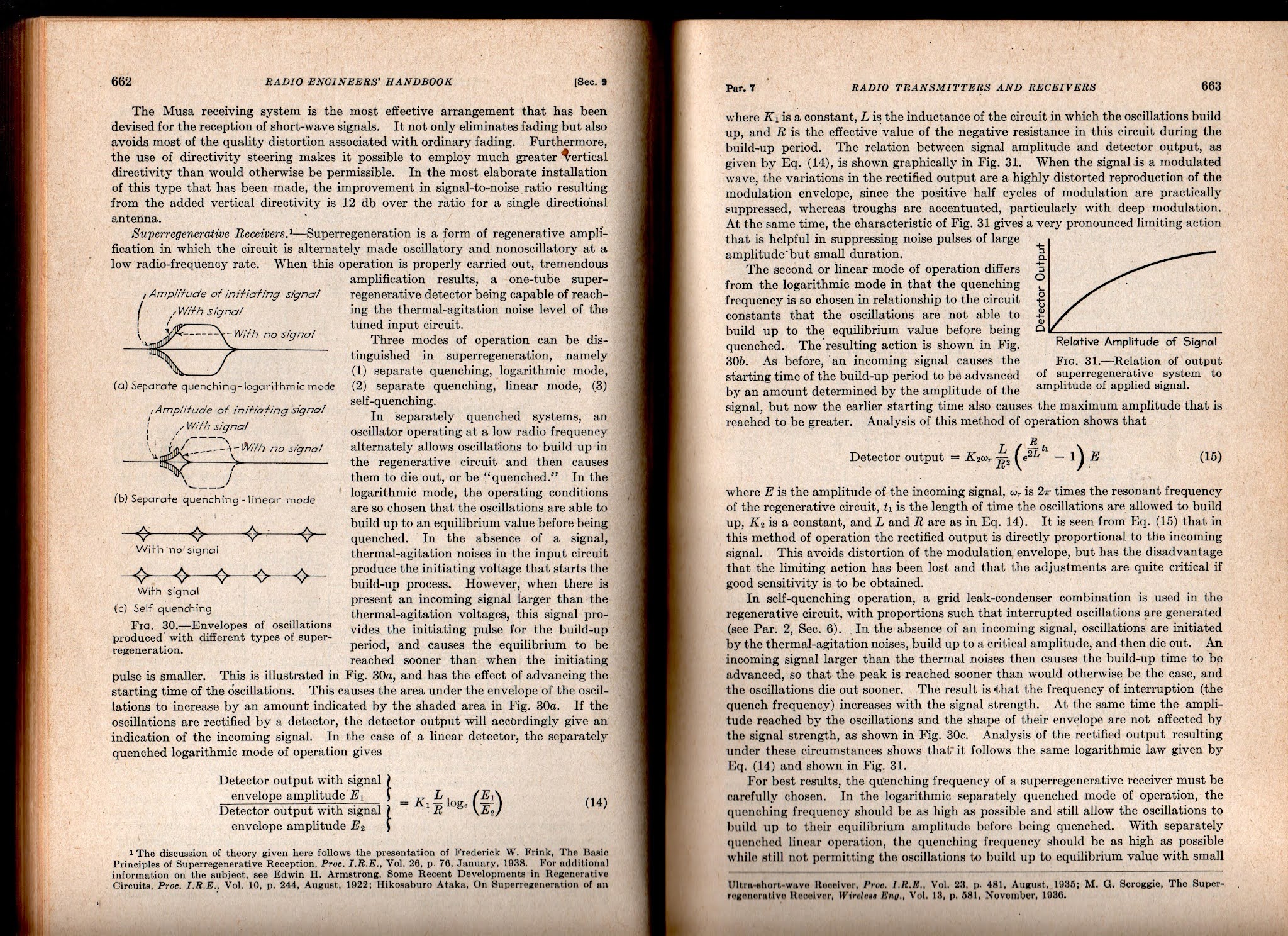
But the best so far (for me) is from Frederick Terman (one of the founders of Silicon Valley) in  his 1943 classic Radio Engineer's Handbook.  Click on the images for a clearer view. 


I will definitely try to get the HW-30's 5 watt AM transmitter going.  I am not so sure I'll do anything with the receiver.  I think this is a matter of picking your battles and "finding joy."   I didn't find joy in FT-8, so I stopped working with it.  Same with my HA-600A, DX-40 Novice rig.  Same with CW in general.  And the same with SDR.  I suspect that super-regen receivers may also fall into this category.  I mean, let's face it, if you are not fond of ordinary regens, is there any real chance that you will like SUPER-regens?  Even Frank Jones seems to have disliked them.  And there is a reason Howard Armstrong moved on to superhets -- they are better! But still, that receiver is hissing away at me...  Stay tuned. 

Sunday, October 17, 2021

2 Meter Homebrew: The Fredbox (Video)


I predict a rebirth of interest in 2 meter homebrew.  This will probably hit around Christmas time.  The impetus will come out of Hyderabad, India.  At this point, I can say no more. 

I was thinking about all of this today.  I remembered "The Fredbox."  G3XBM's report on this fantastic rig was carried on this blog before it was even a blog.  And the Fredbox goes back much further in time -- back to the mid-1970s.  It must have been great fun to have QSOs with this rig in Cambridge England back in the day.  G3XBM actually crossed the English channel with this 10 mW rig.  FB.  

When I was in London (2003-2007), G3XBM's post on the Fredbox got me interested in 2 Meter AM.  I had a down-converter that let me listen, and I went as far as modifying a Benton Harbor Lunchbox for the proper AM transmit frequency.  I don't think I made any contacts, but I still have the bits and bobs of this rig, so if anyone in the Northern Virginia area wants to get on,  please let me know -- I will blow the dust off this project and will build a 2 meter antenna.  

Here are more details from G3XBM on The Fredbox:  


Hans G0UPL got into the Fredbox in 2009 and 2016: