Serving the worldwide community of radio-electronic homebrewers. Providing blog support to the SolderSmoke podcast: http://soldersmoke.com
Podcasting since 2005! Listen to Latest SolderSmoke
Sunday, May 3, 2026
Radio Receivers -- 1942 Training Film -- Crystal Sets to Superhets
Friday, October 10, 2025
Does a simple, single diode envelope detector function the same way as a product detector does?
Mike WU2D has an interesting series of videos on the simple detectors used in crystal radios. Mike's videos touch on a discussion that I had a few years ago with a member of the Vienna Wireless Association. I was describing how an envelope detector uses rectification to recover (demodulate) the audio from an AM signal. The club member dismissed this explanation and claimed that what really happens is that the diode simply mixes the carrier and the sidebands to produce audio. He claimed that the rectification "theory" was just a fable created to deal with people who really didn't know how mixers worked. See: https://soldersmoke.blogspot.com/2022/12/is-envelope-detection-fable-or-is-it.html
I was kind of disappointed by Mike's videos. He seemed to take an agonostic position on this issue. He framed it as "some people believe in the rectification explanation, and some people believe in the product detection explanation." As if both explanations are equally valid. They are not.
This morning, I asked AI about the two explanations. Here is what AI says:
Does a simple, single diode envelope detector function the same way as a product detector does?
AI Overview
No, a single diode envelope detector does not function the same way as a product detector because the envelope detector is a non-linear circuit that recovers the audio from a full amplitude-modulated (AM) signal by following its envelope, while a product detector is a linear mixer that recovers the audio from various modulated signals (including DSB-SC and SSB) by multiplying the modulated signal with a local oscillator. Product detectors are more versatile and offer better signal quality than simple envelope detectors, which are limited to demodulating DSB-AM signals with a full carrier.
I know that AI sometimes gets it wrong, but I think that on this one, it has it right.
I don't think it is necessary to include discussion of modulation percentages nor diode biasing to clearly explain what is going on.
Even if you are using a very weak signal and are completely in the square law region of the characteristic curve, you are still essentially dealing with a form of rectification: portions of the signal on the positive side of the curve will experience less attenuation than signals on the negative portion of the input curve.
When we use a crystal receiver, we are relying on the rectification done by the diode -- even if the rectification happens in the square law region. After the crystal there is some low pass filtering. The envelope of the AM signal remains and this is the audio signal that we listen to. That is why we call it -- correctly -- an envelope detector. And as the AI says, an envelope detector funcions differently than a product detector.
Monday, March 11, 2024
Radio Items Picked-up at VWS Winterfest 2024 Hamfest
-- Behind the MXM there is a nice box marked "Diode Detector" I opened it up and there is just a solid state diode and a 50 ohm resistor to ground. Box may be useful.
-- I got a couple of books: "Weekend Projects" 1979 from ARRL, and "A History of QST -- Volume 1 Amateur Radio Technology 1915 - 2013" 2013 from ARRL.
-- On top of the Weekend Projects book you see a "Crystal Holder" from Gross Radio of New York City. W1UJR has some good history on this company: https://w1ujr.com/written-word/gross-radio-company-circa-1931/ This device seem to be intended to hold in place a raw piece of quartz! Cool.
-- To the right of the books there is a serious-looking VFO. One dollar! Deal! It is a CB VFO, but the markings say it puts out 5.44 to 5.99 MHz. So it should be useful. The dual speed dial is very nice.
-- Above the VFO is a nice step attenuator from the "Arrow Antenna" company of Loveland Colorado.
-- Further to the right are some Electric Radio and Antique Wireless Association magazines that Armand WA1UQO gave me. Really nice. The AWA mags have a very thoughtful piece (warts and all) on Jean Shepherd. And the ER pile has an article by Scott WA9WFA that mentions my work on the Mate for the Mighty Midget receiver. Thanks again Armand!
-- I also got some ADE6+ surface mount mixers. The price was right!
Thanks to VWS for putting on this great hamfest!
Wednesday, March 6, 2024
N6ASD Builds a Zinc-Oxide Negative Resistance Transmitter (and a Spark/Coherer rig)
My journey into the world of amateur radio began in a very primitive way. My first "rig" comprised of a spark-gap transmitter and a coherer based receiver. A coherer is a primitive radio signal detector that consists of iron filings placed between two electrodes. It was popular in the early days of wireless telegraphy.
Spark transmitter (using a car's ignition coil to generate high-voltage sparks):
Coherer based receiver (using a doorbell for the "decoherer" mechanism):
When I keyed the transmitter, a high voltage arc would appear at the spark-gap and this produced (noisy) radio waves. The signal would be received by the iron-filings coherer on the other side of the room. A coherer is (usually) a one-shot receiver. You have to physically hit it to shake the filings and bring the detector back to its original state. That's what the doorbell hammer did. It would hit the coherer every time it received a signal. It amazed me to no end. A spark created in one room of my house could make the hammer move in another room. Magic!
Soon after this project, I started experimenting with *slightly more refined* crystal detectors and crystal radio circuits. As most of you would know, these amazing radios don't require any batteries and work by harnessing energy from radio waves. I guess these simple experiments instilled a sense of awe and wonder regarding electromagnetic waves, and eventually, this brought me into the world of amateur radio in 2015.
My main HF rig is an old ICOM IC-735. The only modification on this is radio is that it uses LED backlights (instead of bulbs):


With space at a premium in San Francisco, the antenna that I have settled for is an inverted vee installed in my backyard (and it just barely fits). I made the mast by lashing together wooden planks. For this city dweller, it works FB:

I have recently gotten into CW, and it has definitely become my mode of choice.
I'm a self-taught electronics enthusiast and I love homebrewing radio circuits. I'll be sharing more info about them soon.
Thanks for checking out my page. I hope to meet you on the air!
73,
N6ASD
Sunday, January 14, 2024
QRP Trigger Warning! 500 kW from WLW (great video)
Thursday, November 16, 2023
The Grid Leak Detector -- Follow-up from Yesterday's Post on the Whole Earth Catalog's "Hippy" One Tube Receiver
Tuesday, October 31, 2023
Building a Crystal Set (Videos)
Thursday, February 23, 2023
Early (1912?) Ham Station
If you zoom in you can see the crystal and the cat's whisker.
Wednesday, February 22, 2023
The Transistor at 75, and the Raytheon CK722 (Pete's First Transistor)
https://www.eejournal.com/article/the-transistor-at-75-the-first-makers-part-1/
Part 4 is especially interesting to us because of the N6QW-CK722 connection:
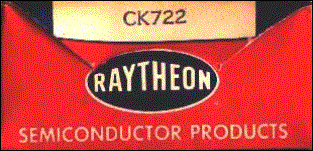
Raytheon: Raytheon started making vacuum tubes in 1922. During World War II, the company made magnetron tubes and radar systems. Raytheon started making germanium-based semiconductor diodes in the 1940s and, just months after BTL announced the development of the transistor in late 1947, started making its own point-contact transistors using germanium salvaged from Sylvania diodes. After attending the 1952 BTL transistor symposium and licensing the alloy junction transistor patents from GE, the company quickly started making germanium transistors including one of the most famous transistors of that generation, the CK722, which was simply a rejected commercial CK718 transistor with downgraded specs for the hobby market. (Jack Ward has created an entire museum around the Raytheon CK722 PNP transistor.) Raytheon exited the semiconductor business in 1962.
Here are all of our blog posts on the CK722:
https://soldersmoke.blogspot.com/search?q=CK722
Here is our post on Pete Juliano's CK722:
https://soldersmoke.blogspot.com/2015/03/pete-juliano-homebrwing-with.html
Sunday, May 15, 2022
"Dream It - Make It" -- Rich WB4TLM, Mrs. Filoramo, and C.F. Rockey W9SCH (aka The Rock)
Friday, January 21, 2022
"From Crystal Sets to Sideband" -- A Great Book about Homebrew Radio by Frank Harris K0IYE (FREE!)
I first came across the above picture of K0IYE's inspirational, completely homebrew station many years ago in the pages of "World Radio" magazine. I have already linked to Frank's book many times over the years, but it is so good that I regularly feel compelled to write about it again. Frank updates the book. Just check out the introduction to his website. Frank even has a Spanish language version of his book. All for free. Thank you Frank.
The introduction to Frank's web site:
Thursday, June 3, 2021
Remastered! The Secret Life of Radio -- With Updated Comments from Tim Hunkin
Friday, November 27, 2020
6EQUJ5 -- SNR, the Big Ear Radio Telescope, and the "Wow" Signal
This Hack-A-Day article explains the significance of 6EQUJ5 on the paper readout of the Big Ear radio telescope. It is a signal-to-noise readout.
The article also has interesting information about the radio telescope that was used.
I have on my shelf John Kraus W8JK's wonderful book "Big Ear Two -- Listening for Other Worlds." John Kraus is the guy who built the Big Ear. In a reminder of how new radio technology really is, Kraus got his start in radio as a ten year-old boy in 1920. He ripped the wire out of the ignition coil of a Model T Ford to make a tuning coil for a crystal radio. He took the earpiece out of the family telephone. His father gave him a chunk of Galena. He used the crystal radio to listen to the early broadcasts of WWJ in Detroit.
Friday, July 24, 2020
Radio Schenectady
A while back I posted a picture (see below) of the shortwave dial of an old receiver used by my wife's grandfather. I noted the odd presence of 'Schenectady" among the exotic foreign locations on the dial. Pete immediately connected the dots by noting that Schenectady was the home of General Electric. This week Chris Waldrup KD4PBJ sent us a great web site describing the shortwave stations in Schenectady. Check out the tube that runs 100 kw AM (Big Bertha).
https://www.radioworld.com/news-and-business/schenectady-shortwave-transmitters-1941
Chris also sent information about BIG AM broadcast band stations:
In addition to Schenectady being home to GE it is the city of license to clear channel AM 50 kW WGY 810. WGY was started by GE so if the radio was GE it was probably a way to promote their station at the time. I heard mention of Rochester too and that would be for 1180 WHAM another 50 kW clear. Both WGY and WHAM are still there going strong banging out their 50 kW.
And Pete reminded us of KDKA, describing its long-lasting impact on one of his ears:
Let us not forget KDKA in Pittsburgh at 1020 which I think is no longer clear channel. I used to listen to KDKA on my crystal set when I went to bed at night. My bed had an exposed bed-spring which was my antenna. To this day there is a slight kink in one of my ears where my Brush headphones rested –I am a side sleeper.
Saturday, June 17, 2017
SolderSmoke Podcast #197: Farhan, Fame, 'Fest, Testgear, SSB History, Dishal Dystopia, QRP CW, MAILBAG
| AI4OT and N2CQR |
![]() |
| N2CQR AND W2DAB |
Wednesday, June 7, 2017
The Leon Lambert Crystal Radio
There is not much to it. That nice dial is mechanically connected to a sweeper arm that runs along a big coil. The galena and cats whisker were apparently held in place by the Fahenstock clips on the front. Leon Lambert made these things in Witchita Kansas around 1924. He started making them without the fancy wooden box, but one report says he found a good source for the enclosures:
In 2004 Dale Davenport wrote:
Leon Lambert's crystal sets show up maybe as or more often than most other brands from that time period apparently, particularly in the Midwest, There are quite a few variations though: some have a little metal tag tacked on, usually on top front center, some do not have a tag at all. Detectors vary some as well and I've seen them with Erla fixed detectors. One thing is more or less constant it seems, and that is the little wooden boxes they are mounted in. I cannot verify the story other than from observations, but was told quite a number of years ago that the boxes the Lambert sets are mounted in were used to ship sticks of chalk, packed in saw dust, to schools. Lambert supposedly had a deal with someone with the local school system to acquire these as they were emptied. I have owned one example, and have seen other examples of these sets that show some pressure marks on the flat sides, near the corners, where they apparently were packed in bundles, and the strapping tape used to secure the bundles left an impression. This seems to indicate that the story might be true and they might be leftover marks from the box's days as a chalk shipping box.Has anyone else heard the story or can anyone else offer more details on this theory? From: http://www.antiqueradios.com/forums/viewtopic.php?t=36735
Here's a picture of the unboxed version -- you can see here where the galena went:
And here we see Leon himself:
Tuesday, June 6, 2017
The Philmore Fixed Crystal Detector
Sunday, May 29, 2016
Great "QSO Today" Interview with H.P. Friedrichs AC7ZL -- "My nature is to build."
I sat in the shack this morning with a cup of coffee, mesmerized by the things Pete was saying. I actually took notes. Some highlights:
-- In describing his zeal to avoid the use of store-bought components, Pete acknowledged that there are limits to this. But then he revealed that his limits are different than those of even the most fundamentalist of homebrew fundamentalists: "Well, I'm not going to mine my own copper." Don't worry Pete -- no one will call you an appliance operator if you use store bought wire.
-- On the same subject, when describing his homebrew diodes for crystal radios, Eric asked Pete why he didn't just go out and buy a Germanium Diode. "That would be cheating," replied Pete. Indeed.
-- "Obsolete technology often gets short shrift."
--"My nature is to build."
http://www.qsotoday.com/podcasts/ac7zl
Sunday, December 27, 2015
"Receiver Here is My SWR meter OM..."
Armed with a new elastic band for my Wrist-Rocket sling shot and some perfectly shaped lead sinkers, yesterday -- with the obvious cooperation of The Radio Gods -- I managed to get two ropes over some 70 foot trees. Soon -- with minimal gnashing of teeth -- I had 185 feet of wire in the air.
This morning I was messing around with L networks at the base of the antenna. I took a coffee break, leaving the 185 foot wire and the ground system connected to the coax. I had the transmitter off, so I was surprised to see the SWR meter jumping around a bit, up significantly from zero. What could that be? It wasn't coming from my station, so it had to be coming from some other transmitter. And the slight bit of jumping that I saw on the SWR meter had the familiar pattern of the human voice. Some radio sleuthing ensued.
I flipped the station antenna switch to the "bench" position, and connected my scope to the coax. Wow! I immediately saw a big strong AM signal with modulation, at about 5 or 6 volts peak to peak. The Rigol 'scope gave the frequency: 1220 kHz.
I tuned the HQ-100 to that frequency. As I listened to Gospel broadcast, I could follow the voice peaks on the 'scope.
Some Googling ID's the station: WFAX 1220 AM. 5 kilowatts in the daytime. 1.5 miles from my house. The vertical portion of the inverted L is obviously picking up a LOT of energy from the WFAX tower. And the horizontal portion of my antenna is broadside to the WFAX tower.
Of course this all made me think about throwing together a crystal radio, but then I realized I'd already listened to WFAX with simple diode -- the one in my SWR meter. That little SWR meter was acting like a crystal radio with a visual output!
Monday, December 21, 2015
The Secret Life of Machines -- The Radio (Video)
Thanks to Rick N3FJZ for sending this to us. In 25 minutes these fellows manage to capture and explain much of the "magic" of radio. Great shots of Marconi, and of Hertz's first rig. Amazing how they built their own spark transmitter and coherer receiver, launched a kite antenna and sent a signal across the harbor. Great stuff. Lots of history. We've met Mr. Wells before -- he was "jailed for having the Knack!"