First, you probably need to turn on closed captioning, and select autotranslate, probably to English. This video is worth it.
This fellow takes on the self-imposed challenge of homebrewing a 2 meter FM receiver. He builds it on a copper clad board, using what looks like dead-bug construction techniques.
He is not a radio amateur. But he should be one, just by virtue if his work on this receiver.
The board looks a lot like one of our projects. He even points out the large number of parts that have been removed from the board. You get the sense that he shares in our common frustration with circuits that for some unknown reason just won't work. I found myself worried that he might opt to remove ALL the parts from the board -- that is our homebrew nightmare.
Fortunately, he does not reach this extreme. He gets the thing to work. It is still not perfect. He will go back to it later. Good idea. Take break. Walk the dog or something. Insight will come.
It is really great and refreshing to have this kind of "warts and all" "blow by blow" description of a build projects. Too often the books present projects as if they worked the first time the builder put them together. This happens very infrequently -- the process described in this video is closer to the norm.
And it is great to have this project come to us from Germany. SolderSmoke is dedicated to INTERNATIONAL homebrew radio.
Wow, this is very cool. I don't have a 5 inch naval gun mount. And NASA has never called me for any reason. This is all almost too much. Watching it all, I feel an urge to go UHF.
Edwin Armstrong presenting the superregenerative receiver at the June 28, 1922 meeting of the Radio Club of America in Havemeyer Hall, Columbia University, New York. His prototype 3-tube receiver was as sensitive as conventional receivers with 9 tubes.
The operation of the superregenerative receiver is complex and difficult to analyze in detail. As noted by Thomas H. Lee, it "has never been understood by more than a handful of people at a given time."[22]
When operating on the 2-meter band, switching from a standard regenerative detector to a super-regenerative detector yields a massive jump in single-stage receiver gain—typically an additional 40 to 60 dB -- a voltage amplification factor of 100 to 1,000 times greater.
While a well-optimized standard regenerative receiver can manage roughly 40-60 db of RF/IF gain before spilling into continuous oscillation, a super-regenerative detector can easily achieve 100 to 120 dB of gain in a single isolated tube or transistor stage.
Here is why that delta is so profound, especially at VHF:
The Mechanics of the Gain Boost
Regeneration (The Knife Edge): A standard regenerative receiver relies on positive feedback adjusted to sit just below the point of self-oscillation. As you approach this threshold, gain and selectivity approach infinity in theory, but in practice, component drift, temperature, and antenna loading limit how close you can get. At 144 MHz staying on this knife-edge is notoriously difficult.
Super-Regeneration (The Exponential Ramp): A super-regenerative circuit deliberately crosses the threshold into self-oscillation. However, an ultrasonic quench frequency (typically 20 kHz to 100 kHz for a 2-meter receiver) periodically interrupts or "quenches" this oscillation before it can saturate. Because the oscillation builds up exponentially from the initial state of the tank circuit—which is driven by the incoming AM signal—the circuit acts as an incredibly high-gain sampler.
Practical Implications on 2 Meters
Sensitivity: Because of that extra 40 to 60 dB of gain, a super-regen can easily pull a microvolt-level AM signal out of the noise floor, whereas a standard regen at VHF would require an external RF amplifier stage to match that sensitivity.
Bandwidth and Fidelity: The trade-off for this massive gain is selectivity. Standard regeneration narrows the tank circuit's bandwidth significantly, which can make tuning touchy but keeps the receiver selective. Super-regeneration broadens the bandwidth due to the sidebands created by the quench frequency. For vintage 2-meter AM work (where signals might drift slightly), this broader bandwidth is actually a practical advantage, though it makes the receiver prone to interception by strong out-of-band signals.
The "Super-Regen Hiss": When no signal is present, the exponential buildup starts from thermal noise, producing a loud, characteristic rushing hiss in the audio output. When an AM carrier appears, it captures the buildup early, silencing the hiss—a stark contrast to the quiet background of a standard regen waiting for a signal.
HOW DOES SUPER-REGENERATION REALLY WORK?
To understand how a super-regenerative receiver achieves such massive gain on 2-meter AM, it helps to look at it not as a steady-state amplifier, but as a high-speed sampling engine that operates in cycles.
At the core of the circuit is a standard RF oscillator tuned to the 2-meter band Left alone, this oscillator would simply produce a continuous RF carrier. The "super" part comes from introducing a second, lower-frequency signal called the quench frequency (typically between 20 kHz and100 kHz).
Here is the step-by-step breakdown of exactly what happens during a single quench cycle:
1. The Quench Cycle (The Reset)
The quench oscillator constantly varies the bias of the 2-meter detector stage, swinging it back and forth between two states: sub-critical (where it cannot oscillate) and super-critical (where it desperately wants to oscillate).
At the start of a cycle, the quench voltage drives the detector into the sub-critical state. Any previous oscillations are completely wiped out. The circuit is wiped clean and made ready to sample the antenna.
2. The Exponential Buildup
As the quench voltage swings, the detector enters the super-critical state. RF energy begins to build up in the 144 MHz tank circuit. Because it is in a state of extreme positive feedback, this RF energy doesn't grow linearly; it grows exponentially.
However, an oscillator cannot start growing from absolute zero. It needs a "seed" to kick off the oscillation. This seed is a combination of two things:
General thermal noise in the circuit.
The incoming 2-meter AM radio signal from the antenna.
3. Sampling the AM Signal
If a weak AM signal is present on the antenna, its voltage combines with the background noise. Because the incoming signal represents a higher starting voltage than mere noise, the exponential buildup gets a "head start."
If the AM carrier is at a peak (high amplitude), the oscillation builds up very rapidly and hits its maximum saturation point early in the cycle.
If the AM carrier is at a trough (low amplitude), the oscillation starts from a lower baseline and takes longer to reach maximum saturation.
4. Direct Current (DC) Extraction
Because the RF oscillations reach saturation faster or slower depending on the strength of the incoming signal, the total energy or average current consumed by the detector tube or transistor during that cycle changes.
Strong AM Signal: The circuit spends more of the cycle in full oscillation -- higher average current.
Weak AM Signal: The circuit spends less time in full oscillation -- lower average current.
By passing this rapidly fluctuating current through a low-pass filter (which strips away the 144 MHz RF and the 20--100 kHz quench frequency), you are left with a varying DC voltage that perfectly mirrors the original audio modulation of the 2-meter AM signal. This is routed directly to an audio amplifier and your speaker.
Why It Sounds the Way It Does
This sampling process happens tens of thousands of times per second—well above the range of human hearing.
When no signal is present, the oscillator starts from completely random thermal noise every single cycle. Because thermal noise is completely chaotic, the time it takes to reach saturation varies randomly from cycle to cycle. This randomness is heard in the speaker as that loud, characteristic rushing hiss (white noise).
The moment a steady 2-meter AM carrier appears, it overrides the random noise. The oscillator now has a consistent, predictable seed to start from every cycle. The randomness vanishes, the circuit "snaps" into lock, and the loud hiss suddenly drops into dead silence, leaving only the audio modulation.
IF IT IS SO MUCH BETTER, WHEY DON'T WE USE SUPER-REGENERATION ON HF?
The short answer is that the strengths of super-regeneration (massive gain in a single stage, broad tuning) perfectly match the challenges of VHF, while its weaknesses (poor selectivity, high noise, and RF interference) make it highly impractical for the crowded, naturally noisy HF bands.
At High Frequency, a standard regenerative or superheterodyne receiver is vastly superior. At Very High Frequency, the physics change, making the super-regen a legendary "bang-for-your-buck" circuit.
Here is a breakdown of why this divide exists:
1. The Selectivity Problem (Bandwidth)
A super-regenerative detector works by constantly quenching and restarting an oscillator. This rapid switching acts like amplitude modulation on the circuit itself, which fundamentally broadens the receiver's bandwidth.
At VHF (e.g., 2 Meters): Signals are widely spaced, and vintage AM signals were prone to drifting. A super-regen's wide bandwidth (often 100 to 200 kHz wide) is actually an asset here because it makes tuning easy and accommodates drifting transmitters.
At HF (e.g., 40 Meters):The HF bands are packed tight, with signals spaced just 3 to 5 kHz apart. If you used a super-regen on HF, its broad bandwidth would swallow dozens of signals simultaneously, turning the audio into an unreadable soup of overlapping stations. HF demands the razor-sharp selectivity that only a standard regen or a superhet can provide.
2. The External Noise Floor vs. Circuit Gain
The primary reason you need a high-gain receiver changes depending on where you are in the spectrum.
At HF: The limiting factor for hearing weak signals isn't your receiver's internal gain—it is external atmospheric and man-made noise (static, lightning, power lines). Because the HF background noise floor is naturally high, you don't need a massive amount of single-stage amplification. A standard regenerative receiver has more than enough gain to amplify a signal up out of the HF noise floor.
At VHF: Cosmic and atmospheric noise drop off sharply at VHF. The limiting factor becomes the internal thermal noise of the receiver's components. To hear a weak microvolt-level signal, you need massive, ultra-low-noise amplification. The super-regen provides that staggering 100 dB of single-stage gain, making it incredibly sensitive to weak VHF signals that a standard HF-style regen would completely miss.
3. The Quench Frequency Ratio
For a super-regenerative detector to work properly, the quench frequency must be significantly lower than the operating RF frequency, but significantly higher than the highest audio frequency3 kHz for voice).
Ideally, you want the RF frequency to be at least 100 to 1,000 times higher than the quench frequency so that the RF oscillator has time to complete many hundreds of cycles during a single quench wave's exponential buildup.
At VHF: A quench frequency of 50 kHz fits perfectly. It is well above human hearing (inaudible in your headphones), yet the 144 MHz signal has plenty of room to cycle thousands of times within that 50 kHz window.
At lower HF (3.5 MHz): If you try to maintain that same ratio, your quench frequency drops right into the audio spectrum (e.g., 5 to10 kHz). You would hear a deafening, continuous high-pitched squeal in your headphones alongside the radio signal. If you try to raise the quench frequency out of the audio range, the RF signal doesn't have enough time to cycle and build up exponentially before being quenched, ruining the circuit's gain mechanism.
4. Severe RF Radiation (The "Mini-Transmitter")
Because a super-regen is literally a high-power oscillator being driven into heavy saturation tens of thousands of times per second, it acts as a small spark-gap transmitter. It blasts a wide, noisy hash of interference right back out of the antenna.
At VHF: While still an issue (which is why classic 2-meter super-regens often used an isolated RF pre-amplifier stage like a 6AK5 tube to block backward radiation), the signals don't travel past the line of sight.
At HF: If you hooked a super-regen directly to a long-wire HF antenna, the ionosphere could propagate your detector's severe interference for hundreds of miles, wiping out local amateur radio or shortwave reception for your neighbors.
Hack-a-Day had a link to this film. It is really good. There is some stuff about radio, and especially the S-Phone system. But the bigger message of the film is the danger faced by the heroic teams who parachuted into occupied France. As shown in the film, many of these people were young women who risked it all in the most dangerous of airborne operations. It is a reminder of how ridiculous the focus on masculine valor in airborne and special operations really is. Three cheers for the SOE. For all of them.
It is about 100 miles across the Mona Channel. That is a longshot on 2 meters, but I got the idea when, this past summer, I regularly heard WIDI 99.5 FM in the Dominican Republic from western Puerto Rico. So over the fall I gathered 2 meter gear, and got a directional antenna and sent all of this gear to the DR.
Here is the antenna. Seven elements. I got it through Amazon. It came kind of incomplete and without any written or on-line instructions. AI told me to do exactly the WRONG thing with what they assumed was a reflector. Fortunately I ran into this YouTube video and learned that it was in fact a "ZL Special" antenna, and that it has, in fact, TWO driven elements. It was through that video that I learned how to assemble this thing.
My "station" consists of a Heathkit HM-2109. It is a VHF wattmeter/SWR meter that I bought by mistake. But I kept it, and it proved very useful in this 2 meter Mona Channel project. There is a Baofeng UV-5R (boo! hiss!) and a Yaesu FT-470 that KD4EBM gave me. I have a Communication Concepts 2 meter amplifier -- I must have picked this up at a hamfest. It promises 35 watts with 5 watts of drive. The old CCI amp gives the rig good juju.
This morning I wrote to the hams of western Puerto Rico:
Invest 94L moved arcoss the Mona Passage yesterday, lowering temperatures, bringing lots of rain and relatively high winds to the area. I happened to check on reception in the DR of WIDI 99.5 FM (near Mayaguez, Puerto Rico), and was surprised to find that the signal had weakened considerably. This morning, after the storm passed, signal levels were back to their normal full quieting. This would support the idea that tropospheric ducting is playing a big role in bringing this signal into the Dominican Republic. I had been surprised by the persistence of the signal -- for weeks it had been full quieting here. I thought that perhaps I was just receiving it directly, line-of-sight, without the benefit of tropo ducting. But Invest 94L has made me question this idea.
I asked Google Gemini AI about the persistence of tropospheric ducting on FM broadcast signals in the tropics. Here is what it said:
AI Overview
In the tropics, tropospheric ducting is a frequent, persistent, and often strong phenomenon, especially over and around large bodies of water. Unlike mid-latitudes where ducting is a seasonal event, the meteorological conditions in the tropics are favorable year-round. Why ducting is persistent in the tropicsHigh temperatures and humidity: Tropical climates are characterized by consistently high temperatures and abundant moisture. These conditions are the primary drivers of atmospheric ducting.
Temperature inversions: Stable high-pressure systems common in the tropics can create temperature inversions, where a layer of warm, moist air sits above cooler air. The sharp change in temperature and humidity with altitude creates the "duct" that traps and bends radio waves over long distances.
Dominance of water paths: Large tropical ocean regions are ideal for ducting. A common ducting phenomenon called the "evaporation duct" is ever-present over the sea surface due to a sharp humidity gradient and is particularly effective for trapping frequencies above 3 GHz. While the FM broadcast band (87.5–108 MHz) is at a lower frequency, coastal areas and islands frequently experience ducting over sea paths.
Atmospheric stability: The general stability of high-pressure systems in the tropics allows ducting conditions to persist for many months at a time. This is observed in areas like the Caribbean and the Persian Gulf, where long-distance radio reception is a common occurrence.
Impact on the FM broadcast band (VHF Band II)Favorable frequencies: The FM broadcast band (VHF Band II) is particularly susceptible to tropospheric ducting. While ducting can occur across a range of frequencies, signals above 90 MHz generally propagate more favorably during ducting events than lower frequencies.
Signal interference: The most noticeable effect of this regular ducting is co-channel interference, where distant stations can override local ones. During an event, a listener may pick up two different stations on the same frequency, or experience temporary loss of reception from a nearby transmitter.
Extended reception: For radio hobbyists, this high frequency of ducting means that signals from FM stations hundreds or even thousands of kilometers away can be received clearly.
Diurnal cycle: Ducting events in the tropics often peak during the evening and overnight hours when surface cooling creates a stable nocturnal boundary layer. Conditions may "burn off" after sunrise, but ducting is common throughout the day during periods of stable weather.
In summary, the specific meteorological and geographical conditions found in tropical regions—consistent heat, humidity, and the presence of large bodies of water—make persistent tropospheric ducting on the FM broadcast band not just possible, but highly probable throughout the year.
WIDI 99.5 FM from western Puerto Rico continues to put a full quieting signal into the eastern Dominican Republic. The station is so regularly strong that this made me wonder if I am really using tropospheric ducting to hear it. If I was using tropo ducting, I think there should be some variation in signal strength over the course of 24 hours right? But it is always strong. Why?
I checked the distance: 97 miles. With its antenna at 2800 feet, its visual horizon will be 64.8 miles away. I am about 98 feet above the ocean. This means my horizon is 12.22 miles away. There appears to be a gap, right? I mean 64.8 + 12.22 = 77.02 miles. So it looks like there is a gap of about 20 miles.
But wait! Mike WN2A reminded me that there is a difference between radio line of sight and visual line of sight. Radio line of sight = 4/3 of visual line of sight.
AI explains where the 4/3 factor comes from:
The radio horizon appears longer than the visual horizon by a factor of about 4/3 due to atmospheric refraction, which bends radio waves slightly downward. To simplify calculations, this effect is modeled by treating radio waves as if they travel in a straight line over a larger, "effective" Earth with a radius 4/3 times the actual radius. This increased effective radius allows radio waves to "see" further over the Earth's curvature, extending the line-of-sight range compared to what is seen by the human eye, which is not affected by atmospheric bending to the same degree.
So that puts WIDI's radio horizon at 86.4 miles. My radio horizon is 16.16 miles. 86.4 + 16.16 = 102.56 miles No gap. We should be able to hear WIDI, even without tropospheric ducting.
Our friend Todd K7TFC in Portland found this in the 1950 ARRL Handbook at an, uh, opportune moment. TRGHS. This seems to describe what a I am hearing, especially that "airmass boundary" in the lower left of the diagram above.
I'm not a VHF guy, and I am a bit surprised at the persistence of this propagation path. It is 4:30 am here and the adult contemporary rock from Puerto Rico (Kokomo by the Beach Boys!) is full quieting here in the Dominican Republic. And it is of the same strength during daylight hours. I don't remember this from the winter months, but I may have just missed it.
One other factor to consider: The island of Mona is about halfway across the path. There are few people there, and there is almost certainly not a repeater of any kind. But there may be a metal tower or two...
Gianfranco IU1DZZ and Mike WN2A both support the tropo hypothesis. Mike mentions the Hepburn Index. I will have to read up on that. Hamilton is also looking at this propagation path. Thanks guys.
WIDI 99.5 FM. Booming in during daylight here on the eastern tip of the Dominican Republic. Their antenna is about 2100 feet above average surrounding terrain. That would put the horizon at about 56 miles. But the path is about 100 miles. What do you folks think is the likely propagation mode?
He has nice picture of the antenna. The plaque has the interesting info:
The plaque on display reads as follows...
"36.9 Megahertz Helix Antenna Doppler Velocity and Position (DOVAP)
Reference Transmitter Antenna
Developed during World War II by the Germans as part of a V-2 guidance and control system, DOVAP traced the course of a rocket using the Doppler Effect caused by a target moving relative to a ground transmitter and receiving stations.
Unlike radar, Dovap did not allow scientists to "see" the rocket on a screen. Instead, it sent up radio waves, which were received and rebroadcast back to earth by the rocket. The returned waves combined with the original ground broadcast and produced a musical tone which varied with the rocket's speed - the faster the rocket, the higher the pitch.
DOVAP data was extremely accurate: it could place a rocket's position at 100 miles up within 50 feet. It could collect data at the extreme altitudes of 100 to 300 miles. Dovap's disadvantage was that it took 3 to 4 weeks to reduce the data.
The antenna is a helix because of its physical and electronic characteristics. A helix is simple to construct and operate, provides necessary signal gain and directivity, and can be operated in several modes or polarizations.
The DOVAP system provided trajectory data and ground guidance for most of the early rocket systems: Corporal, Sergeant, Honest John, Little John, Redstone, and Aerobee Upper Atmosphere programs.
This particular antenna was built in the mid-1960s near C Station. Like much of the early instrumentation used here, it was designed and built at White Sands Missile Range.
Erected by White Sands Missile Range Museum. (Marker Number 06.099.)"
Thanks to Roy WN3F for alerting me to this. Tadashi-san has really built some beautiful stuff. Especially impressive to me is his use of the spectrum analyser and two-tone audio tests to look at IMD of the entire transceiver. See video above. FB OM.
It was great that Bob was able to catch up with Farhan and talk to him about his VHF rig and about the sBITX.
Farhan said that the VHF rig (the BITX23) was presented at the homebrew show-and-tell as a project. The idea was to encourage others to get into VHF homebrewing. Farhan points out that many of us are reluctant to go into VHF building, thinking that we need special or exotic test gear. No true says Farhan. He is trying, with this rig, to bust this myth. FB.
On the sBITX, Farhan points out that he too -- coming as he does from the homebrew tradition -- finds some of the modern rigs quite intimidating. So he designed the sBITX to be less intimidating. It is, he says, a tinkerable rig that could be homebrewed. It is all open source.
Farhan points out that the rig is built around the Raspberry Pi 4, a device that has recently been hard to obtain. This has driven up the price of the sBITX a bit. But good news: Farhan says that the word on the street is that the Raspberry Pi 4 will be available in quantity starting at the end of June.
Having recently been involved in an effort to teach students about radio electronics, I found Rick's comments especially interesting.
At FDIM, he and his daughter were presenting a hidden transmitter hunt using rigs and Yagis at 432 MHz. This was in part the result of his students having wanted to do something new with ham radio. It was very impressive that the students had done this all with gear that they had built themselves. Rick also made sure that they all learned how to solder.
Rick ended the interview with a nice shout-out to SolderSmoke.
On May 16, 2023 Farhan gave us a look at his new BITX23 2 Meter Transceiver. Two days later he made a presentation on this rig at the Four Days in May event.
Highlights:
-- Use (and non-use) of the Cascade tool
-- Cascade and the original BITXs
-- ADE-1
-- SI570
-- Raspberry Pico
-- Diplexer
-- Different Grounds to get rid of digital noise
-- Gimmick Capacitors (and gimmicks made from coax)
-- Ugly SMD Capacitor Soldering
-- Tombstoning!
-- Melting RG-174 Coax
-- No need to learn Arduino programming
-- Dilbert!
-- Bill and Pete -- Techie Tatts!
Thanks Farhan!
Thanks to Rogier PA1ZZ for alerting me to this video and to the PA3CRX YouTube channel.
I like what Chrix did with the old CB transceiver case -- this gives me ideas about the old transceiver that I picked up at a hamfest a while back. I also like Chrix's practice of running coax and power leads UNDER the main BITX boards.
Chrix has been building some great stuff and making some very nice videos -- I have put his channel on the SolderSmoke links in the right-side column of this page.
(Why the T/R diodes in the BITX 20 amplifiers?) National Receiver.
Bill's Bench Farhan's Talk to RSGB got me thinking of VHF 2 meter AM. 2 meter Benton Harbor lunchbox madness. SuperRegens Super Strange. I broke my Maplin AF Sig Gen in the process. Fixed it. Playing with MMMRX again. Put in 6 kHz ceramic filter. Sounds great SSB and AM. Swept IF with noise, TinySA, and NanoVNA. Need better noise gen. Mod to listen with TinySA (on blog). Thinking of 17 meter /12 meter Dual-Bander IF around 21.4, VFO around 3.41 Mhz. Thoughts? Sweeping double half lattice filter from Swan 240. UGLY.
MAILBAG: --- ROOTS OF MAILBAG: Radio Moscow, Havana Cuba, HCJB, others. -- Thomas K4SWL of the SWL Post: Could have been worse! Stairbag?
-- MY NOVICE LOG -- Heard back from ex-WN2RTH ex-WN2FLK ex-WB2RKK. -- Drew N7DA worked Wes W7ZOI in Sweepstakes. FB. -- Peter VK2EMU The movie Frequency and the Magic of Heathkits. Good, but not that good! -- Thomas KK6AHT! Our old friend. Minima! Now has a young son! FB -- Chuck WA7ZZE Saw QST profile. Sympathizes with Two-er trouble. -- Tim M0CZP. Spell corrector. Vatican Diodes. Infallible! -- Ramakrishnan VU3RDD Working on a NORCAL and a noise cancellation arrangement. -- Skip NC9O said I was 40 Hz off on 17. But he had a reason to KNOW! -- Steve K9NVD Glad he's a listener. -- Bob KY3R Novice Nostalgia. Should he use 75 watt bulb for dummy load? Yes! -- Todd K7TFC Video about why solder smoke goes into the face. -- Anthony VU3JVX Homebrew Antuino. I ask for help in moving freq to 450 kHz. -- Jack NG2E Building Pete's DC RX. -- Scott WA9WFA HBR-13 and MMMRX. -- Stephen 2E0FXZ also got a FT-101 VFO. -- Bob K7ZB on the air with 56 mW and a big antenna. -- Dean AC9JQ Retired. -- Allan WA9IRS Right to Repair update. -- Farhan Invited us to Lamakaan ARC, Dec 11 or 12. Will be on QO100 Satellite Live!
-- Many suggestions about my Apollo 11 Time Capsule. Still looking for ideas.
Happy Thanksgiving to all who celebrate this holiday!
This morning Eric Guth has a really interesting interview on his QSO Today podcast.
Courtney Duncan N5BF had a full career at JPL and is the current president of the San Bernardino Microwave Society. There is a lot of interesting stuff in this interview, much of it about space exploration. Courtney tells us about how experience with re-purposing radio gear came in handy at JPL. For example, the helicopter that they have been flying on Mars has a very cheap and light off-the-shelf Zigbee transceiver. He also talks about the origins of the Cube Sats.
Here is Eric's page on this interview, with useful show notes:
The presentation starts at about the 4 minute point.
I think if I were only allowed to watch one YouTube video in the next year, I'd make it this one.
In this amazing RSGB video, Ashhar Farhan VU2ESE takes us back to his earliest days as a radio amateur. He tells us about his very early desire to build radios, his early projects, and his personal evolution as a designer and builder, from a simple DC receiver, to the BITX, the Minima, the uBITX and now the hybrid HDR/SDR sBITX.
There is a lot of homebrew wisdom and tribal knowledge in this video. And we learn so many hitherto unknown details about the rigs that have become so important to us:
-- Farhan had the EMRFD book with him on the famous flight from Sweden to India during which the BITX was designed.
-- We learn about the origins of the BITX oscillator circuits, and that the VFO and BFO are essentially the same.
-- I was really pleased that Farhan included a picture of my HB BITX17 rig in his presentation.
-- Farhan discusses the difficulties he faced in obtaining needed parts in India.
-- We actually see the nylon washers that Farhan used in the original BITX.
-- Farhan discusses his early system for measuring coil inductance.
-- In addition the huge contribution of EMRFD, Farhan talks about how he was helped by Pat Hawker G3VA's writing, and the ARRL's SSB Handbook.
-- Farhkan talks about his Tex 465 'scope and his building of a Spectrum Analyzer.
-- We see his evolution to dual conversion. We see the conceptual birth of the Minima and the birth (thanks Wes!) of the TIA amps. I didn't know about the HF-1. Then Farhan designed the uBITX and now the sBITX.
-- Farhan talks about his practice of taking the pictures of new rigs with the new rig sitting atop the book that was most important in its design and construction. FB.
-- I was really blown away by Farhan's presentation of how the uBITX advertisement was inspired by and in many ways based on the Heathkit ad for an HW-101. Amazing.
-- I learned a lot from Farhan's discussion of SDR theory. I pledge to spend more time with this. I really like Farhan's hybrid HDR/SDR approach.
-- But I have a question: Farhan seems to say that we'd need a big expensive GOOGL computer to do the direct sampling HF SDR. But doesn't the little RTL-SDR do just that? Without a GOOGL?
-- Great to see Wes's AFTIA being used in the sBITX.
-- Really cool that Farhan has his mind on VHF transverters when designing the sBITX. I liked use of the TCXO module to free up one of the Si5351 clock outputs. FB. And great to include an idea from Hans in this rig.
Thanks very much to Farhan (who stayed up until 3 am to do this!) and to the RSGB for hosting.
Farhan VU2ESE is largely responsible for this. He has recently been talking about VHF. (More about this in due course.). This started me thinking about my failed effort in London to get on 2 meter AM. My plan was to use the transmit portion of this HW-30 (above) with a 2-to-10 downconverter and my trusty Drake 2-B for receive.
Tony G4WIF also bears some responsibility: When I expressed interest in Farhan's VHF work, Tony sent me two articles from SPRAT. Both of them were about super-regenerative receivers.
Farhan's comments caused me to pull the HW-30 out of storage. I started poking around the transmitter. But then I noticed something: On receive, the AF amplifier was obviously working. Then, when I tuned through the 2 meter band, the rest of the receiver seemed to be working too. I fired up the HP-8640B sig gen on 2 meters and turned on the AM modulation. Indeed, the old receiver was inhaling!
This launched me into an effort to understand how super-regenerative receivers work. There are a lot of really weak explanations out there. You get the distinct impression that the person explaining the circuit does not understand it himself. This makes explaining it very difficult. I am not the only one to notice this phenomenon: Mike WU2D commented on this in one of his excellent super-regen videos. This one:
Mike very kindly said the operation of this circuit seems like "magic." I was thinking more in terms of Voodoo.
Howard Armstrong discovered super-regeneration years after he invented plain old regeneration. The new discovery came around 1921.
It looks like VHF guru Frank Jones had very early misgivings about super-regeneration. In his 1934 classic 5 Meter Radio Telephony, Jones seems unenthusiastic about the circuit and about our ability to understand it: "To explain, simply, exactly how this form of detection takes place is not a simple matter, but some of its characteristics are easy to visualize." In this book, Jones goes on to predict that super-regens will be superseded (!) by superhets. Indeed, in his 1961 book VHF for the Radio Amateur there are no super-regen circuits; all the receive systems are down-converters to HF receivers.
Still, with that HW-30 hissing away right next to me, I feel I need to understand how the super-regen works. I'm not there yet, but I'm trying. Here are some good resources:
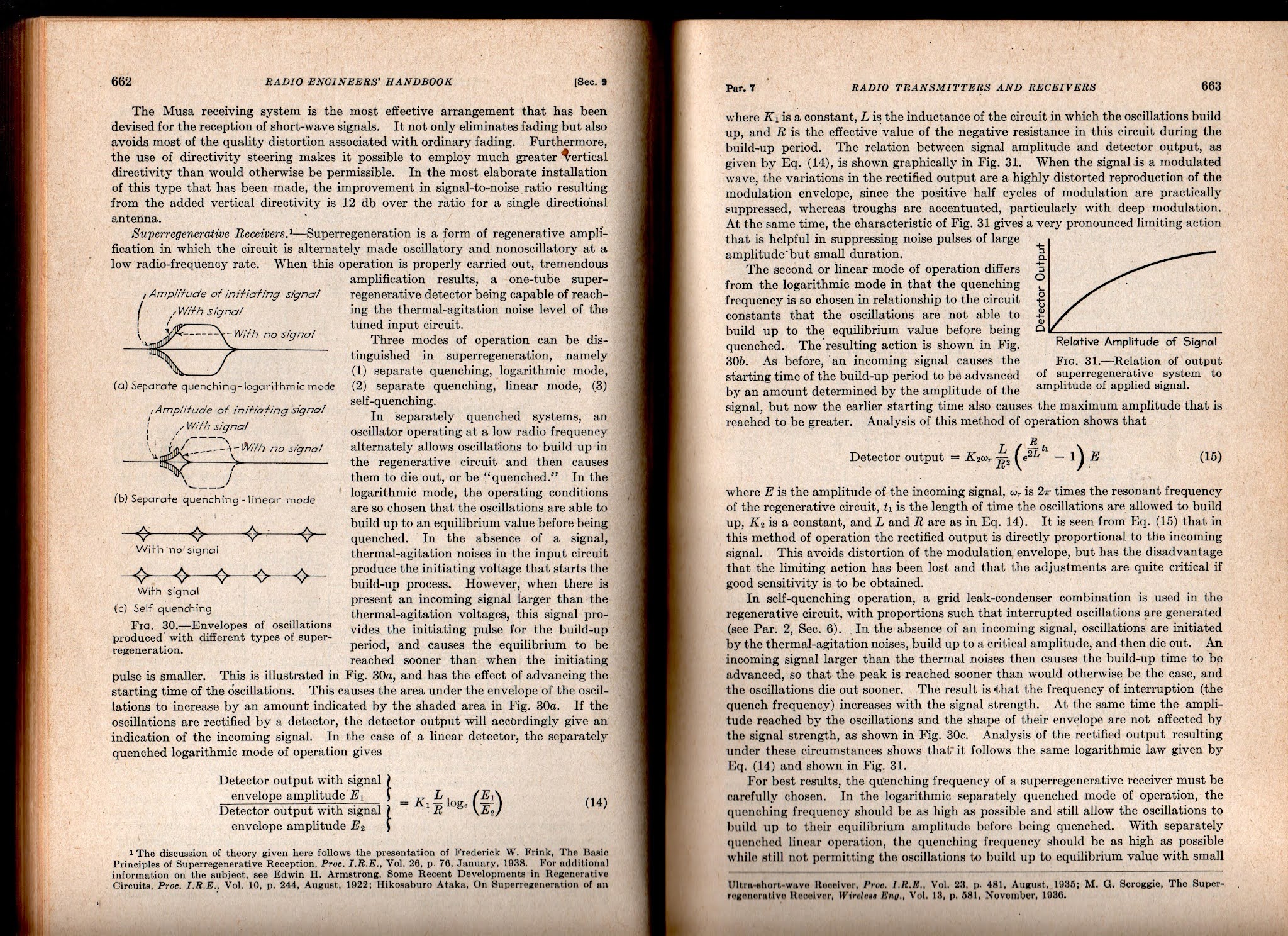
But the best so far (for me) is from Frederick Terman (one of the founders of Silicon Valley) in his 1943 classic Radio Engineer's Handbook. Click on the images for a clearer view.
I will definitely try to get the HW-30's 5 watt AM transmitter going. I am not so sure I'll do anything with the receiver. I think this is a matter of picking your battles and "finding joy." I didn't find joy in FT-8, so I stopped working with it. Same with my HA-600A, DX-40 Novice rig. Same with CW in general. And the same with SDR. I suspect that super-regen receivers may also fall into this category. I mean, let's face it, if you are not fond of ordinary regens, is there any real chance that you will like SUPER-regens? Even Frank Jones seems to have disliked them. And there is a reason Howard Armstrong moved on to superhets -- they are better! But still, that receiver is hissing away at me... Stay tuned.