Pete's Simpleceiver is a thing of beauty. And it is done. And people are already building it: Jim WA7HRG has one in the works. Go to Pete's blog for more details, pictures, videos, LTSpice simulations etc. http://n6qw.blogspot.com/ Congrats Pete!
Serving the worldwide community of radio-electronic homebrewers. Providing blog support to the SolderSmoke podcast: http://soldersmoke.com
Podcasting since 2005! Listen to our latest pocast here:
Podcasting since 2005! Listen to Latest SolderSmoke
Tuesday, December 1, 2015
Sunday, November 29, 2015
A Very Unusual Explanation of AM and SSB -- What Do You Think?
Wow, I've never seen it presented this way. Am I losing it or is this just completely wrong? This comes from this web site:
http://www.dsprelated.com/showarticle/176.php
TRANSMITTED SSB SIGNALS
Before we illustrate SSB demodulation, it's useful to quickly review the nature of standard double-sideband amplitude modulation (AM) commercial broadcast transmissions that your car radio is designed to receive. In standard AM communication systems, an analog real-valued baseband input signal may have a spectral magnitude, for example, like that shown in Figure 2(a). Such a signal might well be a 4 kHz-wide audio output of a microphone having no spectral energy at DC (zero Hz). This baseband audio signal is multiplied, in the time domain, by a pure-tone carrier to generate what's called the modulated signal whose spectral magnitude content is given in Figure 2(b).
In this example the carrier frequency is 80 kHz, thus the transmitted AM signal contains pure-tone carrier spectral energy at ±80 kHz. The purpose of a remote AM receiver, then, is to demodulate that transmitted DSB AM signal and generate the baseband signal given in Figure 2(c). The analog demodulated audio signal could then be amplified and routed to a loudspeaker. We note at this point that the two transmitted sidebands, on either side of ±80 kHz, each contain the same audio information.

http://www.dsprelated.com/showarticle/176.php
TRANSMITTED SSB SIGNALS
Before we illustrate SSB demodulation, it's useful to quickly review the nature of standard double-sideband amplitude modulation (AM) commercial broadcast transmissions that your car radio is designed to receive. In standard AM communication systems, an analog real-valued baseband input signal may have a spectral magnitude, for example, like that shown in Figure 2(a). Such a signal might well be a 4 kHz-wide audio output of a microphone having no spectral energy at DC (zero Hz). This baseband audio signal is multiplied, in the time domain, by a pure-tone carrier to generate what's called the modulated signal whose spectral magnitude content is given in Figure 2(b).
In this example the carrier frequency is 80 kHz, thus the transmitted AM signal contains pure-tone carrier spectral energy at ±80 kHz. The purpose of a remote AM receiver, then, is to demodulate that transmitted DSB AM signal and generate the baseband signal given in Figure 2(c). The analog demodulated audio signal could then be amplified and routed to a loudspeaker. We note at this point that the two transmitted sidebands, on either side of ±80 kHz, each contain the same audio information.
In an SSB communication system the baseband audio signal modulates a carrier, in what's called the "upper sideband" (USB) mode of transmission, such that the transmitted analog signal would have the spectrum shown in Figure 3(b). Notice in this scenario, the lower (upper) frequency edge of the baseband signal’s USB (LSB) has been translated in frequency so that it’s located at 80 kHz (-80 kHz). (The phasing method of SSB radio frequency (RF) generation is given in Appendix A.)
The purpose of a remote SSB receiver is to demodulate that transmitted SSB signal, generating the baseband audio signal given in Figure 3(c). The analog demodulated baseband signal can then be amplified and drive a loudspeaker.
In a "lower sideband" (LSB) mode of SSB transmission, the transmitted analog signal would have the spectrum shown in Figure 4(b). In this case, the upper (lower) frequency edge of the baseband signal’s LSB (USB) has been translated in frequency so that it’s located at 80 kHz (-80 kHz). The baseband signal in Figure 4(a) is real-valued, so the positive-frequency portion of its spectrum is the complex conjugate of the negative-frequency portion. Both sidebands contain the same information, and that's why LSB transmission and USB transmission communicate identical information.
And again, in the LSB mode of transmission, the remote receiver must demodulate that transmitted LSB SSB signal and generate the baseband audio signal given in Figure 4(c).
More on Light Beam Telephony
Hi Bill,
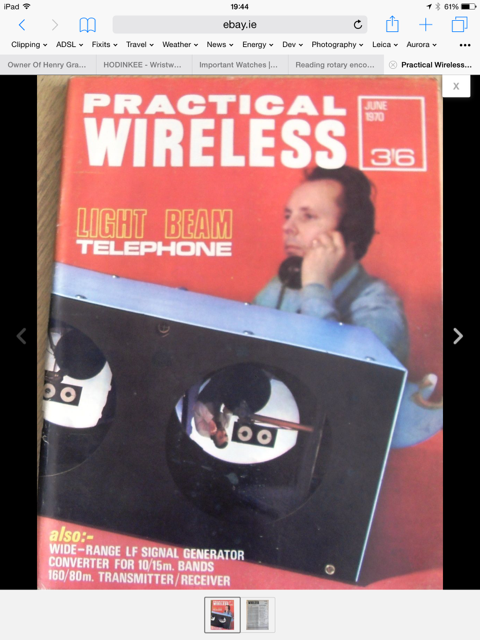
Reading about the Photophone and modulating the Sun experiments by G3ZPF reminded me of my own schooldays when as a final year physics project I think in 1970, I and another pupil built a light modulated telephone based on a design published in Practical Wireless of June 1970 by J. Thornton Lawrence. For the optical system it used a pair of spherical mirrors from old projection televisions. The detector was the expensive (for a school kid) OCP71 photo transistor, though we did also try ordinary less expensive OC71 transistors with the black paint scraped off with less success.
As David G3ZPF noted the problem with filament bulbs was the thermal inertia, and as I found it was also possible for the filament to mechanically resonate in the wooden box and start to howl. As we had never heard of, nor could have afforded an LED, we tried a Neon bulb run from an HT battery and modulated with a transformer in series with it. I recall coupling up a broadcast radio as the audio source playing "My Sweet Lord" by George Harrison and receiving it at the other end of the physics corridor very loud and clear on the audio amplifier on our light telephone receiver, much to the consternation and annoyance of the other teachers in the adjacent classrooms.
I found my black and white photo of the light telephone gear, complete with carbon telephone microphone that we used. It did work a fairly good distance in daylight outside across the school playground, not just the couple of feet shown. Also attached are photos of the original magazine cover and index, but regrettably not the article itself.
This was all before I got my ham ticket, but I already was a SWL and had been exposed to a wonderful ham, Tom GM3OWI (Oh Wild Indians) who visited the school and demonstrated all sorts of neat stuff like lighting a bulb from the output of a transmitter, and also voice modulating a klystron 3cm transmitter that the school had for doing electromagnetic radiation experiments, like polarisation, reflection etc.
Come to think of it, we got to play with a lot of stuff at school in those days which would never be allowed now, mercury, radioactive sources, alpha, beta and gamma, X-Ray and UV. The museum in Edinburgh also had a science area with similar stuff you could play with, and get great shocks from the Van der Graff generator if you put your hand on the glass cabinet and touched the adjacent metal radiator!
Happy days!
73 David Anderson GM4JJJ
Saturday, November 28, 2015
Photophone! Modulating the Sun by G3ZPF (and Alexander Graham Bell, and Mr. A.C. Brown of London)

Yesterday David G3ZPF sent us another very interesting e-mail, this one about some very creative sunlight communication experimenting that he and his brother did many years ago. It appears to me that David -- on his own -- came up with a version of Alexander Graham Bell's Photophone (pictured above).
Wikipedia says that Bell's invention was the first ever wireless telephony device. Bell credited Mr. A.C. Brown of London for the first demonstration of speech transmission by light (in 1878).
Here is the Wikipedia article: https://en.wikipedia.org/wiki/Photophone
I think young David's placement of the small mirror on the cone of the AF amplifier's loudspeaker was brilliant!
Hello again Bill,
Just (literally) finished the book and a couple of surprises awaited me in the final chapters
SSDRA = $200 on Ebay
My flabber has never been so ghasted....and I have a lot of flabber. I will treat my copy with even more reverence now. Srtangely I hadn't heard about EMRFD so I'll need to look into that
Modulating light
Your story about using a laser pen in a receiver reminded me of my method of modulating light which I've never seen anyone else mention.
In the mid 60's my brother had an electronics constructor set for his birthday. After the initial fascination I probably played with it more than him. I remember reading about modulated light transmitters and (because this was before I was anywhere near getting a licence) I decided to build one. My brother was sufficiently curious to help.
We started with the receiver. I purchased an OCP71 and managed to find an old 12" headlight reflector from somewhere. The cork from a wine bottle fitted nicely into the hole at the centre, and the cork was easily drilled out to accommodate the photo-transistor.
My brother constructed the "high gain audio amplifier" project from his constructor kit and we put two legs of the photo transistor across the mic input. We were rewarded by a buzzing sound so loud our parents yelled at us from the other room. It took us a few seconds to realise we were 'receiving' the 50Hz signal off the ceiling light (the house lights were on). Waving the headlight reflector around confirmed this. I still recall the excitement we felt at our 'discovery'.
So far, so ordinary, but the TX side is where I wandered off into the outfield. Normally people modulated an incandescent bulb but this required a many watts of audio power & the 'inertia' of the filament could be a problem.
I cannot remember what prompted me to do this, but next day I pulled the speaker grill off my tiny little medium wave transistor radio and glued a small mirror (from my mothers old 'compact') to the cone of the loudspeaker.
Then we went outside into a field near our house. My brother went to the far end and I set up the lil radio on a camping stool. Moving it around until the sunlight reflected off the mirror hit the headlight reflector about 200 yards away.
Then I turned on the radio. Instantly my brother started jumping up and down excitedly. It worked. My 200mW AF amp was modulating the *SUN* !
All those guys on 160m with their 10w of AM...pah. I had GIGAwatts of power under my control :-)
Looking from the receive end it was possible to see the light from the mirror flickering & I guess the movement of the speaker cone did not move the mirror exactly in the plane of the reflected beam. The 'wobble' fooled the phototransistor into seeing an amplitude modulated beam.
The beauty of this was that only a tiny audio amp was needed. This made me wonder about such a system being used in undeveloped countries (ones with more sunshine) as a comms system, with batteries recharged by the sun.
For the UK I thought about using a slide projector to provide the illumination, instead of the sun. Again a very low power audio amp was all that was needed, and there were no 'inertia' issues to worry about it.
But I was soon to suffer a setback. A few days later the headlamp reflector, sitting on a desk in my bedroom, managed to find itself in a position to focus the suns rays onto the cork holding the photo-transistor. Cooking the transistor & setting fire to the cork. Luckily my mother smelt the burning cork before any collateral damage was caused but I had a face-chewing when I came home from school.
I'd long since forgotten about all this until reading the later chapters of your book.
regards
Just (literally) finished the book and a couple of surprises awaited me in the final chapters
SSDRA = $200 on Ebay
My flabber has never been so ghasted....and I have a lot of flabber. I will treat my copy with even more reverence now. Srtangely I hadn't heard about EMRFD so I'll need to look into that
Modulating light
Your story about using a laser pen in a receiver reminded me of my method of modulating light which I've never seen anyone else mention.
In the mid 60's my brother had an electronics constructor set for his birthday. After the initial fascination I probably played with it more than him. I remember reading about modulated light transmitters and (because this was before I was anywhere near getting a licence) I decided to build one. My brother was sufficiently curious to help.
We started with the receiver. I purchased an OCP71 and managed to find an old 12" headlight reflector from somewhere. The cork from a wine bottle fitted nicely into the hole at the centre, and the cork was easily drilled out to accommodate the photo-transistor.
My brother constructed the "high gain audio amplifier" project from his constructor kit and we put two legs of the photo transistor across the mic input. We were rewarded by a buzzing sound so loud our parents yelled at us from the other room. It took us a few seconds to realise we were 'receiving' the 50Hz signal off the ceiling light (the house lights were on). Waving the headlight reflector around confirmed this. I still recall the excitement we felt at our 'discovery'.
So far, so ordinary, but the TX side is where I wandered off into the outfield. Normally people modulated an incandescent bulb but this required a many watts of audio power & the 'inertia' of the filament could be a problem.
I cannot remember what prompted me to do this, but next day I pulled the speaker grill off my tiny little medium wave transistor radio and glued a small mirror (from my mothers old 'compact') to the cone of the loudspeaker.
Then we went outside into a field near our house. My brother went to the far end and I set up the lil radio on a camping stool. Moving it around until the sunlight reflected off the mirror hit the headlight reflector about 200 yards away.
Then I turned on the radio. Instantly my brother started jumping up and down excitedly. It worked. My 200mW AF amp was modulating the *SUN* !
All those guys on 160m with their 10w of AM...pah. I had GIGAwatts of power under my control :-)
Looking from the receive end it was possible to see the light from the mirror flickering & I guess the movement of the speaker cone did not move the mirror exactly in the plane of the reflected beam. The 'wobble' fooled the phototransistor into seeing an amplitude modulated beam.
The beauty of this was that only a tiny audio amp was needed. This made me wonder about such a system being used in undeveloped countries (ones with more sunshine) as a comms system, with batteries recharged by the sun.
For the UK I thought about using a slide projector to provide the illumination, instead of the sun. Again a very low power audio amp was all that was needed, and there were no 'inertia' issues to worry about it.
But I was soon to suffer a setback. A few days later the headlamp reflector, sitting on a desk in my bedroom, managed to find itself in a position to focus the suns rays onto the cork holding the photo-transistor. Cooking the transistor & setting fire to the cork. Luckily my mother smelt the burning cork before any collateral damage was caused but I had a face-chewing when I came home from school.
I'd long since forgotten about all this until reading the later chapters of your book.
regards
David G3ZPF
Friday, November 27, 2015
VK3YE's HB Superhet: Simplicity+Serendipity = Elegance
Simplicity + Serendipity = Elegance. Indeed it does. I would also point out that Peter's rig contains an admirable dose of ugliness (in the positive sense). Thanks Peter!
Subscribe to:
Comments (Atom)