Sunday, December 3, 2017
Discrete Ceramic 40 Meter Direct Conversion Receiver in Action (Video) -- BUILD THIS THING!
I've been holding off on making this video until I improved the stability. N6QW is vigilent! I only did this video after certifying that it meets the Juliano Stability Criteria. I had to dispense with the polyvaricon and go with an air variable.
We will be talking about this on the SolderSmoke podcast next weekend. I hope to put on the blog a stage-by-stage discussion of how to build this receiver.
The dial from HI8P and the knob from a SW receiver that Elisa gave me definitely add soul to this new machine.
JOIN THE RANKS OF THE TRUE HOMEBREW RADO MAKERS! BUILD A RECEIVER! BUILD ONE OF THESE!

Saturday, December 2, 2017
Cliff Stoll -- Still Passionate About Electronics (Video)
I open Chapter 3 of my book "SolderSmoke -- Global Adventures in Wireless Electronics" with some quotes from Cliff Stoll: "Where's the joy of mechanics and electricity, the creation of real things? Who are the tinkerers with a lust for electronics?" Well Cliff, that would be us!
I'm glad to see in the (obviously) recent video that OM Still has not lost his passion for electronics. You guys will like this one. Keep 'em comin' Cliff!
Friday, December 1, 2017
"The Black Rose" -- Yardley Beers' 1955 HB SSB Transceiver

I've been a fan of Homebrew Hero Yardley Beers W0JF for a long time. Here is a link to previous posts on him: http://soldersmoke.blogspot.com/search?q=Yardley
Yesterday I got a nice e-mail from Boulder Colorado about Yardley's very early SSB rig. I'm guessing that the 4.7 MHz is a typo -- it might have been 3.7 and 14 MHz. FB. Thanks Mike
Bill,
Yardley Beers W0JF moved to Boulder in the early 1950's to work at the National Bureau of Standards (now NIST) laboratory. There he headed the Time and Frequency Division, which maintains the atomic clock. He later taught at the University of Colorado and Denver University.
About 1955 he homebrewed what, at the time, may have been the only SSB transceiver in the world. It was built with individual transistors (no IC's in those days) and Yardley had to grind the crystals himself for the filter. He enjoyed naming his radios and this one was "The Black Rose."
The transceiver ran at 4.7 and 14 MHz. Its 1/2 watt output was fed to a home built amplifier. The transceiver demonstrated the practicality and benefits of SSB in a world where AM was the voice mode.
In the year 2000 Yardley demonstrated this original, old SSB transceiver to the Boulder Amateur Radio Club by using it to make contacts with two club members. Attached to this e-mail are a couple of photos.
73,
Mike W3DIF
Treasurer, Boulder Amateur Radio Club (BARC)

Thursday, November 30, 2017
VK3YE QRP by the Bay Goes VHF/UHF
Peter Parker again hosted the VK3 radio amateurs. This time the event fell on VHF/UHF Field Day weekend. So Peter and his friends went up in frequency and up into SPACE!
VK3HN has a nice blog post here:
https://vk3hn.wordpress.com/2017/11/25/qrp-by-the-bay-chelsea-beach-melbourne-25-11-2017/
Be sure to read about Peter's ankle manacles -- he apparently uses them to get a good ground (sea) plane while running pedestrian mobile on the sea shore. Peter is DEDICATED!
Wednesday, November 29, 2017
Listening for Your Own Signals on the Long Long Long Path

From: http://qrznow.com/the-w8jk-is-a-famous-and-effective-dx-antenna/
Round-the-world paths The bi-directional nature of this antenna makes it possible to discover open round-the-world paths, something not possible with a normal beam antenna. The technique used by Kraus is to rotate the beam slowly, sending short Morse code dots, with a full-break-in or QSK transceiver
 . The delay time for the signal to return is about one seventh of a second, so there is plenty of time for your transceiver to switch to receive mode. When you have found and peaked an open round-the-world path, call CQ, and you may be rewarded with DX anywhere along the path. Also, the question of Long-path and Short-path does not arise – you are transmitting on both paths at once, giving you a greater chance of catching the other station’s beam direction….
Tuesday, November 28, 2017
Videos of iPhone Box DC Receiver
These are just a couple of short videos that I made for my nephew before sending him this receiver.
As you can hear, deafness is not a problem with this design! I did make some frequency stability improvements after this video was made -- I think you can hear a bit of drift. Still, not bad for a very simple circuit using a polyvaricon superglued to the back of a cardboard box.
I'll post more videos of the second version of this receiver. There are further improvements in frequency stability. My goal: "Juliano Si5351" levels of stable-ness.
Saturday, November 25, 2017
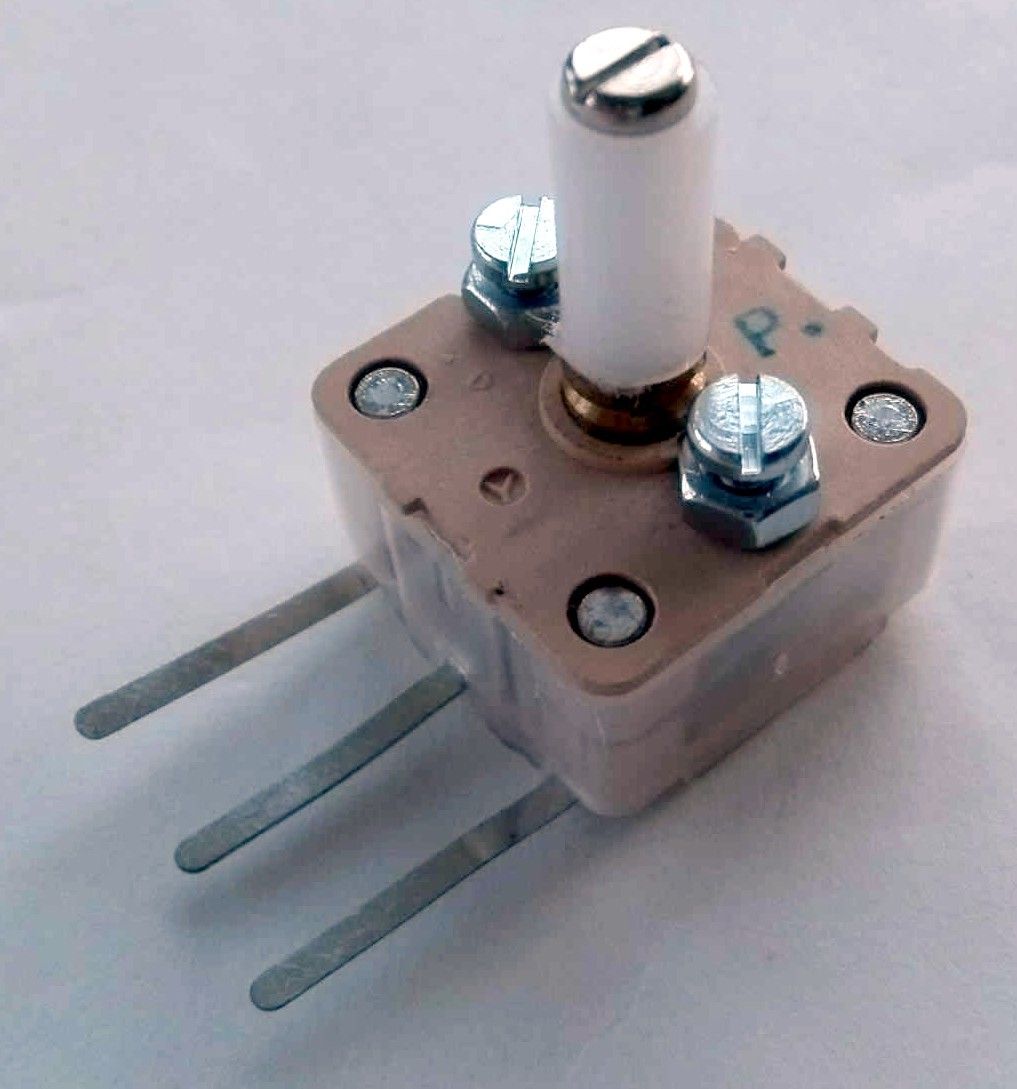
Polyvaricon Variations -- Polyvaricons Are Not all The Same

When I built the first prototype of the iPhone DC receiver, I just reached into my junk box and used a polyvaricon capacitor for the main tuning control. It was marked PL 051. I was really pleasantly suprised at the stability of the Variable Ceramic Oscillator circuit. I could tune the entire 40 meter band with complete stability -- Juliano levels of stability.
Has anyone else noticed variations like this in the stabilty of polyvaricons?
The dial in this version is an Archer device that has been kicking around in my junkbox for more than 20 years. I think it was given to me by my old friend Pericles HI8P -- this adds a tremendous amount of soul to this new machine). The box is an old Bud aluminum chassis. Man, this thing sounds great. I will try to post a video soon.
Subscribe to:
Posts (Atom)