Podcasting since 2005! Listen to our latest podcast here:

Podcasting since 2005! Listen to Latest SolderSmoke

Showing posts sorted by relevance for query direct conversion receiver. Sort by date Show all posts

Friday, May 30, 2025

Hiss, Filters, QRM, and Hearing Loss: Do we need AF filters in direct conversion receivers?

L6 is the 88mH toroid

Messages on Discord about the need to knock down higher frequency audio response in the SolderSmoke direct conversion receiver got me thinking.

I agree with Rick Campbell and others on the benefits of hearing a "wide open" direct conversion receiver. But Rick and others have built DC receivers with 3 kHz low pass AF filters. This made me ask myself a question: Is an audio filter in a direct conversion receiver a good idea?

And I started wondering if perhaps I was being too dismissive about the complaints about high frequency audio -- I had been attributing them to newcomers who were just unaccostomed to radio noise or "static." But maybe there was more to it than that. Maybe a big part of the problem was in my head, specifically in my ears. So this morning I did an experiment. I took an online hearing test. First, without my hearing aids: As expected, it showed significant high frequency loss. (It was as if the US Army had installed a 3 kHz audio low pass filter in my head!) Then I put my hearing aids in and retook the test: This time I passed the test and showed no loss. I then listened to the DC receiver with my hearing aids in. Now I could hear what builders on the Discord server were commenting on: I could hear higher frequency hiss, and, more importantly, stations that were producing 4-5 kHz sounds on my speaker were audible and annoying.

So I went back to Wes Hayward's November 1968 QST article. In his receiver, he has a low pass AF filter using an 88 MILLIHenry coil and a couple of capacitors to ground. I had a few of the coils (given to me years ago by a NOVA QRP club member) so I built it. With my hearing aids in, I noticed an immediate improvement. I then did what one of the Discord builders did and put the filter in with a switch that would let me make "with and without" comparisons. The filter definitely cuts down on any AF above about 3.5 kHz. And it doesn't seem to do damage to the desired signal. This is useful. I left the W7EL diplexer in the circuit.

This filter won't solve the image or "opposite sideband" problem inherent to simple DC receivers, but it will help with signals or noise that are producing tones above about 3.5 kHz in the receiver. I think this is especially important in countries in which there is a lot of SSB crowding on 40 meters. The UK, for example, has an allocation from 7.0 to 7.2 MHz. In the US we go from 7.0 to 7.3 MHz. That is a big difference.

So the answer is probably yes, an AF filter in a direct conversion receiver is probably a good idea, especially if you can switch the filter out of the receiver. You can live without these filters. Not having the filter keeps the receiver very simple, and lets it sound really great. But having the filter in there does help reduce interference and high frequency hiss. So I think this is a useful add-on mod for builders who see a need to cut down on the kind of interference that a lack of this filter causes.

In 2019 W7ZOI noted: "Another unusual element is the 88 mH toroid used in the audio low pass filter at the detector output. A viable substitute would be a 100 mH inductor with radial leads. The muRata 19R107C (from Mouser) should work. Bourns also offers a variety of similar parts."

Monday, March 9, 2026

Steve N7HPR Describes the Group Build of 10 SolderSmoke Direct Conversion Receivers


Group Build of the SolderSmoke Direct Conversion Receiver Challenge

By Steven Bible, N7HPR

Andrew Johnson Amateur Radio Club and Greene County Makers, Greene County Tennessee

The main goal for the group build is hands-on learning. Each of the students are working on their amateur license. Three are working on their Technician, one General, and the remainder on their Extra. The extra exam has a great deal of detailed technical knowledge and the SolderSmoke Direct Conversion Receiver Challenge is a great vehicle for teaching many of these technical details.

Several in the group have experience soldering thru-hole components on a printed circuit board. However, Manhattan style construction was new to them. It would add a valuable skill to their toolbox. The question, from an instructor’s point of view, was how to ease them into this skill before taking on a much larger project? The answer was to first build a smaller project to introduce the students to this unique construction style. I chose Allen Wolke’s W2AEW YouTube video on building a buffered Colpitts crystal oscillator. The added benefit was teaching the oscillator questions on the amateur exams.


#123: Build a crystal oscillator from schematic thru prototype construction and
testing – DIY [https://www.youtube.com/watch?v=blalAktxFoI]

In the video, Allen shows how to identify the nodes on a schematic and use them as the
pads on the PCB. From this I came up with a teaching method where the students study
the schematic and sketch on a handout how they plan to assemble the board. I
designed and 3D printed a template for the student to trace onto the PCB with a pencil.
They would superglue MeSqares onto the squares of the template, and the circles were
suggestions of where to ground components to the PCB. This gave them the mental
exercise to reason how to take a schematic and turn it into a prototype. Building the
oscillator was an excellent introduction and helped lead the students into the larger
DCR Challenge.

PCB Template. Students sketch the template onto the PCB.

Over the course of eight weeks of 2-hour classes, the students built the four blocks of
the Direct Conversion Receiver. I designed and laser cut a baseboard from 1/8-inch (3
mm) Baltic Burch plywood where the students could mount the four blocks of the
receiver. This provided the students some structure in assembling the receiver.


We started with the VFO block first. The most challenging thing was winding the PTO
form. But everyone managed. Other challenges were poor solder joints and missing
connections, which were easy to remedy. They became excellent teaching points.
I also noticed that students would look at the (what I called) the prototype Direct
Conversion Receiver that I built to show everyone what it would look like in the end. As
it turned out, this was a valuable part of the group build. Students would take photos of
the prototype so that they could gain a better understanding of the construction of the
receiver.

As students completed their VFO, I would test it using an oscilloscope demonstrating to
them what and how an oscilloscope works and the signals coming from their VFO.
The second block was the Band Pass Filter. This block had easier transformers to wind
compared to the mixer. This allowed a gentler introduction to toroid winding. To aid in
the identification of the windings, I purchased red and green enameled wire that had a
poly-coat that was easy to remove using a blob of solder on the soldering iron. Overall,
this was a simple block for the students to assemble. As students completed their Band
Pass Filter, I connected it to a nanoVNA and allowed them to tune the filter. Another
great teaching moment introducing them to filters and vector network analyzers (VNA),
all if which are on the General and Extra exams.

The third block to be assembled was the Mixer. This had a little more challenging
transformer with the trifler windings. I purchased enameled wire in three colors: copper,
red, and green. The copper-colored wire was coated with enamel which required
scraping to remove. The red and green was the poly-coating the students were familiar
with from building the Band Pass Filter.

The three colors allowed the students to identify the primary (indicated with a dot on the
schematic) and secondary sides. The schematic showed the location of the colors and
the MeSquares they were to be attached to. This alleviated much of the confusion that
can occur with connecting trifler windings (see DCR Mixer Handout.docx).
The forth block was to assemble the Audio Amplifier. By this time the students have
developed their knowledge and skills to assemble the one block that had the most
components. Assembly went smoothly; however, we would have the occasional
misplaced component, bad solder joint, etc. This was the case throughout the build, but
they were welcomed as excellent teaching moments.

When the entire Direct Conversion Receiver was assembled, we would test them first
using a tinySA in signal generator mode and inject a 7.1 MHz carrier. We would tune the
PTO to tune down to 7.0 MHz and up to 7.3 MHz. We had to add an inductance in
series with the PTO to accomplish this range. This took some trial and error. There was
some troubleshooting to be done to find an error or two. Finally, we connected the
receivers to a loop antenna and listened to on-the-air signals. It was not the best
antenna setup, but it gave the students confidence that their receivers were working.

The amateurs in the group took theirs home and hooked them up to their station
antennas to listen further. Each reported good reception.

The Soldersmoke Direct Conversion Receiver Challenge was an excellent group
project. The students learned a great deal from the hands-on experience. W2AEW’s
buffered Colpitts crystal oscillator video was perfect for introducing Manhattan style
construction. Creating a kit of parts, 3D printed templates, handouts, and laser cut base
gave structure to the group build and minimized construction errors. Having a fully built
receiver (that I called the prototype) for students to refer to proved extremely valuable.
Building as a group provided an encouraging environment where the students would
assist each other and share teaching moments (what to do, what not to do). Finally,
there were many teaching moments that helped solidify knowledge and skills and there
were many direct references to the questions on the Technician, General, and Extra
exams. The goal of the group build was met!

Many thanks to the SolderSmoke team for an excellent project!

73, Steve N7HPR


Thanks Steve!  More to follow -- Steve's handouts on the construction of each stage are really great. 
 Stay tuned!

Friday, May 9, 2025

Ramakrishnan VU2JXN's FB SolderSmoke Direct Conversion Receiver: "Extremely thrilled! Hooked!"

This is a really important Hall of Fame entry for us.  This is our first completed SolderSmoke Direct Conversion Receiver from India (more will come).  

Most importantly, this receiver was built by our good friend Ramakrishnan VU2JXN (ex VU3RDD).  Ramakrishnan goes way back in SolderSmoke history.  He was the one who first suggested (in 2006!) that our podcast needed a blog to go with it.  This was the origin of the SolderSmoke Daily News.  A short time later we announced the birth of Ramakrishnan's daughter.  That same daughter now has her ham license and will build a second receiver with her dad.  

Ramakrishnan VU2JXN

The roots of this receiver are deep in India. When Dean and I first went to the local high school to talk about ham radio support, I carried with me a Direct Conversion Receiver inspired by Farhan VU2ESE.  In fact, that receiver had a picture of Farhan and quotes from him taped to the wooden base.  When Dean and I designed the receiver that we tried to build with the High School kids, we used an oscillator based on the DC receiver that Farhan was building with youngsters at Indian girl's schools.  That is the receiver design that we are using in this SolderSmoke Challenge. 

Ramakrishnan is in Bangalore now, which is where he built this receiver.  Ashish N6ASD is also there now, and is building a receiver. 

Ramakrishnan writes:  

This morning before I got ready to come to work, I got a few minutes 
to turn on the radio and catch the morning nets. Extremely thrilled to
 get this working. The PTO is very stable.

Needless to say, you folks convinced me to get back into homebrew
and you have hooked me into it with this project.

I am off to my ailing mother's place tonight. I don't have a station 
there, but I am carrying a copyof EMRFD with me (I have two!).

I want to listen with this receiver as you all always say 
and make simple modification to this receiver and improve it.
 
Again, couldn't turn off from it even though I am at work! The bug has
caught me.

Here is some more video of Ramakrishnan's receiver: 


Congratulations Ramakrishnan. Welcome to the Hall of Fame! 

--------------------------------

Join the discussion - SolderSmoke Discord Server:

https://discord.gg/Fu6B7yGxx2


Documentation on Hackaday:

https://hackaday.io/project/190327-high-schoolers-build-a-radio-receiver


SolderSmoke YouTube channel:

Monday, August 8, 2022

Polyakov (RA3AAE) Direct Conversion Receiver: 40 meter DC RX with VFO at 3.5 - 3.6 MHz (with video)

I've been reading about Polyakov (or "sub-harmonic") Detectors for a long time: 

https://soldersmoke.blogspot.com/search/label/Polyakov--Vladimir

But until now, I never built one.  Recently,  Dean KK4DAS and the Vienna Wireless Makers group have been building a Direct Conversion receiver.  Their receiver uses an Si5351 as the VFO, but of course Dean and I have decided to try to do things the hard way by building non-digital VFOs.  At first we just came to the conclusion that my earlier Ceramic Resonator VFO wasn't much good (it drifted too much).  This led us into standard Colpitts and Armstrong VFOs, and the fascinating world of temperature compensation.  Then I remembered the Polyakov circuit -- this would allow us to use a 3.5 MHz VFO on the 7 MHz band.  Lower frequency VFOs are easier to stabilize, so I started building my first Polyakov receiver.  You can see the results (on 40 meters) in the video above. 

I started working with a circuit from SPRAT 110 (Spring 2002). Rudi Burse DK2RS built a Polyakov receiver for 80 and 40 that he called the Lauser Plus.  (Lauser means "young rascal" or "imp" in German.) For the AF amplifier, I just attached one of those cheap LM386 boards that you can get on the internet.  With it, I sometimes use some old Iphone headphones, or an amplified computer speaker. 

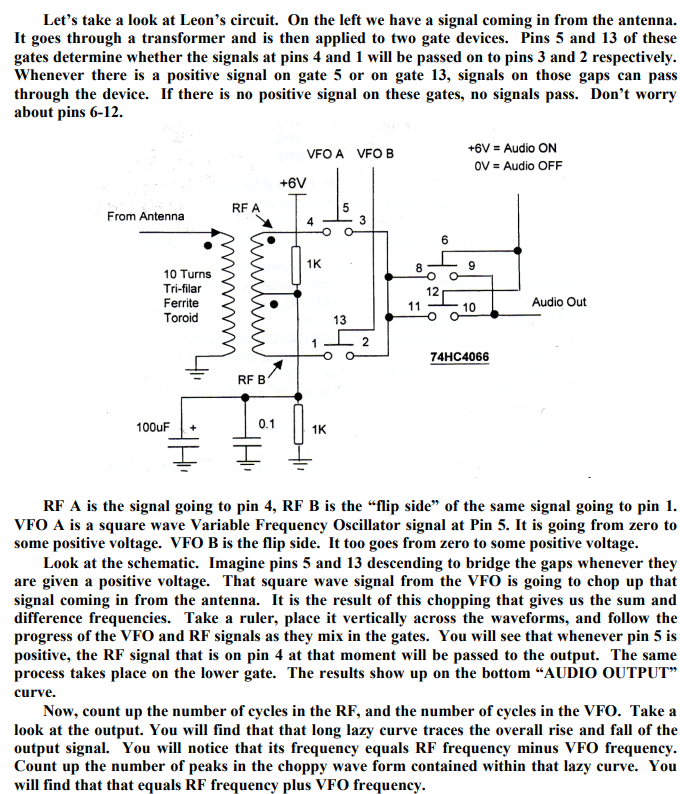
The Polyakov mixer is a "switching mixer."  The book excerpt below shows how I understand these circuits.  The enlightenment came from the Summer 1999 issue of SPRAT (click on the excerpt for an easier read): 


Leon's circuit shows us how a simple switching circuit in which the switches are controlled by the VFO can result in an output that has the sum and difference components. That is the hallmark (and most useful part) of real mixing.  Remember -- we say that mixing happens in non-linear circuits when the passage of one signal depends on what is happening with the other signal.  A switch is as non-linear as you can get! And that switch is being controlled by the VFO.  

In a Direct Conversion receiver we usually run the VFO at the operating frequency. This results in audio just above and just below the operating frequency. 

The Polyakov Direct Conversion circuit is a bit different.  It has the switches (the diodes)  turned on twice each cycle:  When the VFO voltage goes to a positive peak, this turns on one of the diodes.  When the VFO goes to a negative peak, this turns on the other diode.   So in effect the switch is being turned on TWICE each cycle.  So with the Polyakov you run the VFO at HALF the operating frequency.  For a DC receiver designed to run around 7.060 MHz, you build a VFO at around 3.53 MHz.  This has some immediate advantages.  My favorite is that it is easier to get a VFO stable at a lower frequency.  It is easier to stabilize a VFO at 3.53 MHz than it is at 7.060 MHz. 

When you open that SW 1 switch in the Lauser Plus, you no longer have a Polyakov mixer.  Now you just have a diode mixer.   It will be opening and closing once each cycle at the VFO frequency.  DK2RS used this to cover not only the 40 meter band (in Polyakov mode) but also the 80 meter band (in single diode detector mode).  That is why DK2RS has that big variable capacitor in the input circuit -- that LC circuit needs to tune all the way down to 3.5 MHz and all the way up to around 7.3 MHz.  (I used a coil of about 6.5 uH to do this.) 

With just one diode and operating at 80 meters, it works, but not as well as it does in the Polyakov mode on 40.  I can pick up 80 meter signals, but in this mode there seems to be more of an "AM breakthrough" problem. "Experimental Methods in RF Design" on page 8.11  describes what is going on (the last sentence is most relevant here): 

Here are some very good links with information on the Polyakov receiver: 


LA8AK SK: http://www.agder.net/la8ak/   Almost seventeen years after his death he continues to help his fellow radio amateurs through his web sites.  TNX OM!  FB! 


I will post a video tomorrow showing the receiver in operation on 80 meters.  

Three cheers for Vlad Polyakov, RA3AAE

Sunday, December 25, 2022

Some Direct Conversion Receiver History

Here is the article by Wes Hayward and Dick Bingham that started it all:  

https://worldradiohistory.com/Archive-DX/QST/60s/QST-1968-11.pdf

page 15 

Here's a discussion by Wes of the original project: 

https://www.n5dux.com/ham/files/pdf/Direct%20Conversion%20Receivers%20History%20-%20W7ZOI.pdf

Here is an article about DC receiver in phasing rigs by Gary Breed K9AY: 

https://worldradiohistory.com/Archive-DX/QST/80s/QST-1988-01.pdf

page 16

Roy Lewallen W7EL's Optimized transceiver (with a direct conversion receiver): 

https://worldradiohistory.com/Archive-DX/QST/80s/QST-1980-08.pdf

page 14

Jerry KI4IO on Building a DC Receiver

https://groups.io/g/qrptech/message/17

Michael Black wrote on March 5, 2014 at 3:54 PM

Isn't it a bit dated?

When "direct conversion" receivers came along in 1968 (the concept existed before, just not the name), it was to build simple receivers. They took over from regens (which of course for the purpose of CW and SSB, were "direct conversion"), and kind of bumped simple superheterodyne receivers out of the magazines.

And they were easy to build, so long as the meaning of the dots were standard, but good performance was elusive. Endless articles about better mixers or more front end selectivity, and still the same basic results The Heathkit HW-7 comes along, and endless mods to that, but still no perfection.

Slowly the move was back to simple superhets, especially with some of the early seventies ICs intended for radio, and then ladder filters came along (actually they came early at least by 1974 from the UK and/or France, but while they got mention in North America early-ish, it took some years before the KVG filters were pushed aside and ladder filters got the spotlight).

And then wham, in the mid-eighties someone caught on. The problem with direct conversion receivers wasn't the mixer (well not once it was a balanced mixer) or lack of front-end selectivity, it was the matter of properly terminating the mixer. The problems that had been there all along were gone. And direct conversion receivers started their climb to being complicated receivers.

I guess it was that receiver by Gary Breed in QST circa 1986 with diode balanced mixers and termination that changed things. A new concept, but not really, I remember an article in QST in 1974 where a DBM diode mixer for VHF was properly terminated, and yet the concept went no further until a decade later.

Actually, I think there is a tiny bit about mixer termination in "Solid State Design for the Radio Amateur" but it never went so far as to say "this is what we need".

Or perhaps that tiny transceiver by Roy Llewellyn in QST was the first, I cant' remember. It certainly used a diode mixer with termination for the receiver.

And that set the stage for Rick Campbell's various receivers, all counting on termination of the mixer.

The ideas can often be there, but not applied because technology doesn't allow it yet, or just not looking that far beyond this month's construction article.

Michael

Wednesday, December 4, 2024

Challenge Accepted! Why we Designed the High-School Direct-Conversion Receiver the Way we Did

Dean KK4DAS's Beautiful DC Receiver

The folks over at Ham Radio Workbench have graciously accepted the challenge issued in our last podcast: that they scratch-build homebrew the 40 meter Direct Conversion receiver that Dean KK4DAS and I designed for local high school students.  We want to help our brothers over at HRWB.  For example, we may be able to supply a few of the 3D printed PTO coil forms.  Here is some background information on the project. 

Details on the project can be found here: 
----------------------

Design Decisions in the Direct Conversion Receiver

Why did we do it this way?

In thinking about how to design this receiver, we had to make early design decisions on almost every stage.  Here are some of our key considerations.

VARIABLE FREQUENCY OSCILLATOR:

Normally we might have used a variable capacitor to change the frequency of this oscillator.  But variable capacitors are now expensive and hard-to-source.  Our friend Farhan in Hyderabad used a simple variable inductor for this purpose in his “Daylight Again” transceiver. The coil form for this part could be 3D printed.  A metallic screw would vary the inductance as it is screwed in and out of the coil.  

We also decided to use the same simple Colpitts oscillator circuit used by Farhan in his own high school direct conversion receiver.  This circuit is unusual in that the feedback capacitors are also the frequency determining elements (along with the variable inductor).  This simplified the circuit and reduced the parts count, and proved to be remarkably stable.

For the VFO buffer we used the simple JFET buffer from Farhan’s Daylight Again design.  

Based on suggestions from other radio amateurs, we developed a simple frequency readout based on the position of the end of the tuning screw  (how far in or out?).

We selected the 40 Meter band for this receiver because we thought it would be easier to get the VFO stable on this frequency, and because Farhan had built his receiver for 40 meters.

MIXER:

At first we hoped to use a simple singly-balanced mixer using two diodes and a single trifilar transformer.   But we found unacceptably high levels of AM breakthrough (mostly from Radio Marti on 7335 kHz) when using this circuit.  So we switched to a diode ring.  This required two more diodes and an additional trifilar transformer.   We believed the students would have great difficulty building and installing two trifilar transformers so early in their building experience.  So we used transformers that had been wound in Hyderabad by a women’s collective employed by Farhan, and developed a scheme for fool-proof installation of these transformers.

We also found that the mixer needed a diplexer at its output – this would provide a 50 ohm termination at all frequencies and would result in much cleaner action by the mixer and greatly reduced AM breakthrough from Radio Marti.   We used the same circuit used by Roy Lewellen W7EL in his Optimized Transceiver circuit.

BANDPASS FILTER: 

This was the simplest board in the project but it required the students to wind two coils on toroidal cores.  A simple dual-tuned circuit design would be sufficient.  We used component values from the QRP Labs website.  We showed them how to wind the coils, and made a video about the technique.  Students used a simple Vector Network Analyzer (Nano VNA)  to tune the filter.


AUDIO AMPLIFIER: 

We had to make several design decisions here.  First, we rejected the idea of using an IC amplifier like the ubiquitous LM-386. We wanted this to be a completely analog and discrete component experience. Then we rejected the idea of using a push-pull output circuit.  While this would have eliminated the need for an audio output transformer, it would have resulted in a more complicated circuit.  In the end we opted for three simple RC-coupled common-emitter amplifiers with an audio output transformer.  There was no feedback in these circuits.  We found there is a lot of gain (hFe) variation in the 2N3904 transistors that we used.  Care needs to be exercised in making sure that transistors of moderate (but not too high) gain are used.  

This AF amplifier chain probably presented a 1500 ohm impedance to the mixer (instead of the desired 50 ohms), but we think this problem may have largely been taken care of by the diplexer.  

We found some very small (one square inch) speakers that could be easily used in this circuit.

ANTENNA:

While the students could use a wide variety of antennas, we recommended a simple ¼ wave antenna with a ¼ wave counterpoise.  We thought that this antenna – of only 33 feet in length would provide good performance with low complexity, and would be well suited to the “upper floor bedrooms” from  which many of the students would be listening.  Also, this antenna would not require the use of coaxial cable or an impedance matching transformer. We made a video on how to build and use this antenna. 

POWER SUPPLY:

We opted for the use of 9 volt batteries.  This proved to be a safer and wiser choice that limited the kind of mayhem that could occur should a variable voltage supply be used.

Details on the receiver can be found here: 

https://hackaday.io/project/190327-high-schoolers-build-a-radio-receiver

May 29, 2023

Saturday, March 1, 2025

Ken W4KAC's Wonderful SolderSmoke Direct Conversion Receiver -- with a Leaf Blower Tuning Dial


Ken W4KAC tells me that the tuning knob that he used to minimize hand-capacitance effects on his PTO started out as a gear in a leaf  blower.  I commented that the engineers who designed that gear surely never thought that it would someday be used in a homebrew direct conversion receiver.   

Ken lamented the polemical nature of the SSB discussion captured in the above video, but the clip does give a good demo of the SSB capabilities of Ken's receiver. And the video gives some nice close-ups of the receiver itself.  

Ken is a CW guy, and he has already homebrewed a QRP CW transmitter that he hope to pair-up with the receiver.  Here it is: 


Ken reports 160 mW output with a 377 mile reception report on the Reverse Beacon Network.  I made a contact with something similar: https://soldersmoke.blogspot.com/2023/02/first-qso-with-high-school-receiver-100.html

Ken wrote about the importance of persistence: 

Good morning. Just wanted to say, don't give up if your receiver is not quite right. Mine was working, I even posted a video here. When building the AF amp from the transformer end back, the Q4 stage was fine. I added Q3 and had a "motor-boating" oscillation when I applied a signal. I tore it all off the board and started over. I still had the problem, so being stubborn I continued on and kept adding more filter caps to quiet it down all I could. The receiver worked and sounded pretty good during the day when I copied WA4FAT and others. That evening was a different story when the band was working well and very full of signals. Very strong stations were ok, but I was getting lots of "hash" and noise other than normal band noise. FT8 was breaking through weakly all over the band along with other unidentified stuff. Yesterday morning I grabbed a new piece of copper clad and built and entirely new AF amp. It tested properly all through the build. Instead of installing that board I decided to find the problem with the original. I "thought" I had used new transistors when I rebuilt it the first time. Turns out I had probably put the original Q3 back, because replacing it cured the problem. I had an entirely different receiver last night. A pleasure to listen to. Don't give up like I did at first!!

Ken went the extra mile by building a SECOND Direct Conversion receiver.  So he may soon get TWO Hall of Fame credits.  Here is the second one that Ken built: 

Thanks Ken!  

-------------------------------------------

For more information on how you too can build the receiver: 

Join the discussion - SolderSmoke Discord Server:

https://discord.gg/Fu6B7yGxx2


Documentation on Hackaday:

https://hackaday.io/project/190327-high-schoolers-build-a-radio-receiver


SolderSmoke YouTube channel:

Sunday, August 9, 2020

Presence (Absence?) and Direct Conversion Receivers (with wise comments from Farhan)


Hello Bill,
    I was reading an online article by Wes Hayward, W7ZO  from 1968  about the history of direct conversion receivers (http://w7zoi.net/dcrx68a.pdf)  .  It was linked in an email in qrptech.    It recounts how he had first build a dc receiver with a single diode for the detector, and how microphonic it was, and dissatisfying an experience.   This was in the early days of solid state devices, and so they were hard to come by.   He describes meeting another ham engineer at work Dick Bingham, W7WKR who immediately recognized that what he needed was a diode ring mixer.    The story goes on to describe their experiments, and success at this design.   

  They decided to write up the design for QST.   I won't bore you with the details...the article is well worth reading about how Wes mailed the radio and the design to ARRL, and how it ended up in the hands of a new person on their staff there, Doug DeMaw, W1CER (later W1FB.).  Here is an excerpt from the article describing Doug's reaction to the receiver:

"This was the epiphany, the moment when Doug realized that solid-state technology had produce a new way to build a simple receiver. Doug tuned the receiver higher in the band and found some SSB. Again it was like nothing he had ever heard. It was as if the voice came from the same room. Doug used the term presence in his description."

Here I present the earliest use, that I know of, of presence being used to describe a receiver.    I have to say when I read it, I immediately thought of you guys, and decided to share.

Thanks for all you guys do.
   dave    /nt1u
----------------------------------------------------------
Bill replied:

Thanks Dave.   Yea, that's the 1968 article that launched the use of DC receivers.  I had forgotten about DeMaw's early use of "presence." 

Just to cause trouble, perhaps we should start commenting on "absence"  i.e.  "I dunno OM, I think your rig lacks a bit of absence in the mid-range... turn menu item 63b to ELEVEN!"  
:-)
73 Bill 
----------------------------------------------------------
 

Farhan wrote: 

Mon, Aug 3 at 3:22 PM

When I got my license, my friend Anil SM0MFC was living in Hyderabad. He lent me his HW-8.  I stringed up a 40 meter dipole with a lamp cord and worked with it. Somehow, the combination of the lamp cord length and the 40 meter inverted V made it resonate on 20 m as well. The HW-8 had a nominal antenna tuner and I worked pretty good DX.

Till date, it remains the best receiver that I have used for regular contacts. The only trouble it had was the the MC1496 was a nominal detector, it overloaded heavily with shortwave broadcast stations. There was an unnecessary RF amplifier in the front-end that they could have done without.

I made several direct conversion receivers, but never managed to hang on to any. This makes me want to build one, one of these evenings. I even have a KK7B R1 kit. but real men solder on without any PCBs or even circuit diagram!

A 7/14/21 direct conversion radio that puts out 3 watts of power is what my ideal setup would be. I am not too bothered with the images on CW. I just tune them out in my head. Real soon now, at the moment, i am trying to finish a radio that has been in the works for years.  Finally, I am making some headway.
-f
---------------------------------------------
Farhan of course is no slouch in the DC receiver area.  Years ago he wrote a wonderful post about building a DC receiver with his cousin for her class project: 

Included in this post was a passage that I included in my book  SolderSmoke -- Global Adventures in Wireless Electonics: 
--------------------------
Why build a receiver?
    Why do you want to build it? These are available at the Dubai Duty Free asked Harish, an old friend, when he spotted us struggling over the DC40 one evening. I didn't have an answer to this question and considering the amount of work piled this quarter, it appeared to be a sensible thing to ask.
    I think this question is answered by us all in different ways. My personal answer would be because we human beings are fundamentally tool builders. We have an opposable thumb that allows us to grip the soldering iron.
    For an engineer (by the word ‘engineer', I don't just mean those who have a degree, but anyone who applies technical knowledge to build things) the act of building a receiver is a fundamental proof of her competence and capability. It is much easier to put out 1 watt signal than it is to receive a 1 watt signal.
    A simple definition of a good receiver is that a good receiver consistently, clearly receives only the intended signal, such a definition hides a wide range of requirements. The receiver has to be sensitive enough to pick up the weakest signal imaginable (note: clearly), it has to be selective enough to eliminate other signals (only), it has to be stable enough (consistently).
    For a ham or an engineer, building a usable receiver is a personal landmark. It establishes a personal competency to be able to understand the very fundamental operation of the radio and mastery over it.
--------------------
Bill:  OM Ryan Flowers did a 5 part series on building the DC40.  If you are want to build one, I suggest you use the schematics on Ryan's site.  There was an error in Farhan's original schematic -- Farhan corrected it but some of the incorrect schematics are still floating around the internet.  Here is part one of Ryan's series: 

Farhan's DC40


Saturday, March 1, 2025

Wayde VA3NCA Receives SSB, CW, FT8, and CHU Canada on his SolderSmoke Direct Conversion Receiver

Above you can watch and listen to Wayde's receiver as he tunes across 40 meters. It sounds good, even though Wayde is thinking about some improvements. 

 It was highly appropriate that Wayde's first reception report should be of CHU Canada, the Canadian time signal on 7.850 MHz, a bit above the 40 meter band, but clearly in tuning range for an unmodified SolderSmoke direct conversion receiver.  CHU is probably unique in the world in that it is transmitting the carrier and JUST ONE SIDEBAND.  It transmits only the upper sideband.  This makes it clearly detectable by our receiver.  As Dean pointed out to Wayde, all he had to do was "zero beat" the carrier with the PTO signal (tune to the point where they are on the same frequency and the audio tone disappears).   Because there is only one sideband, the direct conversion receiver can demodulate it very well.  If there had been two sidebands, this would have been a standard AM signal, and our little receiver -- which does very well with SSB and CW -- would have been unable to demodulate the signal without distortion. (For an explanation of why this is, see: https://soldersmoke.blogspot.com/2022/12/but-why-why-cant-i-listen-to-dsb-or-am.html   Warning -- this is kind of in the "advanced course" category.)

Here is an overhead shot of Wayde's receiver: 


This is a really nice build.  The use of what appears to be a kitchen cutting board harkens back to the early days of radio when young hams took the cutting boards from their mothers' kitchens and used them as bases for rigs.  This is origin of the term "bread board."  Frank Jones continued in this tradition by building most of his rigs on wooden boards.  Wade's DC receiver continues in that tradition. 

Wade was able to decode some FT8 picked up by this receiver and recorded on his phone: 


Congratulations Wade!   

----------------------------

For more information on how you too can build the receiver: 

Join the discussion - SolderSmoke Discord Server:

https://discord.gg/Fu6B7yGxx2


Documentation on Hackaday:

https://hackaday.io/project/190327-high-schoolers-build-a-radio-receiver


SolderSmoke YouTube channel:

Sunday, March 16, 2025

Juan LU2VJM's Beautiful Argentine SolderSmoke Direct Conversion Receiver

I was really pleased to see Juan LU2VJM's rapid completion of the SolderSmoke direct conversion receiver.  But I wasn't really surprised -- Juan is an experienced homebrewer who has successfully completed Farhan's BITX transceiver.  Juan and I talked about how it is worthwhile for even an experienced homebrewer to go back and build a direct conversion receiver.  Farhan did this.  Farhan said that we do this because we are tool makers.  We have opposing thumbs that allow us to grab a soldering iron.  Indeed.  And you can hear the happiness in Juan's voice when he says in the video, "Today we have reception!"  Excellent. 

I was also pleased to see this receiver enter the Hall of Fame becasue this marks our first receiver from Latin America.  We hope there will be many more.  

Here are some pictures of Juan's receiver during construction: 

Juan's AF Amplifier

Juan's Diplexer with homebrewed coil

Another shot of the AF amplifier

The mixer, getting ready for construction

The completed receiver. FB!

Thanks Juan!  And congrastulations! 


For more information on how you too can build the receiver: 


Join the discussion - SolderSmoke Discord Server:

https://discord.gg/Fu6B7yGxx2


Documentation on Hackaday:

https://hackaday.io/project/190327-high-schoolers-build-a-radio-receiver


SolderSmoke YouTube channel: