Podcasting since August 2005! Listen to our latest podcast here:

Podcasting since August 2005! Listen to Latest SolderSmoke

Showing posts sorted by date for query X-Ray. Sort by relevance Show all posts

Friday, July 24, 2026

A Homebrew X-Ray Machine from North Macedonia

It has been a long time since we saw anything like the X-ray machine described in CL Stong's classic book "The Amateur Scientist."  Here are some other SolderSmoke blog posts about this (and related) stuff:  https://soldersmoke.blogspot.com/search?q=X-Ray

This one comes to us from the fertile workshop of Mikel Pavleski in North Macedonia.  We have covered his work before.  

This device is built around an old DY-86 tube from an old black and white TV.  Mikel describes a very simple test to determine if these tubes have leaked, or if they still have good vacuum. 

Mikel uses a really scary high voltage power supply.  

I like the FN-RISI radiation detector.  Want one!  

Note that Mikel used a remote turn-on when using this machine.  I hope there are no people in the apartment next door!  He does use a lead shield, but only on three of the four sides.  

The use of dental X-Ray film was really cool.   The development of this film in Mikel's lab reminded me of my developing of 35 mm film in a dark room I had set up in our downstairs bathroom.  I couldn't afford an enlarger.

Mikel warns that you should not try this at home!  Good advice!  

Thanks to Mikel, and to Hack-A-Day for alerting us to this project.

Tuesday, July 29, 2025

The Guy with the USB-powered X-Ray Machine -- The Identity of the Project 326 Builder

This morning a comment came in from Hong Kong/Shenzhen that explained who Project 326 is and why he was saying "tubes" and not "valves": 

--------------------

Thank you for featuring my video. Some background for you, I am a British engineer and have lived in China for over 20 years. I am resident in both Hong Kong and Mainland China (Shenzhen, which is just over the border from Hong Kong). I used the term vacuum tubes as most of the viewers are from the US and us Brits are fully conversant with both terms, but in the US, they are often less 'bilingual' in these kinds of phrases.

Hope that helps!

----------------------

It does indeed help a lot.  Please continue to make great videos like the one about the USB X-Ray machine.  

Here is the channel: 

Saturday, July 12, 2025

A USB-powered Homebrew X-ray machine. And who is Project 326?


This is an interesting project.  The use of dental X-ray packs was really innovative. The approporately snarky presentation about nanny-state nervous nellies was great.  It all reminded me the X-ray chapter of C.L. Stong's great book "The Amateur Scientist."   Here is a .pdf of the book:  http://www.ke5fx.com/stong.pdf

The X-Ray machine in Stong's book appears on page 500 (520 in the .pdf)  Here is the opening paragraphs:  


Indeed, it was lonely up there in the 10^-8 cm band! 

But who is behind Project 326?  Who is the robot narrator's human assistant?  At first I thought they were joking when they said they were in Southern China.  But YouTube does show them in Hong Kong.   He has British accent, but oddly he calls valves "tubes."  He also seems to use quite a bit of SolderSmoke terminology and practice:  He uses copper tape as a ground plane. He talks about relaeasing "Magic Smoke" and of passing or failing "the smoke test."  Could it be that Project 326 had been listening to the SolderSmoke podcast?  We hope so!   Please let us know if y ou have any background info on this mad amateur scientist. 

Here is the Project 326 YouTube channel:  

Friday, November 23, 2018

The Max Valier Satellite Flies Over, Sending CW


I understand the launch of Farhan's CubeSat has been delayed a few days.  That's the way it works in the rocket launch biz --patience is required.  In the meantime, I've been practicing with my receive system.  Today at 1000 local the Max Valier satellite flew to my west.  It rose 78 degrees above my horizon to the W NW.  I left my three element quad pointed in that direction and waited for the satellite (which had been launched from India) to fly through its pattern.  

The CW beacon was quite strong, very visible and audible through my RTL-SDR dongle and HD-SDR software.  You can see it and hear it in the video above.  There is something quite charming about this very personal Morse message coming down from orbit and then passing through all that digital technology.   

More info on the satellite: 


"Max Valier Sat" is an amateur satellite built in cooperation by:
  • "Max Valier" High School in Bolzano/Bozen (Italy)
  • OHB System AG from Bremen (Germany)
  • Max Planck Institute for Extraterrestrial Physics from Garching (Germany)
Its main payload is an X-Ray telescope devised and made by MPE. Data generated by this detector will be transmitted, together with housekeeping data, over an amateur radio link with frequency 145.860 MHz.
A second payload is an amateur radio beacon transmitting a message in Continuous Wave. The beacon's frequency is 145.960 MHz
"Max Valier Satellite" was launched by the Indian Rocket PSLV-C38 on June 23, 2017 at 9:29 am IST (05:59 am CET) from Satish Dhawan Space Centre.
More tech details: 
Regarding the CW beacon: 


Beacon by Holger Eckardt DF2FQ:

  • Transmit frequency is 145,960 MHz (IARU and ITU coordinated).
  • Modulation is CW:
    • Duration of one dot is 114 ms.
    • Duration of one dash is 342 ms.
    • Interval between words is 1881 ms.
    • Interval between repetitions of the message is 6000 ms.
  • The beacon transmits Max Valier Sat's call sign and a greeting message.
  • Transmitting power is 500 mW.


And who was Max Valier?  Quite an interesting fellow: 
Max Valier in his Rocket Car in 1930

Sunday, September 24, 2017

GM3OXX SK

Bill,

I expect you will have heard via the grapevine, George Burt GM3OXX is silent key. Bad news travels faster than light.

I knew George GM3OXX before I was even licensed in the 70's, as I heard his broad Scottish accent on 2m AM when he was portable on a local hill and was using 2m to set up 3cm contacts with QRPp WBFM. I climbed the hill and introduced myself and he graciously answered my questions. 

George didn't drive but despite that was able to climb all of the Munros (summits over 3000 feet) in Scotland and operated on 2m from all of them. He used hitch hiking and buses or bicycle to get to foot of the mountains. 

Fast forward a few years, I had my first ticket GM8HEY...

I spent a night in my grandfather's ridge tent on top of Snaefell (the highest mountain in the Isle of Man) (GD) with George. We had planned to take my car to the island by ferry, but had not realized that the TT motorcycle races were on and the Ferry was fully booked. We had to go as foot passengers and reduce the amount of gear. George carried his tripod and dish, 3cm and 2m gear and antennas plus rations etc, I carried this huge ancient canvas tent with wooden poles and pegs. We got to a campsite and we were told it was full, when we asked where the next site was the owner asked us where our motorbikes were, we explained we had come by foot, so he let us pitch our tent after all as we weren't bikers.

George originally had planned to climb the mountain by foot, but with this huge tent even though I was fifteen years younger than George I would never have made it, so reluctantly we took the mountain railway which goes nearly to the summit of Snaefell. 

The previous night it had snowed on the mountain, fortunately it was just freezing cold and windy when we camped right on the top. We had to use rocks to try and hold the old ridge tent down, it had no built in ground sheet. George's "rations" seemed to be a bar of chocolate and some tea that he boiled on a tiny stove powered by some little pebble sized block of flammable material. I have never been so cold and hungry after a night in a sleeping bag. We idled some of the time calling stations on 
2m with George's homebrew 2m battery powered transistorised transceiver.

Next morning it was too windy to set up the dish and tripod, so we assembled it -inside- the ridge tent and successfully operated from there on 3cm WBFM across to G, GW and GM. on 10mW QRP of course.

George went on to break UK and EU distance records on 3cm before packing microwaves in and going back to QRP on HF. 

George was as fit as a mountain goat in his youth, tragically he was struck down with a terrible condition in early middle age that robbed him of his strength and ability to even walk, let alone climb mountains, but you wouldn't have known it, he never complained, just the same old George "building wee boxes" as he put it to me on one of the last times I spoke to him. 

If you visited George's shack, you wouldn't find any commercial gear at all, everything he built himself, it was so beautifully made too, I marvelled at how compact and neat it was. 

There won't  be another George Mary Three  O Ocean  X X-Ray  X X-Ray on the bands.

Thanks for all the great times George, I am sure you won't be resting, you are probably designing that next "wee box".

-- David GM4JJJ


Monday, June 6, 2016

Spectacular Solar Weather


This amazing picture was taken last night at the Bharati Indian Base Station in the Larsemann Hills of Antarctica. The researchers there report that the aurora was so bright that it cast shadows.

Yesterday I was having a nice 40 meter SSB contact with N3TDE.  Rich is 179 miles away, in Pennsylvania.  At 1650 UTC, his signal very suddenly dropped into the noise. 

The purple lines along the bottom of the chart below probably explains both the aurora and the abrupt end of my 40 meter contact.

GOES X-Ray flux plot

Sunday, November 29, 2015

More on Light Beam Telephony


Hi Bill,

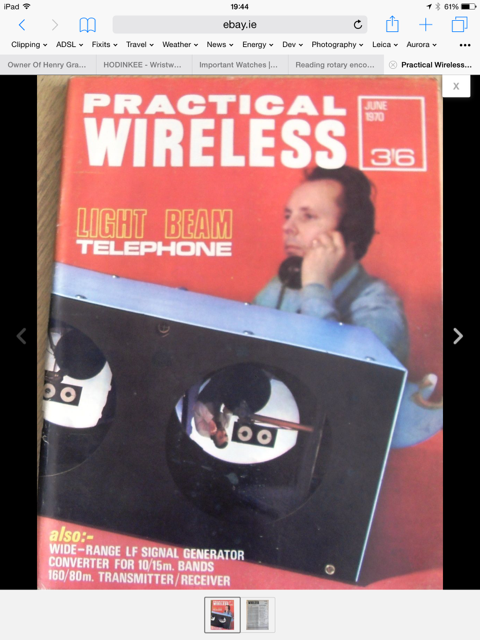
Reading about the Photophone and modulating the Sun experiments by G3ZPF reminded me of my own schooldays when as a final year physics project I think in 1970, I and another pupil built a light modulated telephone based on a design published in Practical Wireless of June 1970 by J. Thornton Lawrence. For the optical system it used a pair of spherical mirrors from old projection televisions. The detector was the expensive (for a school kid) OCP71 photo transistor, though we did also try ordinary less expensive OC71 transistors with the black paint scraped off with less success.
As David G3ZPF noted the problem with filament bulbs was the thermal inertia, and as I found it was also possible for the filament to mechanically resonate in the wooden box and start to howl. As we had never heard of, nor could have afforded an LED, we tried a Neon bulb run from an HT battery and modulated with a transformer in series with it. I recall coupling up a broadcast radio as the audio source playing "My Sweet Lord" by George Harrison and receiving it at the other end of the physics corridor very loud and clear on the audio amplifier on our light telephone receiver, much to the consternation and annoyance of the other teachers in the adjacent classrooms.

I found my black and white photo of the light telephone gear, complete with carbon telephone microphone that we used. It did work a fairly good distance in daylight outside across the school playground, not just the couple of feet shown. Also attached are photos of the original magazine cover and index, but regrettably not the article itself.

This was all before I got my ham ticket, but I already was a SWL and had been exposed to a wonderful ham, Tom GM3OWI (Oh Wild Indians) who visited the school and demonstrated all sorts of neat stuff like lighting a bulb from the output of a transmitter, and also voice modulating a klystron 3cm transmitter that the school had for doing electromagnetic radiation experiments, like polarisation, reflection etc.

Come to think of it, we got to play with a lot of stuff at school in those days which would never be allowed now, mercury, radioactive sources, alpha, beta and gamma, X-Ray and UV.  The museum in Edinburgh also had a science area with similar stuff you could play with, and get great shocks from the Van der Graff generator if you put your hand on the glass cabinet and touched the adjacent metal radiator!

Happy days!

73 David Anderson GM4JJJ

Tuesday, November 3, 2015

Rocket Knack in the Congo


Ground control for Mr. Keka’s space program is a shed with a tin roof. Inside are old computers and televisions.

This guy clearly has a rocketry version of The Knack.  Busted by the police for a match-stick rocket at age 17,  Jean Patrice stuck with his dreams of a Congolese space program.  Years later, when the rat flying in one of his rockets crashed and burned, he declared that the varmint had "died for science."  Indeed he did.  That is what I said about the lizards and mice killed in the payload chamber of my Astron X-Ray Estes rocket during the late 1960's.  A moment of silence please...

Imagine how difficult it would be to make any progress on something like this in the Democratic Republic of the Congo.  Godspeed Jean-Patrice! 

http://www.wsj.com/articles/one-africans-personal-space-race-turns-vermin-into-astronauts-1446239060

Friday, December 23, 2011

Find your Estes Rocket Catalog Online


On Wednesday we were all waxing nostalgic about 73 Magazine. (Did anyone figure out how to download ALL 511 of them?) I mentioned that I read many of the early 1970s editions from cover to cover. This morning I found on the Maker blog links to another publication that was burned permanently into my adolescent memory banks: The Estes Model Rocket catalog. Wow, I spent a lot of time studying the tech stats on the various rockets and rocket engines. (A8-3s!) I suspect that many SolderSmoke fans were also Estes enthusiasts.

Here are ALL the catalogs:
http://www.estesrockets.com/customer-service/full-catalog/

I think mine was the 1971 edition (above). I still feel bad about losing my Astron Big Bertha. And guilty about all the frogs I killed in the Astron X-Ray. I forgot all about the rocket with the 8 mm movie camera.

Our book: "SolderSmoke -- Global Adventures in Wireless Electronics"http://soldersmoke.com/book.htmOur coffee mugs, T-Shirts, bumper stickers: http://www.cafepress.com/SolderSmokeOur Book Store: http://astore.amazon.com/contracross-20

Tuesday, June 2, 2009

Alan Yates Making X-Rays from Rectifier Tubes

Anytime you find yourself writing a sentence like this...
"At only 20-30 kV and a few hundred uA in cold-cathode mode the x-ray radiation pours out, making the end-window Geiger counter scream from more than a meter away."
... perhaps some alarm bells should be going off.

Our friend Alan, VK2ZAY, has been busy in the lab, generating X-Rays from old 2X2 rectifier tubes. This reminds me of one of the articles in the wonderful C.L. Strong book, "The Amateur Scientist." Check it out: http://www.vk2zay.net/article/222

Hey Alan, can you make us up some of those X-Ray glasses that they always advertised in the backs of magazines? As a teenager, I somehow always wanted one of those...

Saturday, January 24, 2009

A. Frederick Collins - Radio Pioneer from my Hometown

I've been reading "Empire of the Air" by Tom Lewis, and I've been struck by how much radio history took place in the Hudson Valley. I have a special interest in this, because I grew up there. As I was reading about Lee de Forest (BOOO! HISS!) I started wondering if the lake near my parents' house was named for him. I grew up near Lake de Forest. Surprisingly, Google and Wiki did not provide the answer (anybody know?), but in the course of my Googling, I discovered something that really surprised me: my little town was the summer home of radio pioneer Archie Frederick Collins (what a great name!). Collins was one of the pioneers of radio telephone, using arc transmitters to send his voice out over the airwaves. Some of the experiments took place right in dear old Congers, N.Y. Collins seems to have been a great guy -- in addition to his pioneering work in radio, he was prolific author, writing for the Knack victims of the day.

Here's a 1908 Scientific American article about his radio work:
http://earlyradiohistory.us/1908col.htm
Here's a good Wiki article on him:
http://en.wikipedia.org/wiki/Archie_Frederick_Collins

One quote from the Wiki: He wrote scientific adventure series novels such as "Jack Heaton, Wireless Operator(1919)" which told of the training and adventures of a 15 year old wireless amateur. Many of his books, such as "The Boy Scientist," (1925) had lots of illustrations and few equations, with an emphasis on "hands-on" experimentation, at a level intended for high school students. After discussing the "Einstein Theory," Collins tells his readers how to build a spectroscope, a radio, and a x-ray machine for home experimentation. Collins encouraged his readers to use their home-built x-ray machine to examine their own bone structure with a fluoroscope.