Serving the worldwide community of radio-electronic homebrewers. Providing blog support to the SolderSmoke podcast: http://soldersmoke.com
Podcasting since 2005! Listen to Latest SolderSmoke
Monday, October 23, 2023
Bringing a Faulty Herring Aid 5 Receiver Into the Light -- Fixing the AF Amp Schematic Error (video)
Sunday, October 22, 2023
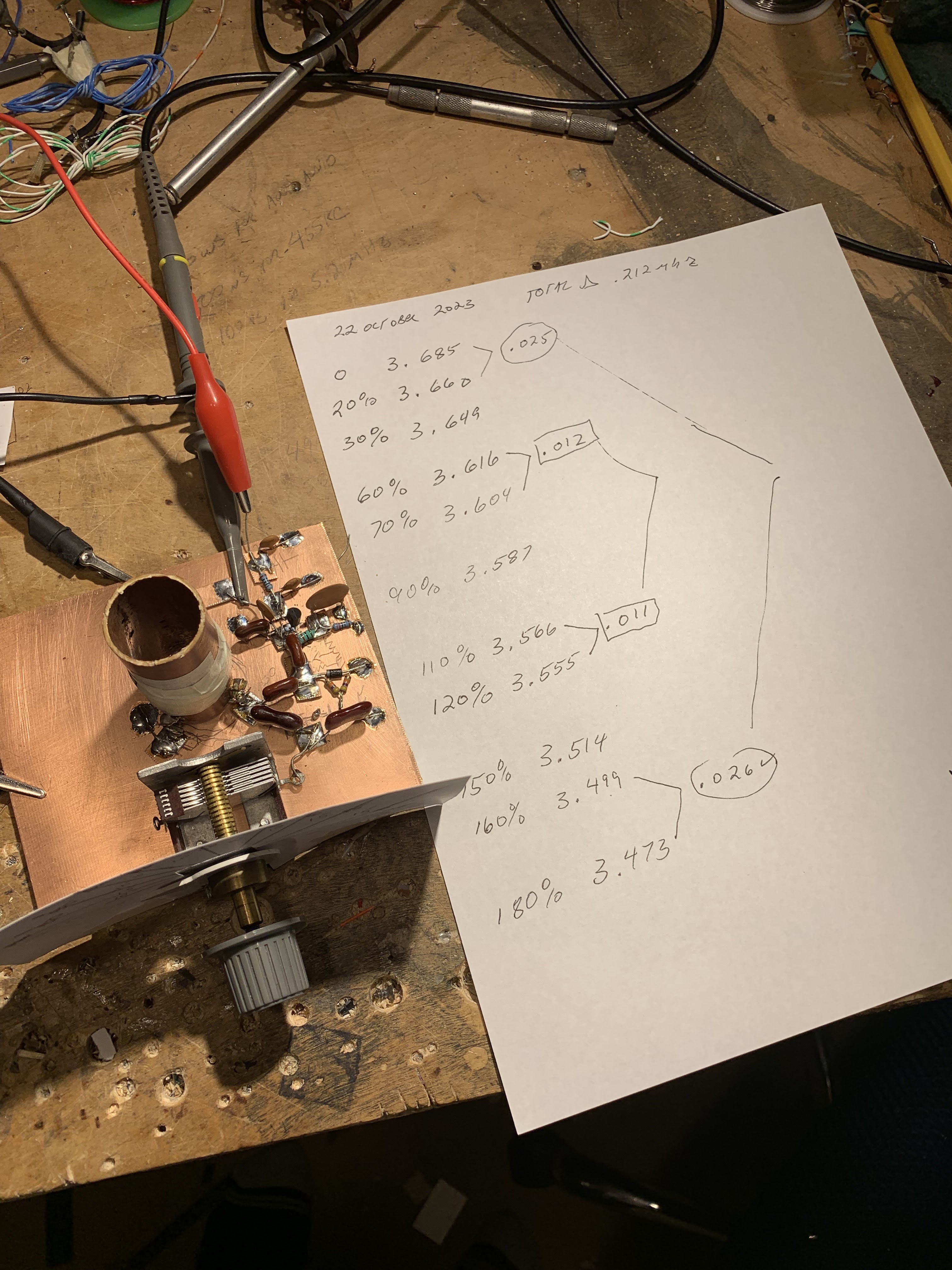
DIAL SCALE LINEARITY -- Spreading out the Frequencies for the 15-10 BITX Rig
Click on the image for a better view
The 15-10 Rig has been performing very well, pulling in a lot of DX contacts on both bands. But there is one thing that has bothered me: The way the transceiver tunes. It can be a bit difficult getting an SSB station tuned in properly. At first I thought this was caused by a lack of lubrication on the variable cap that I've been using (out of an old QF-1), but it turned out that this was not the cause. The problem is something that Pete Juliano has lamented several times: LC style analog VFOs have a tendency to have the frequencies "bunched up" at one end of the tuning range. In other words, the tuning range is far from linear. I was having trouble tuning stations on on the portion of the band where the frequencies were bunched up. I did some quick measurement and found that on this side of the capacitor's tuning range, one turn of the dial would move the frequency about 100 kHz -- that is far too much. On the other end of the capacitor moved only 22 kHz with one turn of the dial (as I recall this is close to the recommended 20 kHz per dial rotation). Clearly I had a lot of the dreaded bunching up. This was what was making tuning difficult.
I had built a pretty standard Colpitts FET VFO. I had a 6.6uH coil, and a 9-135 pF variable cap in series with a 68 pF fixed cap. I was pleased that the VFO worked, and I put it in the circuit. Only later did the bunching up shortcomings become apparent.
I decided to build another VFO, this time paying attention to DIAL SCALE LINEARITY.
I turned to the excellent Bandspread Calculator on Bob Weaver's Electronic Bunker web site: http://electronbunker.ca/eb/BandspreadCalc.html
I plugged in the frequency range that I needed and the values for my variable capacitor. I calculated Cs which was the combined capacitance of the feedback and coupling capacitors. Finally, I had to make a decision about the nature of my variable cap: was it a Midline-Center Cap or was it a Straightline Capacitance cap. I consulted with Bob and he suggested that it might be somewhere between the two. I got out some graph paper and measured it -- it looks to me like a Straight Line Capacitance cap, with the capacitance varying linearly with changes in in the rotation of the shaft.
Thursday, October 19, 2023
How a Homebrewer Substituted MPF102s for the RS 2035 FETs in the Herring Aid 5 -- Who built this one? Any others out there?
For background on all this, see yesterday's blog post: https://soldersmoke.blogspot.com/2023/10/a-big-error-discovered-in-1976-qst.html
Rick WD5L noted that it was remarkable how the builder of the Herring Aid 5 that I found early in 2023 at a hamfest had built his receiver using MPF102s at Q1 and Q5. Here is how this builder kind of "shoe horned" MPF 102s into the QST Herring Aid 5 boards. Pinouts for the MPF102 and the RS 2035 and the PC Board Pattern for the Herring Aid 5 appear below.
Wednesday, October 18, 2023
A Big Error Discovered in the 1976 QST "Herring Aid 5" Article (After 47 Years)

Monday, October 16, 2023
Does Matching Matter? (Diode Matching for Diode Ring Mixers) -- Nick M0NTV Finds the Answer (Video)
Sunday, October 15, 2023
Spy Rigs, Para Sets, Bugs, and Enigma Machines -- Dr. Tom Perera W1TP (video)
Saturday, October 14, 2023
Paul VK3HN's Video on Scratch-Building and SOTA
Wednesday, October 11, 2023
Sunburst and Luminary: Apollo "Rope" Memory, and other items of interest
Wow. That is the method that they stored computer memory for the moon missions. When they were satisfied with a program they would say it was time to "put it on the rope."
Here's an article on the women who built the rope memory (and the integrated circuits used in Apollo). This reminded me of the women's collective in Hyderabad that "wove" the ferrite core transformers for Farhan's BITX rigs:
Here is a Wikipedia article on core rope ROM memory with some great illustrations:
https://en.wikipedia.org/wiki/Core_rope_memory
-- Not long before the fatal Apollo 1 fire, an MIT colleague of Don Eyles had a drink with Astronaut Gus Grissom. Grissom unloaded about the poor state of the spacecraft, saying that, "What we have here is a Heathkit." Grissom died in the fire.
-- Eyles mentions the use of 6L6 tubes in analog audio amplifiers.
-- MIT's Doc Draper used a Minox camera.
-- When the Apollo 11 astronauts came back and were living for two weeks in an isolation chamber, NASA had bulldozers on standby to bury the whole thing ("astronauts, staff and all") in case some dangerous moon bug was detected. (Is that true?)
-- At one point soon before an important missile test, engineers realized that they needed an isolation transformer. They did not have enough time to order one. So they took an isolation transformer out of one of their soldering stations and used it in the missile. It worked. Sometimes you just use what you have on hand.
Tuesday, October 10, 2023
A Low-Power (QRP) Contact from Australia to Spain (with video from both sides!)
Saturday, October 7, 2023
Charlie Brown LIKES Static (with ITU paper on radio noise)
Friday, October 6, 2023
A Pretty Good Troubleshoot -- Fixing the Transmitter in my 75/20 meter Mythbuster Transceiver -- Mind the Gap!
All of a sudden the transmitter in my 75 & 20 meter dual band homebrew Mythbuster transceiver stopped working -- there was no output at all. I went into troubleshooting mode.
The first clue was that the receiver was working fine. This meant that many stages of the rig were taken out of suspicion: It probably wasn't the VFO, the first mixer, the BFO/Carrier Oscillator, the second mixer, or the bandpass filters. Nor was it any of the receive sections in the bidirectional amplifiers I was using.
Suspicion fell on the power amplifiers and on the transmit sections of the bilateral amplifiers.
With the output going to a dummy load, I put the rig into transmit mode and put a bit of audio into the mic jack. Then with the 'scope I started to work my way back from the antenna jack. I wasn't seeing anything. Then I got back to the transmit side of the TIA amplifier between the crystal filter and the mixer. There was a strong signal at the input, but nothing at the output. Bingo! I had found the faulty stage. But where, exactly, had this stage gone wrong?
There are three transistors on each side of a TIA amp (see schematic above) -- I just started from the input of the first one with my scope probe and moved through the circuit. Finally, at the output of the last of the three amplifiers, the signal stopped. I knew I was very close to the problem.
Looking at the components, suddenly I could see the problem: At the output there is a 47 ohm resistor (R2 in the circuit diagram above) and a .1uF cap in series. The cap went to a Manhattan pad. But when I looked at it closely, the lead was kind of floating above the pad. See it?
And when I moved it, the connection between the 47 ohm resistor and its pad seemed quite flimsy.
I quickly replaced both components and was back on the air.
I don't really know how or why the lead to that capacitor broke. Maybe I had bent it repeatedly, to the point of weakness, and, over time, it just let go.
Whatever the cause, I found this to be a satisfying troubleshoot and repair. It required me to think a bit about what could be wrong, and to use some test gear to zero on on the faulty component.
Thursday, October 5, 2023
A Cuban Knack Story, and a Pandemic (SITS!) SSB version of the DSB Jaguey Rig -- Viva el Cacharreo!
First, the Knack Story. Andy CO2AFV clearly has The Dilbert Disease:
Hello my name is Andy. I had an interest in Ham radio before knowing that existed. While I was a child my entertainment was building quartz oscillators that later I tried to receive on neighbors' and friends' radios. One day I succeeded in modulating two of them and I finally established a conversation with a friend about 200 meters from my home!!!
Wednesday, October 4, 2023
Sunburst and Luminary -- A Poem about Transistors and ICs
Tuesday, October 3, 2023
Another Evaluation of the TinySA Ultra (with Teardown) (Video)
Monday, October 2, 2023
"Sunburst and Luminary" author Don Eyles was a Ham, a Hacker, and a user of Plywood who Understood Juju
-- As a kid, Eyles took a summertime shop class with W4LRO. Eyles himself went on to get his ham license -- he was K4ZHF and was active for a while on the 40 meter and 6 meter bands.
-- He writes of how the Apollo software acquired more "juju as labor and logic were poured into them." Juju.
-- He describes the electronics lab in the MIT Instrumentation Laboratory: "If you had a private project you could sometimes get some simple milling done for a smile, and you could scrounge the odd resistor or capacitor... On the second floor there was a small "hackers shop" with a drill press, metal shear, a bending brake, and a few hand tools which was open to anyone, including software engineers. That was the first use of the term "hack" in a technical context, that I can recall hearing. I took the term as referring to the sometimes messy process by which perforations of suitable sizes were made in the aluminum boxes, or chassis, that were used for constructing electronic devices." Indeed. We hack.
-- After describing the first integrated circuits, Eyles looks back at high school and notes that he and a friend, "after learning about truth tables, James Chambers and I had experimented with similar devices composed of relays mounted on a piece of plywood." Plywood.
More to follow on this book.
Sunday, October 1, 2023
Bezos Bucks! New Amazon Link Working Well! Please use it!
Click on image for a better view
Saturday, September 30, 2023
The TinySA Ultra Spectrum Analyser (video)
I got mine this week, and I've been playing with it. When I spoke to Dean KK4DAS, I asked what he thought the first thing I did with it was. He guessed that I tried out the greatly improved Resolution Bandwidth. Good guess, but not quite: I tried out the "listening" feature on this SA. You will recall that the plain-vanilla, non-Ultra TinySA required a hardware mod to allow for listening. Dean had told me that the Ultra came with a headphone jack. Indeed. I fired it up and was able to listen to 1220 AM and also to the FM broadcast stations in the area. With the FM stations, I'm guessing I was using a form of slope detection (IMSAI guy says it detects AM). I tried to see if I could see/hear stations on the ham bands -- so far, no luck. I'm not sure why, but I will work on this.
The IMSAI guy video (above) does a great job in comparing the TinySA Ultra to a "real" spectrum analyser. I think it compares very well.
One note on where I got mine: I ended up getting it from R&L Electronics, the recommended U.S. dealer for the device. I had tried getting it (cheap) through AliExpress. This didn't really work out. The tracking info from AliExpress showed that the box had made it to my local post office, but I never got it. It may have been that they just didn't take the complete mailing address from PayPal. In any event, I was able to get a refund from PayPal, so no loss here. R&L turned out to be a great source.
Friday, September 29, 2023
"The Art of Electronics" #8 -- Why Not a Simple Emitter Follower as The AF Output Circuit?
Back when Dean KK4DAS and I were trying to find a suitable AF amplifier circuit for our High School Direct Conversion receiver project, we were debating what to use as the final. One option was the standard NPN-PNP push-push amplifier (like in Figure 2.53 above) -- an advantage with this one was that it would not require an AF transformer. But we decided that this circuit would add complexity to a project that we were hoping to keep very simple.
Another option was a simple common emitter amplifier with a transformer in the collector circuit. This worked, and was simpler. We ordered the transformers.
In the midst of all this, at the local radio club hams asked us why we just didn't put a single emitter follower at the output to handle the impedance transformation to an 8 ohm speaker (sort of as in Figure 2.52 above). They were convinced this would work. I was not so convinced and pointed out that we had never seen such a circuit in any of the ham radio literature. If this could be done, why hadn't the likes of Doug DeMaw and others used this circuit in their many, many rigs?
This discussion kind of ended there (we opted for the common emitter transformer circuit), but I have thought about it from time to time. A couple of weeks ago, when I got the second edition of The Art of Electronics, I found the above discussion of the use of this kind of emitter follower circuit. You can see why this circuit has not been used. Just to be sure, I built one in LTSpice. Sure enough, it takes way too much current.
Thank you, Horowitz and Hill!
Thursday, September 28, 2023
A Look at Old Radios in Australia (video)
I thought you guys would like Peter Parker's latest video. And in it, Dean KK4DAS might see a clue or two for his Halli restoration/repair project.