Podcasting since 2005! Listen to our latest pocast here:

Podcasting since 2005! Listen to Latest SolderSmoke

Sunday, August 21, 2011

FT-817 Remote Access and The Perils of PC Board Etching

Mike is looking for some beta testers for his FT-817 remote control system, and for someone who is proficient on VB6 who can help him clean up the code.

....................

Bill,

Hello I am a 47 year old ham from Pittsburgh,Pa and my call is WA3O. I felt compelled to write you after my Kindle purchase of your Solder Smoke book. I don't usually read books cover to cover but, this book is different I can not seem to put it down. This is the first time I can personally relate to a book. Like you, I started ham radio at the early age of 13 and have built and struggled with the same projects you have. So I wanted to say thanks!...I am half way through the book and I am dreading finishing it because I probably will never find another book I can relate to so well.

My latest project is some software I wrote for the FT817 and Icom radios. I am not a programmer but, I taught myself VB6 so I could write this remote software. After reading in the book about your Iphone “link”I thought you might like it and I wanted your opinion on it. The software is DTMF control of your radio from any phone. With Skype (and a Skype-in phone number) and my software, you can call your radio from ANY phone (not just a smart cell phone). You dial your number and after a security number the program turns your radio on via the printer port and you have pretty much full control of all the functions of your radio with the voice announcer on the radio (Icom) or the voice out on Microsoft computers it can announce frequency, signal, mode etc. you can even TX. The software even has a time out timer just in case of say a cell phone “drop call”. The software has many features like 50 memory recall, selective scanning, band scanning,direct frequency input. If you have a radio like a IC-7000 or a FT-817 and a auto tuner you have access to all HF,VHF and UHF. I brought the software idea up to some local hams and it sounded like it was a bad idea. I use it every day to listen to 160M while I drive to work in my truck without a BIG 160 antenna on it! I also thought it would be great for guys who just like to see what band conditions are on lunch break. Let's face it we all carry a cell phone. So I would really appreciate your opinion on this.


One last comment...while I was reading about your struggles with etching your own board it reminded me of my first experience with etching solution. My buddy etched boards before and told me all you had to do was draw what you wanted with a Sharpie on a copper PC board and throw it in some solution and “rock it back and fourth a bit and it works like magic. So unknowingly we put the solution in a pie tin and palced the board in. It immediately started boiling and put off an orange smoke! I said NEAT! And before my buddy could tell me it was NOT supposed to do that it ate thru the bottom of the pie tin...What a mess! And mom wasn't happy! LOL

So best of 73's and keep up the good work

Mike Lamanna WA3O

.......................................
Our book: "SolderSmoke -- Global Adventures in Wireless Electronics"http://soldersmoke.com/book.htmOur coffee mugs, T-Shirts, bumper stickers: http://www.cafepress.com/SolderSmokeOur Book Store: http://astore.amazon.com/contracross-20

Tuesday, August 16, 2011

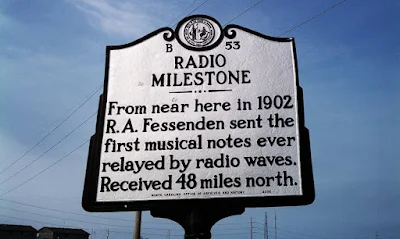
Fessenden's Music from the Outer Banks

George, KB3ODH, found this about 1/2 mile from the Cape Hatteras Lighthouse.

Our book: "SolderSmoke -- Global Adventures in Wireless Electronics"http://soldersmoke.com/book.htmOur coffee mugs, T-Shirts, bumper stickers: http://www.cafepress.com/SolderSmokeOur Book Store: http://astore.amazon.com/contracross-20

Monday, August 15, 2011

Bike Radio II

Thanks for all the suggestions on the bike radio. I googled around a bit and found a schematic that seems very similar to the little receiver I'm working with. I almost certainly would be better off starting anew (perhaps keeping the AF circuitry). But it is interesting to see how a simple AM receiver works. That first transistor is an autodyne circuit -- both a mixer and a oscillator.

Our book: "SolderSmoke -- Global Adventures in Wireless Electronics"http://soldersmoke.com/book.htmOur coffee mugs, T-Shirts, bumper stickers: http://www.cafepress.com/SolderSmokeOur Book Store: http://astore.amazon.com/contracross-20

Sunday, August 14, 2011

Bike Radio

As I mentioned on the podcast, I've been riding my bike to work lately. I really enjoy it. We have great bike trails in this area. They use paths of defunct railroad lines -- I ride Washington and Old Dominion Trail.

My bike is a bit of a boatanchor. It was made in Japan. I bought it 22 years ago when I was in Spain. I've used it in Spain, The Dominican Republic, the UK, Portugal, Italy, and in the U.S.

Of course, my thoughts have turned to putting some sort of HF radio on the bike, probably just a receiver. I still have a little handle-bar AM radio that I added shortly after I bought it. The handle bar mount is still good. See above. I'm pleased to see that it looks very simple, with discrete components. The AF amps are obviously off to the left of the speaker. To the right of the speaker we obviously have the RF and IF circuits. There are some nice tuned transformers there (from the "Chop Shing" company), and three transistors and a diode. What would the standard lineup be for a simple AM radio of this type? Maybe just an RF amp in the front end, a local oscillator, one stage of IF amplification and the diode as the detector?

What do you guys think? Make use of some of the existing circuitry? Start over?

Our book: "SolderSmoke -- Global Adventures in Wireless Electronics"http://soldersmoke.com/book.htmOur coffee mugs, T-Shirts, bumper stickers: http://www.cafepress.com/SolderSmokeOur Book Store: http://astore.amazon.com/contracross-20

Thursday, August 11, 2011

Alarm from Space

So I was sitting in the shack yesterday morning, drinking coffee and listening to IGY by Donald Fagen on Pandora, when I heard what I thought was an alarm. I thought it might have been a smoke detector going off (always a real possibility in the N2CQR shack!). It took me a moment to realize that what I was hearing was the device pictured above. I'd left my 2 meter HT tuned to 145.950 MHz, and Arissat-1 was breaking squelch with SSTV tones. Very cool.

Later, I was thinking about this as I pedaled along on my bike. I remembered our recent discussion of Copthorne MacDonald, inventor of SSTV. Way to go Cop!

It is easy to join in the fun. Just tune you two meter gear to 145.950 and leave it there. You'll soon be alarmed just as I was.

Our book: "SolderSmoke -- Global Adventures in Wireless Electronics"http://soldersmoke.com/book.htmOur coffee mugs, T-Shirts, bumper stickers: http://www.cafepress.com/SolderSmokeOur Book Store: http://astore.amazon.com/contracross-20

Wednesday, August 10, 2011

Shack Background Music from Pandora Radio

Billy alerted me to Pandora. Very cool. You just give it an indication of the kind of music you'd like to listen to. They do the rest. I started out with Creedance Clearwater Revival, and Pandora proceeded to send me a stream of sort-of similar rock. Streaming audio through the web. And it is apparently all legal (you listen to a commercial every once in a while). This is great for background music in the shack. After all, you can only listen to so much SolderSmoke, and 75 meter SSB chatter is not good for you. I'm not sure if it is available outside the USA. I hope it is.
www,pandora.com


Our book: "SolderSmoke -- Global Adventures in Wireless Electronics"http://soldersmoke.com/book.htmOur coffee mugs, T-Shirts, bumper stickers: http://www.cafepress.com/SolderSmokeOur Book Store: http://astore.amazon.com/contracross-20

Big Book Sale

Our book: "SolderSmoke -- Global Adventures in Wireless Electronics"http://soldersmoke.com/book.htmOur coffee mugs, T-Shirts, bumper stickers: http://www.cafepress.com/SolderSmokeOur Book Store: http://astore.amazon.com/contracross-20

Monday, August 8, 2011

The Picture You Heard in SS 136 -- FROM SPAAAACE!

In the last podcast I played a recording of some 2 meter signals picked up by my handheld transceiver from the new amateur radio satellite ArisSat-1. Included in the transmission were some tones that were obviously SSTV. Mike, K2MTS, ran the audio through some SSTV software and got this! Pretty good! From space to my HT, across the room to the SolderSmoke mic, out over the internet in podcast form, back to me in an e-mail, and now, on the blog. Thanks Mike!
Our book: "SolderSmoke -- Global Adventures in Wireless Electronics"http://soldersmoke.com/book.htmOur coffee mugs, T-Shirts, bumper stickers: http://www.cafepress.com/SolderSmokeOur Book Store: http://astore.amazon.com/contracross-20

Sunday, August 7, 2011

SolderSmoke Podcast #136

http://soldersmoke.com/soldersmoke136.mp3
August 7, 2011
Travelogue: New York City
A Stroke of Luck: Lightning strikes Rome HB DC DSB WSPR rig
It's an IGY thing: Recreating the Sputnik Transmitter
ArisSAT-1 deployed. Audio Clip (Can anyone decode the SSTV in this clip?)
Summertime SPRAT -- ZL2BMI rig and the mysteries of the '602
A writer for "The New Yorker" builds a radio
June Smithsonian Magazine has a lot of Knack
Electric Radio on AM selectivity, Japanese, and the sibilant S problem
Gathering Drake 2-B Serial numbers for use with German Tank Equation
Amazon breaks into oscillation on "Atoms to Ampere" prices
MAILBAG

Our book: "SolderSmoke -- Global Adventures in Wireless Electronics"http://soldersmoke.com/book.htmOur coffee mugs, T-Shirts, bumper stickers: http://www.cafepress.com/SolderSmokeOur Book Store: http://astore.amazon.com/contracross-20

Saturday, August 6, 2011

Big Nick's Awesome Homebrew Tube Radios

Eddie, KC4LVV, alerted me to the web pages of Nick, KC9KEP. What beautiful craftsmanship! Inspirational stuff! Check out the homebrew capacitors. And the coils! And the coil winder. It's almost too much!
http://www.bignick.net/TubeRadio.htm

Our book: "SolderSmoke -- Global Adventures in Wireless Electronics"http://soldersmoke.com/book.htmOur coffee mugs, T-Shirts, bumper stickers: http://www.cafepress.com/SolderSmokeOur Book Store: http://astore.amazon.com/contracross-20

Thursday, August 4, 2011

ARISSat Deployed


I just got back from a vacation trip to New York City (amazing place!) and found out that yesterday Russian cosmonauts launched the ARISSat amateur radio satellite. This one looks like lot of fun. It has a two meter downlink. I'll be doing some listening, and my try to get some of the SSTV signals.

Uh oh.... Just read a post from Mark over on Brainwagon reporting on some problems with the deployment:
http://brainwagon.org/2011/08/03/arissat-1-is-off-to-a-bumpy-start/

Details on how to use the satellite can be found here:
http://www.amsat.org/amsat-new/ARISSat/ARISSatHowTo.php

............................................

Our book: "SolderSmoke -- Global Adventures in Wireless Electronics"http://soldersmoke.com/book.htmOur coffee mugs, T-Shirts, bumper stickers: http://www.cafepress.com/SolderSmokeOur Book Store: http://astore.amazon.com/contracross-20

Friday, July 29, 2011

Amateur radio at PAR (W4OP)

An e-mail exchange on QRP-L this morning about using ceramic resonators in 455 kHz filter circuits (great idea Grayson!) led me to the ham radio corner of the PAR electronics web site. PAR is the company run by Dale Parfitt, W4OP.
http://www.parelectronics.com/par-amateur-radio.php.
That's a nice looking 2-B Dale! Please send us the serial number! Even more impressive is Dale's award-wining homebrew solid state version of the 2-B (on the far right). Visit his web site for more info (on his site you can hover your mouse above the pieces of gear for more info).


I'm proud to say that I have a piece of gear in my shack that was built by Dale Par
fitt. The story is told in SolderSmoke The Book: I'd built my own version of Doug DeMaw's Barebones Superhet and had liked it a lot. When I saw another one (this one built on a FAR circuits board) for sale on e-bay, I bought it. It stayed on the shelf for a while. Years later when I started working on it, I turned to QRP-L for help and this fellow named Dale Parfitt came to my rescue. It was only after a long series of e-mail exchanges did we realize that the receiver we were discussing had been built (and sold to me) by... Dale Parfitt.

Our book: "SolderSmoke -- Global Adventures in Wireless Electronics"http://soldersmoke.com/book.htmOur coffee mugs, T-Shirts, bumper stickers: http://www.cafepress.com/SolderSmokeOur Book Store: http://astore.amazon.com/contracross-20

Wednesday, July 27, 2011

Walford Electronics' "QRP In the Country"

A stiff wind and occasional drizzle did not put off the large attendance of QRP and home building enthusiasts who attended QRP in the Country on July 17th. Hundreds of people from all over England and Holland found their way to Upton Bridge Farm, Somerset where the farm barns provided cover. About 25 stalls and displays showed off or sold everything from components to large construction projects. Apart from a few traders selling components, most displays were from Clubs publicising their activities or of ancient domestic and wartime radios, with a few individuals selling items to make space for new projects! There were also practical construction projects to be seen as ‘students’ built their Cary RXs with occasional help from the Bath Buildathon team led by Steve G0FUW. The catering team led by Tony G0GFL cooked a prodigious amount of special local burgers and sausages from the host Tim G3PCJ’s farm served in rolls baked locally that very morning, and washed down by village beer and cider, under the careful eye of Robert PA9RZ!

A raffle raised £200 for those suffering in East Africa; the main prize being a year’s subscription to PW kindly donated by Rob G3XFD which was won by Graham G4DPH. George G3RJV was asked to select a couple of displays that ‘appealed’ to him for two other prizes. The GQRP Club had kindly donated a special edition of Drew VK3XU’s latest project book which was also won by G4DPH for his PW Sprat project; a Walford Electronics Radlet CW TCVR kit went to Colin G3YHU for his valved superhet. A years subscription to BYLARA was won by SWL Mike Jones who is about to take his Foundation licence course.

After the event Tim G3PCJ said he was said delighted with the increased attendance and wished to thank everybody whose hard work had made the event so successful. He urged all Clubs within reasonable distance to plan their displays for next year! Watch the press for announcements of the date!


Any questions to:-
Tim Walford G3PCJ
walfor@globalnet.co.uk
WALFORD ELECTRONICS
www.users.globalnet.co.uk/~walfor


Designers & suppliers of kits for radio enthusiasts

Proprietor Tim Walford BSc MIEE CEng G3PCJ

-----------------
Our book: "SolderSmoke -- Global Adventures in Wireless Electronics"http://soldersmoke.com/book.htmOur coffee mugs, T-Shirts, bumper stickers: http://www.cafepress.com/SolderSmokeOur Book Store: http://astore.amazon.com/contracross-20

Tuesday, July 26, 2011

How Curiosity Will Land on Mars


Our book: "SolderSmoke -- Global Adventures in Wireless Electronics"http://soldersmoke.com/book.htmOur coffee mugs, T-Shirts, bumper stickers: http://www.cafepress.com/SolderSmokeOur Book Store: http://astore.amazon.com/contracross-20

Regens: A Complex Relationship; AA7EE's WBR


Bill -
I've been following your blog for a while now and am moved to let you know of my recent experience with regens, a subject that I know is dear to your heart or perhaps, more accurately, the basis of a complex relationship!
Anyway, the last time I built and owned a regen was as a teenager in the UK in the late 1970's when I had a one-tube HAC Model DX one tube regen. Recently I've been looking for a fairly simple receiver to build that would
receive CW and SSB on 40M, as well as AM. I'm developing an interest in AM on 40, a rather impractical mode in some ways, but one that I have an attachment to. A regen seemed an obvious choice, so after seeing the
reprint in "More QRP Power" of the QST article describing N1BYT's WBR regen, I decided to have a go at it.
In short, I'm so glad this was the first regen of my adult life. It is sensitive, suffers no hand-capacitance effects, has very little radiation from the antenna port due to the oscillator tank circuit being in a Wheatstone Bridge arrangement,
no microphony and to make things even better, is very stable in frequency. I can set it to a net or long-winded CW QSO and it stays there with no easily discernible drift (after a short warm-up period of course).
I know you're probably aware of this receiver, but have you tried building one? I think you'd be pleasantly surprised.
The blog post about my version of this great little receiver is here:
Yours,
Dave Richards
AA7EE

Our book: "SolderSmoke -- Global Adventures in Wireless Electronics"
http://soldersmoke.com/book.htm
Our coffee mugs, T-Shirts, bumper stickers: http://www.cafepress.com/SolderSmoke
Our Book Store: http://astore.amazon.com/contracross-20

Saturday, July 23, 2011

The Dish

Our man in Dayton, Bob Crane, W8SX, sent us a really beautiful picture of my favorite antenna (not the one above). Check it out: http://apod.nasa.gov/apod/ap110721.html

We talk about "The Dish" from time to time on SolderSmoke. That's the name of the movie about the role of this antenna in the reception of the TV signals for the Apollo 11 moon landing. This is -- without a doubt -- the best movie ever made about an antenna.

You can get the movie at the Gadgeteer Book Store:
http://astore.amazon.com/contracross-20?_encoding=UTF8&node=8

Check out "SolderSmoke -- Global Adventures in Wireless Electronics"
http://soldersmoke.com/book.htm

Friday, July 22, 2011

Steve "Snort Rosin" Smith: Silver-Tongued Devil! Dual-band "Vlad the Inhaler" RX

You'll see in the comments attached to my last blog post that our man on the left coast, Steve Smith, gave that cute little Doug DeMaw/Vlad Polyakov receiver a name that might set American-Russian ham relations back a bit: He called it "Vlad The Inhaler." Good one Steve! (But you might want to stay out of the diplo game!)

It occurred to me that with the installation of one little switch in the diode part of the circuit, we could turn this into a dual-band RX. Take a look here:

http://soldersmoke.blogspot.com/2010/03/polyakov-plus-dual-band-receiver-with.html

Check out "SolderSmoke -- Global Adventures in Wireless Electronics"
http://soldersmoke.com/book.htm

Wednesday, July 20, 2011

Doug Demaw and Vlad Polyakov

I was looking through W1FB's Design Notebook the other day and I came across the above schematic for a direct conversion receiver (page 111). Note the Polyakov detector. One strange thing though: Doug was running the oscillator at the operating frequency. I thought the big advantage of the Polyakov design was that you ran the oscillator at half the operating frequency (that's why it is sometimes called a "subharmonic" detector). Any ideas on why Doug did it this way?

Check out "SolderSmoke -- Global Adventures in Wireless Electronics"
http://soldersmoke.com/book.htm

Tuesday, July 19, 2011

Royal Order of the Sputnik Clone Chasers

Kettering Group, UK

From the Chief Designer (AA1TJ):

Fellas,

I came across an online blurb for the recent book, Sputnik: The Shock of the Century, by Paul Dickson; a worthwhile read, judging from the introduction and first chapter.

http://www.sputnikbook.net/intro.php

"Someone brought out a shortwave radio, and soon a beeping noise filled the room. A Russian scientist, Anatoli Blagonravov, confirmed it was Sputnik. "That is the voice," he said dramatically. "I recognize it." John Townsend Jr., one of the scientists at the party, recalled watching Blagonravov: "I knew him quite well, and I could tell that he was a little surprised and quite proud. My reaction was 'Damn!'"

And so an abstraction now had a voice. It also had a name - Sputnik.

Many of those at the party adjourned to the Soviet Embassy's rooftop, attempting to view Sputnik with the naked eye. Several of the American scientists drifted over to the American IGY headquarters in Washington, where they began speculating on what impact the satellite would have. They feared that the American people would be disappointed.

It also dawned on them that they had better start tracking the satellite's orbit. They got in touch with the American Radio Relay League in West Hartford, Connecticut, asking its 70,000 members-all "ham" radio operators-to lend a hand and help track the Sputnik. In less than twenty-four hours, reports on the satellite were coming back to the National Science Foundation, where a temporary control room had been established. Eventually, these hams and other amateur and professional trackers would consider themselves part of a great international fellowship known as ROOSCH, or the Royal Order of Sputnik Chasers."

That's right guys...ROOSCH...the Royal Order of Sputnik Chasers. And to think that fifty four years later a second great international fellowship would rise from the ashes...ROOSCCH, or the Royal Order of Sputnik Clone Chasers! ;o)

(BTW, October 4, 1957 is an important date in American history for a second reason. On that evening the first episode of Leave it to Beaver made its debut.)

...............................................

I thought we should also at this point remember the intrepid lads of the Kettering Group, pictured above. (Some of those dudes look like they would have been right at home in "Leave it to Beaver.") For more info on their amazing Sputnik adventures go here:
http://www.svengrahn.pp.se/trackind/getstart/oldcyts.htm
and here
http://www.svengrahn.pp.se/trackind/trackin1.htm#KEttrack


Check out "SolderSmoke -- Global Adventures in Wireless Electronics"
http://soldersmoke.com/book.htm

Monday, July 18, 2011

Sputnik QSL from the Soviet IGY Committee

I like the reminder of Sputnik's IGY connection. This is from an article by John Foley. W7ETS, in the October 2007 issue of QST. Be sure to read the translation in the caption.

Yesterday Billy and I were at the Smithsonian Air and Space Museum's Dulles Airport center. (We volunteer to take visiting relatives to the airport IF we get to go to the Smithsonian afterwards.) We checked for Sputniks. Nyet. I think they have one on display in the main Air and Space building.

I was thinking that listening to a signal from a spacecraft should be part of the Sputnik event. The packet 2-meter signals from the International Space Station are probably the easiest to receive these days.

Check out "SolderSmoke -- Global Adventures in Wireless Electronics"http://soldersmoke.com/book.htm