Podcasting since 2005! Listen to our latest podcast here:

Podcasting since 2005! Listen to Latest SolderSmoke

Thursday, November 10, 2011

JBOT Amplifier Installed in Azorean DSB Rig

I've been remiss in posting to the blog, but I have a good excuse: I've been melting solder. I have working on the installation of my new Farhan-designed JBOT amplifier in my old Azorean DSB transceiver. I'm really enjoying this project, and I now see it as the first in a series. My shack has a number of creations that were built during the peak years of the last solar cycle, but have since fallen into disuse. Many of them were partially cannibalized -- usually it was the RF amplifier that was taken out. The JBOT was just what I needed. I plan to refurbish all of these rigs, adding a bit of India to each one of them. This is very much in keeping with our "International Brotherhood of Electronic Wizards" ethos.

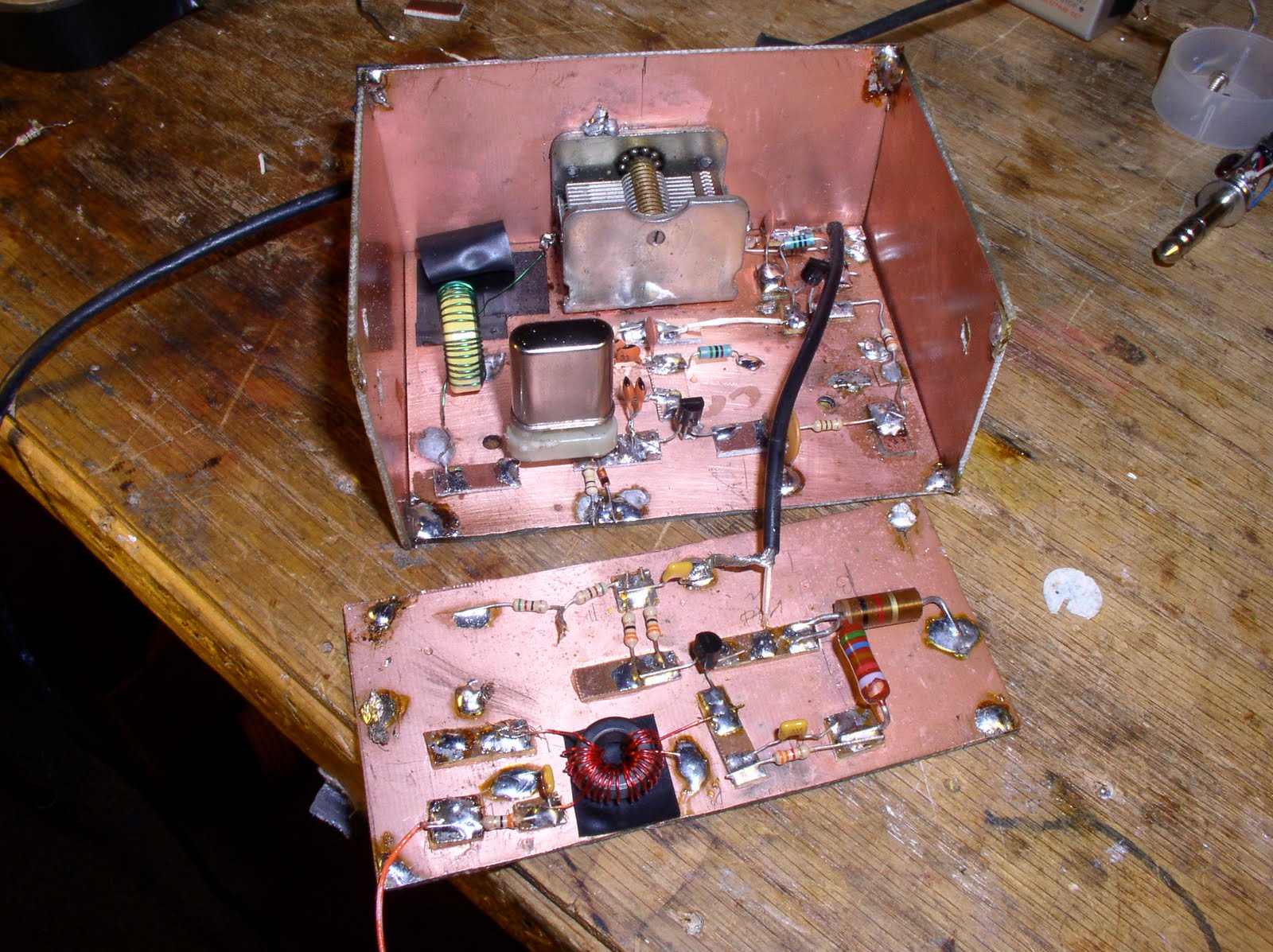
The installation went fairly well, but with all of the ups and downs that accompany this kind of project. The amp worked fine on the bench, fed with a signal generator and into a dummy load. But of course, life got more complicated when I installed it in the rig. Yes, it took off on me. This was no fault of the amplifier -- I just needed to add some additional shielding. It is working fine now. See above. I moved it out of center stage and put it off in the corner to avoid feedback problems. More discussion of this in the next podcast (maybe this weekend).

Our book: "SolderSmoke -- Global Adventures in Wireless Electronics"http://soldersmoke.com/book.htmOur coffee mugs, T-Shirts, bumper stickers: http://www.cafepress.com/SolderSmokeOur Book Store: http://astore.amazon.com/contracross-20

Sunday, November 6, 2011

Tony Sale and the Re-Building of Colossus

Steve "Snort Rosin" Smith sent us this, noting that "Tony Sale definitely had The Knack." As the Brits would say, "indeed."

http://mathdl.maa.org/mathDL/?pa=mathNews&sa=view&newsId=1195


Amazing info on Tony Sale's work here:
http://www.codesandciphers.org.uk/lorenz/index.htm

I got a kick out of this bit:

One reason for wanting to get Colossus working in 1996 was that for far too long the Americans have got away with the myth that the ENIAC was the first large-scale electronic digital calculator in the world. It was not, but they got away with it because Colossus was kept secret until the 1970s. As 1996 was the 50th anniversary o the switch-on of ENIAC I made sure that Colossus was rebuilt and working in Bletchley Park, just as it was in 1944.

There has been a stunned silence from across the water!

Our book: "SolderSmoke -- Global Adventures in Wireless Electronics"http://soldersmoke.com/book.htmOur coffee mugs, T-Shirts, bumper stickers: http://www.cafepress.com/SolderSmokeOur Book Store: http://astore.amazon.com/contracross-20

Saturday, November 5, 2011

21st Century Ham Radio -- EDN Article

A few listeners sent this in. Thanks! Note the mention of AA1TJ's CFL light bulb rig!

http://www.edn.com/article/519742-Ham_radio_in_the_21st_century.php


Our book: "SolderSmoke -- Global Adventures in Wireless Electronics"http://soldersmoke.com/book.htmOur coffee mugs, T-Shirts, bumper stickers: http://www.cafepress.com/SolderSmokeOur Book Store: http://astore.amazon.com/contracross-20

Thursday, November 3, 2011

First Flight in Electric Multi-copter


Our book: "SolderSmoke -- Global Adventures in Wireless Electronics"http://soldersmoke.com/book.htmOur coffee mugs, T-Shirts, bumper stickers: http://www.cafepress.com/SolderSmokeOur Book Store: http://astore.amazon.com/contracross-20

Recreational Engineering


I like that term! "Amateur Engineering" always seemed to sound kind of scary, conjuring up images of bridges that don't quite stay in place. "Recreational Engineering" has a nicer, less ominous ring to it. I found this phrase at the end of this newspaper article on the Maker movement:

http://www.csmonitor.com/Innovation/Tech/2011/1101/Maker-Faire-Mad-science-for-the-masses/%28page%29/2


Our book: "SolderSmoke -- Global Adventures in Wireless Electronics"http://soldersmoke.com/book.htmOur coffee mugs, T-Shirts, bumper stickers: http://www.cafepress.com/SolderSmokeOur Book Store: http://astore.amazon.com/contracross-20

Wednesday, November 2, 2011

Happy Birthday Arecibo! A Tour of the Radio Telescope


Yesterday I was listening (as I do each morning at 0635) to Garrison Keillor's "Writer's Almanac." (I use a beautiful old FM broadcast receiver that Rogier out in California sent me for my birthday.) Garrison announced that it was the birthday of the Arecibo radio telescope (it opened on November 1, 1963). I wanted to post something about this on the blog, but was running a bit late and didn't get to it. This morning I was greeted by an e-mail from Ken, KG6PO, alerting me to a really magnificent video tour of the Arecibo facility. Wow. This is truly amazing. You guys are going to love this one. Three cheers for Bob Zimmerman! As I watched, I got the distinct feeling that we were visiting Bob's shack, and that the dish was his antenna!

Please spread the word about this video -- it is a real shame that it has only received 757 views. Three cheers for the guys who filmed this. Beautiful work.

Links:

http://youtu.be/kQJawfbjpxw

http://www.youtube.com/watch?v=kQJawfbjpxw

Our book: "SolderSmoke -- Global Adventures in Wireless Electronics"http://soldersmoke.com/book.htmOur coffee mugs, T-Shirts, bumper stickers: http://www.cafepress.com/SolderSmokeOur Book Store: http://astore.amazon.com/contracross-20
Monday, October 31, 2011

Pumpkin Pi and JBOT Gremlins

Maria wanted to go with a mathematical theme for this year's Jack-0-Lantern. Pumpkin Pi!

I have been chasing some gremlins and banshees around my old Azores 17 meter DSB rig. The JBOT Amp worked fine into a dummy load, but of course things got a bit more complicated when I put it into the rig and connected it to an antenna. It would take off (like a banshee!) if the load was at all reactive. I think this is the result of inadequate shielding and inputs a bit too close to outputs. But it all settles down nicely when I put a transmatch in the antenna line and tune out the reactance. I may just leave it this way.

Output is a bit low -- only about 1 Watt. I realize that at 18 MHz output should be dropping a bit, but I think I should be getting more. I THINK I'm giving it the recommended 1 milliwatt input. At some point I think Farhan mentioned the possible need to experiment with the number of turns on the secondary of the output transformer....

Our book: "SolderSmoke -- Global Adventures in Wireless Electronics"http://soldersmoke.com/book.htmOur coffee mugs, T-Shirts, bumper stickers: http://www.cafepress.com/SolderSmokeOur Book Store: http://astore.amazon.com/contracross-20

Sunday, October 30, 2011

Snow Static


Related to our post about my new (old!) all-boatanchors heating system (see below), yesterday I had some really horrendous static. I think it was caused by the snow. A Google search on "snow static" brought me to this video (which Gregg in Finland found "shocking""). I liked the tuner and the neon bulbs too.

Our book: "SolderSmoke -- Global Adventures in Wireless Electronics"http://soldersmoke.com/book.htmOur coffee mugs, T-Shirts, bumper stickers: http://www.cafepress.com/SolderSmokeOur Book Store: http://astore.amazon.com/contracross-20

My New Shack Heating System: Heath, Halli, Hammarlund and Drake

Temperatures dropped over the weekend and I had to fire up my new heating system for the SolderSmoke shack. See above. Heating by Heath, Halli, Hammarlund and Drake (sounds like a law firm doesn't it?). I'm happy to report that those old filaments take the chill off quite nicely while adding a nice aroma to the room, along with some very pleasing lighting effects (I especially like the green glow from the DX-100 tuning dial).

The Azores-17 DSB JBOT project is (I think) complete. And I did include a low pass filter. In keeping with the finest of ham radio traditions, now that it is cold I will go out and work on an antenna.

Our book: "SolderSmoke -- Global Adventures in Wireless Electronics"http://soldersmoke.com/book.htmOur coffee mugs, T-Shirts, bumper stickers: http://www.cafepress.com/SolderSmokeOur Book Store: http://astore.amazon.com/contracross-20

Saturday, October 29, 2011

Another Treasure Trove: The Royal Society's Archive

I'm a big fan (wanna-be really) of The Royal Society. In SolderSmoke 138 I noted that Isaac Newton (former Society president) seems to have had The Knack. And when I was in London one of the major perks of my job was that I occasionally got to visit the Society's headquarters. Bill Bryson recently edited a book about the Royal Society -- in his intro he noted that they have always been a very international group (just like us!)
Several readers wrote in with the happy news that the Society's 350 year archive has been placed on-line. Here it is:
http://royalsocietypublishing.org/site/authors/free-archive.xhtml


Our book: "SolderSmoke -- Global Adventures in Wireless Electronics"http://soldersmoke.com/book.htmOur coffee mugs, T-Shirts, bumper stickers: http://www.cafepress.com/SolderSmokeOur Book Store: http://astore.amazon.com/contracross-20

Friday, October 28, 2011

Homebrew Jet Engine from Junkbox Parts!


Bob, W8SX (our man in Dayton) sent me this nice video. I really liked the friendly and enthusiastic way in which the builder described his project. I only wish he would have fired it up! Thanks Bob!

Our book: "SolderSmoke -- Global Adventures in Wireless Electronics"http://soldersmoke.com/book.htmOur coffee mugs, T-Shirts, bumper stickers: http://www.cafepress.com/SolderSmokeOur Book Store: http://astore.amazon.com/contracross-20

Wednesday, October 26, 2011

Azorean Oscillator Re-build

With my JBOT amp ready for installation, it was time to go back and check out the rest of the circuitry on my old Azorean DSB/Direct Conversion 17 meter "Magic Carpet" transceiver. I was surprised to find that the oscillator, well, wouldn't oscillate. The MPF102 that I had in the main oscillator circuit was blown. I suspect voltage spikes from the T/R relay. I installed the required diode across the relay coil. (I seem to blow up a lot of MPF102s. Is it just me, or are these devices really fragile? They are junction FETs, not MOSFETS, so I thought of them as being more robust. But I seem to go through a lot of them.)

After messing around with the oscillator and buffer circuits, the nice clean Manhattan isolation pads that had been there at the start were all messed up, with big piles of solder with the ends of multiple axial leads stuck in there. I decided to start afresh. Out came the little PCB box that housed that housed the oscillator, buffer and amp stages. Off came the walls of the box. (When I built this thing the first time, I didn't realize that I would need an amp to get to the 7 dbm needed to drive the diode ring. I ran out of room on the main board and ended up building the needed amplifier on the back wall of the box!)

So I got to build this little circuit again, ten years and three countries after the original build. It was fun. I like building oscillators. There is that satisfying sense of closure and completion when, at the end of the effort, you turn on your receiver and hear the tone from your creation.

There was also a fun little bit of troubleshooting. After rebuilding the oscillator circuit I noticed that applying power to the "on the wall" amplifier caused the oscillator to shut down. At the buffer, I was seeing RF in and RF out, but the whole thing would shut down when I powered up the next stage. Obviously there wasn't a lot of BUFFERING going on! Sure enough, the MPF102 was bad. I replaced it from my dwindling supply, and all was right with the universe.

Now the amp goes in. But first I will build the low pass filter. I promise.

Our book: "SolderSmoke -- Global Adventures in Wireless Electronics"http://soldersmoke.com/book.htmOur coffee mugs, T-Shirts, bumper stickers: http://www.cafepress.com/SolderSmokeOur Book Store: http://astore.amazon.com/contracross-20

Steve Jobs (age 12) calls Bill Hewlett (of HP)

"When he was in eighth grade, Steve Jobs decided to build a frequency counter for a school project and needed parts. Someone suggested that he call Bill Hewlett. Finding a William Hewlett in the telephone book, the 12-year-old Jobs called and asked, "Is this the Bill Hewlett of Hewlett-Packard?" "Yes," said Bill. Jobs made his request. Bill spent some time talking to him about his project. Several days later, Jobs went to HP and picked up a bag full of parts that Bill had put together for him."

More HP stories: http://www.hp.com/retiree/history/founders/hewlett/quotes.html

Our book: "SolderSmoke -- Global Adventures in Wireless Electronics"http://soldersmoke.com/book.htmOur coffee mugs, T-Shirts, bumper stickers: http://www.cafepress.com/SolderSmokeOur Book Store: http://astore.amazon.com/contracross-20

Tuesday, October 25, 2011

Monday, October 24, 2011

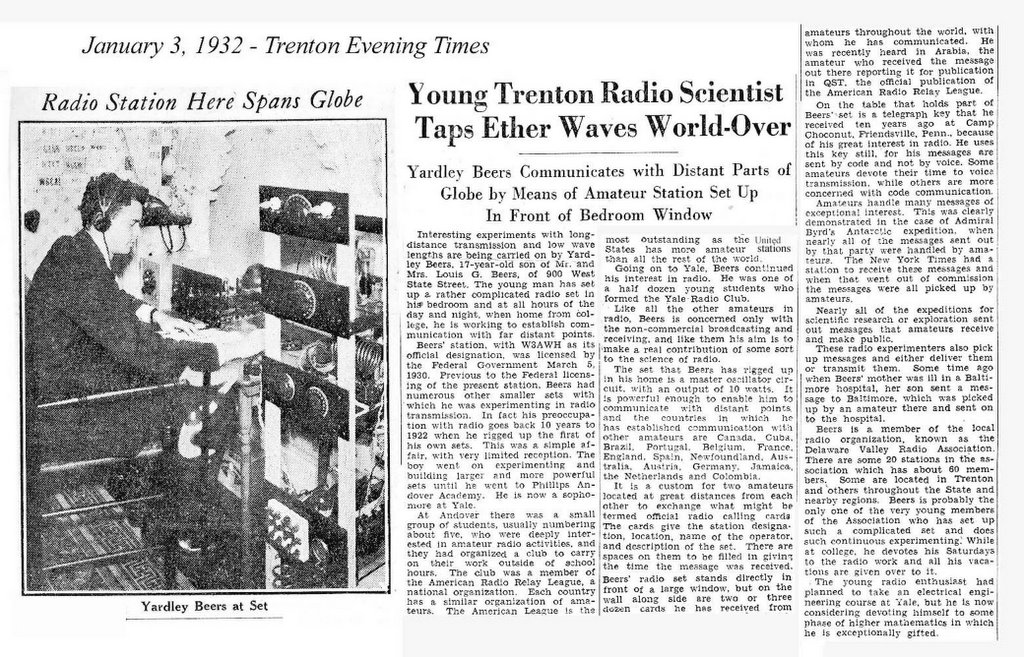
Better Link to 1932 Yardley Beers Article

(From the November 2004 issue of QST)

I hear that picture I posted of the 1932 newspaper article was pretty much illegible. Sorry about that. Try this one from the Delaware Valley Radio Association. Scroll down a bit until you see OM Yardley in his front bedroom shack (the one with a window on the world!). On my Firefox browser I was able to click on it and get an easily read-able view.

http://photos1.blogger.com/blogger/2790/1877/1600/Yardley%20Beer%20DVRA1.jpg

Thanks DVRA!

BTW: Did you catch the name of the fellow who taught young Yardley the Morse Code? Atherton Noyes. Such good strong names!


Our book: "SolderSmoke -- Global Adventures in Wireless Electronics"http://soldersmoke.com/book.htmOur coffee mugs, T-Shirts, bumper stickers: http://www.cafepress.com/SolderSmokeOur Book Store: http://astore.amazon.com/contracross-20

Sunday, October 23, 2011

More on Yardley Beers

Just click on the article and use the zoom feature of your browser to visit the teenage shack of Yardley Beers.

Our book: "SolderSmoke -- Global Adventures in Wireless Electronics"http://soldersmoke.com/book.htmOur coffee mugs, T-Shirts, bumper stickers: http://www.cafepress.com/SolderSmokeOur Book Store: http://astore.amazon.com/contracross-20

Saturday, October 22, 2011

Homebrew Hero: Yardley Beers

How's that for a beautiful homebrew rig! Prompted by our discussion of distinctive ham radio names, Harv, WA3EIB, sent us a very nice report on Yardley Beers, W0JF. The rig pictured is Yardley's "Jason" 20 meter QRP transceiver. Yardley had named the rig for his cousin. Harv met Yardley at a Colorado hamfest in 1993:

"On the table in front of Yardley was an Aluminum Box fashioned into a QRP radio named, “Jason”, 2 broken and worn head phones from the 1920’s, a few 1980’s QST and, several odd radio parts. My bulb of brilliance was not working that day. I said, “I don’t know what I’m looking for!" Somehow Yardley must have studied my eyes. I had locked my vision onto his very elaborate QRP rig. He paused for a few moments and said, “You into QRP?” By this time I felt more relaxed because he was now on my wavelength. I said, “Why yes, I would rather work with a homebrew radio that the ones with features that no one seems to know what they do!”

Harv bought the Jason (and everything else on Yardley's table) and established a lasting friendship with W0JF.

There is a nice article about OM Yardley's life in the November 2004 issue of QST.


Our book: "SolderSmoke -- Global Adventures in Wireless Electronics"http://soldersmoke.com/book.htmOur coffee mugs, T-Shirts, bumper stickers: http://www.cafepress.com/SolderSmokeOur Book Store: http://astore.amazon.com/contracross-20
Friday, October 21, 2011

Steve Jobs and Heathkit

James, WL7FC/VE3ELI, sent us this clip from a Macleans article. Thanks James.

"His dad, though, was not his only early influence. In those days, the neighbourhoods of Silicon Valley were crawling with techies and engineers conducting cutting-edge work for firms like Hewlett-Packard and the Shockley Semiconductor Company. One of them was Larry Lang, who lived a few doors down from the Jobs house. Steve spent almost as much time in Lang’s garage as his own, tinkering with electronic equipment and assembling “Heathkits”: mail-order products such as amateur radios and receivers that took many hours—and much patience—to put together. Jobs would later say that those Heathkits helped him realize that everyday appliances, like the television in his living room, were not “magical” creations. “It gave [me] a tremendous level of self-confidence, that through exploration and learning one could understand seemingly very complex things in one’s environment,” he said. “My childhood was very fortunate in that way.”"


Our book: "SolderSmoke -- Global Adventures in Wireless Electronics"http://soldersmoke.com/book.htmOur coffee mugs, T-Shirts, bumper stickers: http://www.cafepress.com/SolderSmokeOur Book Store: http://astore.amazon.com/contracross-20

Wednesday, October 19, 2011

Oh No! Short Circuit Danger with Anodized Heat Sinks?

Our friend Brent out in Minneapolis sent me some pre-Halloween HB frights yesterday. I'm still concerned. Am I living dangerously with my anodized but collector-connected heat sinks glued to the ground plane?
What say the HB gurus?

--- On Tue, 10/18/11, KD0GLS wrote:

From: KD0GLS Subject: Re: JBOT Amp
To: "Bill Meara"
Date: Tuesday, October 18, 2011, 9:38 PM

Bill,

Well, it is nearly Halloween, but it wasn't my intention to frighten you!

I think it's hard to argue with the fact that it works as-is. The heatsinks you bought look like common anodized aluminum to me. Out of curiosity I dug a couple of similar ones out of my parts bins and measured them. I found exactly what you did - wide open on the surface, and, not surprisingly, a dead short just underneath. I've always assumed that anodize finish was metallic and conductive, but now I know otherwise. I like to learn at least one new thing each day, so thanks for providing today's opportunity!

The clearances are no doubt small, but I think with the low voltages present in your circuit you'll probably be fine. The only potential problem might be if movement or vibration might someday break through that coating. I'd certainly recommend a fuse in the power supply line if you don't already have one.

Anyway, it looks great sitting there in the middle of your old rig. It's inspiring.

Brent


On Oct 18, 2011, at 19:42, Bill Meara wrote:

Brent: You scared me with your question but I think what I did is OK. Maybe. I looked more carefully at the clip on heat sinks I bought. They are covered with a non-conductive coating, but f I scratch them up a bit I can reach the conducting part. So i guess you just have to treat them gently if you intend (as I did) to super-glue them to the PC board. I notice that Farhan did the same thing (see his JBOT page) so I guess I'm OK. I put some heat sink compound in there too. And then there is the super glue. I have no short circuits from the collectors. I guess I could have used a Dremmel to isolate the copper just below the transistors. Or I could have put some mica between the heat sinks and the boards.

The sinks are deeper than the transistors, so there is no direct contact between the top of the transistor and the PC board.

What do you think?
--- On Tue, 10/18/11, KD0GLS wrote:

From: KD0GLS >
Subject: JBOT Amp
To: "Meara Bill" >
Date: Tuesday, October 18, 2011, 5:27 PM

Bill,

The amp looks mighty FB, and maybe I should try it as well. But I'm curious how you've insulated the collectors of all those transistors from the ground plane. From the picture, it looks like all of the metal heat sinks are sitting right on the ground plane copper.

.73,
Brent, KD0GLS, Minneapolis

Our book: "SolderSmoke -- Global Adventures in Wireless Electronics"http://soldersmoke.com/book.htmOur coffee mugs, T-Shirts, bumper stickers: http://www.cafepress.com/SolderSmokeOur Book Store: http://astore.amazon.com/contracross-20

Tuesday, October 18, 2011

My JBOT 5 Watt Linear (Farhan's Design)

There it is -- my version of Farhan's JBOT 5 watt linear amplifier. JBOT stands for "Just a Bunch of Transistors." But I think Farhan is being modest. I really like the design, especially the effort to make this something that hams around the world can reproduce from readily available parts. For example, Farhan's original version used TV balun cores for the transformers. I didn't have any of those around, but I found three "mystery spec" binocular cores in my junk box. They seem to be working just fine. (I tested them a bit: Farhan had written that FT 37-43 cores would work. T1 has seven turns trifilar. Seven turns on my mystery cores yielded 13uH. On an FT 37-43 core 7 turns yields around 20 uH. Close enough -- these are, after all, broadband transformers.)

Note how closely my build follows Farhan's schematic (which you can see in the background). When building this circuit, I just kept Farhan's web page on my computer screen, and scrolled up and down from his schematic to the photo of his version.

This is the first linear amplifier that worked the first time I powered it up. It didn't release any smoke, or leave transistor burn tattoos on fingers, or try to be a 14MHz oscillator.

This version is going into my Azores-built 17 meter DSB transceiver. See how nice it fits:

Our book: "SolderSmoke -- Global Adventures in Wireless Electronics"http://soldersmoke.com/book.htmOur coffee mugs, T-Shirts, bumper stickers: http://www.cafepress.com/SolderSmokeOur Book Store: http://astore.amazon.com/contracross-20