Serving the worldwide community of radio-electronic homebrewers. Providing blog support to the SolderSmoke podcast: http://soldersmoke.com
Podcasting since 2005! Listen to Latest SolderSmoke
Monday, September 19, 2022
Video version of SolderSmoke Podcast #240
SolderSmoke Podcast #240 NIMCELS? Hex DX, CBLA RX, PTO? Solid State HT-37? Exotic caps, Benches, SBE-33, TenTec 540, KWM-1 MAILBAG
SolderSmoke #240
Monday September 19, 2022
http://soldersmoke.com/soldersmoke240.mp3
Sorry, I had some technical difficulties so my audio is a bit distorted.
NIMCELS? Niche Internet Micro Celebrities. I dunno.... Can our listeners come up with an acronym
that describes our place in the universe?
Sponsors: Parts Candy. Carlos in Chicago. Great
leads. Don't scrimp with a crimp! You need some good quality test leads on your workbench. Get yours from Carlos. Click on the picture on the blog page or go to PartsCandy on e-bay.
"Techno Wizardry"? Our lawyers at
Dewey Cheatham and Howe will be after them for that!
Bill's Bench:
Hex Beam has made me a DXer.
91 countries. Having fun. Mozambique (Long path), San Andres island, and Saudi Arabia, all on Friday. All homebrew SSB 100 watts.
Put my old 20 meter CW station back on the air: Barebones superhet and the VXO 6 watter. WYKSYCDS. This may be one of very few CBLA Receivers in the world!
Been getting active in the Vienna Wireless Society. Dean KK4DAS is President and a lot is
happening in the Club. Makers group. Lunch
with the group on Tuesdays. Lots of fun.
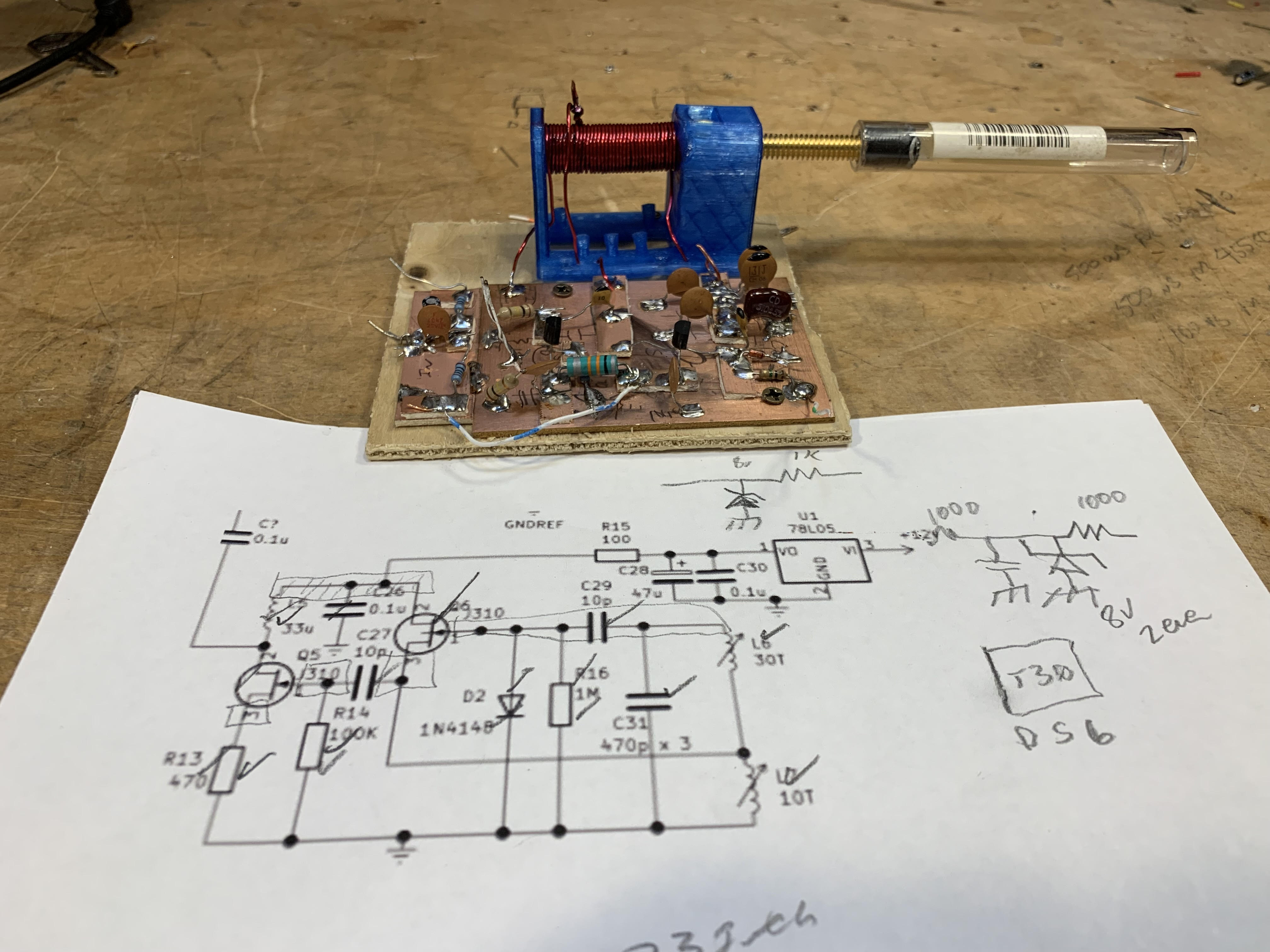
We are looking at Farhan’s Daylight Again Analog rig. Using parts from Dean’s 3D printer, we have made PTOs. See blog post for picture. (But are they really PTOs? Or just Variable Inductors?)
VFO madness. Solid stating an HT-37 VFO. Grayson: “You have clearly lost your mind.” Perhaps. 100 MHz FM broadcast RFI. This brought me to capacitors and linear tuning:
SLC, SLW, SLF and Midline/Centerline caps. Do special caps explain why some VFOs have
linear tuning while others do not? NO,
not really. You can get linear tuning
with ordinary caps. See blog post
Working on the bench. Reading
Adam Savage’s book on workshops and tools. (link to the book in the right hand
column of the blog. Some other
workbench links on the blog. Upgrading
tools and test gear. I have a proper bench
power supply. Better side cutters.
Engineering rulers. Digital calipers.
Better solder (I was talking to Ron WA6YOU – a real solder authority - about
this. Kester 60/40 ).
SHAMELESS COMMERCE DIVISION:
mostlydiyrf.com
Currently offering seven
items:
· UDVBM-1
(in three versions)
·
PG-TIA Broadband IF Amplifier
·
TIA-AGC IF Amplifier
·
Dual-Gate MOSFETs
·
OA741D Op-Amp (discrete components)
·
8-Pole QER Crystal Filter
·
I2C Rotary Encoder
Three more are shown as coming
soon:
·
GP Audio Amp (general-purpose audio amp)
·
HyCas IF Amplifier with AGC
·
M-Cubed (Michigan Mighty Mite kit)
·
Mostly DIY RF offers hardware for
hardware-defined radio. That's not a comment on software-defined
radio. SDR is cool and useful, and it has its place.
·
In fact, I believe in explicitly
making use of technology from all eras (vacuum tubes,
discrete semiconductors, and integrated circuits
·
What does "mostly" DIY mean? It
means making what you want and using ready-made for the rest. Even the most
fanatic DIY'ing home brewer does this without much thought. He uses components
he didn't fabricate, electricity he didn't generate, and theoretical knowledge
he didn't discover. One can't fight all battles, one has to
choose which to fight and which to leave to others. If an appliance-operating
Ham doesn't want to fight at all, that's okay, but Mostly DIY RF has
nothing to offer him.
--------------
I need YouTube viewing hours. So I am
putting some of the best SolderSmoke podcasts up on the YouTube channel. Please listen/watch on YouTube. Here is the
playlist: https://www.youtube.com/playlist?list=PLv9MEKq1quk-gnxog7eBqY_y7cpQadf6T
Google feed no longer sending our e-mails.
So please follow the blog, Get yourself a blog feed reader. I use Feedly.
It is free. Download, search in
Feedly for SolderSmoke, hit subscribe and you are done. https://feedly.com/i/discover Follow
Pete’s blog too! It is easy.
Resurrections:
SBE-33!
TenTEC Model 540
KWM-1
Mailbag:
Dan KC5VPI getting into homebrewing. No longer WRONG!
Michael AG5VG built subharmonic DC receiver, put it on 40 and 20. FB.
Mike AA9IL working on old tube stuff including a DX-100 AMD UUHF gear up to
122GHz.
Ed WA4MZS liked the SolderSmoke book. USCG vet. As is Mike Rainey AA1TJ Semper Paratus!
Clint KA7OEI – The Music of the Beams – My Hex does not sing! So far!
Walter KA4KXX – The Knack started early.
Video of getting a toolbox for Christmas. And working on PTOs! He likes them!
Phillip G4HOJ Also working with subharmonic mixers – using the more complex
4 diode version.
Peter GW4ZUA Built an amazing rig from RADCOM (1980s) Cool VFO with varactor
fine tuning and a coil with a dust core that was cut in half to minimize temp
effect. Box now holds 3 band version of
Pete’s SimpleCeiver. FB.
Bruce KC1FSZ building 25 Watt amp for his Peppermint Bark rigs. We won’t turn him in to the QRP authorities.
Grayson KJ7UM tested the 12BY7A from my DX-100 VFO. It was in fact weak. Thanks Grayson.
Charles Smith KV4JT has some really interesting stuff on how
to solid state tube gear. Especially
R-390s. https://soldersmoke.blogspot.com/2022/08/trigger-warning-solid-stating-old-tube.html
Gianfranco I0ZY Old friend from Rome. Amplifier manufacturer. FB.
Paul WA1MAC getting started again after long hiatus.
Vasily.. I mean Todd VE7BPO.
Always great tech info. Thanks.
Mark WB8YMV building a superhet with a 455 kc IF.
I sent Farhan some comments on his Daylight Again video: He
wrote back “I marvel at their stamina to watch an hour long video of a
man talking with a funny accent!”
Sunday, September 18, 2022
Building Farhan's PTO -- But Is This Really a PTO?
Thanks again to Dean, and to Farhan.
Friday, September 16, 2022
Fixing Up An Old Homebrew Rig -- Barebones Superhet and VXO 6 Watter
Thursday, September 15, 2022
SolderSmoke (Old Smoke) Podcast #103 -- March 15, 2009 -- From Rome -- QRSS, Knights and Wizards, LTSpice, and an Echolink QSO with Jeff KO7M (the guy with the Piper Cub)
15 March 2009
Beware the Ides of March! Ostia Beach and Ostia Antica 248 Knights of QRSS. And Wizards! ET Phones Home (with QRSS?) Possible new grabbers in VK6 and Dubai Telescope, Satellites... REAL QRP QSOs on 80 and 40 Saving an old Toshiba Laptop ECHO-QSO WITH JEFF, KO7M: -- Piper Cubs and MFJ Cubs -- Satellite QSOs -- LT Spice and test gear MAILBAG: Gene W3PM listens from QE2, HB WSPR rig Jim AL7V sending parts for my W3PM rig Jim AB3CV's color burst Gnat Jason NT7S on Tektronix guys and SolderSmoke Kevin ZL3KE on old computers Paul M1CNK's DDS 30-based QRSS beacon Soeren OZ2DAK on exercise bikes to power beacons
Wednesday, September 14, 2022
SolderSmoke Podcast #85 With Mike Herr WA6ARA June 8, 2008 WIZARD ISLAND!
When I was putting this podcast up on YouTube, I needed a picture of Mike Herr WA6ARA who was my guest on this episode. I found a picture of Mike activating a summit... THE SUMMIT OF WIZARD ISLAND! That is Wizard Island (above). Mike and his wife are shown at the summit (below).
Tuesday, September 13, 2022
Great Technical Info and Tribal Knowledge from GQRP
Thanks to Tony Fishpool G4WIF for sending us this link.
There is a lot of great tech info and Tribal Knowledge on the GQRP page. This is all related to our discussion of how to set up an electronic workbench or workshop.
Thanks Tony and thanks to GQRP.
Monday, September 12, 2022
Workbench and Workshop Tips -- Please Put Suggestions in the Comments
During a recent visit to Barnes and Noble I picked up Adam Savage's book (please use the Amazon link in the righthand column) about Making and workshops. Adam's book reminded me of the importance of giving thought to the organization and set-up of your workbench or workshop. I found more tips on YouTube:
Wow, watch the KatVoltage video (above). Unlike the person in a recent unfortunate advertisement, Kat clearly knows which end of the soldering iron to grab. She is setting up a good workshop -- you can tell from how she is organizing the bench. I wish her a lot of luck. htt(s://www.youtube.com/watch?v=1NcVzTu7TbE&t=54s
Andreas (the guy with the white glove and the Swiss accent) has some good ideas:https://www.youtube.com/watch?v=inW57njiq1A
The EEVblog guy has a good guide to the basic stuff that you need to build an electronics workshop. It is a bit dated (2011) but the guidance is still very good (I wouldn't go with the homebrew or kit-built power supplies): https://www.youtube.com/watch?v=R_PbjbRaO2E
Van Neistat has a very good Top Ten List of things NOT TO DO in a workshop. NO FLATHEAD SCREWS. I'm with you Van. NO HOARDING. etc. https://www.youtube.com/watch?
Sunday, September 11, 2022
An Especially Good (Old) SolderSmoke Podcast
Saturday, September 10, 2022
The Cure for Frequency "Bunching Up" in Analog LC VFOs -- It Is Not So Simple. But we have a good calculator. Comments sought!
One of the complaints about analog LC VFOs is that they have non-linear tuning -- when you turn the dial (usually attached to a variable capacitor) the space between frequencies is NOT constant. This is especially apparent at the high end of the frequency scale where frequencies (and stations) appear to be severely bunched together, making tuning difficult. This problem contributes to the defection of some great homebrewers: They give up on LC VFOs and they switch to digital VFOs. Sad.
But there is hope: Not all LC VFOs tune this way. Even on rigs from "back in the day," back when the Si5351 hadn't even been thought of, some LC VFO rigs tuned linearly. My beloved Drake 2-B and my almost equally beloved HT-37 are good examples. How did they do this? How did they escape the dreaded "bunching up?"
For a while, I thought that it might have had to do with the use of the series tuned Clapp circuit. But on further noodling, this didn't seem to make much sense.
Then -- like others -- I thought that it must be caused by the adroit use of special capacitors. You see, in ordinary variable capacitors when you turn the dial, the capacitance increases linearly. But in the LC circuit, frequency changes as the inverse of the square of the capacitance. Thus the bunching up. So the solution must come from the use of the special capacitors that compensate for this, that -- because of the shape of their plates -- produce linear tuning. With these variable caps, frequencies on the dial are spaced out nicely, there is no bunching up. Great right?
Over the years, many hams have jumped to the conclusion that rigs with good tuning linearity MUST be using these special caps. For example, in 2013 a ham posted in the Antique Radio forum this message:
There are three types of open, variable plate caps;
SLC= straight line capacitance where the capacitance varies linearly,
these are the most common and have half-circle plates
SLF= straight line frequency where the plates are tapered to allow
for linear tuning of the frequency
SLW= straight line wavelength, you get the idea...
SLF and SLW caps have oblong plates.
The effect on tuning a receiver can be dramatic. One example is the
Hammarlund SP series of receivers where the ham bands are very
compressed at one end of the tuning range. They used SLC caps
in the VFO. On the other hand rigs like the Kenwood TS-520
and FT-101 series have linear tuning across each band. These use
SLF variable caps. Most old 1920's battery radios used SLW
where stations were identified by their wavelength.
Well, not really.
-- I now have several VFOs from the extremely linear-tuning FT-101. But when you open them up to look at the tuning capacitor, it is NOT a Straight Line Frequency capacitor.
-- Many of us over the years have built VFOs that are quite linear in their tuning without resort to these special capacitors -- we did it with ordinary Straight Line Capacitance caps.
-- When you look at the "How to build VFO" literature in the ham radio books, you see a lot of good recommendations about using solid, brass-vaned caps with ball bearings at either end. But never do you see circuits that require the use of SLF or SLH capacitors. If they were the key to tuning linearity, we'd see them mentioned in the literature. But we don't.
So where does the linearity -- or bunching up -- come from?
The answer comes to us from a really neat calculator from Bob's Electron Bunker:
http://electronbunker.ca/eb/BandspreadCalc.html
This calculator allows you to select your frequency range, and the tuning range of your variable cap. It then displays for you what the tuning range will look like on your dial. You can see if there will be bunching up, or if the frequencies will be nicely spread out. And -- and this is the really cool part -- you can then specify if your capacitor is SLF, SLW, SLC or Midline-Centerline. This really illustrates the effect of the different capacitor types.
I used Bob's calculators to do some experiments with various types of capacitors, various frequency ranges, and various combinations of trimmers and padders. You can see what I did here:
http://soldersmoke.com/VariableCapsSLCSLF.pdf
One important thing to keep in mind: The SLF caps were made for AM broadcast receivers that were tuning from 540 to 1600 kc. That is a 3:1 tuning range. Most of the time in HF ham radio, we are tuning across a much smaller range, say from 5 MHz to 5.5 MHz. That is a 1.1:1 tuning range. In those cases where we ARE tuning across a wide tuning range -- for example with a receiver covering 3-9 MHz, the SLF cap can help prevent the bunching up.
But we can have fairly good linear tuning without resort to SLF caps. Bob and his calculator point out that by narrowing the frequency range of interest, and by using either smaller range caps (ordinary SLC caps), or SLC caps with trimmers and padders, we can achieve tuning linearity. And sometimes, when you have achieved this nice tuning linearity with a plain SLC cap, putting a fancy SLF cap makes tuning linearity worse.
One piece of VFO tribal wisdom that is confirmed by all this: It is better to use a smaller variable cap with a maximum capacity of about 30 picofarads.
I think we should spend as much time focusing on VFO tuning linearity as we do on VFO frequency stability. Bob told me that in the old days, the calculations for various tuning linearity scenarios were difficult. But now we have Bob's calculator. When building a VFO, just use Bob's calculator, plugging in the numbers to get a preview of what your tuning linearity will be like. If it is bunched up, you can play with the trimmer and padder values to achieve the tuning linearity you desire.
Thursday, September 8, 2022
Another Free Book: Contra Cross
Wednesday, September 7, 2022
Building a Workshop (or a Shack) in a Crawl Space
Tuesday, September 6, 2022
Michael AG5VG Builds a Sub-Harmonic Receiver and Moves it to Higher Bands
Good Evening Bill,
Monday, September 5, 2022
Why Do Some VFOs Tune More Linearly Than Others?
This has been one of the major complaints about our beloved analog LC VFOs: The frequency tuning on these circuits is often not linear. For given amount of VFO frequency dial turn you can get vastly different changes in frequency. At one end of the tuning range the frequencies are nicely spaced and tuning is easy. But at the other end of the tuning range all of the frequencies are bunched together. This is one of the problems that leads some homebrewers to defect to the sad land of "digital VFOs."
But wait. It appears that the old designers found a solution to this problem. Just look at the tuning dial of my HT-37. The frequencies are all spaced out evenly. How did they do that?
I had been thinking that this success may have resulted from Hallicrafters' engineers using the series-tuned Clapp circuit. Here the main frequency determining element is a series-tuned LC circuit and not the parallel tuned LC circuit that we see in the more commonly used Colpitts circuit.
But hold on -- how could that be? The frequency bunching problem that we attributed to the Colpitts circuit must also exist in the Clapp, right? I went back to SSDRA where there was a good discussion of Colpitts and Clapp VFOs. The advantage of the Clapp was said to be in its use of a larger value coil which helped minimize the effects of stray inductances. But there was no mention of the Clapp offering improved linearity in tuning.
I have in front of me two transceivers: The Mythbuster uses a 9 MHz Clapp circuit (see below). The 17-12 rig uses a Colpitts Circuit. I checked the tuning linearity of both. Both appeared quite linear in tuning, with no real difference between the two.
Then I looked at the tuning capacitor in the Mythbuster 17-12 rig. It came out of an old Hallicrafters transmitter, probably the HT-44. I looked closely at the stator and the rotor plates. Both are curved. I'm guessing that this may yield a more constant change in capacitance for a given movement of the main tuning dial.
Next I opened up the VFO on the Mythbuster. (It is the VFO from an old Yaesu FT-101.) I couldn't see the stators very well but it appears that their shape is different from the square shape we often see in variable capacitors. Could it be that this variable capacitor was also made to provide linear tuning?
Back in 2013 Norm Johnson wrote about all this in the Antique Radios.com forum:
A capacitor that has uniform increase in capacitance with rotation will have the stations at the high end of the band squeezed together. Another type known as the straight-line frequency variable capacitor has, as you might guess, a characteristic that gives even spacing of frequencies with shaft rotation. These were popular in the 1920's but weren't very good for superhets where you needed to have a dual section capacitor that would tune both the RF and local oscillator, and have them track each other properly. The midline variable capacitor is more compatible with a superhet, and easier to make both sections track properly. This is the type that you see in most receivers from the late 1930's to the end of the tube era. They don't have quite the equal spacing between stations across the band that the old straight-line frequency caps had, but they're much better than the variables that change capacitance linearly with rotation.
I wrote an online calculator that helps in the design of the tuning. It shows what frequency range you'll get with a specific type of variable capacitor, including the effects of padder and trimmer capacitors. It also displays a dial scale that shows how the frequencies are lined up accross the dial.
http://electronbunker.ca/eb/BandspreadCalc.html
Steve W6SSP also provided some really good info back in 2013:
There are three types of open, variable plate caps;
SLC= straight line capacitance where the capacitance varies linearly,
these are the most common and have half-circle plates
SLF= straight line frequency where the plates are tapered to allow
for linear tuning of the frequency
SLW= straight line wavelength, you get the idea...
SLF and SLW caps have oblong plates.
The effect on tuning a receiver can be dramatic. One example is the
Hammarlund SP series of receivers where the ham bands are very
compressed at one end of the tuning range. They used SLC caps
in the VFO. On the other hand rigs like the Kenwood TS-520
and FT-101 series have linear tuning across each band. These use
SLF variable caps. Most old 1920's battery radios used SLW
where stations were identified by their wavelength.
Steve W6SSP
The Drake 2-B also has perfectly linear tuning. I looked at the manual: "The tuning condenser is of special design..." I'm guessing that they used an SLF variable capacitor. The 2-B had no need for ganged capacitors -- the "preselector" was tuned via a separate front panel control.
I looked at the tuning dials on my Hammarlund HQ-100 receiver. It is fairly linear in its tuning, but not as linear as the HT-37 or the Drake 2-B; on all of the tuning ranges the frequencies seem to spread out a bit at the lower end. My guess is that Hammarlund used the midline variable described above by Norm Johnson. The HQ-100 did use a ganged variable cap, with one section tuning the RF amplifier and the other tuning the local oscillator.
Sunday, September 4, 2022
Free Book! "SolderSmoke -- Global Adventures in Wireless Electronics" by Bill Meara. Free for the Next Five Days
https://www.amazon.com/gp/product/B004V9FIVW/ref=dbs_a_def_rwt_hsch_vapi_tkin_p1_i1
Please spread the word and post reviews. Comments posted on the Amazon page (above) are especially welcome.
Saturday, September 3, 2022
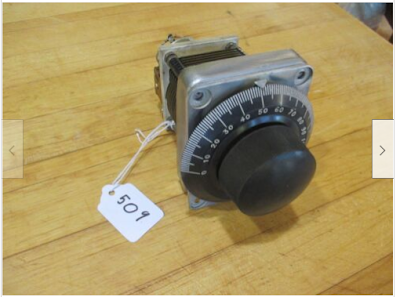
Where Do You Think This Variable Capacitor Came From? What Piece of Gear Did it Come out of? Is it in the Old Catalogs?
Thursday, September 1, 2022
New Video: Farhan's Presentation on the "Daylight Again" Analog Transceiver
Tuesday, August 30, 2022
Old Smoke: SolderSmoke's Early Theme Music from W8MOJ, Boatanchors in South Africa, and Homebrewing in Dubai
Over on the SoulderSmoke YouTube channel I have been putting up some podcasts from days-gone-by. Recently they have been from our last days in London and our earliest days in Rome. We have had a nice series that includes "Echo-calls" from Andy ZS6ADY in South Africa, talking about old tube radios (Boatanchors) in that country. Soon we will start a series that includes Echo-calls with Ron Sparks AG5RS, who was homebrewing in Dubai.
But these early podcasts begin and end with some very distinctive techno-music from Mark O Johnson, W8MOJ. Here is our old blog post that describes Mark's musical contribution to SolderSmoke. Thanks Mark! https://soldersmoke.blogspot.com/2011/01/tech-details-on-soldersmokes-theme.html
Sunday, August 28, 2022
Building a Solid-State "Magic Eye" and Fitting it in the Old Tube's Glass Envelope
Saturday, August 27, 2022
Free Book by Bill Meara -- Not About Radio. But it is about family life on a very long trip.
Free! From time-to-time Amazon Kindle allows me to make this book available FOR FREE. You can get the Kindle version for free until the end of August. Here is the link: https://www.amazon.com/dp/B00L8DR4RK
All I ask is that you spread the word, and post reviews. I hope you like it. Thanks, Bill