Podcasting since 2005! Listen to our latest podcast here:

Podcasting since 2005! Listen to Latest SolderSmoke

Tuesday, November 15, 2022

Dhaka Jack Moves to France

Jack Welch AI4SV has been an important member of the SolderSmoke community for many years.  I remember fondly our Straight Key Night CW contact in which he told me that my HT-37 had "presence" even on CW.  His thoughtful (!) piece on time crystals was also quite memorable.  Jack has finally settled down (a bit) after a string of foreign assignments.  He has landed happily in France, in a villa, on a vineyard, surrounded by wild boar and hunters.  FB OM. 

Hi Bill & Pete,


I've packed up the shack and moved from Cyprus to France, so no more 5B4APL. To obtain a French callsign, you have to submit proof that you've lived in France for three months, so I'm F/AI4SV until December and then we'll see. 

I'm not sure how long we will be here, but probably a few years at least. Since we know next to nothing about French real estate, we are renting for the first couple years -- a château on the outskirts of Bordeaux. Before you think that I've come down with delusions of grandeur, I should point out that in that area, château means an old, stone house that is hard to heat in the winter -- and particularly difficult to run wiring around. Antennas and grounding are going to be particularly challenging. The selling point for the house was not so much my hobby as its location in wine country. In fact, there is a Sauterne my house's name on it (although I have nothing to do with production of the wine, that's in professional hands).

Back in the early days of Soldersmoke, Bill used to occasionally mention the dreaded Italian wild boar, the cinghiale. I didn't think that would ever be terribly relevant to me, but it is. A couple days after arriving in the Bordeaux suburbs, a sanglier (French cousin of the cinghiale) strolled across a road as I came around a bend. We almost had a month-long supply of bacon, but I managed to steer around him.

Since it will be a while before all our belongings arrive and even longer to set up a proper station, I have focused on operating QRP in the field and activating SOTA summits. That has gone well, but I aborted my most recent attempt when I ran into a bunch of orange-clad rifle-toting hunters who were combing the mountain in search of sanglier. Apparently it's a big thing here. I decided to survive to activate the peak on another day.

Finally, I have attached a journal article, which at first glance doesn't seem to have a lot to do with radio, but kind of does. It turns out that both the human ear and violins have non-linear characteristics that cause them to function as audio frequency mixers. Looking through the article, you'll find some familiar looking formulas about mixing products, harmonics and resonance. If Bill wants to get away from ICs, perhaps his next rig could include a 17th Century Italian violin as a mixing stage.

Cheers & 73,

Jack
F/AI4SV

----------------------
Hello Jack:  

Great to hear from you.  Wow, France!  You are rivaling my string of nice-to-go assignments.  FB OM.  Have fun.  

Yes, the Cingales.   Hunting season was always a bit of an uneasy time.  We used to dress the kids up in reflective vests.   One time we found a very drunk Italian hunter wandering around with a shotgun (that was kind of scary).  We would know when hunting season started by the sound of gunfire in the morning.    Kind of reminded me of other places!  

In retirement I have gotten back into VWS.  We are having a lot of fun.  Just yesterday 30 students at the Thomas Jefferson High School got their Technician licenses. They will soon build Direct Conversion receivers. 

As for mixing, what you sent reminded me of my early confusion on this subject.  In the SS book I describe the "Terzo Suono"  -- it is really just an additive heterodyne.  I confused it 
with a true mixing product.  But it was an educational confusion. 

Please keep in touch and let us know how things are going at the Villa!  

73  Bill 

Wednesday, November 9, 2022

Direct Conversion Receiver -- Simple 2-Diode Mixer Defeats Radio Marti, but Diode Ring is the Best

 Here is another update on Direct Conversion receiver construction. In Northern Virginia we get very strong signals from the Radio Marti transmitter in Greenville NC. During the morning hours it is just above the 40 meter band at 7335 kHz. In the evening it is a bit higher in frequency at 7435 KHz. (in the video above I mistakenly give the morning frequency, when in fact they were on the higher evening frequency). In either case, Radio Marti has been a big source of unwanted AM breakthrough in our simple DC receivers. It now serves as something of a test of our bandpass filters and mixers.

In this video I try out the simple mixer described in detail here: https://soldersmoke.blogspot.com/2022...

The following morning, I tested the mixer with Radio Marti (in fact) on 7335 kHz. By adjusting the VFO signal input to the minimum value needed to turn on the diodes, I was able to bring Radio Marti AM breakthrough to minimal levels. But I could still hear it (weakly) in the background. Putting a very simple diplexer at the audio output of the mixer (just a .1uF capacitor in series with a 47 ohm resistor to ground) helped a lot.

I could also hear break through from Spanish-language broadcasts from Vatican Radio on 7305 kHz (using the 250 kW transmitter in Greenville NC) from 11:30-11:45. Perhaps most surprisingly, I was also getting AM breakthrough from 40 meter FT8!

Here is a short video showing the simple two-diode mixer in action during the morning hours:

I also tried out the more common two diode mixer with trifilar toroid. (In this one, the VFO turns both diodes on, then turns both of them off). The results were similar to what I got with the other two diode mixer.

We are trying to develop four circuits -- bandpass filter, mixer, variable frequency oscillator, and audio amplifier -- that will be simple enough for construction by high school students, but not so simple as to compromise performance. We want the receiver to work well.

So far, my conclusion is that the best results come from the diode rig mixer with two trifilar toroids. Here is a short video showing the diode ring in action on the morning of November 9, 2022:

Wednesday, November 2, 2022

Understanding a Very Simple Two-Diode Mixer


Take a look at the simple little mixer above.  I think I first saw it in SPRAT.  Thinking that it was really just a simplified version of the two diode Doug DeMaw mixer that I had been using for years, I couple of years ago I built it into a little Direct Conversion receiver.  It worked great.  But later, I began to have doubts about it.  In the words of young James Clerk Maxwell, I started to wonder about "the particular go of it." 

You see, the way the DeMaw mixer is set up,  both of the diodes are simultaneously on and off.  This has the effect of "chopping up" the incoming RF at a rate set by the VFO frequency.  Boom.  Fournier.  Mixing.  Great.  


But look at the mixer at the top of this post.  Here the VFO signal is coming in on the wiper of the 1k pot. The same signal is hitting both diodes at the same time.  The diodes are not being fed differentially.  So D1 and D2 are NOT both simultaneously tuning on and off.  Instead, when the wiper goes positive, D2 turns on while D1 is off.  On negative swings of the voltage at the wiper, D1 turns on while D2 is off.  For me, this made it a "mystery mixer." 

This reminded me of the sub-harmonic DC receiver I built earlier in the year:  The VFO runs at half the operating frequency, but the diodes are set up to switch on and sample the RF TWICE each VFO cycle.  This is the equivalent of having the VFO at the operating frequency.  


Could it be that this was just a sub-harmonic mixer with the VFO at the operating frequency? (I should note that Doug DeMaw published a design that actually made this mistake.  See:  https://soldersmoke.blogspot.com/2011/07/doug-demay-and-polyakov.html ) I knew that this would sort of work, but it would not work very well.  And the mystery mixer seemed to work very well.  Hmmm. 

I was loaning the DC receiver with the mystery mixer in it to a local high school.  I worried that I was loaning them something that I didn't really understand. I remembered that I'd been trying to figure out this mixer since early 2021:  https://soldersmoke.blogspot.com/2021/02/some-thoughts-on-singly-balanced-mixers.html  

Our beloved book, Solid State Design for the Radio Amateur (SSDRA) has an explanation of this circuit on page 74.  But this explanation didn't seen to work for me.  Check it out. YMMV. 

Bottom line:  I still couldn't figure this circuit out, so left it alone for while.  

The other day I woke up and looked at it with fresh eyes.  Suddenly it hit me.  Although the VFO was hitting the diodes in the same non-differential way as is done in the sub-harmonic mixer,  the RF (signal) is entering the mixer in a differential way.  This means that the two diodes are taking turns sampling the upper side of L2, then bottom side of L2, via L1 and L2.  This results in a complex repeating waveform that is similar to that of diode ring mixer.  Within that complex repeating waveform, there are sum and difference frequencies. I did some noodling on this: 


The key difference between this mixer and the sub-harmonic mixer is the way L2 is positioned:  In the sub-harmonic mixer, there is no differential feed of the RF.  Both diodes get the same polarity of RF.  The VFO switches on D1, then D2.  The RF is sampled at twice the VFO frequency.    But in the mystery mixer that had me scratching my head, the RF is fed to the diodes in differential form.  So while the diodes here are -- as in the sub-harmonic mixer -- being switched on and off sequentially, they are taking turns sampling the top and the bottom of L2.  That provides the complex repeating waveform that we need to get the sum and difference frequencies.  In a DC receiver the difference frequency is audio. 

What do you guys think?  Do I have this right?  How would you characterize this mixer:  Is it multiplying by 1 and 0?  Or is it multiplying by 1 and -1? 

This would be good mixer for a school project.  It is simpler than a mixer with a tri-filar toroid. 

Friday, October 28, 2022

SolderSmoke Podcast #241 Mars, Direct Conversion, PTOs and Glue Sticks, Anniversary of the BITX20, Multus Proficio SDR, Boatanchor Station, MAILBAG

The board I use to test DC RX circuits 

SolderSmoke Podcast #241 is available

Audio (podcast):  http://soldersmoke.com/soldersmoke241.mp3

Video (YouTube): (215) SolderSmoke Podcast #241 October 28, 2022 - YouTube

Introduction:

Back on Mars.  Opposition approaching.  I have a Mars filter.  And (like T.O.M.) a Mars globe. 

N2CQR DXCC done

SolderSmoke in the WayBack Machine

Sticker news

PARTS CANDY -- Don't Scrimp with a Crimp! 

Bill's Bench

School DC RX projects -- in Hyderabad and Northern Virginia. 

Direct Conversion Receivers -- Keeping it Simple, Learning a Lot.  A step beyond the Michigan Mighty Mite. Do we really need 100db?  Do we really need to shield VFOs?  Farhan's super-simple and stable Colpitts PTO.  Audio amps, 1000-8 transformers and rolling your own LM386

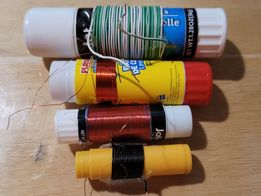
PTOs and Glue Stick PTOs.  Paul Clark WA1MAC. Brass vs. Steel bolts.  #20 thread vs. #28 thread.  Backlash Blues. The best Glue Sticks. 

2 meters and the VWS.  Bill has a Baofeng. 

SHAMELESS COMMERCE:  MOSTLY DIY RF

Pete's Bench

20th Anniversary of the BITX20   Pete's early BITX rigs. 

Computer Woes

The Multus Proficio SDR rig

Simple SSB in China  BA7LNN

Things of beauty: Tempo One, NCX-3 and a SBE-33

MAILBAG

-- NS7V is listening.

-- Graham G3MFJ sent SPRAT on a stick.

-- Nick M0NTV  FB Glue Stick and 17 Shelf videos.

-- Dino KL0S HP8640 Junior

-- Mark AA7TA   Read the SolderSmoke Book

-- Steve EI5DD Connaught (Ireland) Regional News

-- Dave K8WPE  Planting the seeds of ham radio interest

-- Peter VK3YE Ruler idea on PTO frequency readout

-- Michael AG5VG Glue Stick PTO

-- Tobias  A polymath with UK and Italy connections.  And cool tattoos.

-- Alain F4EIT   French DC receiver

-- Michael S.  was in USMC, working on PCM/TDM gear

-- Alan Yates writes up Amazon transformer problem

-- Todd VE7BPO,  Dale W4OP, Wes W7ZOI

-- Farhan VU2ESE sent me an sBITX

-- Todd K7TFC   The Revenge of Analog

-- Jim Olds    Building QRP HB gear  


The Multus SDR rig Pete discussed

The older rigs Pete mentioned


My version of DC RX that Farhan is working on

My PTO with VK3YE's ruler frequency readout


Saturday, October 15, 2022

DC Receiver: 100db Gain? Diplexer? VFO in a box?


Here is a progress report on Direct Conversion Receiver developments. Dual Tuned Circuit, Diode Ring with Diplexer, PTO VFO from Farhan's Daylight rig, two stage 49 db BJT AF amp with a transformer. It works very well. I discuss: Shielding of the VFO -- necessary or not? Why brass in the PTO? Do we really need 100db in a receiver, especially with ear buds? Sourcing the AF amplifier's transformer. Using W7EL's diplexer. (I think it has solved my Radio Marti breakthrough problem). Developing a DC RX circuit that can be built by students. I end with a bandsweep of 40 meters that includes CW, FT-8, SSB, and AM

Tuesday, October 11, 2022

SolderSmoke FOREVER! Archived in the WayBack Machine

 
There were recently some stories about an effort to put on the Internet Archive recordings and other material from the history of ham radio.  I am pleased to report that the SolderSmoke podcasts have been included in the new collection: 


They also archived the recordings of my contacts with the MIR space station (and other spacecraft) from the Dominican Republic in the mid 1990s: 


I have also suggested that they find a way to archive all of Jean Shepherd's recordings about ham radio. 

Thanks to Kay K6KJN for putting our material into the archive. 

Monday, October 10, 2022

Listening on 40 with a Glue Stick PTO in a Direct Conversion Receiver; Some PTO History


Thanks to Paul WA1MAC for this idea.  He first shared it with us via the SolderSmoke mailbag in 2008! Sorry it took so long for me to try one Paul. 


The PTO itself is an old idea of course.  Here is an article from 1966: 
OM faced the problem of having to keep track of frequency while turning the dial many times.  He was hoping to use a turns counter -- in 1966 we didn't have the San Jian frequency counters.  I note that his PTO looked a lot like the one KK4DAS 3D printed for me (using file from Farhan).  

And some background on PTOs: https://sites.google.com/site/randomwok/Home/electronic-projects/permeability-tuners-last-stand


Sunday, October 9, 2022

Paul Clark's Dollar Store PTOs made with Glue Sticks or Chap Sticks


A few weeks ago Pete Juliano and I got some e-mails from Paul Clark about his use of Chap Sticks and Glue Sticks (acquired at a Dollar Store!) in Permeability Tuned Oscillators.

Dean KK4DAS, Mike KA4CDN and I had been experimenting with PTOs following Farhan's use of one in his new Daylight Again transceiver. We are also looking at simple circuits for use in Direct Conversion Receiver builds for high school students.
Yesterday, I noticed a Glue Stick on the floor under my bench. TRGHS. I built one of Paul Clark's PTOs and used it with the circuit from Farhan's Daylight Again rig. For the ferrous material, I just glued (!) a .5 inch toroid (I think it is #7 material) onto the moving internal part of the glue stick. For the coil I used a total of 9 turns of #20 wire, with a tap at 2 turns. You can see the results in this video.

I think it is really useful, a very nice way to get good frequency control using an item available in most super-markets (I bought two glue sticks at Harris Teeter yesterday!). This continues a long ham radio tradition of using household items for ham projects -- we started with breadboards.

 Some of Paul's coils: 


Some of Paul's data:

Here's the data I got in testing these on the NanoVNA:
Burt's lip balm
16t #24 insulated
brass tubing ferrule
80pf
9.93mhz-10.80mhz
3.21uh-2.714uh
Dollar Store PTO Forms in 3 sizes
Small Jot Glue Stick (8 for $1.25!)
1 3/8" of #30 enameled close wound
waiting brass tubing to fit cup
80pf
2.980mhz with no core, I'm waiting brass tubing to fit this one (we have no hobby stores around here anymore that stock the K&S music wire and brass tubing assortments)
35.65uh
Medium Playschool Glue Stick
36t #30 enameled
1/2" copper water tubing
80pf
2.96m-3.380m
36.13uh-27.72uh
Large JOT Glue Stick
1/2" copper water tubing
80pf
28t #24 insulated
4.995m-5.625m

12.69uh-10.00uh

Friday, October 7, 2022

How the Diode Ring Multiplies by 1 and -1 -- "The Secrets of the Diode Ring" -- Plus another Bandsweep with the DC RX


A deeper look into how the Diode Ring detector works: "the particular go of it." Here I rely on a wonderful diagram from the RSGB. This diagram clearly shows how in this circuit, the switching action of the diodes -- controlled by the VFO -- results in sum and difference frequencies at the output. This is amazingly illuminating. I then tried to build this actual circuit. It works, but I am also getting a lot of AM breakthrough from a local AM station (WFAX) and Radio Marti at 7335 kHz. I will try again. In any case, the diagram shows how the diode ring does its thing! I need to beef up the Band Pass Filter. I tuned around a bit on 40 meters -- you can listen. Students at a local high school have been trying to get the DC receiver I loaned to them going -- they may be confused by the intricacies of SSB tuning. I will see them next week.

Here is the RSGB diagram that reveals the secrets of the Diode Ring.  (Now that could be the title of a book or movie.  I claim the rights to that!)  Click on the image for a better view. 

Thursday, October 6, 2022

How to Tap an Aluminum Heat Sink: Pete Juliano Shares Tribal Knowledge


This is a SolderSmoke Classic:  Pete Juliano N6QW coached me on how to tap (put screw threads)
a piece of aluminum.  This is an important homebrew skill that -- as I demonstrate -- is 
easy to screw up (no pun intended).  Thanks to Pete for sharing this tribal knowledge. 

This video has been quite popular.  It has been viewed more than 33,000 times since 2014, and there are 35 comments attached to it.  

Thanks Pete! 

Adding a Diode Ring to the Direct Conversion Receiver, And How the Diode Ring Works


I take a look back at Wes Hayward's classic DC receiver from the November 1968 QST.
I then try to describe how diode ring mixers work ("the particular go of it") using Alan Wolke's excellent YouTube description as my base.

I present some drawings that I did that use the "crossed diode" diagram as the start.

I also discuss interference from Radio Marti's 250 kW transmitter on 7335 kHz in Greenville NC.

Finally, we listen to the receiver a bit.

Alan Wolke's Diagram

Wes Hayward's 1968 DC Receiver

Tuesday, October 4, 2022

Tim Hunkin's "The Radio Set" Drawing, and The Secret Life of the Radio (Remastered)


Click on the image for a better view. Click here for the whole drawing: 

I really liked this, and there is a lot more like it on the site of Tim Hunkin, the fellow who made all the great Secret Life of Machines shows.  His site: https://www.secretlifeofmachines.com/index.shtml

They remastered the show about radios.  It is worth watching: 

Thanks Tim! 

The Workshop and Bench of the QRP Home Builder, Todd VE7BPO


What a treat!  We have been learning so much, for so long from Todd VE7BPO.  I was really pleased to have this look at the workshop where all the magic happens.  

While my technical abilities are far inferior to his, I was pleased to see some scenes and some shelves that are similar to those that can be found here. 

Thanks Todd! 

Sunday, October 2, 2022

Update on the Direct Conversion Receiver -- Now only 4 transistors


I took a new look at the receiver, did some measurements, and decided to take out the RF amplifier and the AF pre-amp. The receiver works fine without them, another indication that they were unnecessary. Line-up is now: Band-pass filter, Mixer, VFO, AF amp. I think there is only 49 db of gain in the entire receiver, but it is useable with an un-amplified speaker, and is a bit too loud on ear buds. Not bad for just 4 transistors. And I think we could do this with just 3 (no need for the VFO buffer).

Here is the AF amplifier I used:  

Friday, September 30, 2022

Sticker News (from Holland)

Lex PH2LB sends this really interesting Vice story about stickers and sticker culture.  Who knew?  The original article is in Dutch, but just hit the Google Translate button and Bob will be your uncle. 

https://www.vice.com/nl/article/wxnpp5/wie-zijn-de-mensen-die-overal-stickers-plakken

I shared with our Solder-Sticker Community these thoughts: 

Really cool Lex.   This reminds me that we need more stickers.  And maybe a new design.  The IBEW thing confuses Americans -- here it looks like a labor union thing. 

The Color Burst Liberation Army logo (below) is one possible element that we might want to include.  I think our new stickers should exhort people to DO something:  

"BUILD A SHORTWAVE RECEIVER!" 

"LIBERATE 3.579 MHz!"  

"MELT SOLDER!"  

"RESIST FT-8!"

"JUST SAY NO TO SDR!"    

Things like that. 

Thoughts?  Discuss.  


Bandsweep with the New Homebrew 40 meter Direct Conversion Receiver


It is inhaling nicely but some improvements are still pending. Click on the video above to see and listen to the bandsweep done on 40 this morning. 

-- The front end consists of capacitive divider input impedance matching circuit, followed by one LC circuit and an FET RF amp.  

-- The VFO is a super-simple Colpitts design by Farhan.   The two feedback capacitors do double duty in the LC tan circuit.  

-- I am using an old variable capacitor instead of the PTOs that we have been experimenting with.  

-- The mixer is singly balanced using one trifilar toroid and two diodes.  We have found out that even with these three simple devices, there is significant variation in how people connect them to VFO, RF in and audio out.  I think we have found the best way to do this:  Be sure to put the VFO on the primary of the transformer, and let this signal turn the diodes on and off. 

-- For the AF amplification, I have one FET, followed by two BJTs.  I have a small audio transformer between the speaker and the final AF amp.  There is plenty of audio. 

You may wonder why, after all the SSB superhet transceivers, I am building a simple Direct Conversion receiver.  Well, we hope to help a bunch of high school kids build one, so we need to be really familiar with how it works.  And I find that as simple as it is, there is still a lot to learn in a project like this. 

Thursday, September 29, 2022

A Bout of Direct Conversion-ism in Northern Virginia -- DC Receivers Under Construction


There I was, minding my own business,  when suddenly I was dragged into the construction of Direct Conversion receivers. 

Here is a video about my latest effort.  But I feel the urge for more simplification -- I may go back to the seminal DC receiver designed by Wes W7ZOI and presented in the November 1968 issue of QST.  It is on page 15 here: https://worldradiohistory.com/Archive-DX/QST/60s/QST-1968-11.pdf

Tuesday, September 27, 2022

SolderSmoke Podcast #130 Feb 5, 2011 Trivia Questions! Recorded on a D-104! Heroic efforts to Suppresssss Ssssibilant SSSSs

February 5, 2011

For many reasons, this is a pretty amazing SolderSmoke episode. We presented some radio-electronic trivia questions. This is the one where I used an Astatic D-104 microphone to record the show. I even describe putting Starburst candies, Chicklet gum, and even Duct Tape on my teeth in an effort to get rid of the sibilant S problem. This was truly heroic podcasting my friends! There is lots of other great stuff in this one. Maria arrives in the shack with both Tyson the cat and Cappuccio the dog! Lots of space talk. The story of Grote Reber's name. Much more: Some important trivia questions (answers will be given in the podcast): What is the connection between radio amateur (and pioneer radio astronomer) Grote Reber and world famous astronomer Edwin Hubble? In the world of radio-controlled helicopters, what is "TBE"? In Britain they have radio "rallies," but at one time they had hamfests." When did this happen? Only one terrain feature on Venus is named for a man. He is man of radio. Who is he? What music did Neil Armstrong listen to on his way to the moon? Plus: -- The Air and Space Museums -- Our music -- The SolderSmoke D-104 -- NASA asks for our help -- Telescope repairs -- A BFO for the Trans-O -- Back on Echolink MAILBAG! Please send reports on the D-104 audio!

Monday, September 26, 2022

Open Circuits: Cutting Open Components for a Look inside -- First Chapter Free


Bob KD4EBM sent me this: 

“…. Eric Schlaepfer (@TubeTimeUS) and Windell Oskay (co-founder of Evil Mad Scientist)’s latest book, Open Circuits, is a celebration of the electronic aesthetic, by literally opening circuits with mechanical cross-sections, accompanied by pithy explanations and illustrations. Their masterfully executed cross-sectioning process and meticulous photography blur the line between engineering and art, reminding us that any engineering task executed with soul and care results in something that can inspire feelings of awe (“wow!”) and reflection (“huh.”): that is art. …”

I saw on Hack-A-Day today that the first chapter of the book is available as a free download: 

https://nostarch.com/download/OpenCircuits_Chapter1.pdf

Many of our favorite parts are dissected in that chapter.  The innards of a ceramic disc capacitor, for example, are shown above.

Thanks Bob!