In the course of working on my 160 meter AM station I came across a strong AM signal a bit below Top Band. Turns out it is part of something called the "Travelers" Information Service." The signal from this system on 1.670 MHz is very strong here. A Shortwave (Midwave!) Listener in Austria heard it too. Check out the confirmation letter from the Virginia Department of Transportation. Nice of them to do this. Here is the QSL letter sent to Austria: https://remotedx.wordpress.com/2014/06/01/very-rare-reception-vdot-highway-advisory-radio-1680-khz/ They are running 10 watts into a 49 foot tall vertical with 40 radials. They have a text-to-speech system that is constantly describing weather conditions. Quite useful actually. I found a web site that lists all the stations of this kind in the US:
Thanks to Peter Parker VK3YE for alerting us to this beautiful receiver from Bore 4O6Z in Montenegro. This may be our first ever report on a Montenegrin rig. And it is a thing of beauty. Bore says it is based on a phasing circuit by homebrew legend V. Polyakov, RA3AAA.
It is snowing here today, so I am stuck in the hamshack. YEA!
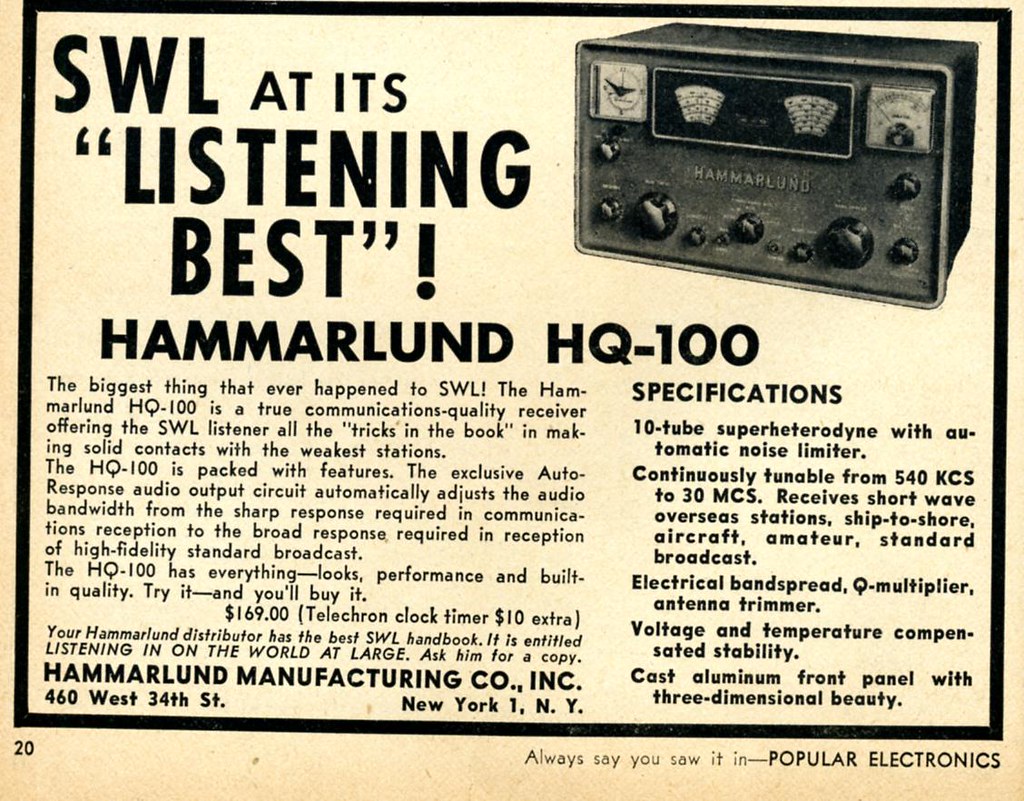
I've had the Hammarlund HQ-100 receiver on the bench because I am building an outboard digital frequency readout for it and for the DX-100. More on this later. But as long as I had it on the bench I decided to do a mod to the audio output that has LONG been needed.
Here is a nice web page that describes the problem and the solution. The problem is the "Auto Response audio output circuit" touted in the add up above. Essentially I had to remove the touted circuitry. The AutoResponseectomy only took me about 15 minutes and the results are quite noticeable. The old receiver sounds a lot nicer. I'm listening to 40 meter AM now. FB.
I listened to it as I aligned my HQ-100 receiver and worked on a digital frequency readout for the old receiver. The interview was the perfect accompaniment for such a project. Inspirational stuff. Lots of great info on QRPp and homebrewing. Mike talks about some of his more famous rigs including the voice-powered New England Code Talker (pictured above).
I loved the story of Michael carting his DX-100 home in a wagon. And I really sympathized when he described the harsh reaction of the phone operator to his early efforts at voice modulation.
Strongly recommended! You won't be disappointed. Great interview. Thanks to Eric and Mike.
Hi Bill I thought I would drop you a quick line to show you something I have been playing around with for the past couple of weeks. It's a SSB superhet using a PJRC Teensy 3.1 microcontroller (YouTube link below), and a great audio library by Paul Stroffregen. Suffice to say I'm really happy with it.
There is a direct conversion front end, albeit using a VFO 15kHz down from the incoming RF. The 15kHz IF is then fed into the Teensy audio line in which can handle up to 22kHz. From there everything is in software. First is a 2.4kHz BPF tuned to the LSB, followed by mixer with a 15kHz BFO. Finally, there is a 2.4kHz LPF. Next step is to add both CW-wide and CW-narrow filters which can be selected during run time.
As you can tell from the video, my antenna is not the best and I have quite a bit of QRM in the shack. I really need to think about a better antenna, but that's another story.
I have been following your R2 endeavors with interest, and as I said to Pete I will attempt to replicate the R2 on a Teensy. I will try and use the divide by 2 arrangement you tried as the logic looks right.
I will also be adding in a transmitter. For that I'll use the microphone input and then take the audio from the line out straight to the RF pre/power amp.
I must admit that I really enjoy homebrewing hardware/software hybrids as you get the best of both worlds. As i say that, I wonder how much ADCs cost these days to directly digitize RF... Now that would be interesting.
I'll say again that I really enjoy following the podcast. I have loved electronics since I was a small boy when my parents bought me a battery, switch and light bulb. This age of cheap DDSs, microcontrollers and the like is amazing, and I get so much enjoyment putting them all together to make functioning ham radios. I hope more get into the homebrew field as the entry barrier is dropping fast.