Serving the worldwide community of radio-electronic homebrewers. Providing blog support to the SolderSmoke podcast: http://soldersmoke.com
Podcasting since 2005! Listen to Latest SolderSmoke
Monday, October 24, 2011
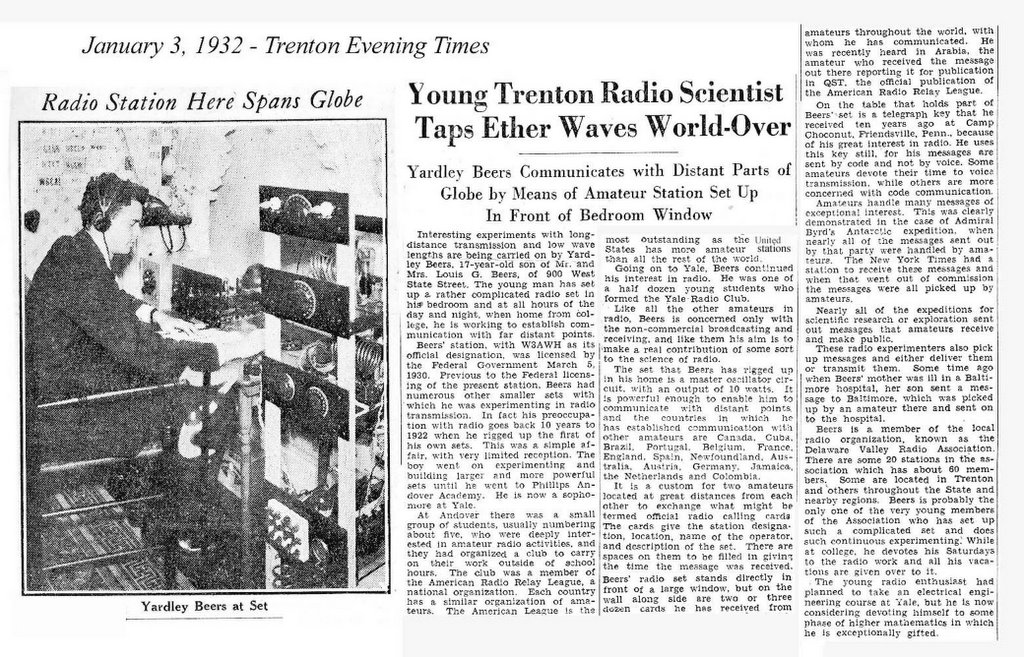
Better Link to 1932 Yardley Beers Article
I hear that picture I posted of the 1932 newspaper article was pretty much illegible. Sorry about that. Try this one from the Delaware Valley Radio Association. Scroll down a bit until you see OM Yardley in his front bedroom shack (the one with a window on the world!). On my Firefox browser I was able to click on it and get an easily read-able view.
http://photos1.blogger.com/blogger/2790/1877/1600/Yardley%20Beer%20DVRA1.jpg
Thanks DVRA!
BTW: Did you catch the name of the fellow who taught young Yardley the Morse Code? Atherton Noyes. Such good strong names!
Our book: "SolderSmoke -- Global Adventures in Wireless Electronics"http://soldersmoke.com/book.htmOur coffee mugs, T-Shirts, bumper stickers: http://www.cafepress.com/SolderSmokeOur Book Store: http://astore.amazon.com/contracross-20
Sunday, October 23, 2011
More on Yardley Beers
Just click on the article and use the zoom feature of your browser to visit the teenage shack of Yardley Beers. Our book: "SolderSmoke -- Global Adventures in Wireless Electronics"http://soldersmoke.com/book.htmOur coffee mugs, T-Shirts, bumper stickers: http://www.cafepress.com/SolderSmokeOur Book Store: http://astore.amazon.com/contracross-20
Saturday, October 22, 2011
Homebrew Hero: Yardley Beers
How's that for a beautiful homebrew rig! Prompted by our discussion of distinctive ham radio names, Harv, WA3EIB, sent us a very nice report on Yardley Beers, W0JF. The rig pictured is Yardley's "Jason" 20 meter QRP transceiver. Yardley had named the rig for his cousin. Harv met Yardley at a Colorado hamfest in 1993: "On the table in front of Yardley was an Aluminum Box fashioned into a QRP radio named, “Jason”, 2 broken and worn head phones from the 1920’s, a few 1980’s QST and, several odd radio parts. My bulb of brilliance was not working that day. I said, “I don’t know what I’m looking for!" Somehow Yardley must have studied my eyes. I had locked my vision onto his very elaborate QRP rig. He paused for a few moments and said, “You into QRP?” By this time I felt more relaxed because he was now on my wavelength. I said, “Why yes, I would rather work with a homebrew radio that the ones with features that no one seems to know what they do!”
Harv bought the Jason (and everything else on Yardley's table) and established a lasting friendship with W0JF.
There is a nice article about OM Yardley's life in the November 2004 issue of QST.
Our book: "SolderSmoke -- Global Adventures in Wireless Electronics"http://soldersmoke.com/book.htmOur coffee mugs, T-Shirts, bumper stickers: http://www.cafepress.com/SolderSmokeOur Book Store: http://astore.amazon.com/contracross-20
Friday, October 21, 2011
Steve Jobs and Heathkit
"His dad, though, was not his only early influence. In those days, the neighbourhoods of Silicon Valley were crawling with techies and engineers conducting cutting-edge work for firms like Hewlett-Packard and the Shockley Semiconductor Company. One of them was Larry Lang, who lived a few doors down from the Jobs house. Steve spent almost as much time in Lang’s garage as his own, tinkering with electronic equipment and assembling “Heathkits”: mail-order products such as amateur radios and receivers that took many hours—and much patience—to put together. Jobs would later say that those Heathkits helped him realize that everyday appliances, like the television in his living room, were not “magical” creations. “It gave [me] a tremendous level of self-confidence, that through exploration and learning one could understand seemingly very complex things in one’s environment,” he said. “My childhood was very fortunate in that way.”"
Our book: "SolderSmoke -- Global Adventures in Wireless Electronics"http://soldersmoke.com/book.htmOur coffee mugs, T-Shirts, bumper stickers: http://www.cafepress.com/SolderSmokeOur Book Store: http://astore.amazon.com/contracross-20
Wednesday, October 19, 2011
Oh No! Short Circuit Danger with Anodized Heat Sinks?
What say the HB gurus?
--- On Tue, 10/18/11, KD0GLS wrote:
From: KD0GLS Subject: Re: JBOT Amp
To: "Bill Meara"
Date: Tuesday, October 18, 2011, 9:38 PM
On Oct 18, 2011, at 19:42, Bill Meara wrote:
The sinks are deeper than the transistors, so there is no direct contact between the top of the transistor and the PC board.
What do you think?
From: KD0GLS >
Subject: JBOT Amp
To: "Meara Bill" >
Date: Tuesday, October 18, 2011, 5:27 PM
Bill,
Our book: "SolderSmoke -- Global Adventures in Wireless Electronics"http://soldersmoke.com/book.htmOur coffee mugs, T-Shirts, bumper stickers: http://www.cafepress.com/SolderSmokeOur Book Store: http://astore.amazon.com/contracross-20
Tuesday, October 18, 2011
My JBOT 5 Watt Linear (Farhan's Design)
Note how closely my build follows Farhan's schematic (which you can see in the background). When building this circuit, I just kept Farhan's web page on my computer screen, and scrolled up and down from his schematic to the photo of his version.
This is the first linear amplifier that worked the first time I powered it up. It didn't release any smoke, or leave transistor burn tattoos on fingers, or try to be a 14MHz oscillator.
This version is going into my Azores-built 17 meter DSB transceiver. See how nice it fits:
Monday, October 17, 2011
My JBOT passes the Smoke Test
Our book: "SolderSmoke -- Global Adventures in Wireless Electronics"http://soldersmoke.com/book.htmOur coffee mugs, T-Shirts, bumper stickers: http://www.cafepress.com/SolderSmokeOur Book Store: http://astore.amazon.com/contracross-20
Sunday, October 16, 2011
Bringing some Knack into Astro-Photography


Our book: "SolderSmoke -- Global Adventures in Wireless Electronics"http://soldersmoke.com/book.htmOur coffee mugs, T-Shirts, bumper stickers: http://www.cafepress.com/SolderSmokeOur Book Store: http://astore.amazon.com/contracross-20
Friday, October 14, 2011
SolderSmoke: Engineering Site of the Day on EE Web!
Dilbert would be so proud! In spite of my Bachelor of Arts Degree, yesterday the SolderSmoke blog was named Engineering Site of the Day by EE Web. I'm especially pleased that the Sputnik rig of the G3XBM team was the featured photo. Check it out:http://www.eeweb.com/websites/solder-smoke-daily-news
http://www.eeweb.com/
Our book: "SolderSmoke -- Global Adventures in Wireless Electronics"http://soldersmoke.com/book.htmOur coffee mugs, T-Shirts, bumper stickers: http://www.cafepress.com/SolderSmokeOur Book Store: http://astore.amazon.com/contracross-20
Thursday, October 13, 2011
Can we put a Sputnik signal back in space for $300?
http://hackaday.com/2011/10/11/send-a-satellite-into-space-for-300/
We just make the antenna a bit longer and put it on 20 MHz. Or for a shorter antenna, 40 MHz.
Bert and the fellows out at UVA are going to take care of the whole SETI thing (Jerry, NR5A, was in the lead on this -- he started the SolderSmoke SETI-AT-HOME group). But we'll need some additional volunteers to cover the Low Earth Orbit portion of the SolderSmoke Space Program. And of course we have to come up with the 300 bucks.
Our book: "SolderSmoke -- Global Adventures in Wireless Electronics"http://soldersmoke.com/book.htmOur coffee mugs, T-Shirts, bumper stickers: http://www.cafepress.com/SolderSmokeOur Book Store: http://astore.amazon.com/contracross-20
Wednesday, October 12, 2011
An HW-7 that Glows in the Dark
You are right, there is a lot of disdain for the HW7 out there.
While looking for a reasonable selection of do-able modifications to the HW7, I observed a sentiment that when all boiled down would sound like this: “Yea, rip out the innards and build a new transceiver in the carcass that is left.”
On the flip side, I have experienced relatively good results from my virgin HW7. Oh yea, I did add dial and meter lighting along with A nice set of Radio Shack Knobs but that is about the extent of the changes.
So Bill, I was wondering if any listeners to Solder Smoke know of a good source of reasonable modifications to the HW7 without inducing an implant? Second, is there a way of adding an S-meter to a direct conversion receiver? Are there any mods that can be lifted from the HW8 or HW9 and applied to the Old Senior HW7?
Thanks & 73’s
Harv WA3EIB Albuquerque, NM
Our book: "SolderSmoke -- Global Adventures in Wireless Electronics"http://soldersmoke.com/book.htmOur coffee mugs, T-Shirts, bumper stickers: http://www.cafepress.com/SolderSmokeOur Book Store: http://astore.amazon.com/contracross-20
Tuesday, October 11, 2011
Comet Hits Sun, SFI up, Report from San Vito
The SOHO spacecraft caught some great images of a comet crashing into the sun. The YouTube clip above is from July. Here is NASA video of one that took place just last week:
http://www.nasa.gov/mission_pages/sunearth/news/comet-cme.html
Coincidentally I'm sure, the solar flux has increased significantly and the upper HF bands are working again. My 17 meter rigs still need final amps -- I am ordering parts for Farhan's JBOT circuit. (I plan to build three or four.) But because I had the 2B on 15 meters for the Sputnik event (still no Sputniks heard here) I noticed that DX was coming on that band. Using my HT-37 and a 40 meter dipole I easily worked several Europeans on 15 meter SSB. Especially nice was a long rag chew (using my rusty Italian) with Gianfranco, IZ4NPE, in beautiful Ferrara, Italy (a bicycle city).
Somehow tying this all together, I got an e-mail from Walter in San Vito, Puglia (the heel on Italy's boot). Walter has one of those "dream jobs" for a radio amateur: He tracks sunspots!
Our book: "SolderSmoke -- Global Adventures in Wireless Electronics"http://soldersmoke.com/book.htmOur coffee mugs, T-Shirts, bumper stickers: http://www.cafepress.com/SolderSmokeOur Book Store: http://astore.amazon.com/contracross-20
Monday, October 10, 2011
Amateur Rocketeers Reach 121,000 feet (36,880 meters)! AMAZING VIDEO!
Our book: "SolderSmoke -- Global Adventures in Wireless Electronics"http://soldersmoke.com/book.htmOur coffee mugs, T-Shirts, bumper stickers: http://www.cafepress.com/SolderSmokeOur Book Store: http://astore.amazon.com/contracross-20
Sunday, October 9, 2011
Carl Sagan on the META (SETI) Results
I mentioned this in Ppodcast #138 and wanted to provide more info. Here are the relevant paragraphs from Sagan's book, "The Pale Blue Dot."
"Of course, there's a background level of radio noise from Earth-radio
and television stations, aircraft, portable telephones, nearby and more
distant spacecraft. Also, as with all radio receivers, the longer you
wait, the more likely it is that there'll be some random fluctuation in
the electronics so strong that it generates a spurious signal. So we
ignore anything that isn't much louder than the background.
Any strong narrow-band signal that remains in a single channel we take
very seriously. As it logs in the data, META automatically tells the human
operators to pay attention to certain signals. Over five years we made
some 60 trillion observations at various frequencies, while examining the
entire accessible sky. A few dozen signals survive the culling. These are
subjected to further scrutiny, and almost all of them are rejected-for
example, because an error has been found by fault-detection
microprocessors that examine the signal-detection microprocessors.
What's left-the strongest candidate signals after three surveys of the
sky-are 11 "events." They satisfy all but one of our criteria for a
genuine alien signal. But the one failed criterion is supremely important:
Verifiability. We've never been able to find any of them again. We look
back at that part of the sky three minutes later and there's nothing
there. We look again the following day: nothing. Examine it a year later,
or seven years later, and still there's nothing.
It seems unlikely that every signal we get from alien civilizations
would turn itself off a couple of minutes after we begin listening, and
never repeat. (How would they know we're paying attention?) But, just
possibly, this is the effect of twinkling. Stars twinkle because parcels
of turbulent air are moving across the line of sight between the star and
us. Sometimes these air parcels act as a lens and cause the light rays
from a given star to converge a little, making it momentarily brighter.
Similarly, astronomical radio sources may also twinkle-owing to clouds of
electrically charged (or "ionized") gas in the great near-vacuum between
the stars. We observe this routinely with pulsars.
Imagine a radio signal that's a little below the strength that we
could otherwise detect on Earth. Occasionally the signal will by chance be
temporarily focused, amplified, and brought within the detectability range
of our radio telescopes. The interesting thing is that the lifetimes of
such brightening, predicted from the physics of the interstellar gas, are
a few minutes-and the chance of reacquiring the signal is small. We should
really be pointing steadily at these coordinates in the sky, watching them
for months.
Despite the fact that none of these signals repeats, there's an
additional fact about them that, every time I think about it, sends a
chill down my spine: 8 of the 11 best candidate signals lie in or near the
plane of the Milky Way Galaxy. The five strongest are in the
constellations Cassiopeia, Monoceros, Hydra, and two in Sagittarius-in the
approximate direction of the center of the Galaxy. The Milky Way is a
flat, wheel-like collection of gas and dust and stars. Its flatness is why
we see it as a band of diffuse light across the night sky. That's where
almost all the stars in our galaxy are. If our candidate signals really
were radio interference from Earth or some undetected glitch in the
detection electronics, we shouldn't see them preferentially when we're
pointing at the Milky Way.
But maybe we had an especially unlucky and misleading run of
statistics. The probability that this correlation with the galactic plane
is due merely to chance is less than half a percent. Imagine a wall-size
map of the sky, ranging from the North Star at the top to the fainter
stars toward which the Earth's south pole points at the bottom. Snaking
across this wall map are the irregular boundaries of the Milky Way. Now
suppose that you were blindfolded and asked to throw five darts at random
at the map (with much of the southern sky, inaccessible from
Massachusetts, declared off limits). You'd have to throw the set of five
darts more than 200 times before, by accident, you got them to fall as
closely within the precincts of the Milky Way as the five strongest META
signals did. Without repeatable signals, though, there's no way we can
conclude that we've actually found extraterrestrial intelligence.
Or maybe the events we've found are caused by some new kind of
astrophysical phenomenon, something that nobody has thought of yet, by
which not civilizations, but stars or gas clouds (or something) that do
lie in the plane of the Milky Way emit strong signals in bafflingly narrow
frequency bands.
Let's permit ourselves, though, a moment of extravagant speculation.
Let's imagine that all our surviving events are in fact due to radio
beacons of other civilizations. Then we can estimate-from how little time
we've spent watching each piece of sky-how many such transmitters there
are in the entire Milky Way. The answer is something approaching a
million. If randomly strewn through space, the nearest of them would be a
few hundred light years away, too far for them to have picked up our own
TV or radar signals yet. They would not know for another few centuries
that a technical civilization has emerged on Earth. The Galaxy would be
pulsing with life and intelligence, but-unless they're busily exploring
huge numbers of obscure star systems-wholly oblivious of what has been
happening down here lately. A few centuries from now, after they do hear
from us, things might get very interesting. Fortunately, we'd have many
generations to prepare."
Our book: "SolderSmoke -- Global Adventures in Wireless Electronics"http://soldersmoke.com/book.htmOur coffee mugs, T-Shirts, bumper stickers: http://www.cafepress.com/SolderSmokeOur Book Store: http://astore.amazon.com/contracross-20
Meet the Author (of SolderSmoke) Event TODAY
One More Page Books
2200 N. Westmoreland Street #101
Arlington, VA 22213
703-300-9746
Our book: "SolderSmoke -- Global Adventures in Wireless Electronics"http://soldersmoke.com/book.htmOur coffee mugs, T-Shirts, bumper stickers: http://www.cafepress.com/SolderSmokeOur Book Store: http://astore.amazon.com/contracross-20
Saturday, October 8, 2011
Happy 50th Birthday to the Parkes Radio Telescope
http://www.cio.com.au/article/402613/australia_celebrates_50_years_dish_/?fp=16#closeme
This is my favorite antenna. And it is the subject of the BEST movie ever made about an antenna.
Our book: "SolderSmoke -- Global Adventures in Wireless Electronics"http://soldersmoke.com/book.htmOur coffee mugs, T-Shirts, bumper stickers: http://www.cafepress.com/SolderSmokeOur Book Store: http://astore.amazon.com/contracross-20
Party Like its 1957! (with the Sputniks on 21.060 MHz)
Our book: "SolderSmoke -- Global Adventures in Wireless Electronics"http://soldersmoke.com/book.htmOur coffee mugs, T-Shirts, bumper stickers: http://www.cafepress.com/SolderSmokeOur Book Store: http://astore.amazon.com/contracross-20
Friday, October 7, 2011
"Spine Tingling" Sputnik Recordings From 1957
Doug, W8NFT, sent me this booklet and copies of the recordings that came with it. Below you will find links to the booklet itself and the two mp3 files. Note that the signals were captured using an HRO receiver. Side A is a "re-creation" of the launch ("spine tingling in its realism!!!!") Side B is an actual recording of the sat's iconic beeping. http://soldersmoke.com/Sputnik Booklet.PDF
http://soldersmoke.com/Sputnik Side A.mp3
http://soldersmoke.com/Sputnik Side B.mp3
Our book: "SolderSmoke -- Global Adventures in Wireless Electronics"http://soldersmoke.com/book.htmOur coffee mugs, T-Shirts, bumper stickers: http://www.cafepress.com/SolderSmokeOur Book Store: http://astore.amazon.com/contracross-20
Thursday, October 6, 2011
ON6WJ's Sputnik Rig
More Sputnik news (with some audio from the original) tomorrow.
DSW to all!
Wednesday, October 5, 2011
Listening for Sputniks, Watching a Satellite

I felt like a junior high school kid yesterday, rushing into the shack, firing up the old rigs, anxious to tune in some special stations. It was Sputnik Anniversary Day! 15 meters was still in pretty good shape at 2315 UTC. On the trusty Drake 2-B I could hear W1AW's code practice session a bit above the Sputnik frequency of 21.060 MHz. All of a sudden WA5TCZ was booming in, calling CQ Sputnik! OM Darron later e-mailed and let me know that he wasn't running a replica rig -- like me, he was looking for them.
This morning, inspired by all this space activity, I pulled out my newly cleaned and collimated telescope and took a tour of the skies of Northern Virginia. Jupiter is very bright in the East (I could see the Galilean moons in my finder scope!) Mars is in the West, but is too far away for any detail to be seen in my 'scope -- it is just a little red disk. I had to go out into the street to position the 'scope for the great nebula in Orion. At 1023UTC the International Space Station flew over -- I watched it disappear into the sunrise. A good morning indeed.
I have a suggestion: Can the Sputnik event be extended through the weekend to give more people the chance to tune in these magnificent rigs?
Our book: "SolderSmoke -- Global Adventures in Wireless Electronics"http://soldersmoke.com/book.htmOur coffee mugs, T-Shirts, bumper stickers: http://www.cafepress.com/SolderSmokeOur Book Store: http://astore.amazon.com/contracross-20