The conclusions of this article ring true, but I am not certain that changes to the Google algorithm, or the introduction of AI answers to Google queries explain the changes that are reflected in the above chart.
Very cool. I like his description of how he found parts for this transmitter:
The power amplifier tubes needed ventilation as well as shielding; that was always a challenge because I had no good source of perforated metal. The black sheet with the round holes actually came from the cover of a car air filter that I found in the trash.
There is a lot more interesting stuff on Nathan Zelde 4Z4GE's site:
Thanks to Rogier PA1ZZ for sending me this YouTube link. It is a truly wonderful channel from Spain. Not only the Collins Gold Dust Twins, but also lots of great (and not-so-great!) older receivers. SP-600s, S-38s, Rhode and Schwartz rigs, lots of great stuff. Go to the "Videos" link and enjoy the Thermatron goodness. Thanks Rogier! And thanks Fernando!
The aticle and the podcast (don't worry, it is NOT an AI podcast) explain how we were able to generate the AI podcasts we presented during the last two days.
The audio podcast feature was introduced only ONE WEEK AGO! Rarely have we been so close to the cutting edge!
The product itself first launched in 2023 as Project Tailwind, and has since been rebranded and expanded in big ways. Just last week, the team launched Audio Overviews, which generates a podcast — with two chatty hosts, plenty of back and forth, and a truly remarkable penchant for the phrases “deep dive” and “buckle up” — based on the information you provide. It’s fascinating, it’s complicated, and it’s getting better really fast.
This one looks not at the SolderSmoke Daily News blog, but instead at the SolderSmoke podcast itself.
I was delighted to see the inclusion of Pete, Dean, Farhan and Mike Rainey! This was really great.
Look, it is not perfect. There are errors. But probably about the same number of errors that you would get from real, human hosts, right? Voltaire told us not to let the perfect be the enemy of the good. And I find this to be amazingly good. Look, it is so good that it is kind of scary, right?
Before you get too critical realize how this has been done: I did nothing more than load the SolderSmoke Podcast Archive website into GPT-like model. Then I asked it to produce a deep dive podcast. That's it. About 5 clicks. It developed the podcast in about 3 minutes. I did the same thing yesterday but with the SolderSmoke blog. And this is only the beginning.
Click on the paragraphs or go to the link for a clearer view
I think the explanation of Collins'32S-3 cleanliness is due to 1) Thermatrons in the final stages and 2) Negative feedback to take down any IMD products that might appear due to non-linearities in the finals.
There is nothing magical in that technique. Heck, we could homebrew that today. We could build HDR stations (perhaps transistor-tube hybrids) that would be cleaner than their commercial SDR cousins.
Wow, thanks a lot Todd. There is some great wisdom in your video. You clearly demonstrate that it is possible to build your own stable LC VFOs. Sure, for many the arrival of the synthesizer chip put an end to this kind of project. But some of us still want to fully homebrew all the stages in our rigs, and not be dependent on mysterious chips and software written by others.
I really liked the way Todd acknowedged the tremendous contributions of Wes, and Roy, and Rick and others.
Of course, all of Todd's recommendations are right on the mark. I have been following most of them (but I do fall short and occassionally use a Manhattan pad or two). Todd even gets into the mysterious and arcane practice of boiling (three times!) toroidal transformers. I do have a preference for air-core coils, but that boiling sounds like fun.
One thing that Todd and Brad might also want to consider: tuning linearity. Too often LC VFOs end up having the frequency spacing very close at one end of the dial and very broad at the other end. "Bob's Electron Bunker" provides some great tools for alleviating this problem:
Michael AG5VG finished this receiver last weekend. He hopes to build a CW transmitter using an output of the Si5351. Obviously I defer to Pete on that one. Good going Michael. I think it sounds great and looks even better.
Oh man, this is terrible. Just months before launch of the Europa Clipper mission to Jupiter's satellite, they discovered that some of the MOSFETS in the spacecraft might get fried by the Jovian radiation. 1500 MOSFETS. Ouch. Details here:
A question this morning from Scott KQ4AOP caused me to Google this old book On page 59 I found the article about my first transmitter. Someone has put a copy of the entire book on the interenet. Here it is:
As an analog, HDR, discrete component, radical homebrew fundamentalist, obviously I have been concerned about all the hype about SDR. SDR advocates often make it sound as if those of us who build with discrete analog components (crystal filters!) are hopless troglodytes, about to be thrown on the ash heap of radio history. Or something like that. They sort of imply that without the cleansing benefits of SDR, our signals will remain hoplessly dirty.
I find it interesting that Sherwood concluded that the cleanest transmitter he ever owned was a Collins 32S-3! He compared the two tone output of this old rig to that of a modern transceiver. This was in 2019. See above. HDR wins.
Don't get me wrong. I want to clean up the signals from my HDR rigs. But I am encouraged by Sherwood's remarks. I do not think I will have to go SDR in order to have a clean signal. I may just do some two-tone tests on the rigs, make some adjustments, and maybe build a class A Thermatron .1 kW linear.
Here is a good (and very recent) article on IMD ("splatter") produced in transmitters. The focus is on VHF, but much of this is relevant to HF operators. I found the footnotes on the ARRL "Clean Signal Initiative" to be worrisome. They seem to just be assuming that all ham operators will be using commercial gear, and the "OEM" needs to be made to meet certain standards. This seems to leave the homebrewer out in the cold. I can see where someday soon, the "standards" will exceed the capability of analog homebrewers. That would be bad.
The role that signal strength plays in the perception of "splatter" is often misunderstood by the "waterfall police." We often we hear some irate waterfall policeman screaming that, "You are 40 over and far too wide." Here is a good quote from the article on this point:
"If you have a calibrated spectrum display (as many SDR’s are these days), you can directly measure the
level difference in dB. If it is 30 dB or more, then it could be an acceptably “clean signal”, even if it is
bothersome. Most ham voice communication is conducted with less than 30 dB signal/noise, and in that
case the unwanted IMD is buried in the noise."
And even in a low noise environment, if the signal is 40 db over S9. that would mean the signal PEP is at -33dbm. If the IMD products are 46 db down from the signal peak, that means your IMD products are -79 dbm. That is S-8! That signal will look quite wide in the waterfall, but it would be within FCC specs, right? The problem here is not so much distortion, as signal strength. And let's remember that "legal limit" is usually a misnomer: FCC regs require hams to use the minimum power necessary, not 1.5 kW on every single QSO.
I think the point I was trying to make about the influence of signal strength is here:
Referring to fig. 1C, note the high level of rf at the 3rd order level - typically 36-dB down. Consequently, there will be rf energy outside the normal 23 kHz passband that will be only 36-dB below the carrier peaks, or about one four-thousandth of the peak power. Not bad if the station is only 25-30 dB out of the noise, but very objectionable if it's 40-60 dB out of the noise.
I think it is supposed to read "2-3 kHz passband" vice "23kHz passband."
I guess the point is that QRP levels of operation can hide a host of ills. IMD ills. This makes me wonder about the cleanliness of my own signals. I will have to do some more careful measurements.
Rogier PA1ZZ sent me this today. I think I may have seen pieces of it before, but this restoration
is really nice. But ham radio seems to have been a lot cooler in California. I don't remember it being so socially advantageous on the East Coast. See Dilbert cartoon below.
So many memories:
-- The video opens with someone working on a QF-1 Q multipliers. We have destroyed so many of these relics, in pursuit of the variable capacitors (which turn out to be not so good).
-- A Drake 2-B on Field Day.
-- An HT-37 in a shack.
--What looks like an HW-32a in a mobile rig.
-- Maybe an HW-101.
-- A BC-348.
-- The ATV station with lots of homebrew gear was very cool.
-- I also liked the single THERMATRON homebrew CW rig made from an old TV. FB.
-- The CW used in the video was all pretty good. There was a lot of chirp. This, of course, adds character to a signal. FB.
After the video, they take a walk down memory lane, looking at ham radio magazines with some cool jazz playing in the background. I saw a Swan 240 and a D-104. The debauchery of the 1970s was evident on the magazine covers. Even QST seemed to be caught up in this. Check out the August 1975 cover of QST.
Anyway, this video was a lot of fun. Thanks Rogier!
What favorite rigs do you see? Make note of them in the comments.
This video and the Dilbert cartoon reminded me of a discussion we had many years ago about THE KNACK:
I really loved this video. Throughout we see Grayson's sense of humor. Early on he explains the differences between a tube (what remains from a roll of paper towell), a valve (like the plumbers use) and a THERMATRON (like a 6146). Grayson is the inventor of the word Thermatron. We should all pledge to use it whenever possible.
Grayson's humor also shows up when describing the parts acquistion process for the Thermatron Michigan Mighty Mite. He puls out a coil (a huge coil) and laments that it is not -- despite its large size -- sufficiently inductive.
There are wonderful shout outs to SolderSmoke, to Electric Radio, to the Color Burst Liberation Army, to Pete Juliano, and to Rex Harper.
Grayson describes the utility of Rex Harper's Thermatron ME pads.
During the video, Grayson actually builds the Thermatron MMM. In under 2 minutes! He then experiences the Joy Of Oscillation, or JOO as it has come to be known. OM needs a contact -- listen for him on 3579. He is calling CQ.
Grayson talks about his book, Hollow-State Design. I have a copy with me here at SolderSmoke Shack South in the Dominican Republic. Great stuff. The above link takes you to Lulu, where you can order the book. You can also get it from Electric Radio Magazine here: https://www.ermag.com/product-category/books/
Thank you Grayson for bringing us this video, and so much more over the years. And for giving us the very useful and fun word: THERMATRON!
"Three years earlier, Lovelock had listened on his homemade shortwave radio in Finchley to the 'beep, beep, beep' transmission of the USSR’s Sputnik, the first satellite that humanity had put into orbit. Now he was playing with the super powers."
I like all the CuriousMarc videos, but I especially liked this one. Marc and company visited some of the very early launch sites and bunkers at Cape Canaveral. If you thought Apollo tech was crude, take a look back at what they used in Mercury and Gemini. Wow.
I spotted two ham radio receivers. In the first bunker at 10 minutes 28 seconds we see an old National HRO Sixty with the classic HRO dial, much like the one given to me by Armand WA1UQO. (Thanks again Armand!) Note how they attribute one of the early launch disasaters to two diodes in the power supply that shorted due to launch vibration. I hate it when that happens.
In the second bunker we see a Hammarlund HQ-140 at 19 minutes 7 seconds. This was apparently being used as a Frequency Standard (or maybe a time standard?) perhaps receiving WWV at 10 MHz. I note that the frequency knob shows it set for the AM broadcast band...
No store-bought transistors for these guys -- they homebrew their own point contact transistors using a bit of Germanium from a diode. This makes me feel like such an appliance operator.
This video is in Polish, but The Knack is a universal language, and this guy obviously speaks it. Turn on captions, then opt for auto-translate to English. You will then get English subtitles and Bob will be your uncle.
I really liked this one. This fellow has obviously DONE this; his video is filled with both practical tips and theoretical explanations. He talks about the virtues of beeswax, and about how to borrow red nail polish to mark the collector lead. FB.
When I was 14, I had to make a power supply for a Heath HW-32A. Mine ended up working, but it was nowhere near as nice as Mr. Carlson's BC-348 supply (shown in the video above). I didn't have a sand blaster, nor a drill press, nor much of anything else, really.
But hey, don't real boatanchor hams use Greenlee chassis punches? What's with the drill press and the hole saws?
Note that Mr. C takes care to make sure that the rectifier tube is in the proper angle FOR OPTIMAL VIEWING. That's some serious attention to detail OM. And whoa, DELICATE SURFACE MASKING TAPE from 3M? Respect! Also, era-specific looming material.
His point about the importance of the cardboard washers in the power transformer was really useful. I hadn't thought about that.
I continue to mine the AT&T video archive. Here's a really wonderful 1961 film showing how particles really are waves also. The simplicity of the gear that the Bell Labs folks used to demonstrate this is really admirable. I would love to see the preceding film (the one that shows how light waves are really also particles).
He was, of course, right about the impact of satellites, but he was the inventor of the geo-stationary concept. I wonder how he would react to the low-earth orbit Starlink system we are now using.
He coments about how contact with extraterrestrial civilizations could come at any time, but notes that false alarms are common -- this made me think of recent explanations of the famous "Wow!" signal.
His "Communicate don't Commute" idea seems to foreshadow the "remote work" via Zoom that kicked in during the pandemic.
And he talks about Dick Tracy-like wrist radios. I sort of have one now (thanks to Elisa), in the form of my Apple Watch. But it may be that putting a camera in there would be a bit too much...
This is a really OLD video, but there is a lot of great material here:
-- Tubes. (Valves or Thermatrons)
-- Coax.
-- Frequency Division Multiplexing.
-- Negative Feedback and the fight against distortion.
-- Transistors and early experiments with semiconductors.
-- Fiber optics and Masers.
-- Satellite communications.
-- Early hopes for video communications.
The video is, by today's standards, extremely misogynist. And the sound experiment with the poor woman wearing a male head was just weird. But still, an interesting film.
Thanks to Mark KM4GML for reminding us of this wonderful Bell Labs (AT&T) video archive.
I found it on Amazon Prime. The workshop scenes remind me of ham workshops. The movie character Harry Caul was based on real-life Marty Kaiser. Was Marty a ham?
POSTSCRIPT (August 23, 2024): Yes, he is a ham! W3VCG! FB. Here is his web site:
As I have mentioned in the podcast and in blog posts, I have a lot of trouble picturing HOW 20 meter photons somehow fly off my antenna. I understand how EM WAVES are generated. But there doesn't seem to be any corresponding explanation for how the photons are generated.
This video looks at a related question: How BIG are the photons of visible light? I am not sure this is all correct (and neither, apparently, is the creator of this video) but it is very interesting.
Check out the shadow at my feet. The sun is directly overhead. This happens here on July 31, shortly after noon. We define "the tropics" as the area of the earth at which -- as some point in the year -- the sun will be directly overhead. Here we are at about 18 degrees North latitude, so for us, the overhead date is July 31. We are definitely in the tropics. A good graphical description of what is happening appears here:
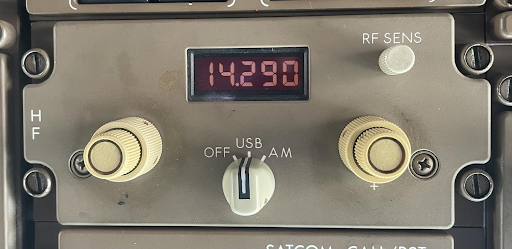
20S 0943Z 0543L K8JSM/AM Sean, pilot on a 757/300. En route from San Francisco to Orlando with 246 souls on board, including a bunch of kids going to Disneyland. Was 35,000 feet over Louisiana (12 miles East of Shreveport) when I first spoke to him. (He had been in QSO with Andrew VK6IK in Western Australia. I could hear Andrew also.) Sean was using the 400 W Rockwell-Collins transceiver on the plane (that's his picture of the control panel, above), with the antenna vertical in the back vertical stabilizer (rudder). I told him I was running 20 watts from a homebrew rig to a vertical ¼ wave ground plane antenna about 70 feet up; he speculated that the fact that we were both vertically polarized must have been helping. Sean said he also pilots 767s transatlantic.
I really had two contacts with him, Around 0600 local he was calling CQ and no one was answering. So I called him again and we continued: I told him about the Aeronautical Mobile contact I had had from Samana. I also told him about my contacts with MIR and RS-10 (and the RS-10 robot!) from the Dominican Republic 1992-1996. I told him that Elisa had been present for many of the contacts with Norm Thagard on Mir station (Elisa walked in the HI7 shack at around this time – Sean said hello.) Sean said he has been a ham for a long time – since before he was a pilot. He has built a 2 meter “tape measure and PVC” antenna. I told him we have a little aircraft radio and use it to listen to the tower at Punta Cana airport, and to aircraft calling the regional ATC in Santo Domingo. Sean says he too has a little airband receiver and often uses it to listen to airplane tower traffic. Sean said the airline encourages this kind of contact because it is a way to keep pilots alert on long overnight flights (other pilots have other activities to do the same). As we spoke he was waiting for a meal (salmon). He mentioned that he could see the constellation Orion out the window; I told him I had been looking at Orion in low in the East just before talking to him. In the end, Sean had to sign as the plane crossed into Florida and aircraft pilot duties took precedence.