Podcasting since August 2005! Listen to our latest podcast here:

Podcasting since August 2005! Listen to Latest SolderSmoke

Tuesday, March 2, 2010

Mars Express Phobos Fly-by (Wednesday)

The European Space Agency's Mars Express probe will be doing the closest ever approach to the Martian moon Phobos. On Wednesday night the spacecraft will come within 67 km of Phobos. They will use a very cool radio technique to gather data about the internal structure of the object (see below).
Mars Express carried the Beagle II lander to the red planet. I was in the UK when they made that brave attempt to put the probe on the surface, and shared in the disappointment when no signals came back. Later, I had the privilege of meeting Beagle II's creator, Colin Pillinger. Colin gave me signed copies of his wonderful books on Mars.

Here's some more info on Wednesday's fly-by (from ESA):

1 March 2010
ESA’s Mars Express will skim the surface of Mars’ largest moon Phobos on Wednesday evening. Passing by at an altitude of 67 km, precise radio tracking will allow researchers to peer inside the mysterious moon.

Mars Express is currently engaged in a series of 12 flybys of Phobos. At each close pass, different instruments are trained towards the mysterious space rock, gaining new information. The closest flyby will take place on 3 March at 21:55 CET (20:55 GMT).

From close range, Mars Express will be pulled ‘off-course’ by the gravitational field of Phobos. This will amount to no more than a few millimetres every second and will not affect the mission in any way. However, to the tracking teams on Earth, it will allow a unique look inside the moon to see how its mass is distributed throughout.

How will the ground teams make these tremendously sensitive measurements? Ironically, they will turn off all data signals from the spacecraft. The only thing that the ground stations will listen out for is the ‘carrier signal’ – the pure radio signal that is normally modulated to carry data.


Phobos

Preparing for closest approach to Phobos
With no data on the carrier signal, the only thing that can modulate the signal is any change in its frequency caused by Phobos tugging the spacecraft. The changes will amount to variations of just one part in a trillion, and are a manifestation of the Doppler effect – the same effect that causes an ambulance siren to change pitch as it zooms past.

After the closest flyby, the work is not over. Mars Express will sweep past Phobos a further seven times before the campaign is complete. In addition to the tracking experiment, known as MaRS for Mars Radio Science, the MARSIS radar has already been probing the subsurface of Phobos with radar beams. “We have performed a preliminary processing of the data and the Phobos signature is evident in almost all the data set,” says Andrea Cicchetti, Italian Institute of Physics of Interplanetary Space, Rome, and one of the MARSIS team.

MARSIS completely deployed
The MARSIS radar is already taking data

“All the experiments on Mars Express have something to say about Phobos,” says Olivier Witasse, Mars Express Project Scientist, ESA. This is a bonus for science, considering that none of them were originally designed to study Phobos the moon, only Mars the planet. The science results from these flybys are expected in subsequent weeks or months, when the various teams have had time to analyse the data.


All photos from ESA.

Sunday, February 28, 2010

SolderSmoke Podcast #122

Bill (N2CQR) and Ian (G3ROO) in Dover, England (with hydrogen balloon spark key)


SolderSmoke!
A SHOW FOR ELECTRONICS HOMEBREWERS!
Listen at: http://www.soldersmoke.com
SolderSmoke #122

Feb 28, 2010
Snow in Rome!
In London: A visit to Marconi's house, Maplins, and Faraday's lab
A visit to the Dover Construction Club
Computer problems resolved
A short period of QRSS, then back to WSPR
Putting the Drake 2-B into WSPR mode
The Rome-Norway WSPR pipeline
Increased solar activity
50 years of SETI with Frank Drake
QQ Review
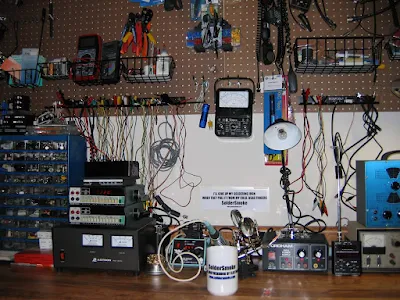
Work Bench Eye Candy
Movie Review: UP! (Five Soldering Irons)
MAILBAG

Thursday, February 25, 2010

KNACK IN THE SHACK: N5ITU

Jeff, N5ITU, clearly has The Knack.

The mug and the bumper sticker are available at the SolderSmoke Cafe Press store:
http://www.cafepress.co.uk/SolderSmoke

Jeff is in Texas. We had a feeling that this particular bumper sticker would appeal to those the Lone Star State.

Reverse Polarity Protection -- Words of Wisdom from K7QO

Words of wisdom from Chuck Adams, K7QO:
Wednesday, February 24, 2010 12:11 AM
From:
To:
qrp-l@mailman.qth.net
This posting due to the traffic on the SST reverse
voltage application.

Here is what I do. There is a diode, the 1N5817,
a Schottky Diode. Will take 20V peak reverse voltage,
will handle 1A continuous with 25A surge and has only
a 0.45V forward drop and the reverse current is 500uA.

I put one of this in series with the 12V line input of
every electronic device I build. If the designer used
a 1N4001-7 in series, I replace it.

I am not a fan of the diode across the voltage input
line and having it short out when reverse voltage is
applied. What if the applied voltage is a gel-cell
without a fuse? You blow the diode and you blow the
rig. IMHO is this not an ideal way to do it. Should
be using fuses too, but I don't. Haven't found a way
to use the flat auto fuses with gel-cells in a handy
low-profile way and inexpensive parts. I'd appreciate
the education, if someone has film and photos of great
arrangements.

I buy the diodes from Mouser.Com for about $26 per 250.
For a dime a rig it is a real cheap way to protect your
equipment from yourself and others.

With the limit of 1A at 13.8V, it is well within the
QRP operating limits. And why do you need more than
1A anyway?????? :-) And the low forward voltage
drop
means that the finals (which are usually fed
direct from the B+ line anyway) don't lose much
in applied voltage and you get pretty much the
same output as without the diode. And you protect
those expensive parts for a dime. A quarter if you
buy just one diode from Mouser.

Hope this helps. Just the way I do it, and I'm
not always right. But I've only lost a few parts
and that was before I started using 1N5817's on
everything.

The 1N4001 through 1N4007's are fine if you are
feeding 9-12V to a 78L08 regulator.
FYI
chuck
--
chuck adams, k7qo
http://www.k7qo.net/
chuck.adams.k7qo@gmail.com

F8CKH: The Knack, 747s, and Homebrew QRP

Here is some further evidence that The Knack is a global phenomenon. I'm sure our readers will find Antoine's story quite familiar. Looking at his QSL (below) we can see that he has a special reason to be interested in QRP: After a full workday of operating a very high-powered rig (!), a simple little QRP rig must represent an appealing contrast. And even if that 747 is very QRO, I think we will all agree that Antoine has the kind of job that most knack victims dreamed about when they were kids.

Hi Bill,
I have been listening to your podcasts for a while now after I heard about them in one of the Amateur Logic TV shows. I picked up one podcast randomly and I got to say that I really enjoyed the tone and content of your talks. Very informative and interesting. I like also the fact that your amateur radio experience is based on homebrewing and experimenting. Back in 1997, I earned my French amateur radio license at the age of 16 (extra and big CW lover). I have been always amazed by what we could do with very little and go very far. My family is Hamradio friendly: my grandfather was F8KE back in 1930s and he has been around the hobby for most of his life. At 7 or 8 I remember times where we were at his place and I would ask for permission to leave the table early to go upstairs and visit my grandfathers shack. Everything there was homebrew and I was really pleased to see that the magic of Radio was achievable with only few components, homebrew antennas and a bit of luck. He encouraged me to learn the Code and at 12 I was already up to 20 wpm! My dad used to be 6W8FC while he was in the service and he gave me the passion for weak signal and DXing. Technically speaking, I HAD to become a Ham Radio operator.
I am really fascinated by your level of dedication to homebrewing and also that you share that we us, fellow operators addicted to -soldersmoke-. Just like you, I have been all over the place since I am an Airline Pilot qualified on the Airbus and Boeings... UK, New Zealand, US, I got a chance to operate from couple of places and something got the pleasure to be behind the scene and become the reason of a pile up. Operating from down under from Kiwi lands was a wild and exciting experience, indeed!
Finally I am about to move permanently to the US, in Pennsylvania. I applied for a Vanity Callsign (NY3G) and hopefully I will hear from the FCC soon.
I wanted to mention also that I got rid of almost all my regular Yaesu, Kenwood rigs to start from scratch. My project? To design, build, operate an HF station from scratch. No more commercial rigs for me! Well I will try! I am really happy to finally make use of a workbench that I just cleaned at home. I will set up a blogspot account to illustrate my projects... I think that would be great to make QSO with you Bill, sometime!
Thanks again for bringing some much enthusiasm into this fascinating side of Ham Radio, Homebrewing.
Best Regards,
73
Antoine Pierre GAMET F8CKH