
Showing posts sorted by date for query Eyles. Sort by relevance Show all posts
Showing posts sorted by date for query Eyles. Sort by relevance Show all posts
Thursday, October 8, 2026

Wednesday, May 14, 2025
The Computer Hardware of the Apollo Program
Watching this, it seems like a miracle that we made it to the moon. Some of this construction is downright scary. Sometimes soldering is not good enough -- so they weld. Other times they don't even solder -- they wire wrap! Even in 1965, the wiring of the memory modules was so complex that it was beyond human comprehension. All of this brought back memories of that wonderful book "Sunburst and Luminary" by Don Eyles. I have hopes that he will appear in the MIT video about landing on the moon. Don worked on those programs.
Sunday, March 16, 2025
CuriousMarc Gets an Apollo DSKY Running. FPGA AGC Computer. Rope Memory.
I really liked this video. So much amazing wizardry in it. Just the FPGA Apollo AGC simulator that Mike whipped up. Wow. Kudos!
Their occassional references to "rope" brought back fond memories of "Sunburst and Luminary" by Don Eyles: https://soldersmoke.blogspot.com/search?q=Apollo+rope
Friday, November 10, 2023
SolderSmoke Podcast #249 -- Travel, Pete's 6BA6 rig, Books!, VFOs, SDR, Computers, Spectrum Analysers, Transistor Man! MAILBAG

New VFO for 15-10 Transceiver
Schematic below
SolderSmoke Podcast #249 is available: http://soldersmoke.com/soldersmoke249.mp3
There is also a video version of this podcast: https://youtu.be/5xyaYivtOhw
Travelogue:
HAPPY VETERANS' DAY TO PETE AND GRAYSON AND TO ALL THE OTHER VETERANS WHO ARE LISTENING.
Trip out to San Francisco. Sticker placed on the corner of Haight and Ashbury: See picture below. Note other sticker. Really Groovy!




Stabilizing the EB63A (with Pete recommended LP filters from e-Bay.
.jpg)


Cuban Cacharreo! Andy CO2AFV's Knack Story https://soldersmoke.blogspot.com/2023/10/a-cuban-knack-story-and-pandemic-sits.html
Bill's DXCC-100. DONE.
Tribal Wisdom: W1REX on HRWB https://soldersmoke.blogspot.com/2023/11/listen-to-rex-w1rex-lots-of-tribal.html
Pete's Bench:
Pete's 6BA6 rig
Pete's 6BA6 Rig
Pete Re-invents the Shirt-pocket SSB Rig
Pete's remake of the ShirtSleeve Transceiver
Pete Builds Two Computers
Pete Adds a Second Band to his Homebrew SDR
BEZOS BUCKS ARE BACK! PLEASE BUY THERE! >>>>>>>>>>>>>>>>>>>>>>>
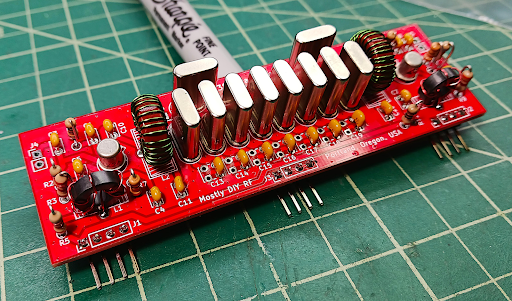
Mostly DIY RF: Work proceeds in the Oregon Silicon Forest on P3ST kit development. Todd is confident the P3ST will be released on December 18th.Many other kits available now: https://mostlydiyrf.com/
Sign up for the newsletter: https://mostlydiyrf.com/subscribe/
Bill's Bench:
Rebuild of the 15-10 VFO (for improved Dial Spread) (with yet another QF-1 capacitor) https://soldersmoke.blogspot.com/2023/10/dial-scale-linearity-spreading-out.html
Why Building for 10 meters is harder: https://soldersmoke.blogspot.com/2023/09/why-building-for-10-meters-is-harder.html
Copper Tape shielding of 15-10 rig.
Crushing Spurs with Better Bandpass Filters (see blog post) https://soldersmoke.blogspot.com/2023/09/crushing-17-and-12-meter-spurs-with.html
Another 15-10 rig in the works... for SSSS. Boards are accumulating...
More problems discovered with the Herring Aid 5 Receiver . Lots of SS blog posts Comment from Rick WD5L. ) https://soldersmoke.blogspot.com/2023/10/a-big-error-discovered-in-1976-qst.html Did you try to build one? Did you succeed or did you fail? Please let us know.
The Basil Mahon books (blog posts) https://soldersmoke.blogspot.com/2023/11/basil-mahon-is-author-for-us-he.html
The Sunburst and Luminary book of Don Eyles (blog posts)
The Art of Electronics by Horowitz and Hill (blog posts)
Spectrum Analysers: Tiny SA Ultra https://soldersmoke.blogspot.com/2023/09/the-tinysa-ultra-spectrum-analyser-video.html and Polarad 632C-1; George WB5OYP gave me one of these spectrum analysers (I NEED a manual! Does anyone have a manual or a schematic? ) :
Polarad 632C-1
Stabilizing the EB63A (with Pete recommended LP filters from e-Bay.
MAILBAG:
TRANSISTOR MAN T-SHIRTS! Thanks to Roy WN3F!
Todd VE7BPO on AF amplifiers. Thanks Todd.
Wes W7ZOI -- Always a privilege to exchange e-mail with Wes.
E-mail from Jay Rusgrove W1VD. About the Herring Aid 5.
E-mail from Eamon Skelton EI9GQ! Amazing!
HB2HB with Denny VU2DGR https://soldersmoke.blogspot.com/2023/09/hb2hb-contact-with-denny-vu2dgr.html
Nick M0NTV on diode matching for ring mixers: https://soldersmoke.blogspot.com/2023/10/does-matching-matter-diode-matching-for.html
Paul Taylor VK3HN on the new Elecraft CW rig.
Dean KK4DAS fixed the noise in his Hallicrafters SW receiver. A long battle, finally won.
Dean also in contact with G3UUR.
Ramakrishnan VU2JXN helping me set up a backup of blog on WordPress.
Mark KA9OOI noticed that SS podcast archive appears gone. In fact just temporarily relocated to http://soldersmoke.com/
(SS PODCAST Archive temporarily relocated to http://soldersmoke.com/
Andreas DL1AJG - Crystal radio video. https://soldersmoke.blogspot.com/2023/10/building-crystal-set-videos.html
George N2APB on the Herring Aid 5
Grayson KJ7UM experimenting with Varactors and Thermatrons!
Thomas K4SWL on Mattia's DC receiver. https://soldersmoke.blogspot.com/2023/10/mattia-zamanas-amazing-direct.html
Bob Weaver of Dial Bandspread Linearity fame. Electron Bunker
Mike Bryce WB8VGE QRP Hall of famer -- he too couldn't get the Herring Aid 5 working.
Kirk NT0Z wrote about the Wayback machine. But this former ARRL staffer he also tried and failed to get the Herring Aid 5 going. Way back when... https://soldersmoke.blogspot.com/2015/03/kirks-herring-aid-tuna-tin-and-regen.html
.jpg)
New 15-10 VFO with schematic
Dial Bandspread (Before)

At corner of Haight and Ashbury
Sunday, October 29, 2023
Apollo Core Rope Memory -- CuriousMarc Takes it on (video)
Here is another amazing Apollo video from CuriousMarc (AJ6JV). Thanks to Bob KD4EBM for alerting me to this. We have recently been discussing the "Apollo rope memory" as I read Sunburst and Luminary by Don Eyles (ex K4ZHF). In this video Marc and his colleague Mike get ahold of some actual Apollo memory modules, develop a device that allows them to read it, and they discover a design error. Wow.
My analog HDR head hurts after watching this. Even Marc says he was approaching his limits in explaining all this.
I had not heard of the bug they discovered in the Apollo 11 software just a month before launch, and how they had to climb into the Saturn V to fix it. Amazing.
Thanks Marc, thanks Mike and thanks Bob.
Wednesday, October 11, 2023
Sunburst and Luminary: Apollo "Rope" Memory, and other items of interest

Wow. That is the method that they stored computer memory for the moon missions. When they were satisfied with a program they would say it was time to "put it on the rope."
Here's an article on the women who built the rope memory (and the integrated circuits used in Apollo). This reminded me of the women's collective in Hyderabad that "wove" the ferrite core transformers for Farhan's BITX rigs:
Here is a Wikipedia article on core rope ROM memory with some great illustrations:
https://en.wikipedia.org/wiki/Core_rope_memory

The Rope
Other stuff of interest that I have spotted so far in the book Sunburst and Luminary -- An Apollo Memoir by Don Eyles:
-- Not long before the fatal Apollo 1 fire, an MIT colleague of Don Eyles had a drink with Astronaut Gus Grissom. Grissom unloaded about the poor state of the spacecraft, saying that, "What we have here is a Heathkit." Grissom died in the fire.
-- Eyles mentions the use of 6L6 tubes in analog audio amplifiers.
-- MIT's Doc Draper used a Minox camera.
-- When the Apollo 11 astronauts came back and were living for two weeks in an isolation chamber, NASA had bulldozers on standby to bury the whole thing ("astronauts, staff and all") in case some dangerous moon bug was detected. (Is that true?)
-- At one point soon before an important missile test, engineers realized that they needed an isolation transformer. They did not have enough time to order one. So they took an isolation transformer out of one of their soldering stations and used it in the missile. It worked. Sometimes you just use what you have on hand.
Wednesday, October 4, 2023
Sunburst and Luminary -- A Poem about Transistors and ICs

Sunburst and Luminary by Don Eyles has a lot of the kind of color that helps the reader understand what was going on technologically during the 1960s. For example, there is this poem about integrated circuits (you don't get to use "poem" and "integrated circuits" in the same sentence very often):
The transistor's a marvelous invention
Replaced the tube convention
Found its niche
To amplify or switch
Whatever the designer's intention.
But the breakthrough was the IC
Integrated monolithically
It became pivotal
As computers went digital
With increasing complexity.
Eyles tells us that this poem was written by hardware designer Jayne Partridge, and appears in Eldon Hall's write-up of the Apollo Guidance Computer and the decision to use ICs in it:
Monday, October 2, 2023
"Sunburst and Luminary" author Don Eyles was a Ham, a Hacker, and a user of Plywood who Understood Juju

-- As a kid, Eyles took a summertime shop class with W4LRO. Eyles himself went on to get his ham license -- he was K4ZHF and was active for a while on the 40 meter and 6 meter bands.
-- He writes of how the Apollo software acquired more "juju as labor and logic were poured into them." Juju.
-- He describes the electronics lab in the MIT Instrumentation Laboratory: "If you had a private project you could sometimes get some simple milling done for a smile, and you could scrounge the odd resistor or capacitor... On the second floor there was a small "hackers shop" with a drill press, metal shear, a bending brake, and a few hand tools which was open to anyone, including software engineers. That was the first use of the term "hack" in a technical context, that I can recall hearing. I took the term as referring to the sometimes messy process by which perforations of suitable sizes were made in the aluminum boxes, or chassis, that were used for constructing electronic devices." Indeed. We hack.
-- After describing the first integrated circuits, Eyles looks back at high school and notes that he and a friend, "after learning about truth tables, James Chambers and I had experimented with similar devices composed of relays mounted on a piece of plywood." Plywood.

More to follow on this book.
Saturday, September 23, 2023
Sunburst and Luminary -- An Apollo Memoir by Don Eyles (video)
Buy the book from the Amazon link on the right side of the page >>>>>>>>>>>>>>>>>>>>>>>
There is so much great stuff in this 2018 video. I am definitely going to buy the book. This is another of those things that reminds me (a hardware guy) of the importance of software (Sunburst and Luimary were the names of two programs that Eyles wrote to enable the LEM to land on the moon).
-- Asked about one of the biggest ancillary contributions of the Apollo program, Eyles immediately says, "integrated circuits." They used three terminal NOR gates. Lots of them.
-- They never had a hardware failure in the Apollo computers. Demonstrating a classic troubleshooting technique, when they discovered what they thought was a hardware failure, they ran the program on another computer. The problem was also there, so they knew there had been no failure on the first machine.
-- The LEM simulator was very cool.
-- Eyles' ability -- in two hours -- to write the code for the automatic landing program that Astronaut John Young was asking for, then have it flown on an Apollo mission to the moon was very impressive.
Thanks to the MIT Museum for posting Don's talk. And thanks to HackADay for alerting us to it.
Also, take a look at this one: https://www.youtube.com/watch?v=oi4h04ZgQsQ
Subscribe to:
Posts (Atom)