Podcasting since August 2005! Listen to our latest podcast here:

Podcasting since August 2005! Listen to Latest SolderSmoke

Sunday, February 26, 2023

First QSO with the High-School Receiver -- 100 mW to Dipole. (with videos) -- Homebrew to Homebrew!

  
Alan W4AMV in Raleigh NC

Dean KK4DAS and I have been working with a local high school.  The students are building a direct conversion receiver for 40 meters.  

We've been giving out prizes for the first team to complete each stage.   I wanted to give one of the teams a little oscillator that could b heard with their receiver.  So this morning, using a 7040 crystal from the AF4K (SK) company, I threw together a one transistor oscillator.  It has just 8 parts, including the key:
I had a low pass filter in the antenna tuner.  The antenna was a low-to-the-ground 40 meter dipole.  The transmitter was putting out around 100 milliwatts.   

N2CQR's Ten Minute Transmitter

The Reverse Beacon Network showed that I was getting out quite well: 


Then I thought, wait a second, let's make a contact with the prototype high-school direct conversion receiver.  

With the receiver hooked up, I again called CQ on 40 CW.  BOOM!   Very quickly Alan W4AMV in Raleigh NC  came back to my call.  Wow!  That's 222 miles.  And a quick check of QRZ.com revealed that Alan is a homebrewer.  Then Google reminded me that his work has been featured on the SolderSmoke blog.    TRGHS. 

I was so excited during this contact that I almost forgot to film it.  But I did manage to get some short clips of the QSO in progress.   You have to listen carefully, but you can hear our calls in there while Alan is transmitting (listen for the lower tone): 


And in this clip you can watch me transmit using the 10 Minute Transmitter: 


UPDATE (Feb 27 2023):  I asked Alan about the rig he was using:  "A PLL EXCITER DRIVING A PAIR OF FETS PUSH PULL ABT 50 w to an inverted L at 55 feet. The Rx a single conversion 9 MHz IF and it is connected to an active antenna in the trees out in the woods abt 25 feet up. Uses an automotive whip antenna about 3 feet long. "

Alan's Rig

This little contact is a reminder of the fun that can come from using simple, homebrew, QRP gear.  It is really amazing that the very first contact with this receiver was with another homebrew station.   This all reminds Dean and me of something we have been telling the students:  the little DC receiver they are building is not a toy -- it is capable of being used in real, long-distance contacts.

Thanks Alan!    

Saturday, February 25, 2023

Video by KK4DAS on Progress in High-School Direct Conversion Project


More info in blog post below. 

Progress Report: High-School Students Build Diode Ring Mixers (Board #2 of 4). Hyderabad Soul Added to the New Machines

Dean KK4DAS works with students

A team from the Vienna Wireless Society was back in the local high school Thursday and Friday of this week, helping the students finish their variable frequency oscillators and build their diode ring mixers.  Club President Dean KK4DAS was in the lead, and did an amazing job working with the school and procuring all the needed parts.  Mike KD4MM  and Don KM4UDX provided patient and understanding help to the students. 

Students at work on the receiver

On the oscillators, the students  had to add about six parts to install a buffer circuit built around a J310 FET.  They also had to replace some of the 3D printed coil forms for the main-tuning variable inductor. (Dean KK4DAS made some really nice forms -- see below.)   Several teams of students experiences were very pleased to get their oscillators running. 

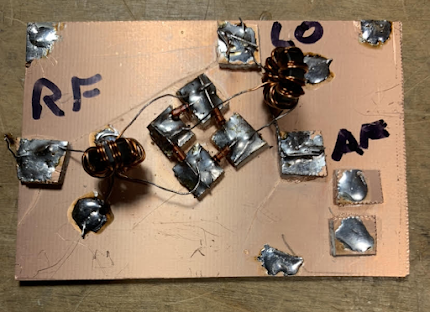
Manhattan Mixer Pads

Then it was on to the diode ring mixer.  We had planned on having the students wind their own trifilar toroids, but we realized that this might be too much -- it would add a lot of time to the build, and would introduce a lot opportunity for error.  

One of Farhan's transformers

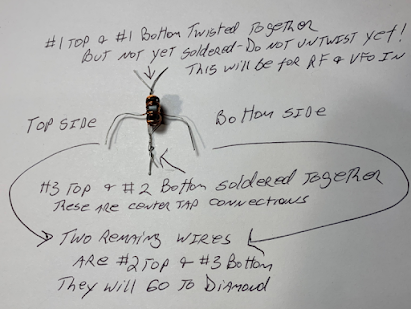
I remembered that Farhan had given me a big supply of FT-37-43 trifilar toroids that had been assembled in Hyderabad.  We decided to use these transformers.  We reasoned that this was not a big deviation from our DIY ethos -- after all, we didn't ask the student to wind their audio transformers, nor did they wind the RF choke in the VFO buffer.  But we faced a problem:   the Hyderabad transformers were all wound with the same color wire on all three turns.  This would make it hard for the students to figure out which wire went where (there were 12 such wires on each mixer board!).   I figured out how to do this:  The night before, I soldered together the center tap wires, and I twisted together the input coil wires.  We told the students to first solder the center taps in place, then solder the two free wires to the diode ring, and finally untwist the input coil wires, soldering in these connections.  This worked.  

How the transformers were prepped

Before we started, I gave the students a quick class on the essentials of mixers. And I pointed out that we were using transformers made in Hyderabad India and donated by our friend Farhan.  I told the students that whenever we include parts given to us by a ham radio friend we are adding "soul to the new machine." Indeed, Farhan's toroids added a lot of soul. 


We have been insisting that the students have each stage tested before moving on to the next.  This week we used signal generators to put RF and VFO energy into the mixers, and oscilloscopes to make sure that audio was coming out.  

One of the test set-ups for the mixers

The students are making good progress.  After today's session we did an estimate of where each of the projects stand at this point: 

We are building 15 receivers. 
Oscillation without the buffer:   11
Oscillation with the buffer: 5 
Mixer built and tested (but no diplexer yet):  5 
Mixer working, diplexer built  2

During the next month or so the students will build the bandpass filter and the audio amplifier, and put all the boards together to complete the receiver. 

Thursday, February 23, 2023

Early (1912?) Ham Station

 
Perhaps a bit overdressed by today's standards, but he's got a familiar look on his face.  Confidence and pride in his rig, and a steely determination to make contacts with it.  

If you zoom in you can see the crystal and the cat's whisker. 

More on this here: 

http://uv201.com/Photo%20Pages/ham_3.htm?fbclid=IwAR10Lbi2CAsYeiBDUjWb5KIQrh1SJVGwDyL2_1ZrkPk1VbllAUbeahwxsAI

Wednesday, February 22, 2023

The Transistor at 75, and the Raytheon CK722 (Pete's First Transistor)


https://www.eejournal.com/article/the-transistor-at-75-the-first-makers-part-1/

Part 4 is especially interesting to us because of the N6QW-CK722 connection: 

     Raytheon: Raytheon started making vacuum tubes in 1922. During World War II, the company made magnetron tubes and radar systems. Raytheon started making germanium-based semiconductor diodes in the 1940s and, just months after BTL announced the development of the transistor in late 1947, started making its own point-contact transistors using germanium salvaged from Sylvania diodes. After attending the 1952 BTL transistor symposium and licensing the alloy junction transistor patents from GE, the company quickly started making germanium transistors including one of the most famous transistors of that generation, the CK722, which was simply a rejected commercial CK718 transistor with downgraded specs for the hobby market. (Jack Ward has created an entire museum around the Raytheon CK722 PNP transistor.) Raytheon exited the semiconductor business in 1962.

Here are all of our blog posts on the CK722: 

https://soldersmoke.blogspot.com/search?q=CK722

Here is our post on Pete Juliano's CK722: 

https://soldersmoke.blogspot.com/2015/03/pete-juliano-homebrwing-with.html