Podcasting since August 2005! Listen to our latest podcast here:

Podcasting since August 2005! Listen to Latest SolderSmoke

Sunday, January 18, 2015

Digitizing the Barebones Superhet


I did this for Pete.  And I did it to start out the new year with something different.  And because I needed the crystal for my beloved BITX and didn't want to buy more crystals. 

After successfully broadening the filter in my Barebones Barbados Superhet (originally built by Dale Parfiit W4OP) I decided to replace the VXO with an outboard Arduino/DDS device. Nothing new in that  (I was playing with this back in October), but in what I think is a symbolically significant twist, I pulled out the tuning cap for the VXO and, in the hole left by the tuning control, replaced the knob with a BNC connector.  That connector now carries DDS signals into the receiver.  The crystal was at around 23.125 MHz -- that's why the LCD display is showing 23 MHz.  

It works great.   I was listening to the DX station in Iran this morning.  

Here is a video of the October 2014 experiments: 


Our book: "SolderSmoke -- Global Adventures in Wireless Electronics" http://soldersmoke.com/book.htm Our coffee mugs, T-Shirts, bumper stickers: http://www.cafepress.com/SolderSmoke Our Book Store: http://astore.amazon.com/contracross-20

Saturday, January 17, 2015

Colin Finishes His BITX


Wow, that is one beautiful BITX.  Nicely done Colin.  But I must say that you are exhibiting an almost inhuman degree of patience!  Who needs a case?  Fire that thing up and make the traditional "still-on-the-workbench" initial contact. 

Hi Guys,
I loved the last SolderSmoke, it was another great episode. It really does amaze me, that a few years ago, hams were saying that it was too difficult to build your own gear that would be anywhere near to the commercial stuff, but here we are with Arduinos etc bringing powerful functionality to the masses. I couldn't have imagined building an SSB rig with a pretty and functional LCD screen when I started in ham radio.
Bill, first regens, now SDRs? Amazing! I exchanged a few words with George Dobbs about your change of heart towards regenerative receivers, he seemed genuinely pleased. :)
Pete, your Si5351 work with the pretty displays is cool, I can see me getting pretty hooked! I have the Si5351 board, Paul M0XPD advised me to buy it. I'd love to build another SSB rig in a smaller box for regular SOTA activating. I must look into the pretty little displays and have a play with the Si5351. I notice that Hans Summers has now put out a cheap Si5351 based kit, handy for us guys in Eu. http://www.hanssummers.com/synth.html
I finished building my BITX board yesterday but wanted to have a sleep before applying power! Today I carefully checked the circuit for errors and found none, phew! I fired the rig up gently, watching the current carefully. I wound up the TX bias to 50mA as stated in the MKARS80 instructions, all went well. I plugged in the mic and spoke - BANG! - Everything went off. Oops - I had used a 500mA fuse for initial safety and forgot to swap it for the bigger one! I fitted a 1.6A fuse and hey presto, all was fine. I was absolutely amazed and to be honest, rather proud of myself. I think the TX is a little bit too hot, my meter is showing about 6W on voice peaks- eek! The rig seems to be perfectly behaved though, no wierd effects seem to be happening. I can just turn the bias down a bit, right?
Anyway, I was happy with my progress so I finished for the day. I still need to investigate and probably tweak the carrier suppression.
I spent a short while talking into a dummy load, using my FT817 to monitor the transmission. My 2yr old son was interested in my voice coming out of the 817'sspeaker!
Thanks for all the guidance and help along the way, I'm elated that I've built a voice rig that works! I've attached a pic of my finished board, I only just squeezed the circuit on, but isn't she pretty? :-)
Can't wait to get the rig built into it's case and score that first QSO.
73, Colin, M1BUU


Our book: "SolderSmoke -- Global Adventures in Wireless Electronics" http://soldersmoke.com/book.htm Our coffee mugs, T-Shirts, bumper stickers: http://www.cafepress.com/SolderSmoke Our Book Store: http://astore.amazon.com/contracross-20

Friday, January 16, 2015

Kansas Mighty Mite

Our book: "SolderSmoke -- Global Adventures in Wireless Electronics" http://soldersmoke.com/book.htm Our coffee mugs, T-Shirts, bumper stickers: http://www.cafepress.com/SolderSmoke Our Book Store: http://astore.amazon.com/contracross-20

Thursday, January 15, 2015

Pete's Beautiful Tiny Color Display


Oh man, this is the kind of thing that lures me ever deeper into the digital morass.  That would be hard to do with my beloved discrete analog circuits!    Be sure to note the size (it is sitting on the top from a pill bottle -- you can also look at the pen for a size reference). It is 1.25 inches by 1.25 inches.  Pete has it working with the Si5351 software.  As you can see there is still room at the bottom of the display.  Pete notes that an SWR readout is possible.  And Pete got this device for FIVE BUCKS! 

Our book: "SolderSmoke -- Global Adventures in Wireless Electronics" http://soldersmoke.com/book.htm Our coffee mugs, T-Shirts, bumper stickers: http://www.cafepress.com/SolderSmoke Our Book Store: http://astore.amazon.com/contracross-20

Wednesday, January 14, 2015

Broadening the Barebones Barbados Receiver


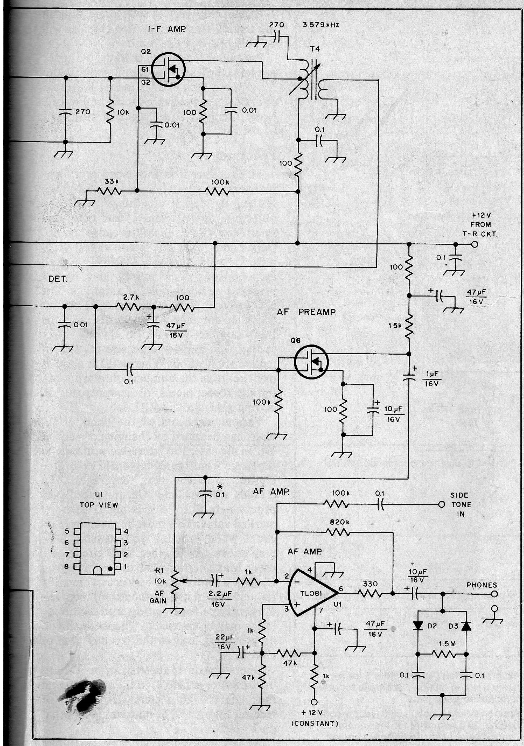
I've been working on the crystal filter of the Barbados Barebones Superhet receiver.  This was designed by Doug DeMaw in 1982.  This one was built by Dale Parfitt W4OP and then repeatedly modified by me.  It is now on 17 meters with a crystal-switchable VXO.    Earlier I had made a very crude attempt to broaden the filter from its original very narrow CW configuration.    This week I did this again, but this time I actually characterized the crystals and used Wes's LDA and GPLA software (from EMRFD) to design the filter.  

I played with the capacitor values and finally got the 3 kc bandwidth I wanted, but I'm having trouble getting rid of the ripple.   I know this is dependent on the impedances at the two ends.  The programs say I need 2000 ohms.   

I'm kind of puzzled about how Doug DeMaw did this with his original design.  For his crystals and his 250 Hz (!) bandwidth he said he needed 450 ohms.   He used 4.7:1 turns ratio transformers at either end and said that by putting 10k resistors across these transformers he got the needed impedance.  I can see how this would work looking into the gate of the 40673 IF amp, but looking back at the drain of the 40673 mixer, I'm not so sure that that would yield 10k. (See schematic below.)

But who am I to doubt Doug?   So I assumed he was correct about the 10K and I re-wound the transformers with a 2:1 turns ratio, thinking that would get me closer to the needed 2k.   But the ripple is still there.  I guess I could use a return loss bridge at this point... 

I don't know whether this is worth messing with anymore.  The receiver sounds nice.  The 3kHz bandwidth gives it a nice sound, and the ripple doesn't seem to be noticeable  That FAR circuits board is tightly packed and difficult to work with.  So, should I leave good enough alone, or should I proceed with fanatical ripple eradication.  Any advice?

BTW:  Why is it that receivers always seem to sound better when opened up (as above) on the workbench?  


Our book: "SolderSmoke -- Global Adventures in Wireless Electronics" http://soldersmoke.com/book.htm Our coffee mugs, T-Shirts, bumper stickers: http://www.cafepress.com/SolderSmoke Our Book Store: http://astore.amazon.com/contracross-20

Tuesday, January 13, 2015

Kai's Redwood Mighty Mite with Poker-Chip Hacksaw Key


And Check out Kai's homebrew key:


Hi Pete,
 
  Thanks for your kind words.  I really enjoyed the MMM project, first analog oscillation 😊.  Your right about the homebrew key being a hacksaw blade and a few pieces of plywood.  The knob is an old poker chip.  You can adjust the spring tention by moving the blade in and out of the plywood.  Travel can be adjusted by raising and lowering the bolt under the blade.  I needed something for CW and wanted to stick to the ham maker thing.  As for me sending lefty, I do that so I can switch when the right gets tired or I need to hold ipod for video.  Thanks for what you add to soldersmoke.  73.
 
Kai
Ps I will send picture of key.

On Monday, January 12, 2015, Pete Juliano <jessystems@verizon.net> wrote:
Hi Bill,
 
Wow –so cool! I was impressed with not only his M^3 but the homebrew key and sending with his left hand.
 
It would be nice for Kai to send us his details for the key.  It looked like a hacksaw blade sandwiched between some plywood blocks of wood and some sort of plastic tuning knob from a defunct transistor radio as the key knob. Now that is what I call homebrew –elegant and it works well!
 
73’s
Pete N6QW

Our book: "SolderSmoke -- Global Adventures in Wireless Electronics" http://soldersmoke.com/book.htm Our coffee mugs, T-Shirts, bumper stickers: http://www.cafepress.com/SolderSmoke Our Book Store: http://astore.amazon.com/contracross-20

Sunday, January 11, 2015

SolderSmoke Podcast #170 Double A DX-pedition, SI5351, Mighty Mites, Phasing Dreams


SolderSmoke Podcast #170 is available: 

http://soldersmoke.com/soldersmoke170.mp3

Bill's Double A, DSB, Dipole, Dominican DX-pedition.  
             Living the "How's DX?" Dream
Seeing the Southern Cross with Soviet Binoculars
Pete goes remote 
SI5351 a chip with a lot of potential
Pete's experiments with Nokia LCD displays 
Michigan Mighty Mites around the world
               The Postal Stream Roller
Steve Silverman's very kind variable cap offer
MOXON modeling with EZNEC
Aspirations for 2015

Our book: "SolderSmoke -- Global Adventures in Wireless Electronics" http://soldersmoke.com/book.htm Our coffee mugs, T-Shirts, bumper stickers: http://www.cafepress.com/SolderSmoke Our Book Store: http://astore.amazon.com/contracross-20