SolderSmoke Podcast #168 is available.
22 November 2014
http://soldersmoke.com/soldersmoke168.mp3
The benefits of software inefficiency.
Don't throw a wet blanket on computer baby steps.
DDS-ing Pete's old boatanchors and Bill's BITX.
Bill's DSB amplifier woes: a JBOT unfairly scorned.
Getting ready for solar-powered beach DSB.
Michigan Mighty Mite Crystal Offer -- FREE ROCKS!
Tribal knowledge: Beware of mistakes in published schematics!
QRO update: Working Japan on 17 meters.
Happy Thanksgiving!
Our book: "SolderSmoke -- Global Adventures in Wireless Electronics"
http://soldersmoke.com/book.htm
Our coffee mugs, T-Shirts, bumper stickers: http://www.cafepress.com/SolderSmoke
Our Book Store: http://astore.amazon.com/contracross-20
Serving the worldwide community of radio-electronic homebrewers. Providing blog support to the SolderSmoke podcast: http://soldersmoke.com
Podcasting since August 2005! Listen to our latest podcast here:
Podcasting since August 2005! Listen to Latest SolderSmoke
Saturday, November 22, 2014
Friday, November 21, 2014
Tube Transmitter in a Cuban Cigar Box
Beautiful use of a cigar box by Ben, KK6FUT. Ben is working in close proximity to Pete N6QW and has obviously fallen under the influence of Pete's "Build Something With Tubes" field.
Watch out for the high voltage Ben. You aren't in Arduino-land anymore! One hand behind the back OM!
Our book: "SolderSmoke -- Global Adventures in Wireless Electronics" http://soldersmoke.com/book.htm Our coffee mugs, T-Shirts, bumper stickers: http://www.cafepress.com/SolderSmoke Our Book Store: http://astore.amazon.com/contracross-20
Thursday, November 20, 2014
Impedance Matching Transformers -- Pete's Magic Decoder Ring!
We got some questions on this and Pete was kind enough to write up some notes on the topic. We may talk more about this during the next podcast (Saturday):
Broad Band
Impedance Matching Transformers.
Broad Band impedance matching transformers are designed to transfer power
over a wide frequency range. More basic you have an amplifier that has an output
impedance of 200 Ohms and you want to match that to a 50 Ohm load.
So what is the magic decoder ring so that you get a 4:1 match, ie going
from 200 Ohms to 50 Ohms. Getting technical for a moment the maximum power
transfer theorem says maximum power is developed when the source is matched to
the load. The Broad Band Matching
transformer enables that to happen over a wide frequency range.
So how do we get from 200 Ohms (the source) to 50 Ohms (the load)? Just as there are many
airlines that fly from LA to NY so it is with the matching approach. We will
cover several.
First a short discussion about broadband cores themselves. One of the most
common cores for HF work is the type 43 core which is good up to about 50 MHz.
For transformers up to 200 MHz then the type 61 are a better choice. Typically
at HF the FT -37-43 is one of the more common ones see (3/8 inch in diameter),
as is the FT-50-43 which is ½ inch in diameter. The iron powder cores are not the 1st choice
for broad band matching.
#1 Way:
Build a transformer that has a
primary of x number of turns (and since it is large, 200 Ohms will have
more turns) and the secondary will have y number of turns ( and since it is
smaller, 50 Ohms, will have fewer turns.) The transformer action is based on
the ratio of the Primary turns Squared to the Secondary Turns squared. Our
transformation is 4:1.
Thus if we divide the primary turns squared and divide it by the secondary
turns squared the result is 4. Here are some example: if we had a primary of 8
turns ( 64) and a secondary of 4 turns (16) – 64/16 = 4. So that is our transformer a primary of 8 turns and a secondary of 4 turns. When building
these transformers use two different colors of wire as that makes it much
easier to identify the windings. Observe the phasing, meaning the end you
connect to the collector of your output transistor is the start end. That same
start end for the secondary winding is the output “hot” side of the secondary.
#2 Way.
The same ratio holds in going from 200 to 50 Ohms. But this time we will
use a single winding of 8 turns and at 4 turns we will have a tap for the 50
Ohm point. Since that tap will very likely have Dc on it connect a 100 NF cap
at the 4th turn winding and this is the output. What you have just done is
create an auto transformer.
#3 Way.
At time one may have an oddball transformation and you can cascade
transformers and multiply their individual turns ratios. At one time I needed a
9:1 transformation. I built a 2.5 transformer and then hooked that to a 4:1 and
the result was a 9:1 transformer.
The attached table has “worked out” some common matches that are often needed
like matching a 50 Ohm amplifier to a 500 Ohm Crystal Filter which is a 10: 1
match. This is easily done with a 6 turn primary (50 ohms 6^2 = 36) and the
secondary has 19 turns ( 500 Oms 19^2 = 361). 361/36 = 10.03:1. Close enough for ham radio! The 1st way is probably more preferable for this
application.
Pete N6QW
11/2014
Our book: "SolderSmoke -- Global Adventures in Wireless Electronics" http://soldersmoke.com/book.htm Our coffee mugs, T-Shirts, bumper stickers: http://www.cafepress.com/SolderSmoke Our Book Store: http://astore.amazon.com/contracross-20
Wednesday, November 19, 2014
Electro-mechanical Heaven.... with Hell (Hellschreiber)
Bob LeDoux sent us a link to a really amazing site about the Hellschreiber system. The site is filled with great videos, pictures, and animations like the one above. Lots of radio history too. Check it out:
http://www.nonstopsystems.com/radio/hellschreiber-function-operation.htm
This is all the work of F. Dorenberg, N4SPP. Thanks OM!
Bob writes: I'm working on a microcontroller based reader for
this mode. For old fossils, like us, this mode looks perfect. It can
be sent using simple CW equipment and it appears to be a great
replacement for those who are tiring of Morse code.
Its perfect for Knack victims. We can even build mechanical printers. Thanks Bob!
Our book: "SolderSmoke -- Global Adventures in Wireless Electronics" http://soldersmoke.com/book.htm Our coffee mugs, T-Shirts, bumper stickers: http://www.cafepress.com/SolderSmoke Our Book Store: http://astore.amazon.com/contracross-20
Tuesday, November 18, 2014
Pete's Video on Connecting Arduinos and DDS chips (video)
After watching all Pete's work with the smaller Arduinos, that Uno R3 board seems HUGE. That's what I should stick with. Great idea using those robust terminal strips. Thanks Pete.
Our book: "SolderSmoke -- Global Adventures in Wireless Electronics" http://soldersmoke.com/book.htm Our coffee mugs, T-Shirts, bumper stickers: http://www.cafepress.com/SolderSmoke Our Book Store: http://astore.amazon.com/contracross-20
Monday, November 17, 2014
Pete and Ben's "Let's Build Something" Direct Conversion Receiver
This direct conversion receiver is part of the "Let's Build Something" project of Pete N6QW and Ben KK6FUT. Publication will be in QRP Quarterly late in January 2015. Pete reports that the front panel is a piece of galvanized sheet metal from Home Depot –total cost 82 cents.
Our book: "SolderSmoke -- Global Adventures in Wireless Electronics" http://soldersmoke.com/book.htm Our coffee mugs, T-Shirts, bumper stickers: http://www.cafepress.com/SolderSmoke Our Book Store: http://astore.amazon.com/contracross-20
Sunday, November 16, 2014
N2CQR WINS ARRL SWEEPSTAKES! AGAIN! (video)
We did it AGAIN! Winners in the Homebrew Double-Sideband QRP Northern Virginia Category! Sweet! I can't wait to pick up the trophy!
Our book: "SolderSmoke -- Global Adventures in Wireless Electronics" http://soldersmoke.com/book.htm Our coffee mugs, T-Shirts, bumper stickers: http://www.cafepress.com/SolderSmoke Our Book Store: http://astore.amazon.com/contracross-20
Saturday, November 15, 2014
The Amazing Rigs of Lee Snook, W1DN
Back in March 2013 we ran a blog post linking to a video of a beautiful superhet receiver built by Lee Snook, W1DN (that's his shop). Then the video disappeared. Today Peter Parker, VK3YE, alerted us to the reappearance of the video. Some Googling led me to Lee's YouTube channel and many other videos of some truly amazing homebrew projects.
Here is his YouTube Channel: https://www.youtube.com/user/swradios/featured
And here are all his videos: https://www.youtube.com/user/swradios/videos
Check this out digi fans (from his QRZ page):
Our book: "SolderSmoke -- Global Adventures in Wireless Electronics" http://soldersmoke.com/book.htm Our coffee mugs, T-Shirts, bumper stickers: http://www.cafepress.com/SolderSmoke Our Book Store: http://astore.amazon.com/contracross-20
Friday, November 14, 2014
At the Comet
That's an awe-inspiring "selfie"! This looks like something out of Kubrick's "2001 -- A Space Odyssey." Congratulations to the European Space Agency!
Using the CIVA camera on Rosetta’s Philae lander, the spacecraft have snapped a ‘selfie’ at comet 67P/Churyumov–Gerasimenko. The image was taken on 7 September from a distance of about 50 km from the comet, and captures the side of the Rosetta spacecraft and one of Rosetta’s 14 m-long solar wings, with 67P/C-G in the background. Two images with different exposure times were combined to bring out the faint details in this very high contrast situation.
Our book: "SolderSmoke -- Global Adventures in Wireless Electronics" http://soldersmoke.com/book.htm Our coffee mugs, T-Shirts, bumper stickers: http://www.cafepress.com/SolderSmoke Our Book Store: http://astore.amazon.com/contracross-20
Thursday, November 13, 2014
Colin's BITX
With advice and tribal knowledge from N6QW and MeSquares from W1REX, Colin M1BUU, is making excellent progress on his BITX. I see that he has some territory on the board reserved for a DDS VFO. That's fine, but here's and idea for Colin and other builders: Why not build it with the standard VFO first and then add the DDS or Si570 VFO later, perhaps as an external accessory? That way you get the experience of building an LC VFO -- the full BITX experience.
Yea, it is hard to imagine Paul M0XPD as a newcomer to the hobby such a short time ago -- he is definitely now in the ranks of the esteemed digital Elmers.
And yes Colin, we do hope you avoid unwanted oscillations. Because of Farhan's great design you have a good shot at avoiding this plague. But be prepared OM. It happens to the best of us. A lot. Stiff upper lip! Never give in!
*************
Hi Bill,
I enjoyed your video about your Arduino experiment. You bet me to it! I'm really looking forward to getting my version of an Arduino powered BITX up and running.
Steady progress is being made, yesterday I added my first bidirectional amplifier to the build. I now have the mic amp, BFO, balanced modulator and first amp completed. I tested the BFO on it's own and got a respectable looking signal out of it and with a good swing below 10MHz.
Next I need to add the crystal filter, second IF amp and mixer. Pete's video will help for the mixer! BTW, I'm using the ver3 schematic but I intend to use the ver1 band pass filter.
I set out building the circuit following the N2CQR layout diagram but I've already run short on space! I do have a good excuse though, my board is smaller than yours (10"x6").
Despite my best intentions, I'm falling back towards old habits of making my circuits physically small. I'm using MeSquares in order to try and force myself to space things out a bit. I do hope that I don't end up with any unwanted coupling!
I must try hard to leave lots of space between the next bits of circuit.
I was listening to SolderSmoke 104 today and Paul M0XPD was introduced as a new ham. Little did we know that Paul would become such a big player!
73, Colin M1BUU
Our book: "SolderSmoke -- Global Adventures in Wireless Electronics" http://soldersmoke.com/book.htm Our coffee mugs, T-Shirts, bumper stickers: http://www.cafepress.com/SolderSmoke Our Book Store: http://astore.amazon.com/contracross-20
Wednesday, November 12, 2014
Tricycle Mobile Contact
I couldn't resist posting this picture of the vehicle used by Budd, W3FF. I talked to him yesterday on 17 meters -- transcontinental -- as he pedaled home in California on his magnificent trike. He wasn't using the quad in the picture (he was on a vertical). The six meter quad is fantastic. He worked Japan with this rig on six. He has a trike trailer that carries his linear amplifier.
More on Budd and his trike mobile operations here:
https://sites.google.com/site/w3ffhomepage/
Our book: "SolderSmoke -- Global Adventures in Wireless Electronics" http://soldersmoke.com/book.htm Our coffee mugs, T-Shirts, bumper stickers: http://www.cafepress.com/SolderSmoke Our Book Store: http://astore.amazon.com/contracross-20
DDS amplifier
Tony, G4WIF, asked about an amplifier to boost the output of the AD9850 chip. Here is Dr. Juliano's prescription:
You might find that once you plug that DDS into a circuit you may not quite get 1 V pk to pk and in fact after about 10 MHz it really starts to sag. See the attached drawing as you can put this “afterburner’ on the output of the DDS. The isolated output is good if you are interfacing with “toob” type equipment –it can be left off if you are doing SS or just left in place. This is the output from the amp and as you can see fairly clean.
73’s
Pete N6QW
Our book: "SolderSmoke -- Global Adventures in Wireless Electronics"
http://soldersmoke.com/book.htm
Our coffee mugs, T-Shirts, bumper stickers: http://www.cafepress.com/SolderSmoke
Our Book Store: http://astore.amazon.com/contracross-20
Tuesday, November 11, 2014
Digitizing my BITX17 with an Arduino and an AD9850 chip
This is only temporary! My analog, discrete, hardware-defined BITX17 was NOT harmed or even modified for this little experiment.
Our book: "SolderSmoke -- Global Adventures in Wireless Electronics" http://soldersmoke.com/book.htm Our coffee mugs, T-Shirts, bumper stickers: http://www.cafepress.com/SolderSmoke Our Book Store: http://astore.amazon.com/contracross-20
Monday, November 10, 2014
Background on the use of Si5351 -- code and integration with Arduino Nano (video)
I somehow missed this one. Here Pete talks about how the use of the Si5351 in ham radio has been evolving, who has been working on it, etc.
Our book: "SolderSmoke -- Global Adventures in Wireless Electronics" http://soldersmoke.com/book.htm Our coffee mugs, T-Shirts, bumper stickers: http://www.cafepress.com/SolderSmoke Our Book Store: http://astore.amazon.com/contracross-20
Sunday, November 9, 2014
Pete Goes Superhet with the Si5351 generating BOTH VFO and BFO (video)
Congrats to Pete for his amazingly fast development of a 40 meter superhet receiver using a single Adafruit Si5351 paired with an Arduino Nano for ALL of the frequency generation. No more VFOs, no more crystals. It sounds great! Amazing stuff.
Our book: "SolderSmoke -- Global Adventures in Wireless Electronics" http://soldersmoke.com/book.htm Our coffee mugs, T-Shirts, bumper stickers: http://www.cafepress.com/SolderSmoke Our Book Store: http://astore.amazon.com/contracross-20
BIG Amplifiers with SMALL Microcontrollers and LOTS of Tribal Knowledge
Hi Bill,
I wanted to forward to you a slightly edited email I sent to one of our podcast listener’s as I think this is a really good example of some “Tribal Knowledge”.
------------------------------ ------------------------------ ------------------------------ ------------------------------ ------------------------------ ------------------------------ ------------------------------ -----------
Hi OM,
Ham radio publications are much like the Internet –all that is published must be scrutinized. One such publication had a beautiful QRP to QRO amp using a 3CX800A7. A few watts in and 800 Watts out. My daughter was in FM radio broadcasting and I told her to introduce herself to the station engineer and to look out for any pulls – then the floodgates opened –about a week later I had a 3CX800A7.
So I started to work on the amp. The circuits just didn’t make sense and parts were missing that would make it work correctly. I contacted the author and here is what he shared. He built the amp but never did get to proof the final article. In fact he sent me his notes and sketches which were correct. Thus I could have never built that amp using just the article. I built it for one band, 20 Meters. It has a tuned input and a Pi-L output so is quite excellent on harmonic reduction.
Oh BTW this amp caused me to learn about PIC Microcontrollers. You cannot hit the 3CX800A7 with HV voltage until the cathode is warmed up (must be a female tube). That time delay is 3 minutes. I could not find a suitable time delay relay with a 3 minute delay that didn’t cost an arm and a leg. So that is when I thought about using the PIC16F84 as a time delay relay. Later I ported that over to a 12F675. The cost was less than $10. In the 3CX1500A7 amp ( another free tube) I have two microcontrollers in there. One is used for a three second step start on the filaments (don’t want to shock the filaments with inrush current) and the second for the 3 minute delay before starting the HV step start sequence.
You can see the “Big AMP” on my website at http://www.jessystems.com.
There was only one problem – I was worried about the cooling of the tube so I made sure there was plenty of air which I dump into a very small sub-chassis and the exhaust is out through the tube. Well “Dah” large volume in and small port for exhaust and you have a jet engine sitting on the desk top. Man it was loud – I would wear headphones when it was working. When I built the 3CX1500A7 amp I used a larger plenum so not as loud.
There are several key points I want to make about tribal knowledge:
- Turn off the soldering iron and spend a good deal of time “noodling” over the circuit so that it is clear what each function will do and that all the wires connect to something.
- Contact the author and ask lots of questions and you might be surprised to find out the published design is not what was designed!
- Look for uncommon solutions to build problems. Many times parts used in the articles are so unique that only one exists in the whole world and it is installed in the authors unit.
- The amp was built in 2000 and the use of the PIC16F84 as a time delay for an amp was a bit leading edge but don’t be afraid to employ some advanced technology into your projects. [Today an Arduino built into the amp could do time delay, temperature control of blowers, SWR sensing, grid trip protection and even warm your coffee.]
- In the Big AMP I figured out how to keep the blower going for about 1 minute after the amp is turned off to “cool down” the tube. The point here is to think about not just the amp itself but refinements to make that $600 tube last for a very long time thus filament current inrush protection and tube cool down.
- Don’t forget SAFETY – there is 2000 Volts @ 1 amp running around chassis–it is an electric chair sitting on your desk top. I included a microswitch that when the top cover is off it de-energizes the HV circuits. See if you can spot it in the photos.
73’s
Pete N6QW
PS The amp really does exist –see below.
Our book: "SolderSmoke -- Global Adventures in Wireless Electronics" http://soldersmoke.com/book.htm Our coffee mugs, T-Shirts, bumper stickers: http://www.cafepress.com/SolderSmoke Our Book Store: http://astore.amazon.com/contracross-20
Saturday, November 8, 2014
Pete's Boards Come Alive as a Direct Conversion Receiver (video)
I love it when a new rig is spread out on the workbench like this, pulling in its first signals. Like First Light on on a new telescope. These are the same boards you have been seeing in Pete's previous videos: The Si board, the mixer, and the AF amp. Now they are linked together in the form of a Direct Conversion receiver.
Our book: "SolderSmoke -- Global Adventures in Wireless Electronics" http://soldersmoke.com/book.htm Our coffee mugs, T-Shirts, bumper stickers: http://www.cafepress.com/SolderSmoke Our Book Store: http://astore.amazon.com/contracross-20
Pete's "Let's Build Something" Audio Amplifier (video)
Who needs LM386 ICs? Pete goes discrete! Love the MePads. And I knew Pete was going to test it with his finger! He's just taking stray hum from the power lines and coupling it to the input through that Exacto knife.
Seems to me like these boards is getting close to actually receiving signals.
Our book: "SolderSmoke -- Global Adventures in Wireless Electronics" http://soldersmoke.com/book.htm Our coffee mugs, T-Shirts, bumper stickers: http://www.cafepress.com/SolderSmoke Our Book Store: http://astore.amazon.com/contracross-20
Pete's Mixer (Pictures)
Hi Guys,
Just finished building the PD/BM that will be used in the final circuit of the LBS Part I. I will also upload a video of the build.
The W1REX MeSquares really work very well and greatly facilitate the build. So the newbie builder -- will have one leg up by using the squares method.
73’s
Pete N6QW
Pete's video on this circuit appears below -- just scroll down a few.
Our book: "SolderSmoke -- Global Adventures in Wireless Electronics" http://soldersmoke.com/book.htm Our coffee mugs, T-Shirts, bumper stickers: http://www.cafepress.com/SolderSmoke Our Book Store: http://astore.amazon.com/contracross-20
Friday, November 7, 2014
Bandpass Filter Construction by Pete Juliano (video) TFMS!!!
MePads! Arduinos! Breadboards! SuperGlue! Graph paper! Noodling! Room for Relays!
TFMS (TUNE FOR MAXIMUM SMOKE!)
Another great video from N6QW. Thunder power!
Our book: "SolderSmoke -- Global Adventures in Wireless Electronics" http://soldersmoke.com/book.htm Our coffee mugs, T-Shirts, bumper stickers: http://www.cafepress.com/SolderSmoke Our Book Store: http://astore.amazon.com/contracross-20
Thursday, November 6, 2014
Pete Builds a Doubly Balanced Modulator (Video -- Part 3)
Another beautiful piece of cinema from Giovanni Manzoni's Newbury Park Studios. Bravo Giovanni!
Pete is obviously a doubly balanced kind of guy. I liked his use of the W1REX MePads and the breadboard. Also, the balance pot and the un-balance switch are very handy innovations.
Most of all I like the way Pete's video takes you from schematic to actual circuit.
Thanks Pete!
Our book: "SolderSmoke -- Global Adventures in Wireless Electronics" http://soldersmoke.com/book.htm Our coffee mugs, T-Shirts, bumper stickers: http://www.cafepress.com/SolderSmoke Our Book Store: http://astore.amazon.com/contracross-20
Monday, November 3, 2014
SolderSmoke Podcast #167: Arduinos, Amplifiers, Books, and Tribal Knowledge
SolderSmoke Podcast #167 is available:
http://soldersmoke.com/soldersmoke167.mp3
3 November 2014
Who the heck is Giovanni Manzoni?
Pete's Bench Report:
"Let's Build Something" Project
Arduinos and Si5351s
Bill's Bench Report: 140 watt Amplifier Completed!
Low Pass Filter Design with the ELSIE Program
Samlex Power Supply
How I almost blew it up!
The new amp and the lids in the FT4TA pileup
Tribal Knowledge!
"Nature abhors a vacuum (tube)!" "The Innovators" by Walter Isaacson.
Carter, WA9DNF, REALLY knows which end of the soldering iron to grab!
Meeting with Thomas, KK6AHT. The two electronic cultures.
Interviews by Chris, KD4PBJ, at Two Days in Huntsville:
Glen Popiel, KW5GP, Author of "Arduino for Ham Radio"
John Henry of TenTec
Steve, WG0AT
Giovanni Manzoni
Giovanni Manzoni b. circa 1950 Civatavecchia, Lazio, Italy is a noted videographer specializing in the avante garde use of YouTube in ham radio homebrew settings. Long noted for his insistence on the use of completely home-made video equipment, Manzoni went so far as to demand that his cameras and recorders only use discrete components -- he claimed that integrated circuits "freaked him out." Manzoni's collaborators have long been puzzled by his claim that all his videos are filmed "on location." What he means by this remains unclear, however, in a 1997 interview in QST-Italia, he was quoted as saying "No matter where you go, there you are!"
Our book: "SolderSmoke -- Global Adventures in Wireless Electronics" http://soldersmoke.com/book.htm Our coffee mugs, T-Shirts, bumper stickers: http://www.cafepress.com/SolderSmoke Our Book Store: http://astore.amazon.com/contracross-20
Saturday, November 1, 2014
OH NO! SolderSmoke Goes QRO! Bill's Amplifier Project (video)
I got the Communications Concepts Inc. EB-63A amplifier working today. Yea!
Kind of ironic that the highest power amp I have ever built gave me the LEAST trouble. This just goes to show that circuit layout is very important. This amp is a proven design, with a proven layout and board. That's why it didn't turn into a 140 watt solid state oscillator!
Our book: "SolderSmoke -- Global Adventures in Wireless Electronics" http://soldersmoke.com/book.htm Our coffee mugs, T-Shirts, bumper stickers: http://www.cafepress.com/SolderSmoke Our Book Store: http://astore.amazon.com/contracross-20
Wednesday, October 29, 2014
"Science Friday" Interviews Author of "The Innovators" (listen)
Michael Rainey alerted me to Ira Flatow's Science Friday interview with author Walter Isaacson. I'm reading Isaacson's new book "The Innovators" (appropriately, on my Iphone 5). The book is very good, with surprisingly frequent references to ham radio. Flatow's interview with Isaacson is also quite good, and will give you a better idea of what the book is about. Here it is. It is worth a listen:
http://www.sciencefriday.com/segment/10/24/2014/meet-the-innovators-who-made-the-digital-revolution.html
Our book: "SolderSmoke -- Global Adventures in Wireless Electronics" http://soldersmoke.com/book.htm Our coffee mugs, T-Shirts, bumper stickers: http://www.cafepress.com/SolderSmoke Our Book Store: http://astore.amazon.com/contracross-20
Tuesday, October 28, 2014
Mailbag: Coils Wound Backwards, Last QSO 1981, Visions of Transistors Keeping Him Awake. Paul has THE KNACK
Hi Bill
I'm just getting back into ham radio after 33 years (last QSO: 1981),
want to do it all through homebrew, seem to have the same mindset as
guys like you and Frank K0IYE, bought your book [love it and Frank's],
and just "discovered" the Soldersmoke podcasts. I've been listening to
them with one ear as I bike to and from work (about 40 minutes each way, so it's almost perfect). I'm employed as a digital geek, but yearn for the days of DeMaw's prime (worked him once when he was W1CER), when the 40673 ruled. I'm very glad that, 40 years later, people like Farhan can weave discrete analog wonders, even if they later choose to use digital *control* (NOT DSP! No!).
I had to start somewhere with your podcasts archive, so I started with
2014 and really enjoyed your struggles with the Herring-Aid 5. My 1st
receiver was the "DC 80-10" by DeMaw from somewhere around 1970 in QST or the Handbook -- used a CA3028 as the product detector -- and I had similar struggles. While listening to it, I immediately thought "you wound the feedback coil backwards, you idiot!"
I got my license back in March 2014 and want very badly to get back on
the air with a homebrewed, or at least minimally-kitted, station. I've
built the receiver: David White's (WN5Y) Beginner's and Experimenters
receiver[1] heavily modified, have a long wire antenna up, a decent RF
ground, and all the parts I need for QRP z-match tuner, swr meter, T/R
switch, sidetone, and IRF510-based transmitter. Target: 40m CW by the middle of December, 30m in the couple of months after that with a
fully-Manhattan-style Barebones Superhet and another IRF510
transmitter. Then one of these BitX things. It's been a couple of
decades since I felt that there weren't enough hours in the day. Some
nights I can't sleep, what with all these transistors and simple analog
ICs whirling around...
Anyway, keep it up, I'll be listening.
-- Paul Lender, AD0HQ
[1] I built an Arduino/AD9850 DDS -- a la AD7C -- and used it to tune a
4-crystal filter (10-cent crystals from Tayda!) for the receiver with
the same Rigol scope that you use. I tried, really tried, to do it with
an analog RF signal generator. Change is good. Change is good.
I'm just getting back into ham radio after 33 years (last QSO: 1981),
want to do it all through homebrew, seem to have the same mindset as
guys like you and Frank K0IYE, bought your book [love it and Frank's],
and just "discovered" the Soldersmoke podcasts. I've been listening to
them with one ear as I bike to and from work (about 40 minutes each way, so it's almost perfect). I'm employed as a digital geek, but yearn for the days of DeMaw's prime (worked him once when he was W1CER), when the 40673 ruled. I'm very glad that, 40 years later, people like Farhan can weave discrete analog wonders, even if they later choose to use digital *control* (NOT DSP! No!).
I had to start somewhere with your podcasts archive, so I started with
2014 and really enjoyed your struggles with the Herring-Aid 5. My 1st
receiver was the "DC 80-10" by DeMaw from somewhere around 1970 in QST or the Handbook -- used a CA3028 as the product detector -- and I had similar struggles. While listening to it, I immediately thought "you wound the feedback coil backwards, you idiot!"
I got my license back in March 2014 and want very badly to get back on
the air with a homebrewed, or at least minimally-kitted, station. I've
built the receiver: David White's (WN5Y) Beginner's and Experimenters
receiver[1] heavily modified, have a long wire antenna up, a decent RF
ground, and all the parts I need for QRP z-match tuner, swr meter, T/R
switch, sidetone, and IRF510-based transmitter. Target: 40m CW by the middle of December, 30m in the couple of months after that with a
fully-Manhattan-style Barebones Superhet and another IRF510
transmitter. Then one of these BitX things. It's been a couple of
decades since I felt that there weren't enough hours in the day. Some
nights I can't sleep, what with all these transistors and simple analog
ICs whirling around...
Anyway, keep it up, I'll be listening.
-- Paul Lender, AD0HQ
[1] I built an Arduino/AD9850 DDS -- a la AD7C -- and used it to tune a
4-crystal filter (10-cent crystals from Tayda!) for the receiver with
the same Rigol scope that you use. I tried, really tried, to do it with
an analog RF signal generator. Change is good. Change is good.
Monday, October 27, 2014
Dear Santa: I want a Knack Watch. The one with real tubes...
This is what all the cool homebrewers will be wearing next year. Just be careful at airport security -- they might not understand!
Check it out: http://www.johngineer.com/blog/?p=1595
We received some comments from some noted Thermatron authorities:
Hi Guys,
This will cause all of the bells, whistles and sirens to go off all it once.
Now all that is needed is a logo on the watch that says
EBOLA ( Electronic Bi-state Operational Long Arithmetic) and this will cause you to go to jail without passing Go or collecting $200.
Pete
---------------------
Wow, I love this thing!…even though it uses little black plastic things to work. Have no idea what they are. (johngineer has knack squared)
Reminds me of a project I am trying with fellow ham. We picked up an old HP nixie tube freq counter at junk yard. We were going to strip out the nixie tubes to make a clock, but decided we could make it as clock as is. Want to program an Arduino thing into generating a frequency that is the time and feeding it into the counter.
For example 3:45:25 would be 34,525 Hz.
But my Italian is terrible so haven’t been able to get the Arduino to work. Just learning it. Project a bit over my head. picked up one of those online language courses on Italian. Hard, but not as hard as Turkish!
Grayson
TA2ZGE - Ankara, Turkey
KJ7UM
Follow the Hollow-State Design Blog
-----------------------
I'm wondering if I could do it Manhattan style, with discrete components...
Our book: "SolderSmoke -- Global Adventures in Wireless Electronics" http://soldersmoke.com/book.htm Our coffee mugs, T-Shirts, bumper stickers: http://www.cafepress.com/SolderSmoke Our Book Store: http://astore.amazon.com/contracross-20
Saturday, October 25, 2014
Spark Forever! Pete's First Transmitter
The SolderSmoke legal team (we too use Dewey, Cheetham & Howe!) has advised us to be very careful about divulging the details on this rig. They are not sure about the statute of limitations. Beyond what he said on the podcast, all Pete will say is that TOOBs were involved: 1S4, 3S4, 3Q4, 3Q5, 3V4s. He says power out was ALWAYS less than 100 mw ERP. That's his story and he's stinking to it.
Our book: "SolderSmoke -- Global Adventures in Wireless Electronics" http://soldersmoke.com/book.htm Our coffee mugs, T-Shirts, bumper stickers: http://www.cafepress.com/SolderSmoke Our Book Store: http://astore.amazon.com/contracross-20
Friday, October 24, 2014
Smart-Phone Cosmic Ray Detector
http://hackaday.com/2014/10/17/detect-cosmic-rays-with-your-smartphone-using-crayfis/
I find this cosmic ray project very appealing.
Also, Adam Fabio over on Hackaday recently posted a Hack-let on ham radio:
http://hackaday.com/2014/10/17/hacklet-19-ham-radio/
Our book: "SolderSmoke -- Global Adventures in Wireless Electronics" http://soldersmoke.com/book.htm Our coffee mugs, T-Shirts, bumper stickers: http://www.cafepress.com/SolderSmoke Our Book Store: http://astore.amazon.com/contracross-20
I find this cosmic ray project very appealing.
Also, Adam Fabio over on Hackaday recently posted a Hack-let on ham radio:
http://hackaday.com/2014/10/17/hacklet-19-ham-radio/
Our book: "SolderSmoke -- Global Adventures in Wireless Electronics" http://soldersmoke.com/book.htm Our coffee mugs, T-Shirts, bumper stickers: http://www.cafepress.com/SolderSmoke Our Book Store: http://astore.amazon.com/contracross-20
Wednesday, October 22, 2014
"Two guys and a Minima walk into a bar..."
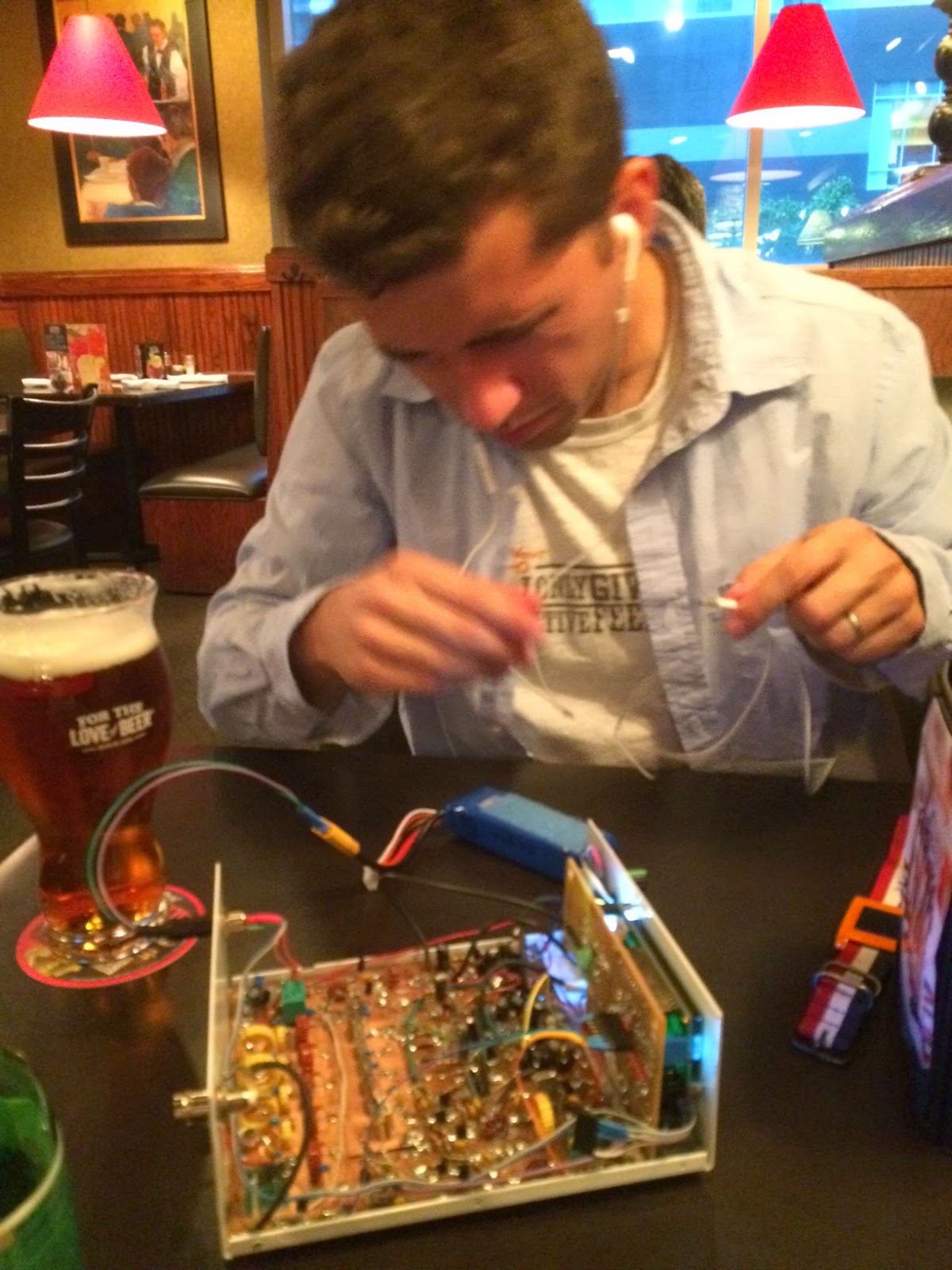
Thomas, KK6AHT, was in Washington this week. He and I got together for a beer and a look at his Minima.
I'd seen pictures of it, but it was much more impressive in person. Thomas did a great job on this rig. It is a really nice mixture of digital and analog. I liked the fact that he built the analog portion Manhattan style using MePads. He and I agreed that while it would make sense to produce a PC board for the Arduino/Si570/LCD portion of the rig, builders should be encouraged to do the rest Manhattan style.
Showing true homebrew dedication, Thomas was unhappy with the level of audio output when we turned it on. He started to trouble-shoot right there in the Ruby Tuesday bar!
It turns out that we were in a very Knack-ish location. We were on the site where they created ARPANET.
Thomas very kindly left me with a nice package of Minima digi-parts including the Arduino chip loaded with the software and an SI570. So now I have no excuse.
Thanks Thomas!
Our book: "SolderSmoke -- Global Adventures in Wireless Electronics" http://soldersmoke.com/book.htm Our coffee mugs, T-Shirts, bumper stickers: http://www.cafepress.com/SolderSmoke Our Book Store: http://astore.amazon.com/contracross-20
Tuesday, October 21, 2014
Arduino Hell!
Hi Bill,
I am a long time listener of SolderSmoke and a big fan! Since your last podcast was on the use of Arduino’s for ham radio, my Arduino Hellschrieber project may be of interest to you and your listeners. I am using the $15 dollar RadioShack color display they are closing out and a simple circuit with our favorite transistor!
I have a video in my second blogpost and all the details with code below.
Keep up the great work, I have your book both in print and Kindle!
73, Dan WA6PZB
Our book: "SolderSmoke -- Global Adventures in Wireless Electronics" http://soldersmoke.com/book.htm Our coffee mugs, T-Shirts, bumper stickers: http://www.cafepress.com/SolderSmoke Our Book Store: http://astore.amazon.com/contracross-20
Monday, October 20, 2014
Has AA1TJ Joined the FMLA?
I have learned that esteemed homebrewer Michael Rainey, AA1TJ, recently whipped up a 56 MHz, quarter-wave, helical coaxial resonator (BTW: the spoon is also homebrew). Hmm, 56 Mhz. Or perhaps we should say MegaCYCLES? Michael claims this device is for a low phase- noise VFO, but I find the frequency selection highly suspicious. The last time I heard of that frequency it had to do with an underground group set up by the late (or not so late) Frank Jones.
Here is all the info on Frank's Five Meter Liberation Army.
http://www.sunflower.com/~brainbol/frank/
A man of the '30s awakens one night in the '90s (episode 13) with a new mission: recapture 56-60 mc. He forms a Five Meter Liberation Army from his mobile home in a Barrio trailer park run by Tom Joad of Steinback's Grapes of Wrath (episode 9), and soon draws a decidedly uncolorful bodyguard (episode 7). A six foot tall half Mexican stockbroker named for Ayn Rand makes him rich and a demonic white ferret and a half-siamese cat become his familiars. (episodes 10 and 9). The leader of all this, called only "Frank," settles down in the narrator's basement to be joined by Maj. Armstrong (episode 8), Hiram Maxim (episode 23) and one-time pals Carl and Jerry from the 1950s Popular Electronics (episode 25). His huge 1940s sedan, with contemporary plates, is immune from police (episode 13 et seq) and his breadboarded electronic creations recall those distant days when a ham built his own rig and could "fix a radio." Of course all this is crazy. No one builds anything anymore and the other things Frank stands for, like self- reliance, tolerance and a generally Boy Scout viewpoint are simply out of step. Frank knows that too (episode 20), but he does not care. If you're standing in the middle of the road and see a big brown Frazer coming at you, you better jump - one way or the other.
VIVA EL FMLA! VIVA!
Our book: "SolderSmoke -- Global Adventures in Wireless Electronics" http://soldersmoke.com/book.htm Our coffee mugs, T-Shirts, bumper stickers: http://www.cafepress.com/SolderSmoke Our Book Store: http://astore.amazon.com/contracross-20
Sunday, October 19, 2014
Tribal Knowledge Video: Putting Screw Threads in Aluminium
http://youtu.be/LuqliWT1k5A
Thank you Giovanni Manzoni, whoever you are!
Our book: "SolderSmoke -- Global Adventures in Wireless Electronics" http://soldersmoke.com/book.htm Our coffee mugs, T-Shirts, bumper stickers: http://www.cafepress.com/SolderSmoke Our Book Store: http://astore.amazon.com/contracross-20
Friday, October 17, 2014
Author Walter Isaacson was a Radio Amateur
This is the guy who wrote the biographies of Einstein, Steve Jobs, and Ben Franklin that I've been talking about on the podcast. President of the Aspen Institutes, former Chairman of CNN and editor of Time Magazine. And, as I learned today, a former ham radio operator. In his new book, "The Innovators," he writes:
"My father and uncles were electrical engineers, and like many of the characters in this book, I grew up with a basement workshop that had circuit boards to be soldered, radios to be opened, tubes to be tested, and boxes of transistors and resistors to be sorted and deployed. As an electronics geek who loved Heathkits and ham radios (WA5JTP) I can remember when vacuum tubes gave way to transistors."
When I told Billy about this, he said, "No wonder you like his books so much!" Indeed. Walter has THE KNACK. I'm enjoying his book, "The Innovators."
Our book: "SolderSmoke -- Global Adventures in Wireless Electronics" http://soldersmoke.com/book.htm Our coffee mugs, T-Shirts, bumper stickers: http://www.cafepress.com/SolderSmoke Our Book Store: http://astore.amazon.com/contracross-20
Thursday, October 16, 2014
A Different Kind of Workshop
Sometimes it is good to take a break from the electronics and look at how people are making other things. I've been working on the heat sink for a 140 watt solid state amplifier, so this fellow's comments about working with metal kind of resonated with me.
Our book: "SolderSmoke -- Global Adventures in Wireless Electronics" http://soldersmoke.com/book.htm Our coffee mugs, T-Shirts, bumper stickers: http://www.cafepress.com/SolderSmoke Our Book Store: http://astore.amazon.com/contracross-20
Wednesday, October 15, 2014
SW Echo Theory Confirmed By a BBC Engineer
BBC Relay Station Singapore
Hi Bill,
I heard your description of the echo on your podcast and
before listening I knew the cause - but I think you know that now!
Yes, it's from two separate transmitters, and quite common,
though not usually noticed.
It has nothing to do with path length differences - the
longest round-the-world echo via the ionosphere is only about 0.15 seconds - so
anything more has a different cause.
It's from the audio feed to the transmitter. Your regen
receiver picked up two transmitters on different frequencies. It was very
noticeable before transmitters used digital land-line feeds, just analogue and
satellite.
On a BBC SW frequency (forget the which one now) one tx was
in UK and the other in Singapore, on the same frequency with the same programme
to completely different service areas. When propagation was right and listening
in Europe, the UK signal fed by analogue audio from Bush House came first and
the Singapore tx came with two geostationary satellite delays later, plus the
tiny bit of UK-Singapore ionospheric path difference.
Now it's worse because there are all sorts of digital delays
via land-line and satellite, although using the same frequency for the same
service in not common.
In the UK Absolute Radio on AM medium-wave has multiple
transmitters (mostly 1215 kHz and 1197 kHz) on the same frequency which are
audible at night. If you listen carefully you can often hear multiple (up to
FOUR!) echoes from different transmitters all being fed by different internet
feeds/satellite links with varying delays.
As an ex-BBC engineer, I can tell you that in the old days
not only were these AM medium-wave group stations all synched to within 0.05Hz,
but the phase of the modulation was adjusted so all tramsitters were modulating
in phase! Now the commercial boys have taken over most of these syched groups,
not only are the frequencies all over the place, but the modulation isn't even
time delayed to match, let alone synchronized! Some even put diferent
commercials in the breaks so if you're geographically between stations you get
a complete, unlistenable-to mess. Apparently these days that's ok.
Why did we bother...?
Anyway, I hope this adds to and confirms your findings.
73,
Ian Liston-Smith, G4JQT
(A grumpy old retired BBC Engineer)
Subscribe to:
Posts (Atom)