Serving the worldwide community of radio-electronic homebrewers. Providing blog support to the SolderSmoke podcast: http://soldersmoke.com
Podcasting since August 2005! Listen to our latest podcast here:
Podcasting since August 2005! Listen to Latest SolderSmoke
Sunday, February 15, 2015
World Radio Day! Article with Farhan
The Hindu did a nice article on World Radio Day. They wisely featured someone with a true case of The Knack, someone with a strong emotional connection to radio and radios: our friend Farhan.
http://www.thehindu.com/features/metroplus/thank-you-for-the-radio/article6886601.ece
Our book: "SolderSmoke -- Global Adventures in Wireless Electronics" http://soldersmoke.com/book.htm Our coffee mugs, T-Shirts, bumper stickers: http://www.cafepress.com/SolderSmoke Our Book Store: http://astore.amazon.com/contracross-20
Saturday, February 14, 2015
This Kid has THE KNACK TO THE MAX! And is in the International Brotherhood of Electronic Wizards! (VIDEO)
Oh man, we've all been there in one form or another. The struggle, the frustration, then, THE TRIUMPH! I love when his mother drops the plate.
Thanks to John KC0BMF
Our book: "SolderSmoke -- Global Adventures in Wireless Electronics" http://soldersmoke.com/book.htm Our coffee mugs, T-Shirts, bumper stickers: http://www.cafepress.com/SolderSmoke Our Book Store: http://astore.amazon.com/contracross-20
A Sweet Little Poem for Valentines Day
I was alone and all was dark
You might not want to actually use any of that poetry today.
Sent in to us by Bob Crane, W8SX
Our book: "SolderSmoke -- Global Adventures in Wireless Electronics" http://soldersmoke.com/book.htm Our coffee mugs, T-Shirts, bumper stickers: http://www.cafepress.com/SolderSmoke Our Book Store: http://astore.amazon.com/contracross-20
Beneath me and above
My life was full of volts and amps
But not the spark of love
My life was full of volts and amps
But not the spark of love
But now that you are here with me
My heart is overjoyed
You've turned the square of my heart
Into a sinusoid
My heart is overjoyed
You've turned the square of my heart
Into a sinusoid
You load things from my memory
Onto my system bus
My life was once assembly code
It's now like C++
Onto my system bus
My life was once assembly code
It's now like C++
I love the way you solder things
My circuits you can fix
The voltage 'cross your diode is
much more than just point six
My circuits you can fix
The voltage 'cross your diode is
much more than just point six
With your op-amps and resistors
You have built my integrator
I cannot survive without you
You're my function generator
You have built my integrator
I cannot survive without you
You're my function generator
You've changed my world, increased my gain
And made my math discreet
So now I'll end my poem here
Control, Alt, and Delete
And made my math discreet
So now I'll end my poem here
Control, Alt, and Delete
You might not want to actually use any of that poetry today.
Sent in to us by Bob Crane, W8SX
Our book: "SolderSmoke -- Global Adventures in Wireless Electronics" http://soldersmoke.com/book.htm Our coffee mugs, T-Shirts, bumper stickers: http://www.cafepress.com/SolderSmoke Our Book Store: http://astore.amazon.com/contracross-20
Friday, February 13, 2015
SPARK FOREVER! George and Tommy Build a Spark Rig
It has been a while since I visited the Amateur Logic TV site. When I looked in last week I found George and Tommy building a spark transmitter. Pretty cool! The sparks begin to fly at about about the 23 minute point in this video. Very interesting. Way to go guys!
SPARK FOREVER! (You will see that emblazoned on the QSL cards of REAL old timers. They were railing against those newfangled Continuous Waves. There is a lesson in there for me... )
More AmateurLogic here: http://www.amateurlogic.com/downloads.htm
Our book: "SolderSmoke -- Global Adventures in Wireless Electronics" http://soldersmoke.com/book.htm Our coffee mugs, T-Shirts, bumper stickers: http://www.cafepress.com/SolderSmoke Our Book Store: http://astore.amazon.com/contracross-20
Thursday, February 12, 2015
Pete and Ben's "Let's Build Something" Reference Page
Lots of tribal knowledge here! That's the direct conversion receiver that forms phase 1 of Pete and Ben's "Let's Build Something" project. Arduinos! Si5351s! AD9850s! And it will morph into an SSB transceiver. Check it out:
http://www.jessystems.com/LBS_Detail.html
Our book: "SolderSmoke -- Global Adventures in Wireless Electronics" http://soldersmoke.com/book.htm Our coffee mugs, T-Shirts, bumper stickers: http://www.cafepress.com/SolderSmoke Our Book Store: http://astore.amazon.com/contracross-20
Wednesday, February 11, 2015
REALLY AMAZING! The Portable SDR Project! 42 Hours Left To Save It!
Holy cow! Look at that rig. The whole HF spectrum. AM, CW, SSB, Digital Modes, Waterfall display, GPS. It may even have a Vector Network Analyzer! (Deep breaths Pete Juliano, deep breaths!)
Michael KE7HIA is trying to get this project going via a Kickstarter campaign. He needs to get to $60,000 He currently has about $47,000 pledged. There are only 42 hours to go:
https://www.kickstarter.com/projects/1703258614/psdr-pocket-hf-sdr-transceiver-with-vna-and-gps
Wow, this rig would have been great for my Double A DR DX-pedition!
Features:
- Coverage from 0 to 35MHz
- Waterfall display that lets you see radio signals
- Receives AM, USB (Upper Side Band), LSB (Lower Side Band), and Morse code (CW)
- Modulates USB and LSB signals
- Variable bandpass filter
Hardware:
- Powerful ARM processor
- Color LCD display
- Dual DDS frequency Synthesizers
- Quadrature Sampling Detector & Exciter
- Digitally controllable instrumentation amplifiers
- Morse Code key (the "Giblet" on the bottom right corner of the enclosure)
- Magnitude & Phase measurement chip (for VNA and antenna analysis functions) with Impedance Bridge
- Dual SMA connectors, smartphone style earphone/microphone connector, and USB port
- GPS
- Built in Microphone and Speaker
- Internal Lithium Polymer battery with charger and high efficiency switching regulator
- MicroSD slot
- Pads for grabbing raw I/Q signals, both in and out.
Things it will be able to do with your help:
I designed the hardware to be capable of the following, but I can't write all the software myself. Please note that I can't guarantee when or if these functions will be added, or that they will work as desired.- Work as a full Vector Network Analyzer (VNA)
- Work as a spectrum analyzer
- Cover more modes, including digital modes and image modes
- Work as an emergency location beacon
- Antenna Analyzer
- Frequency Synthesizer
- Media player
- E Reader / Picture viewer
- Have improved audio
- GPS Mapping navigation device
- High end ARM development board
- USB control of any features, including the possibility to operate the PSDR remotely. The USB port supports USB On-the-Go, making it possible to connect keyboards or other devices. Firmware updates will also be possible over USB.
Tuesday, February 10, 2015
Navassa Island 1972
The K1N DX-pedition is currently on Navassa Island (between Jamaica and Haiti). This made me think of one of my earliest ham radio memories: The 73 Magazine article on a 1972 operation on that island. Here is a short video on that trip. It is kind of wacky and fun.
Our book: "SolderSmoke -- Global Adventures in Wireless Electronics" http://soldersmoke.com/book.htm Our coffee mugs, T-Shirts, bumper stickers: http://www.cafepress.com/SolderSmoke Our Book Store: http://astore.amazon.com/contracross-20
Monday, February 9, 2015
Lucien's German Mighty Mite (Video)
Excellent Lucien! Thanks for sending this. I know what you mean about a project that doesn't work. It is rewarding and educational to figure out where you went wrong. I knew a guy who would ask, at a hamfest, "Does this rig work?" If the the seller admitted that it didn't, he'd reply, "Good, I pay extra for that!" He liked the challenge of fixing it. Of course, there are limits to this, and sometimes these challenges will make you wish you had taken up stamp collecting.
Hi Bill and Pete,
For me too, it's a happy day - I got the Mighty Mite working! Thank you so much for the inspiration to get into homebrewing...
I'm just licensed for a year now and this was my very first project (except for 2 basic kits that I build) and it really was a great learning experience. The best part: Since it didn't work out "plug'n play", I had to debug the thing and actually start thinking - so I put 2 caps in parallel instead of the wrong one I had used (I found them in a little box some guys at a hamfest gave me for free - never thought I would ever use something from it...). And I had to use the voltmeter to look for a short circuit. Basic stuff, but for me, this was a breakthrough!
Here are some more things I learned during this first project (don't laugh):
- Where the heck do I plug stuff that's supposed to go to "ground" in? Now I know: usually to the negative pole!
- When 2 lines cross in a schematic, that doesn't mean there's a connection!
- How do these ready-made breadboards actually work? Had to try out...
- It's important to think about the actual layout beforehand!
- When debugging, trial and error doesn't help.
- There's yet another crazy foreign unit called "gauge"! (I used smaller magnet wire than recommended, it still seems to work...)
- 9V-blocks get VERY hot when shorted for a minute or so!
Attached is an image of my ugly prototype, now I want to give it a better "home"... And here is a little video, demonstrating that it works, inspired by IZ1KSW:
BTW, frequency is about 3,5793 Mhz.
Thanks again for all the great inspiration and vy 73 from Germany,
Lucien / DH7LM
Our book: "SolderSmoke -- Global Adventures in Wireless Electronics" http://soldersmoke.com/book.htm Our coffee mugs, T-Shirts, bumper stickers: http://www.cafepress.com/SolderSmoke Our Book Store: http://astore.amazon.com/contracross-20
IZ1KSW's Italian Mighty Mite (Video)
Hi Bill and Pete,
This is a great day for me!
I just managed to get my MMM oscillating!
This is my very first homebrew project guys and I'm so excited! I started from scratch... and when I say from scratch, I mean that I didn't even have one of the 7 components required, no PCB boards, no junkbox, nothing... just the soldering iron and the will to "build something".
Thanks to Pete suggestions I managed to put some components together and now I have a (small) junkbox (I'm very proud of it) and thanks to soldersmoke I entered the ranks of the homebrewers.
I send you also a couple of pictures, I used Manhattan style and I found it very useful to understand the circuit. It's far from being a clean and neat building but it's a first step.
Our book: "SolderSmoke -- Global Adventures in Wireless Electronics" http://soldersmoke.com/book.htm Our coffee mugs, T-Shirts, bumper stickers: http://www.cafepress.com/SolderSmoke Our Book Store: http://astore.amazon.com/contracross-20
Sunday, February 8, 2015
Glowing Blue Numerals! A Frequency Counter for the BITX17 (VIDEO)
These little frequency counters from China have a lot of potential. And they add a dash of digital color to an otherwise bland analog hamshack. I got mine on e-bay.
My BITX17 has now been "accessorized" with
1) A rotatable Moxon antenna (big improvment!)
2) A 120 watt Communications Concepts Linear amplifier (another big improvement) and
3) This digital frequency readout.
What next?
Our book: "SolderSmoke -- Global Adventures in Wireless Electronics" http://soldersmoke.com/book.htm Our coffee mugs, T-Shirts, bumper stickers: http://www.cafepress.com/SolderSmoke Our Book Store: http://astore.amazon.com/contracross-20
Saturday, February 7, 2015
DuWayne's Scalar Network Analyzer -- In an Altoids Tin!
DuWayne (KV4QB) has done something very cool here. He's taken an Arduino Nano, a cheap AD9850 DDS board, a small screen, and a couple of log detectors, and he has built IN AN ALTOIDS TIN a scalar network analyzer that lets you see the bandpass of a filter. (We posted an earlier version of this here: http://soldersmoke.blogspot.com/2015/01/duwaynes-ad9850-arduino-tft-swr-scanner.html ) Wow. I've been doing this by hand, changing the input freq at 100Hz increments, measuring the output, putting the results into a spread sheet, converting to log (db), creating a graph... DuWayne makes it a lot easier. DuWayne is being encouraged to write up the results, possibly for QRP Quarterly.
Hi Guys
Started playing around with the SWR scanner that I had been working on. Waned to see how hard it would be to make a very simple scalar network analyzer out of what I had. Really wanted something small to use for checking bandpass other filters. Hoped to get about 30 db. of range ,which should be enough for most filters. I have a couple of 8307 log detectors, but was afraid that it would be a pain getting it working and shielded in an Altoids tin along with the rest of the circuitry. Went with something even easier than the resistive SWR bridge I already had. Replaced the bridge with two basic diode RF probes, and changed the amplifiers so I could adjust the gain. I use one to measure the direct output of the 9850 DDS module, and the other for the output of the device under test. Kept the same control function as in the SWR scanner. A short push on the encoder button starts a sweep of the selected band. Holding it down for over a second cycles through the bands. Once a scan is done you can use the encoder to scroll through the sweep. I display the frequency and iDUT value in db relative to the output of the DDS module. The USB connector is available and different start and stop frequencies can be entered if needed when working with IF stages.
Well it worked much better than I had expected. After a simple adjustment of the amp gains with the output looped directly to the input, I was getting nearly 50 db with the loopback removed. Just using some standard value resistors, in a pi attenuator I got a very nice looking sweep that was within a couple db of the 40 db i had built it for. Since I only used standard value resistors, I though this was good enough.
Then I used ELSIE to design a 14mhz lowpass filter, again used standard values for L and C that I had on hand . Really happy with the results I got.
Finally I grabbed 3 crystals out of a bag without checking frequency or other parameters, I threw together a basic crystal filter. Used the USB interface to set the sweep range, I was really really really pleased with the results I was able to obtain.
Attaching some pictures of the progress so far. As you can see that with what I used to build the test fixtures, I am amazed that they even worked at all.
73 DuWayne
Our book: "SolderSmoke -- Global Adventures in Wireless Electronics" http://soldersmoke.com/book.htm Our coffee mugs, T-Shirts, bumper stickers: http://www.cafepress.com/SolderSmoke Our Book Store: http://astore.amazon.com/contracross-20
Friday, February 6, 2015
A De-Soldering Primer By Wayne Burdick
A De-Soldering Primer
By
Wayne Burdick, N6KR
Removing resistors and other parts from
double-sided boards is easy and
fun. After years of careful analysis of my own
technique I have documented
the process. I start with technique #1, below;
if that doesn't work, I try
#2, etc. Good luck!
1. Turn the board over. With one hand
behind your back, a wry smile, and
the confidence of a pet surgeon, simply heat
the lead in question and
listen for the pleasant sound of the component
hitting the work bench.
2. Well, that *would* be too easy,
wouldn't it. Staying with the solder
side for now, locate a large solder sucker
(the larger the better; it
should frighten smaller pets when brandished).
Heat each joint and deftly
suck out the solder with a single satisfying
Thwop! Listen for the part
hitting the bench.
3. Didn't fall out, eh? No problem:
rummage in that tool bin for a shiny
new roll of solder wick. Crack open a beer,
too, and take a generous swig.
Wedge that wick in between the lead and pad,
heat until you see the solder
flow nicely onto the wick, and pull it out of
the way just in time to see a
beatiful, black annular ring around your
component lead. Nudge each lead
with your iron and keep your fingers crossed.
4. OK, so you've got a tough customer:
small lead, hole just barely
larger, and a bit of off-color solder that
can't be bothered with any of
the usual techniques. Have another sip of that
brew. Vigorously flip the
board back to the component side. Now grip the
lead professionally with
your most elegant long-nose pliers and hold on
tight. Give it a playful
yank, then pray. Should pop right out.
5. Damn. Finish the beer and get out
your brutal, 8" electrician's
long-nose. Grab the component with gusto this
time, buster, then tip the
board up at a 45. Turn up your soldering
station to max and heat that baby
up on the backside. Pull down hard with the
pliers.
6. No go? Hmmmm -- let's get serious.
Put the board up directly on its
edge and hold it in place vertically with your
chin. Since your iron is
suspect by this time, test it for several
seconds on the nearest exposed
skin. (Doing it by accident is just as
effective.) Heat the joint with
*feeling* this time. Lunge and parry. Don't
worry about the pad, traces,
or other parts--this is war! With maximal chin
pressure exerted to hold
the offending board in place, pull the lead
out, out, Out!
7. OK, so you "...couldn't get
hold of it...," blah blah blah. Fool!
You must risk everthing at this stage. Insert
a small screwdriver under
the part, and white-knuckle that soldering
iron on the obverse. Pry and
heat until it pops. (Note: It is important to
keep in mind the concept of
"kick-back" should you succeed at
this. PC boards are likely to
wobble, flop, slip, then fling out of your
grasp once the offending little
monster finally lets go, taking test leads and
soldering station with it.)
8. So, what kind of inept dweeb are
you, anyway? Give up! Clip the part.
Leave some lead to grab onto and repeat #6 and
7. If your face has turned
red it is best to shield the work from veiw
with your body, then steal a
quick look behind you to be sure noone is
suppressing a giggle as they
watch this humiliating display.
9A. The lead came out but you STILL
have some solder left in the hole?
Gads. Find another part that you can
sacrifice. Press its helpless
lead into the depressingly small pit you made
in the center of the pad.
Heat the base of the lead until you achieve
Punch-Through. Yank and Heat,
Yank and Heat. Evetually the solder will give
up in disgust and the
sacrificial component lead will slide
smoothly, signalling victory.
9B. To your left is a hand drill; to
your right is a #60 bit. You know
what you must do.
10. Now—you brute!— now that you've
overheated the pad, broken the trace,
cracked the component, gouged the board,
pitted the tip, blistered the
skin, wasted a beer, and irrefutably proven
once and for all that you
should have taken up gardening instead, NOW
maybe you'll learn the color
code!
;)
N6KR
Our book: "SolderSmoke -- Global Adventures in Wireless Electronics" http://soldersmoke.com/book.htm Our coffee mugs, T-Shirts, bumper stickers: http://www.cafepress.com/SolderSmoke Our Book Store: http://astore.amazon.com/contracross-20
Thursday, February 5, 2015
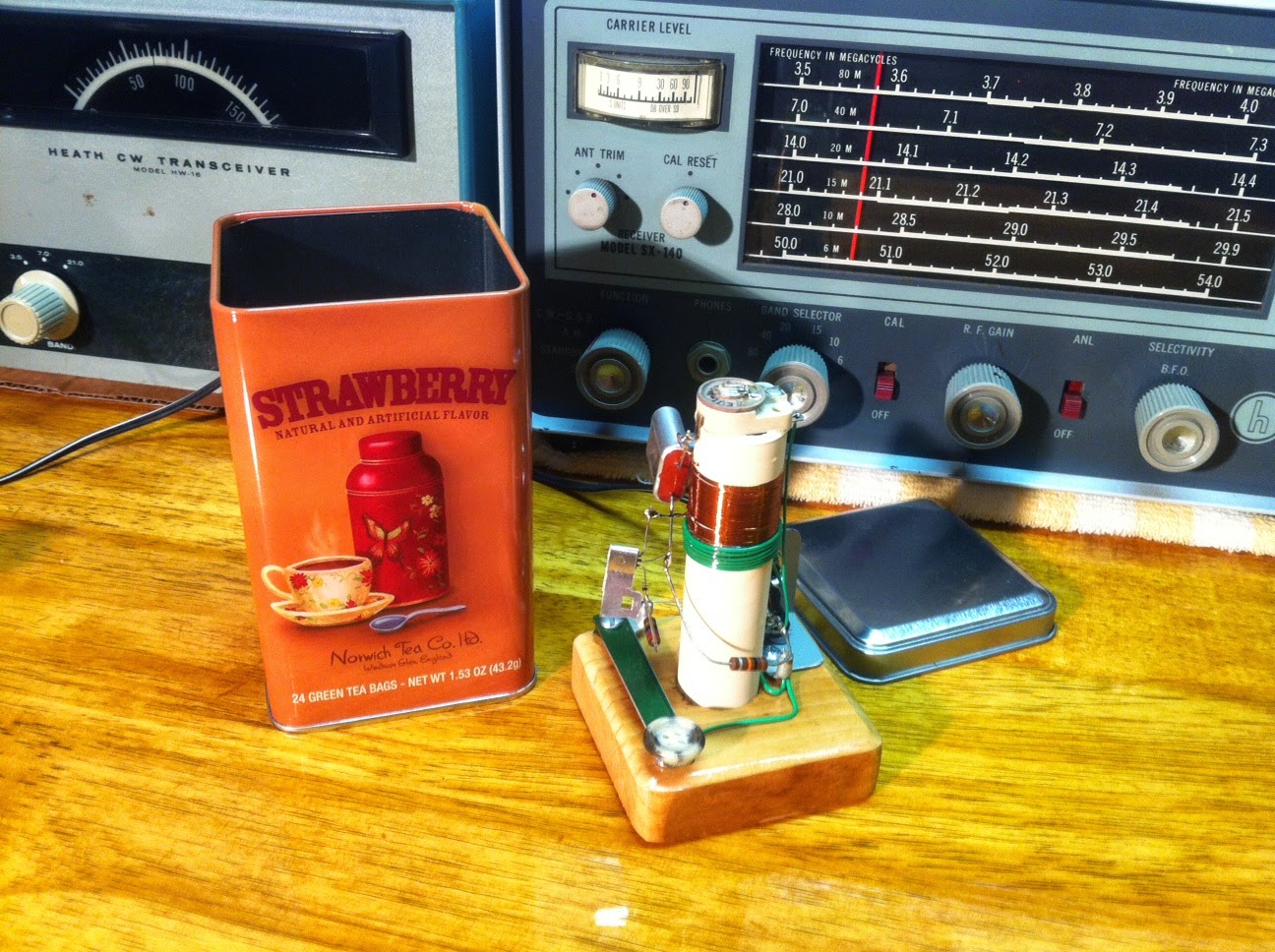
K8GZ's Towering Tea Tin Ohio Mighty Mite
Here is a very innovative approach to the Mighty Mite. The compression cap atop the coil form gives it a towering appearance. Pete and both liked the button key. The Te Tin is very nice and marks another example of the long ham radio tradition of bringing kitchen items (breadboards!) into radio projects. E-mails from K8GZ appear below.
Podcast 171 is fantastic, loaded with
Information and inspiration. Your
podcasts continue to lead me down
the road of home few. I'm trying to
get the demons out of a regen that
will companion my MMM.
I have attached photos of my MMM,
complete with on board key. A ceramic
trim capacitor fills in for the air cap.
A reverse polarity diode helps to keep
electronic smoke in precious components.
Thanks for the crystal and inspiration.
The MMM emits a stable signal whether
it is powered by 1.5 or 12 volts.
73
K8GZ
Kaye Hartman
Information and inspiration. Your
podcasts continue to lead me down
the road of home few. I'm trying to
get the demons out of a regen that
will companion my MMM.
I have attached photos of my MMM,
complete with on board key. A ceramic
trim capacitor fills in for the air cap.
A reverse polarity diode helps to keep
electronic smoke in precious components.
Thanks for the crystal and inspiration.
The MMM emits a stable signal whether
it is powered by 1.5 or 12 volts.
73
K8GZ
Kaye Hartman
Thank you for the crystal that arrived on
Sat. the 13th. I was hoping for a
"Plug-N-Play" since the MI Mighty Mite
was assembled, waiting for a crystal.
However, Noodleing was required.
Several salvaged transistors were tried
with the winner being an unmarked one
with a low hfe of 21. It draws 120 ma. at
12 volts and 4 ma. at 1.5 volts. I added a
cap across the key to soften the key
clicks (per Pete). Also I added a reverse-
protection diode (to protect myself from
additional moments of stupidity).
I live in an environment that is not
antenna friendly, so no air time yet.
I must try some portable operation
to get the MMM on the air.
Thanks for the crystal. It really makes the
project extra special.
Pictures will follow as soon as I figure out
how to send them. Time to have a tech-talk
with my grandchildren.
73,
Kaye Hartman, K8GZ
Lancaster, OH
Our book: "SolderSmoke -- Global Adventures in Wireless Electronics" http://soldersmoke.com/book.htm Our coffee mugs, T-Shirts, bumper stickers: http://www.cafepress.com/SolderSmoke Our Book Store: http://astore.amazon.com/contracross-20
Wednesday, February 4, 2015
Mama Mia! N2HTT's Regen Receiver (Video)
I am fairly certain that Pete Juliano will take pride in N2HTT's success on this project, and will attempt to attribute it, in part, to the Italian ancestry that they share. The Tarantella background music will definitely encourage that kind of thinking.
In presenting this nice video, we continue with our "rigs not yet in a box" theme. There is something especially nice about the sound of receivers that are not yet boxed up.
Mike has some great information on the construction of this receiver (and other projects) on his blog:
http://n2htt.net/
Bravo Michele!
Our book: "SolderSmoke -- Global Adventures in Wireless Electronics" http://soldersmoke.com/book.htm Our coffee mugs, T-Shirts, bumper stickers: http://www.cafepress.com/SolderSmoke Our Book Store: http://astore.amazon.com/contracross-20
Monday, February 2, 2015
Video of Colin's First Contact with his Homebrew Scratch-built BITX20
I love this video. Colin finished his BITX a week or so ago and has been waiting for an opportunity to test it. Over the weekend he braved the winter of Northern England and, with his son, set up his new rig out in his snow-covered garden. Appropriately for a first contact with scratch-built rig, the circuitry was unencumbered by any kind of case or box. That's the way it should be done! Well done Colin! You are well and truly a member of the International Brotherhood of Electronic Wizards, and the diagnosis of "The Knack" has been confirmed (a severe case, it appears).
Hi Pete and Bill,
It's been a lovely fine day here in West Yorkshire, so I took a table out into the garden and set up my BITX circuit on it. I set up my SOTA dipole on a 9m fishing pole.
How amazing to contact someone in another country using a rig and mic you've made yourself! Do I qualify as a REAL radio ham now? Do I have a confirmed case of the knack? :-)
Although I may appear underwhelmed in the video, (besides the air punches!), I did really get a kick out of the QSO.
73 and huge thanks to both of you for the encouragement and support.
Colin, M1BUU
Our book: "SolderSmoke -- Global Adventures in Wireless Electronics" http://soldersmoke.com/book.htm Our coffee mugs, T-Shirts, bumper stickers: http://www.cafepress.com/SolderSmoke Our Book Store: http://astore.amazon.com/contracross-20
Brian's Mighty Mite
Bill,
All the parts finally arrived from China so the MMM lives :)
Good to finally join the CBLA!!
It made for a very enjoyable Saturday afternoon while the snow fell!
I left some room between the antenna connector and the coil for the low pass filter I'm going to build if the caps ever arrive.
Thanks for the crystal and the inspiration to get busy and build something; it brought back a few childhood memories of building things for the homebrew contest at the local hamfest.
73,
Brian
KA0PHJ
Our book: "SolderSmoke -- Global Adventures in Wireless Electronics" http://soldersmoke.com/book.htm Our coffee mugs, T-Shirts, bumper stickers: http://www.cafepress.com/SolderSmoke Our Book Store: http://astore.amazon.com/contracross-20
Saturday, January 31, 2015
SolderSmoke #171 DC RX in QQ, Power Supplies, Small Screens, 12 Buck Counters, HW8 Error?, KX3 RX
SolderSmoke Podcast #171 is available:
http://soldersmoke.com/soldersmoke171.mp3
Bench Report:
Pete's Small Screens (in Color!)
Si5351s
Bill's Graph Paper Frequency Readout
Bill's Broadened Barebones Barbados RX. DIGITIZED!
Another AD9850 DDS using M0XPD Kanga UK Shield
New 13 dollar Color Display (Prettier than Graph paper!)
Pete and Ben's Article in QRP Quarterly Available free here:
http://www.qrparci.org/qqsampl
The DEEP SPIRITUAL REWARDS of DC Receivers
The Importance of Good Power Supplies
SPRAT Article on HW8 Design Error
Latest Edition of Hot Iron
Elecraft KX3 -- Has one of the best receivers in the world
Our book: "SolderSmoke -- Global Adventures in Wireless Electronics" http://soldersmoke.com/book.htm Our coffee mugs, T-Shirts, bumper stickers: http://www.cafepress.com/SolderSmoke Our Book Store: http://astore.amazon.com/contracross-20
15% Off on SolderSmoke and other books at Lulu This Weekend
All three of my books are here:
Our book: "SolderSmoke -- Global Adventures in Wireless Electronics" http://soldersmoke.com/book.htm Our coffee mugs, T-Shirts, bumper stickers: http://www.cafepress.com/SolderSmoke Our Book Store: http://astore.amazon.com/contracross-20
Friday, January 30, 2015
More Glowing Numerals! BIG! BLUE! $13!
Even though my pencil and graph paper frequency readout for the BITX rigs has its own undeniable charm, this little device could get me to go digital. I heard about it from Chuck Adams and the folks on the qrp-tech mailing list. 13 dollars. It covers .1 MHz to 2.4 GHz. You just hook up a 9 volt source and the RF input. It also does IF offset. The construction looks great and it would be very easy to put into (or aside) any rig. Here is where I got mine:
Our book: "SolderSmoke -- Global Adventures in Wireless Electronics" http://soldersmoke.com/book.htm Our coffee mugs, T-Shirts, bumper stickers: http://www.cafepress.com/SolderSmoke Our Book Store: http://astore.amazon.com/contracross-20
Thursday, January 29, 2015
Beagle 2 Found On Mars
I was one of the millions of people who woke up that Christmas morning in 2003 thinking not of Santa Claus but of Colin Pillinger's Mars Lander, the Beagle 2. We were in London by then, and later on I got to meet Colin Pillinger. I still have the books about Beagle 2 that he gave to me. Wow, it looks like they came very close. Too bad Colin did not live to see these pictures.
The Planetary Society has a very good article on all this:
http://www.planetary.org/blogs/emily-lakdawalla/2015/01160800-beagle-2-found.html
Wednesday, January 28, 2015
Back Into the Digital Morass
Using a very nice M0XPD AD9860 shield from Kanga-UK and software by Richard AD7C I put together another little DDS VFO. This one went together without a lot of hair pulling. I put the LCD, brightness control and rotary controller on one piece of vero board -- this will also serve as the front panel.
Our book: "SolderSmoke -- Global Adventures in Wireless Electronics" http://soldersmoke.com/book.htm Our coffee mugs, T-Shirts, bumper stickers: http://www.cafepress.com/SolderSmoke Our Book Store: http://astore.amazon.com/contracross-20
Tuesday, January 27, 2015
The Battery That's Been Working for 175 Years
In case you missed this. Makes you think, doesn't it? I'm thinking of a QRPp QRSS transmitter that would just keep on going. Battery designed by Giuseppe Zamboni.
http://motherboard.vice.com/read/this-battery-has-lasted-175-years-and-no-one-knows-how
Our book: "SolderSmoke -- Global Adventures in Wireless Electronics" http://soldersmoke.com/book.htm Our coffee mugs, T-Shirts, bumper stickers: http://www.cafepress.com/SolderSmoke Our Book Store: http://astore.amazon.com/contracross-20
Monday, January 26, 2015
New Analog Frequency Readout for BITX17 VXO
I've been getting tired of being in the dark about the frequency on which my BITX17 was operating. So I pulled out some graph paper, my frequency counter, and a pencil. You will see two frequencies at each point -- that's because I use two crystals, switched by the black knob on the left. I realize this paper and pencil approach is hopelessly out of date, but I see it as "appropriate technology" for a discrete component all-analog transceiver.
Pete set me straight on how to come up with the numbers: VXO frequency minus ACTUAL carrier oscillator/BFO freq. After doing this I took great delight in going on the air and asking guys with fancy "glowing numerals" rigs to compare their freq readout with my pencil and graph paper readouts: they were painfully close.
But I am not slipping completely into stubborn Luddite-ism; this weekend I worked on a DDS-based AD9850/Arduino VFO with I-Q output based on Paul M0XPD's Kanga-UK Arduino Shield. STAY TUNED!
Our book: "SolderSmoke -- Global Adventures in Wireless Electronics" http://soldersmoke.com/book.htm Our coffee mugs, T-Shirts, bumper stickers: http://www.cafepress.com/SolderSmoke Our Book Store: http://astore.amazon.com/contracross-20
Sunday, January 25, 2015
Jailed for The Knack: Gerry Wells, Homebrew Hero
Thanks to Thomas of the "SWLing Post" for alerting us to the story of UK radio legend Gerry Wells. As Thomas said in his post, you really need to drop what you are doing and listen to this great BBC program about Gerry:
http://swling.com/blog/2011/02/radio-documentary-the-wireless-world-of-gerry-wells/
The poor fellow was actually JAILED for his "radio obsession." Wow. That was kind of harsh. But Gerry overcame adversity and had a very happy life in radio.
Thomas has more on Gerry here:
http://swling.com/blog/2014/12/jonathans-interviews-with-gerry-wells/
Thanks Thomas! And thanks to the BBC.
Our book: "SolderSmoke -- Global Adventures in Wireless Electronics" http://soldersmoke.com/book.htm Our coffee mugs, T-Shirts, bumper stickers: http://www.cafepress.com/SolderSmoke Our Book Store: http://astore.amazon.com/contracross-20
Saturday, January 24, 2015
VE3MKC's Teensy Si5351 SDR Receiver with a Tiny Color Screen (video)
From: Rich
To: "soldersmoke@yahoo.com"
Sent: Thursday, January 22, 2015 9:22 AM
Subject: Cheap, open source Arduino SDR project
Sent: Thursday, January 22, 2015 9:22 AM
Subject: Cheap, open source Arduino SDR project
Bill
First, thanks for Soldersmoke and all you do for us QRP hackers around the world. I'm a big fan!
I've detected you are getting sucked into the world of microcontrollers of late. I know you are not really that excited about SDR but this is a radio that combines Arduino, the currently popular SI5351 and a Softrock to make a very functional SDR. I started this project last year which uses the fabulous Teensy 3.1 and companion audio shield. I recently packaged it all up and it looks like a QRP radio now. Still doesn't transmit but as I like to say thats "just a small matter of software".
There are several posts about it on my blog. The most recent:
There's a link to a video and a link to the code in that post.
Rock on Bill!
73, Rich Heslip
VE3MKC
From: solder smoke
Sent: Friday, January 23, 2015 4:09 AM
To:
Subject: Re: Cheap, open source Arduino SDR project
Wow Rich that is really beautiful. Amazing! I am also sending this to Pete Juliano, but I was at first hesitant about this because I feared that your combination of Si5351 and TFT display might be TOO exciting for him. Deep breaths Pete...
73 and Thanks, Bill
From: jessystems@verizon.net
To: soldersmoke@yahoo.com;
Subject: Re: Cheap, open source Arduino SDR project
Date: Fri, 23 Jan 2015 06:03:40 -0800
To: soldersmoke@yahoo.com;
Subject: Re: Cheap, open source Arduino SDR project
Date: Fri, 23 Jan 2015 06:03:40 -0800
Hi Rich & Bill,
Wow –really exciting project Rich! Congratulations and Bravo!
This is so exciting, for all hams, as this just shows the power of the available low cost technology that is now on the market. Your project is really tempting as I have a V6.2 15M softrock sitting in a box (somewhere). I was somewhat put off with the Power SDR as the opposite sideband rejection is not too good –it is clear you have cracked that nut.
Thanks for sharing Rich and yes Bill I am taking very deep breaths.
73’s
Pete N6QW
- Jan 23 at 9:27 AM
- Pete Juliano
- me
Thanks guys! When I saw the Teensy 3.1 with the companion audio codec board the first thing that came to mind was a portable SDR. Since its Arduino compatible I am able to leverage the SI5351 library, encoder library etc so its mostly just putting software blocks together. The digital filter design is a bit tricky but Loftur VE2LJX did quite a bit of work on that and now it works really well.
I hope to add CW decoding and PSK31 at some point. I've used less than half the flash on the Teensy so lots of room for new features. I'm hoping if the word gets out I won't have to do this all myself!
Pete - too bad you missed the Black Friday sale - Teensy 3.1 and the audio shield for $18. Deep breaths...
: )
73, Rich
VE3MKC
Our book: "SolderSmoke -- Global Adventures in Wireless Electronics" http://soldersmoke.com/book.htm Our coffee mugs, T-Shirts, bumper stickers: http://www.cafepress.com/SolderSmoke Our Book Store: http://astore.amazon.com/contracross-20
Subscribe to:
Posts (Atom)


