Serving the worldwide community of radio-electronic homebrewers. Providing blog support to the SolderSmoke podcast: http://soldersmoke.com
Podcasting since 2005! Listen to Latest SolderSmoke
Saturday, July 2, 2022
A Double Sideband Transmitter from France -- F4IET's "Master Robert"
Wednesday, June 29, 2022
Details on Pete N6QW's Wireless Set
Tuesday, June 28, 2022
Flip-up Workbench Build -- Possible Application for Our Test Gear
Monday, June 27, 2022
Pete N6QW's Hybrid Wireless Set -- A Thing of Beauty, with Thermatrons
Thoughts on Homebrew, Makers, DIY, and Hams -- from Lex PH2LB
Sometimes we get a comment that is so good that we elevate it to the main blog page. That was the case with Lex PH2LB's comment on the blog post of Owen Duffy (yesterday).
----------------------
When I started the hobby, it arose out of technological curiosity, the interest in understanding things and the will to make things myself (designing myself was not my main goal). It doesn't matter to me whether it is 100% DIY or a kit (such as Heathkit, Elecraft, QRP-Labs etc) which is modified or not after construction. Just having fun with the hobby and pushing boundaries. And yes I also have some off-the-shelf transceivers (I'm super happy with my FT817ND) and my QO-100 uplink is also a kit (which is then already soldered a little more than average). As far as new tools are concerned: here at home are 2 types of 3D printers, various tools for SMT assembly, and I have a nice workshop equipped with tools and equipment for metal / plastic / wood processing. And every day I try to learn something new, because I stand by the IBEW moto : If you know stuff, you can do stuff.
Am I a maker then? I wouldn't call myself that. Just like I don't call myself a hacker because I'm quite handy with computers, technology and have certain skills. I'm just a hobbyist who wants to do and make things after work.Sunday, June 26, 2022
ZL2BMI Double Sideband QRP Transmitter in SPRAT #191
Very cool that SPRAT had a Double Sideband (DSB) transmitter article in its current issue (#191 Summer 2022). The author is DSB guru Eric Sears ZL2BMI,creator of the famous ZL2BMI DSB QRP transceiver.
I think DSB is a great way to break into homebrewing for phone. Building a DSB transmitter is a LOT easier than building an SSB rig. The DSB transmitter can then be converted into a DSB/Direct Conversion transceiver.
Here is a link to 75 SolderSmoke blog posts about DSB (keep on scrolling, keep on hitting the "older posts" button): https://soldersmoke.blogspot.com/search/label/DSB
Here are a bunch of blog posts that mention ZL2BMI: https://soldersmoke.blogspot.com/search?q=ZL2BMI
Thank you Eric, and thanks to G-QRP.
Saturday, June 25, 2022
Australian Homebrew: Owen Duffy ex VK1OD now VK2OMD. Are Hams Makers?
This week I stumbled upon this amazing blog from Australia. I had to check with Australian friends to find out more about the author. Owen Duffy has for many years been a rigorous homebrewer who has documented his findings on his blog: https://owenduffy.net/blog/
For example, Owen asks the question, "Are hams makers?" https://owenduffy.net/blog/?p=122
There is a lot of great material on this blog. It goes back to 2013. Peter Parker notes that an earlier version of the blog (before Owen was forced to change his callsign from VK1OD to VK2OMD) goes back even further and is accessible via the Way-Back Machine: https://web.archive.org/web/*/
Check it out. Lots of really useful and interesting material there. Thanks Owen. And thanks to the Australian friends who provided background info.
Friday, June 24, 2022
W8ZAP on 40 AM with a Collins 20V3 Broadcast Transmitter
Thursday, June 23, 2022
WIRED on the Dangers of another Carrington Event, Solar Cycle 25, Capacitors Could Save Us All
This Wired article has some really interesting info on competing theories about the solar cycle, about the danger to the Earth from solar flares, and about what a flare like that of the Carrington event could do to the transformers we are currently using. The article points out that large capacitors could protect these transformers from the effects of the flare. But the power companies are not installing the capacitors.
I think one of the scientists Pete mentioned in SolderSmoke podcast #238 is mentioned here:
Wednesday, June 22, 2022
Hammarlund and Homebrew Heroine: Janis AB2RA, HQ-100 Filter Cap Question
Dean KK4DAS is getting ready to work on his dad's HQ-170A. He too will find lots of wisdom and tribal knowledge on Janis's wonderful web site.
Her main page: http://www.wireless-girl.com/ (with a vast amount of technical info available through the links on the upper left side of this page)
About Janis: http://www.wireless-girl.com/AboutMe.html
Thanks Janis!
Tuesday, June 21, 2022
Summer Solstice -- EITs. Solar Tsunamis. Strange Falcon 9 Spirals Seen in New Zealand
Monday, June 20, 2022
QRP Labs HQ Tour
And here is a 2022 Turkish media interview with Hans and his team in the workshop:
Sunday, June 19, 2022
A Great Book on Oscillators (Analog LC Oscillators) by John F. Rider (Free!)
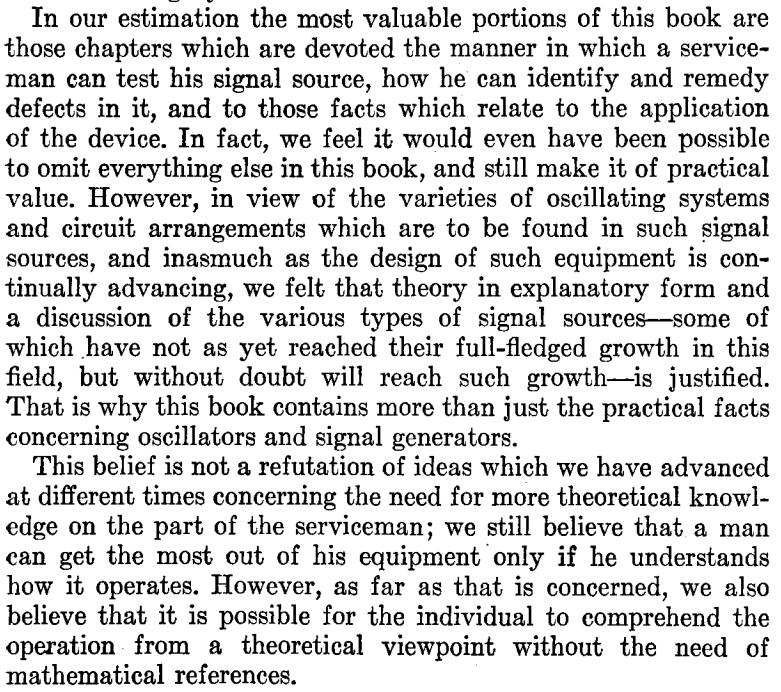
Thanks to Peter Parker VK3YE for alerting us to this wonderful 1940 book. John F. Rider -- a real hero of electronic literature -- does a great job in discussing the practical aspects of oscillator circuits.
This excerpt from Rider's foreword gives a sense of the approach taken in this book:
Friday, June 17, 2022
SolderSmoke Podcast #238 -- SolderSmoke Shack South, Cycle 25, Chiquita Banana Radio, RCA, HQ-100, Mate Mighty Midget, Sony SWL RX , Mailbag
SolderSmoke Podcast #238 is available: http://soldersmoke.com/soldersmoke238.mp3
TRAVELOGUE:
Cathartic decluttering: Bill preparing for future winter travel to Dominican Republic. Will build SolderSmoke Shack South. Dividing everything up: Rigs, parts, tools, supplies, antennas, test gear. Everything.
PETE'S BENCH:
Thursday, June 16, 2022
Watch Mr. Wizard! 1952 Program on Electromagnetism. And more! (video)
Tuesday, June 14, 2022
Hans Summers G0UPL Wins FDIM 2N2222A Power Out Challenge -- 4.1 Watts from Two 2N2222As
Monday, June 13, 2022
SolderSmoke FDIM Interview with Keith W. Whites -- Teaching Electronic Design to EE students using a QRP Transceiver designed by Wayne Burdick
I told Keith Whites that I had struggled to understand the Gilbert Cell and the NE602, the device that lies at the heart of the rig used in both courses: The NE-602 Gilbert Cell Mixer used in Wayne Burdick's NORCAL 40A. Here is how I came to understand the device: https://soldersmoke.blogspot.com/2021/11/how-to-understand-ne-602-and-gilbert.html
Here is Bob Crane's interview: http://soldersmoke.com/2022 Whites.mp3
Here the slides that Keith used at FDIM: http://soldersmoke.com/2022 Teaching NorCal40A.pdf
Keith's students obviously got a lot out of this course. Keith has kindly offered to make his course notes available to those who need them.
Thanks to Bob Crane, Keith Whites, David Rutledge and Wayne Burdick.
Saturday, June 11, 2022
Putting the "Mate for the Mighty Midget" Back to Work -- With a DX-100 on 40 Meter AM
After working on it for a while I got so fond of my old Hammarlund HQ-100 that I moved it from the AM/Boatanchors operating position over to a more convenient spot right next to my computer. This left a big gap on the receive side of the AM station.
I briefly put my HRO-ish solid state receiver above the DX-100, but I'm afraid that receiver needs some work. More on that in due course.
I thought about putting my SOLID STATE Lafayette HA-600A atop the thermatronic DX-100, but this just didn't seem right. The Radio Gods would NOT approve.
So I turned my attention to the Mate for the Mighty Midget that I built in 1998 and have been poking at and "improving" ever since.
This receiver worked, but not quite right. It received SSB stations well enough, but when I turned off the BFO I could no longer hear the band noise. I wasn't sure how well the RF amp's grid and plate tuned circuits tracked. And I had serious doubts about the detector circuit that Lew McCoy put in there when he designed this thing back in 1966.
As I started this latest round of MMMRX poking, I realized that I now have test gear that I didn't have in 1998: I now have a decent oscilloscope. I have an HP-8640B signal generator (thanks Steve Silverman and Dave Bamford). I have an AADE LC meter. And I've learned a lot about building rigs.
FRONT END TRACKING
The MMRX has a tuned circuit in the grid of the RF amplifier, and another in the plate circuit of the RF amplifier. There is a ganged capacitor that tunes them both. They need to cover both 80/75 and 40 meters. And they need to "track" fairly well: over the fairly broad range of 3.5 to 7.3 MHz they both need to be resonant at the same frequency.
McCoy's article just called for "ten turns on a pill bottle" for the coils in these parallel LC circuits. The link coils were 5 turns. No data on inductance was given. Armed now with an LC meter, I pulled these coils off the chassis and measured the inductances of the coils. I just needed to make sure they were close in value. They were:
L1 was .858uH L2 was 2.709 L3 was .930uH L4 was 2.672
Next I checked the ganged variable capacitors. At first I found that one cap had a lot more capacitance than they other. How could that be? Then I remembered that I had installed trimmer caps across each of the ganged capacitors. Adjusting these trimmers (and leaving the caps connected to the grid of V1a and V2A, I adjusted the trimmers to get the caps close in value. I think I ended up with them fairly close:
C1: 63.77-532 pF C2 64.81 -- 525.1 pF
I put the coils back in and checked the tracking on 40 and on 80/75. While not perfect, it was close enough to stop messing with it.
DETECTOR CIRCUIT
I've had my doubts about the detector circuit that Lew McCoy had in the MMMRX. In his 1966 QST article he claimed that the circuit he used was a voltage doubler, and that this would boost signal strength. But I built the thing in LT Spice and didn't notice any doubling. And consider the capacitors he had at the input and output of the detector: 100 pF. At 455 kHz 100 pF is about 3500 ohms. At audio (1 kHz) it is 1.5 MILLION ohms. Ouch. No wonder years ago I put a .1 uF cap across that output cap just to get the receiver working.
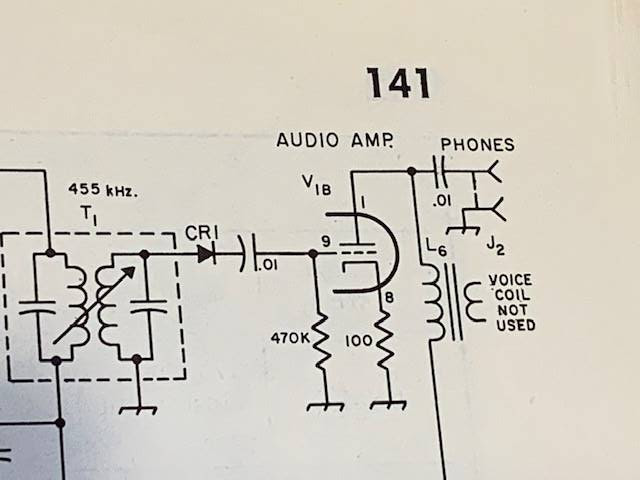
Scott WA9WFA told me that by the time the MMMRX appeared in the 1969 ARRL handbook, the second "voltage doubling" diode was gone, as were the 100 pF caps. Now it was just a diode, a .01 uF cap and a 470,000 ohm resistor. I switched to the 1969 Handbook circuit (but I have not yet changed the 1 meg grid resister to 470k -- I don't think this will make much difference). Foiled again by a faulty QST article, again by one of the League's luminaries.
6U8s out, 6EA8s in
We learned that the 6U8 tubes originally called for by Lew McCoy are getting old and not aging well. So I switched all three to more youthful 6EA8s. This seemed to perk the receiver up a bit.
MUTING from the DX-100
My K2ZA DX-100 has a T/R relay mounted in a box on the back of the transmitter. When the Plate switch goes up, it switches the antenna from receiver to transmitter. The box also has a one pole double throw switch available for receiver muting. I put the common connection to ground, the normally connected (receive position) connect the ground terminal of the AF output transformer to ground -- it is disconnected from ground on transmit. The other connection (normally open) is connected to the antenna jack -- on transmit this connection ground the receiver RF input connection. These two steps mutes the receiver very nicely.
Replacing Reduction Drive
Over the years I have had several different reduction drives on the main tuning cap. I had a kind of wonky Jackson brothers drive on there that needed to be replaced. I put in a new one -- this smoothed out he tuning considerably.
Ceramic Resonator
I never could get McCoy's 455 kc two crystal filter to work right. So at first I made due with the two 455 kc IF cans. This made for a very broad passband. Then I put a CM filter in there. This was more narrow, but with a lot of loss. There may have been others. But the filter spot is currently held by a 6 kHz wide ceramic filter. This one is my favorite so far.
Digital Readout
When I was running the DX-100 with the Hammarlund HQ-100 I built a little frequency readout box. The box was from a Heath QF-1 Q multiplier (I am sorry about this). The readouts are in Juliano Blue and come via e-bay from San Jian. I now have it hooked up to the DX-100's oscillator. I haven't tapped into the MMMRX's oscillator yet.
Friday, June 10, 2022
SolderSmoke FDIM Interview: Adam K6ARK and his 2.6 gram Mini-Pixie SMD Transceiver
I liked how Adam recorded in the field the CW from his rig, I also liked his key (!) and his EFHW antenna and "tuner." Adam's ability to cope with no CW sidetone was also admirable.
Adam's YouTube channel is here: https://www.youtube.com/c/K6ARKPortableRadio
Thanks to Adam and to Bob Crane.