On Saturday October 24, Dean AC9JQ (Indiana) and Rick N3FJZ (Maryland) made contact on 40 meter SSB using Si5351/TIA BITX rigs. FB!:
Bill:
Dean and I made contact. We both were in and out most of the time, but conditions seemed to improve towards the end where I could understand Dean about 90%. Using the RST "by the book", I would say he was a 33, 3 =(readable with some difficulty), and signal strength was 3=(weak), and based on what Dean was reporting, my signal back to him was the same - 33.
73 to you both.
Rick - N3FJZ.
Monday, October 26, 2015

Sunday, October 25, 2015
HB2HB! AC9JQ and N2CQR Make Contact on 40 with Homebrew Rigs on Both Sides (with help from N3FJZ/HB)
This weekend brought another HB2HB (Homebrew to Homebrew) contact. We have been following with interest the 40 meter transceiver project of Dean, AC9JQ. Above you can watch a video of Dean's rig in action before it went into the box. Earlier this month Dean achieved a remarkable "Double First" when he made his very first amateur radio contact. He was using his homebrew rig to do it. So his first contact was also his first homebrew contact. FB. More info on Dean's rig and homebrew exploits can be seen here:
http://soldersmoke.blogspot.com/search?q=ac9jq
This week Dean got a decent 40 meter dipole up in the air. We arranged (via e-mail) to meet on 40 on Friday evening. We made contact, but conditions weren't great. We tried again several times on Saturday, looking for open spots amidst the madness of the CQ WW DX contest. Rick N3FJZ joined us and also tried to make contact with Dean, but had no luck either. Daytime conditions didn't allow for a good contact between Indiana and the Washington/Baltimore area where Rick and I are located.
Finally, last night after family obligations at both ends settled down, Dean and I found a relatively open frequency on 40 and made a good contact. A short snippet of it can be heard by clicking on the link below. Keep in mind that Dean was running about 2 watts to a dipole on 40 at night.
http://soldersmoke.com/HB2HBAC9JQ.mp3
Thanks Dean! Thanks Rick!
Saturday, October 24, 2015
German Thermatron Homebrew
Michael DF2OK has been melting solder in Germany. Above is a short video of the first sounds made by an AC-1 replica he built. Michael notes: "Yeah, I love these old style radios. You can see nearly everything. :-) BTW: All without Arduino and other black boxes and chips!"
FB Michael.
During the AC-1 build Michael struggled with a bad tube. His discovery and resolution of the problem is presented in this video (understandable even to those who don't speak German):
Finally, here is a nice video of Michael's 40 meter regen receiver. Anyone who has built or worked with a regen will understand perfectly this video. Watch Michael tune in stations while adjusting the regeneration. Note his demonstration of the lack of hand capacitance. FB Michael! Thanks!
Friday, October 23, 2015
QST Error on Elecraft K3 Phase Noise Measurement CORRECTED

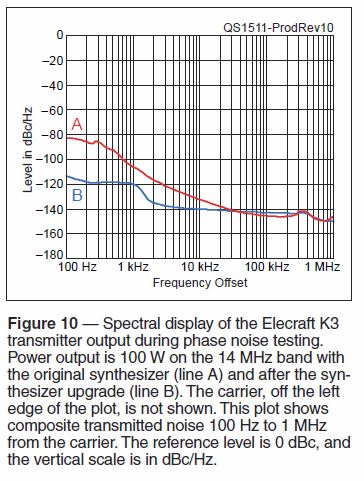
Wayne Burdick, N6KR, of Elecraft let us know that there was an error in the QST article about the KSYN3A Synthesizer Upgrade. The original graph in the QST article showed an improvement in phase noise at close-in frequencies, but it also showed a significant worsening of the phase noise beyond 10 kHz. THIS CHART WAS INCORRECT. The Upgrade does, in fact, improve the phase noise performance as shown in the corrected graph above. A corrected version of the article appears here:
Pete and I will continue our study and discussion of phase noise; as synthesizers make their way into more and more of our hombrew rigs it is important for us to understand the significance of this parameter.
Thursday, October 22, 2015
November 2015 QST -- Wrist Radios, Phase Noise, and a 1958 BITX!

A Early BITX
I liked this issue. Highlights:
Page 30. Glen Popiel's article on the Arduino.
Page 33. I know this may come as a surprise, but in spite of my admitted Ludite tendencies, I found the article on High-Speed Wireless Networking to be very intriguing.
Page 38. Hey! Mike Aiello N2HTT has an article about an Arduino-based CW recorder. FB Mike!
Page 54. Review of LNR LD-5 QRP Transceiver. "The LD-5 is actually an SDR in a box with switches and knobs..." They give a phase noise graph.
Page 58. Review of Synthesizer upgrade for the Elecraft K3. Uh-oh. Phase noise again. The review says the upgrade results in a reduction of phase noise, but the graphs seem to show an increase in transmitted phase noise on 20 meters as soon as you go 10 kHz from the transmit frequency. I guess this is a tradeoff for a larger decrease in close-in (less than 1 kHz spacing) phase noise? But if the objective on the transmit side is to deal with "a major problem with multiple operators in the same band segment in close proximity" resulting from transmitted phase noise, is this a good trade-off? Also, it would have been interesting to know if the reviewer could detect -- by ear -- any improvement in the received signal.
Wayne Burdick, N6KR, of Elecraft e-mailed us to let us know that there was an error in this QST article. The original graph in the article showed an improvement in phase noise at close-in frequencies, but it also showed a significant worsening of the phase noise beyond 10 kHz. THIS CHART WAS INCORRECT. The Upgrade does, in fact, improve the phase noise performance. A corrected version of the article appears here:
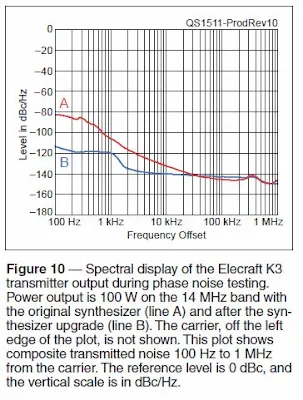
Wayne Burdick, N6KR, of Elecraft e-mailed us to let us know that there was an error in this QST article. The original graph in the article showed an improvement in phase noise at close-in frequencies, but it also showed a significant worsening of the phase noise beyond 10 kHz. THIS CHART WAS INCORRECT. The Upgrade does, in fact, improve the phase noise performance. A corrected version of the article appears here:
Here is the corrected graph:
Page 71. My nightmare. The WristRig. The Apple Watch on 40 meters. Sorry Steve, Dick Tracey did not have The Knack, and tackling the "Apple Watch challenge" is not an indication of "homebrew chops." Software coding chops yes, but homebrewing is, for me, a different thing. (But, as we always say, too each his own... And thanks to Steve for the interesting article. )
Page 82. Ross Hull. Very interesting article, especially the part about OM Ross's untimely death by electrocution.
Page 100. "The Cosmophones" by Joe Veras. Cool pictures (as always) from Joe. And I loved the first lines: "What in the world is a bilateral transceiver? Byron Goodman, W1DX, posed that question in his June 1958 QST review of the Cosmophone 35." Wow, four months before my birth By Goodman was writing about BITXs in QST!
Subscribe to:
Posts (Atom)