Podcasting since 2005! Listen to our latest podcast here:

Podcasting since 2005! Listen to Latest SolderSmoke

Showing posts sorted by relevance for query San Jian. Sort by date Show all posts

Tuesday, August 10, 2021

Mythbuster Video #16 -- GLOWING NUMERALS! In Juliano Blue!

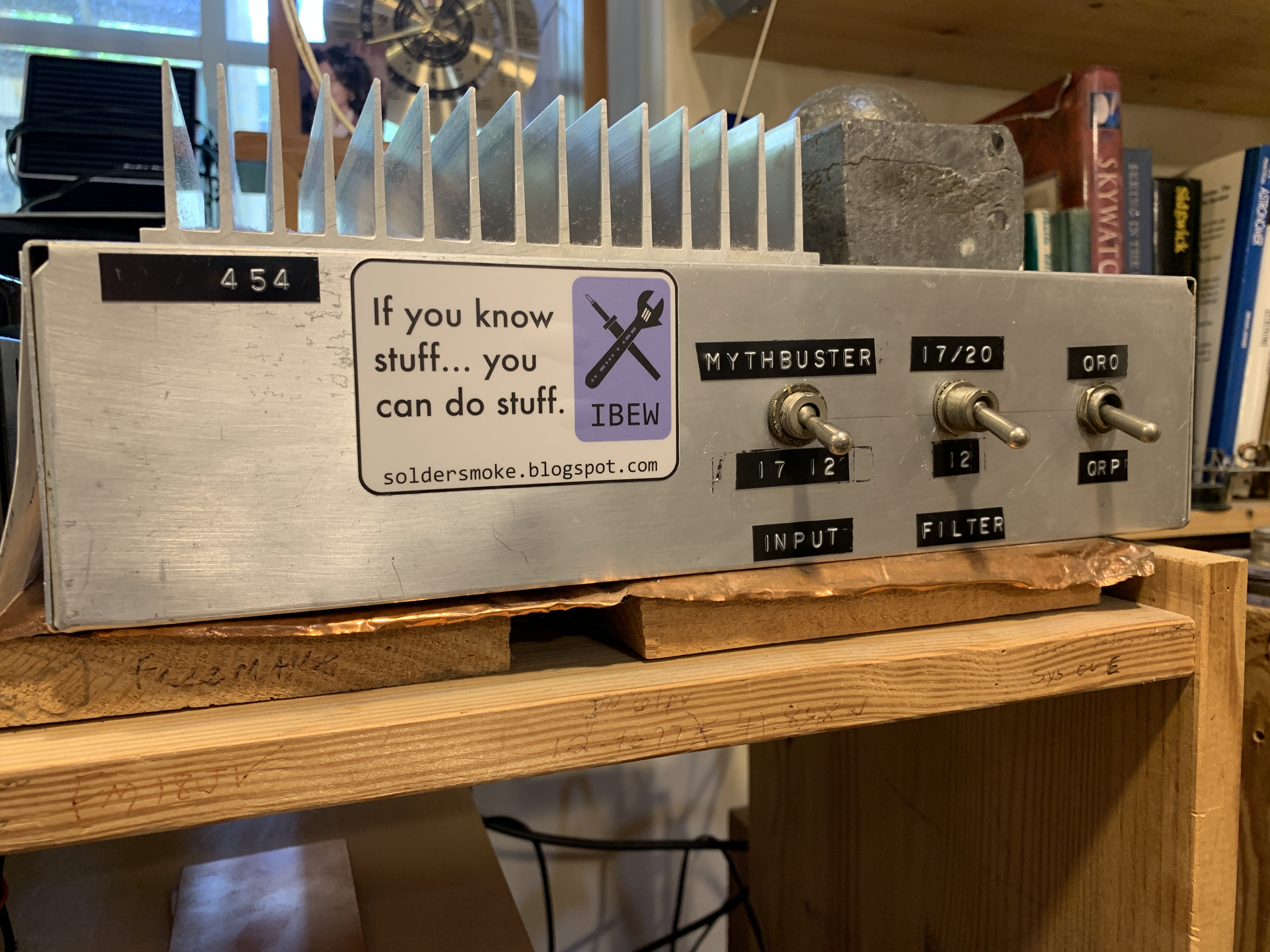
I added two San Jian frequency counters to the front panel. In addition to making the rig a lot easier to operate, they add a classy touch of Juliano Blue to the project.

I got my counters here: https://www.ebay.com/itm/224223678132

There is a limitation of some of the the San Jian counters: https://soldersmoke.blogspot.com/2021/02/a-problem-with-san-jian-plj6-led-counter.html

But this limitation didn't cause any problem with this rig:  In this case I just plugged in the IF frequency of 5.2397 MHz.  I connected the input to my VFO running around 9 MHz.  For 20 meter signals, I select the "up" option;  the San JIan counter just adds the IF frequency to the VFO Frequency.  For example 9 + 5.2397 = 14.2397 MHz .   For 75, I select the "down" option.  Here the San Jian just subtracts the IF frequency from the VFO frequency -- for example 9 - 5.2397 = 3.7603 MHz.  

The band select switch operates relays that select the proper band-pass and low-pass filters.  This switch also alternatively turns on either the 20 meter San Jian or the 75 meter San Jian. 

Saturday, March 20, 2021

SolderSmoke Podcast #229 -- G2NJ Trophy, SDR, HDR, CW! Mailbag


Soldersmoke Podcast #229 is available: 

http://soldersmoke.com/soldersmoke229.mp3


--  G2NJ Trophy is awarded to Pete Juliano, N6QW. 

 -- Get your vaccine shot as soon as you can!  

-- More from "Conquering the Electron" by Derek Cheung. 

-- Bad fire in the chip factory.  Such a shame.  Sad!  I had NOTHING to do with it.  I was home that day.  I can prove it.

 -- Bezos is not such a bad guy.  Turns out he is a space-geek.  

 -- Perseverance was the big space news.  Very cool.  


Pete's bench:

Raspberry Pi vs. Microcontrollers

Treedix display

Conversion of the Dentron Scout

CW rigs?

6L6 on a wooden chassis


SHAMELESS COMMERCE DIVISION-  

I NEED TO BUILD UP TIME VIEWERS VIEW MY VIDEOS: So please watch!

https://www.youtube.com/channel/UC20TcdWSSFliMhg3k2A1a5w

--  Our Patreon sponsors get an early look at our YouTube content.  So please, consider

becoming a Patreon sponsor.

--  Please continue to use the Amazon search engine on the blog page (upper right).   


Bill's bench: 

Hodgepodge:   

-- BITX40 Module.  

-- Ramseykit Amp. 

-- San Jian counter,  

-- CW using 750 Hz oscillator. 

-- RF-actuated piezo buzzer.  

-- SDR!  SDR using PC and tablet.  

-- Checking the output with SDR.  

-- Moving the carrier osc frequency.  

 Also, I put the Fish Soup 10 back on the air.  Nice contacts under 200 mw.

Up next:  A rig for 80/75 and 20 meters.  Single Conversion.  Using VFO from a Yaesu FT101 that runs 8.7 – 9.2 Mhz.   Quiz question:  What IF should I use?

MAILBAG

Mark Zelesky sent me wood tokens with power and Ohm's law formulae.  Thanks!

Scott WA9WFA Built a really nice Mate for Mighty Midget RX – getting it going!

Tryg EI7CLB found board of his George Dobbs Ladybird RX.  Rebuild it OM!

Tom WX2J – We talked about “No lids, no kids, no space cadets” nastiness.

Nick M0NTV about sideband inversion.  I like the simple rule about subtraction.

Jonathan M0JGH – Always listen to Pete.  Got married, has mixing product. Leo?

Mike AE0IH.  Dad used a BC-348 in the service. Looking for one.  FB.

Adam N0ZIB – “Silent Shep” site --- with some ham radio shows I had not seen.

Walter KA4KXX in Orlando has a similar subtraction problem with San Jian counter.

Bill N5ALO sent me a really nice KLH speaker.   I’m using it now.

Jason N2NLY – interested in building SSB transceiver.  One step at a time OM…

Trevor in Annapolis sent xcsd cartoon that really hit home. 

Farhan is doing OK in India, diligently protecting his family from the virus.  

Peter VK2EMU also doing well.

Dave AA7EE Casually killed a DC receiver in Hollywood, and disposed of the remains. 

Charlie ZL2CTM doing great things with simple SSB.  Blogpost.

Phil VK8MC in Darwin sends article on "Mend not End" battle against planned obsolescence.

Bob KY3R re my SDR adventures, asked if I’ve had a recent medical/psychiatric evaluation. 


Saturday, February 19, 2022

Pete's Eclectic Approach to the Pea Shooter, San Jian counters on Analog VFOs, Non-Restaurant Menus

I liked Pete's comments on the various (analog, digital, mixed) approaches to homebrew: 

http://n6qw.blogspot.com/2022/02/2022-return-to-peashooter-build.html

http://n6qw.blogspot.com/2022/02/2022-peashooter-20m-compact-ssb.html

I too have San Jian digital counters watching the stability of analog VFOs (DX-100, HQ-100, Mythbuster). 

Variety is the spice of life!  

I also liked Pete's comment about the fellow who does on-the-air menu counseling for FTDX-3000 owners.  I sometimes run into guys on the air who want to do something similar with my simple homebrew rigs.  They start by making comments about my audio -- they will usually say it is "too high" or something like that.  Especially when I'm using the separate transmitter and receiver (which have to be "netted" imprecisely by ear), I have to explain that maybe resort to their RIT control would help.  If they persist, I sometimes have to tell them that how my rig sounds depends A LOT on the placement of the carrier oscillator relative to the passband of the crystal filter (most recently, the filter from the 1963 Swan 240).  Most of them have never had to do that kind of adjustment, so the "technical discussion" usually ends at that point, with my interlocutor saying 73, and presumably moving on to someone whose rig has menus to fiddle with.  (Recently heard audio techno term: "massaging the codec.") 

To each his own!    


Monday, March 1, 2021

A Frequency Counter for the Hodgepodge -- An Analog Solution to a Digital Problem


Imagine my dismay when I discovered that I could not use my $5 San Jian PLJ6-LED frequency counter with my Hodgepodge transceiver.    The problem is described here: 

This video describes my solution.  I took some pleasure in using an analog solution to solve a very digital problem.   I know this could have been fixed with one or two changes to lines of code, but I liked doing it this way.  This was all kind of fun, and it allowed me to use yet another bit of circuitry that was sitting idle in the shack.  That is the whole point of the Hodgepodge project.  

The best is yet to come.   Especially for those of you who like waterfalls.... Stay tuned. 

Thursday, February 3, 2022

Exorcism Lite -- Spur Suppressed on 17 meter Transmitter -- Split TX/RX Station On The Air


I spent most of January in the tropics, away from my workbench.  This seems to have had a good effect on my 17 meter split TX/RX project.  As I was leaving, heading south,  I was thinking about several difficult options to deal with my spur problem (see previous blog posts). I thought about turning the transmitter into a transceiver by building a receiver board.   I thought about putting San Jian frequency counters on both the transmitter and the receiver, then doing a visual numerical "netting" by just putting the two devices on the same frequency (I actually ordered 3 San Jian counters).   The counter option was even more complicated than it at first seemed -- I would have to build a converter to shift the RX VFO frequency up.  VK2EMU suggested a tube type "Magic Eye" (interesting idea, but also complicated).   This was getting out of hand. 

When I got back home, I took a new look at the problem.   I decided to take one more shot at suppressing the 8th harmonic of the carrier oscillator.  I had already built a new oscillator and buffer using the circuit from Farhan's BITX20.  And I had put it in a metal box.  Now I decided to do three things: 

1) Tighten up the low pass filter at the output of the buffer by moving the cutoff frequency lower (to around 7 MHz) thereby getting a bit more suppression at 41 MHz

2) Try putting a series LC shunt circuit tuned to 41 MHz  at the output of the carrier oscillator (between the oscillator and the buffer). 

3)  Reduce the voltage to the oscillator/buffer.  I have this on a pot, so I can adjust it down to the point where the remnant of the harmonic is no longer audible, while keeping the main carrier osc signal sufficiently strong. 

It seemed to work.  I could now hear the desired frequency for spotting, without the confusing tone from the spur.  

Why had I been able to do this back in 2002 in the Azores using a simple trimmer cap to ground?  My guess is that I was using my Drake 2-B as the receiver.  The trimmer cap to ground may have reduced harmonic output.  And I was probably cranking back the RF gain on the 2-B to the point where I could hear the desired signal but not the remnants of the spur.  I have no RF gain control on the Barebones Barbados receiver that I am using in this project. 

So, what's the lesson from all this?  Well, if you are faced with a serious technical problem, and you find yourself considering complicated and difficult solutions,  go to the Dominican Republic for about a month (especially if it is January or February), and then take another look at the problem when you return.  If you are unable to travel this far or for this long,  taking a walk or taking a weekend break from a troublesome problem will likely have a similar mind-clearing effect. 

The video above shows part of a February 1, 2022 QSO with Gar WA5FWC using the split TX/RX 17 meter rig.  Gar is an amazing long-time SSB homebrewer who got his start with phasing rigs back in the day. 

Saturday, October 28, 2023

Mattia Zamana's Amazing Direct Conversion Receiver

Thanks to Ed KC8SBV for sending me this awesome video.  It looks like Mattia built this receiver way back in 1995.  The tuning indicator is very cool, and I had not seen a similar indicator before (could this be a way for us to escape the clutches of the San Jian counters or the Arduinos?)  The Italian ham magazine articles are great, and you can follow the rig description even if you can't read the Italian.  The pictures in in the attached drive are also very good.  

WB9ZKY used Google Translate to get English versions of the articles.  Thanks Chuck! 

https://www.dropbox.com/scl/fi/kil3osilchqlyk8afim2r/part1.pdf?rlkey=9ubgaqb8t4k91d1a10su9mw1p&dl=0

https://www.dropbox.com/scl/fi/t2790qatf5riepyqh5oj1/part2.pdf?rlkey=bhs77gkcchziakh7ngjbpuaz7&dl=0

I have been in touch with Mattia via YouTube:  He reports that he has done other electronic projects, but he considers this to be the most interesting.  He does not have a ham license -- he has a Shortwave Listener license.  His father was a ham:  I3ZQG. 

This is one of the rare cases in which the builder should -- I think -- be issued his ham licence purely on the basis of this build.  

Mattia writes:  

Jul 25, 2023 ITALIA

Mattia Zamana


Tuesday, February 16, 2021

My Current Rig: The Quarantine Hodgepodge


As I continue to Stay In The Shack,  last week I was looking for something to do. This is what I came up with.   

Left to right: 
-- Speaker
-- Ramsey-kit QAMP20 modified for 40. I now have two MTP3055V MOSFETS in there.  
-- BITX40 Module with a solidified VFO from a Galaxy V (note the knob from a Drake 2B!)
-- Power supply 

It puts out about 15 watts SSB.  I was bracing for attacks from the 40 meter waterfall police, but no, everyone said it sounds great.  I had four very nice contacts yesterday.  It was fun. 

Still to do:  Possibly a San Jian frequency counter to give some Juliano Blue glowing numerals for the frequency readout.  This would be a step up from the Juliano Blue sticky note and  corresponding piece of black electrical tape that currently serves as the frequency indicator. 


Wednesday, April 13, 2022

The 17 & 12 SSB Transceiver -- Circuit and Build Info -- Video #4


I REALLY LIKE THIS RIG. IT IS LIKE A MAGIC CARPET THAT CARRIES MY VOICE ACROSS THE SEAS.

Cutting Display Hole sets off smoke alarm. Reverse Polarity Protection. IF and Crystal Filter at 21.470 MHz 50 ohms! TRGHS! Amp for VXO Carrier Oscillator/BFO. Mic Amp from uBITX. Transmit/Receive switching from mic connector. VFO: NO DIE CAST BOXES! HT-37 Variable Cap, Frequency Shift. BP filters from QRP LABS designs (G0UPL). TIA amp boards from K7TFC. Needed RF amp to hear band noise. BITX40 PA design, but RD006HHF1 instead of IRF510. Should I run receiver input through LP filter? Frequency Readout Story: How to use one San Jian counter on two bands.

Monday, September 10, 2018

N2CQR Wins a Contest AGAIN!


Pete N6QW suggested I do a blog post on this.  

This past weekend I dusted off my old scratch-built, all-analog, no-chips BITX20. (THREE CHEERS FOR FARHAN AND HIS BITX DESIGN!)   I hooked it up to my trusty CCI .1KW (note decimal point) amplifier and my new 135 foot store-bought doublet.  This all happened just as the Worked All Europe  DX contest was kicking off, with lots of activity on 20.   TRGHS.  I was in.  My contest operating style was in the category of "relaxed-casual-noncompetitive." I took a lot of breaks.  In fact there were more breaks than non-breaks. You have to pace yourself in the contest world.  

My results: 

8 SEPT: DF0HQ, SN7D, GM6X, DP6A, S51A, DL0HN, DB0HX, OZ5E, DJ5MW, HG7T, IK4UPB, VY2ZM, G6XX, EF1A, LZ5R, 9A5W, YP0C, F6HQP, DL7ON, HB9DQL, ON6NL, DA0WRTC,  9 SEPT: EI7M, P3X, RU1A, DP7D, SP2KPD, DL0WW.

P3X might not count because, you see, Cyprus is considered to be in ASIA.  Really? 

Anyway, I 'm assuming that I am the winner in the homebrew, discrete component , all-analog transceiver category.  Woo Hoo!  

The contest rig is pictured above.  Before you point to the glowing numerals and cry foul, realize that the little Altoids box between the two speakers holds a San Jian frequency counter that was deliberately kept OUTSIDE the BITX box.  So it is more of an outboard accessory.  I can run the BITX 20 without the digital assist -- I have an old fashioned non-digital dial pointer to indicate frequency.  The "Low - High" switch you see switches the VFO from the low portion of the 20 meter phone band to the higher part of the band.   The box below the BITX 20 holds the uBITX. 

Seriously though, I was quite pleased with the performance of the doublet.   


Friday, February 19, 2021

A Problem with the San Jian PLJ6-LED Counter

I had hoped to use this handy and cheap little frequency counter to add some glowing Juliano Blue to the frequency readout on my Quarantine Hodgepodge rig.   I've used these boards with my BITX20, my HA-600A,  and with my DX-100/HQ-100 rigs.  But guess what -- these boards do not work with the BITX40 module board that is the heart of the Quarantine Hodgepodge.  And the reason why is interesting. 

Here is what happens:  First, you plug in the IF frequency of your rig.  In my case 12 MHz.  You connect your VFO output to the signal input on the PLJ6.  You power up the PLJ6.  You then have to select one of two IF frequency options.  One of these options ADDS your IF frequency to whatever it detects at the signal input.  In my case, for a 7.2 MHz signal it would detect a VFO signal at 4.8 MHz. If it were to ADD this signal to the IF freq,  it would readout 16.8 MHz.  And it does.  But obviously that is wrong.  So you go to the other option -- this one SUBTRACTS the designated IF frequency FROM whatever it finds at the signal input.  So here we get 4.8 - 12 =  -7.2   Almost perfect right?  But here is the problem:  The PLJ6 can't handle negative numbers!  So it displays 000000.  Not helpful. 

Here is the manual: 

I didn't have this trouble with any of the other rigs because none of them required the use of negative numbers.  My BITX 20 for example had an IF of 11 MHz and has the VFO running a bit above 3 MHz -- so the PLJ6 just adds the IF to the VFO signal and Bob is my uncle.  Similar problem-free addition takes place with the other rigs. 

I found some discussion on this problem on the internet.  Here is one: 

Some of the respondents didn't seem to understand the problem.  Others hint that the ability to handle negative numbers was as some point in the code for the PLJ6 device,  and may somehow be accessible, but no further info is provided. 

I have already worked up a possible solution, but I'm interested in how you folks would approach this problem.   Any thoughts or suggestions?  I will reveal my solution in the days ahead.   

Thursday, February 2, 2023

Direct Conversion Receiver Bandscan -- 40 Meters early on a Thursday Morning -- With W1AW/4


I superglued a San Jian frequency counter to the front panel of my High School Direct Conversion receiver.  Then I tuned it through the 40 meter band.  You can hear the W1AW/4 station.  And several SSB stations.  

Monday, April 25, 2022

75/20 - 17/12 Two Homebrew Rigs in Scrap-Wood Boxes


I moved the 17/12 Rig off the workbench and placed it (as planned) atop the Mythbuster rig.  Now I have four bands easily accessible.  In these pictures you can see all four bands being displayed on the San Jian Frequency Counters. 

I found a kitchen drain screen that is an ideal cover for the 3 inch speaker in the 17/12 rig. 


I reconfigured the Low Pass filters in the CCI .1 kilowatt amplifier.  I put a 12 meter LP filter in there in place of the 40 meter LP filter (that I haven't been using much). 

I have been working a lot of DX on both 17 and 12.   

Wednesday, July 29, 2015

A "Curiously Strong" Frequency Counter


I got a six digit San Jian frequency counter for use with my BITX20.  I was trying to figure out how to put it in a box and mount it on the rig when I realized that the counter fits almost perfectly in an Altoids tin.  THE RADIO GODS HAVE SPOKEN. 

I found the counter on Amazon.  I use an eight digit version with my BITX17.  But I think the six digit version is better (it fits in an Altoids tin!)

Our book: "SolderSmoke -- Global Adventures in Wireless Electronics" http://soldersmoke.com/book.htm Our coffee mugs, T-Shirts, bumper stickers: http://www.cafepress.com/SolderSmoke Our Book Store: http://astore.amazon.com/contracross-20

Tuesday, January 19, 2016

Arduino Problems -- Back from the Ledge

As I was struggling through this, someone -- who will remain nameless -- told me that because of all the technical problems resulting from the many Arduino IDE "upgrades," suicide prevention hotlines now answer all calls with an automated question:  "If you are calling about an Arduino problem, press 1 for assistance."

It got pretty ugly but with the help of Tom up in NYC I managed to get through it. First he convinced me that it is indeed POSSIBLE to upload the latest version of the IDE -- the dreaded 1.6.7.   I just had to REALLY get rid of earlier versions.  This got me past the horrible Bundled Java Runtime Environment problem (who thinks up these names?).

We then worked with the libraries needed to upload the AD9850 code of Richard AD7C.  You see, I work on Arduino stuff.   Then I stop.  18 months pass.  I forget all I learned.  Then I start over.  The pain begins again.  In an effort to break this cycle, I am now taking notes (in the inside cover of Mario Banzi's book).

I am using the AD9850 with a Kanga Arduino shield designed by Paul M0XPD.   It takes the AD9850 output, divides by 4 and puts it out as 2 square waves in quadrature.  I use this with my R2 phasing receiver.   The problem was that the display on the Arduino showed a freq 4 times the actual tuning freq.  Believe me, this gets old fast.  I considered just getting a San Jian freq counter and supergluing it on the top of the DDS box.  I was going to connect this to the square wave output.  That would have given me one readout with the actual receive freq, and another (on the Arduino) showing the (4X) freq coming out of the AD9850.  But that would have been too much of a Kludge. Tom talked me out of it and modified the code so that the Arduino display shows the actual receive freq.   Thanks Tom.  

Armed with the new IDE and with my knowledge of Arduino basics refreshed, I was able to reload the LA3PNA Si5351 code into my 40 meter DIGI-TIA.  But not before having to swap out the Arduino that drives the Si5351.   One Arduino happily accepted the code, another did not.  Why?  Who knows?  It is a digital mystery.  Those little 1s and 0s are fickle you know.

The Radio Gods rewarded me for all this.  At about 5:45 AM today I was listening to a very friendly SSB roundtable on 160.  The guys were getting ready to sign off.  The last one ended the conversation by asking the others to "Be kind.  Smile at your neighbors."  Nice.
Then WFAX AM started the broadcast day at 6 am, wiping out my 160 meter reception.  Next project:  High-Pass filter at 1.7 MHz.


Monday, October 10, 2022

Listening on 40 with a Glue Stick PTO in a Direct Conversion Receiver; Some PTO History


Thanks to Paul WA1MAC for this idea.  He first shared it with us via the SolderSmoke mailbag in 2008! Sorry it took so long for me to try one Paul. 


The PTO itself is an old idea of course.  Here is an article from 1966: 
OM faced the problem of having to keep track of frequency while turning the dial many times.  He was hoping to use a turns counter -- in 1966 we didn't have the San Jian frequency counters.  I note that his PTO looked a lot like the one KK4DAS 3D printed for me (using file from Farhan).  

And some background on PTOs: https://sites.google.com/site/randomwok/Home/electronic-projects/permeability-tuners-last-stand


Sunday, June 1, 2025

Alan Wolke W2AEW's Build of the SolderSmoke Direct Conversion Receiver


We were already very proud to put Alan Wolke W2AEW in our Hall of Fame.  But Alan put icing on the cake this morning by making his own video about his build, along with some pre-CME video of the machine inhaling CW and SSB (see above).  The SSB is DX, from France.  FB Alan, thanks.  

My only comment to Alan was on the frequency readout.  I noted that many builders had resorted to San Jian PLJ frequency counters.  A few others had done what he did and used the frequency readout feature of their Tiny Spectrum Analyzers.  I told him that at first I had gone very low tech.  It was in fact, quite barbaric.   Check it out: 

I think it is kind of low-tech cool.  I am a bit disappointed that none of the builders have done anything similar.  Mark KI5SRY came the closest, but his solution was relatively spophisticated.  Look, it is not to late.  Get out those index cards and calibrate those screws!  Send in pictures or videos.  

Sunday, September 18, 2022

Building Farhan's PTO -- But Is This Really a PTO?

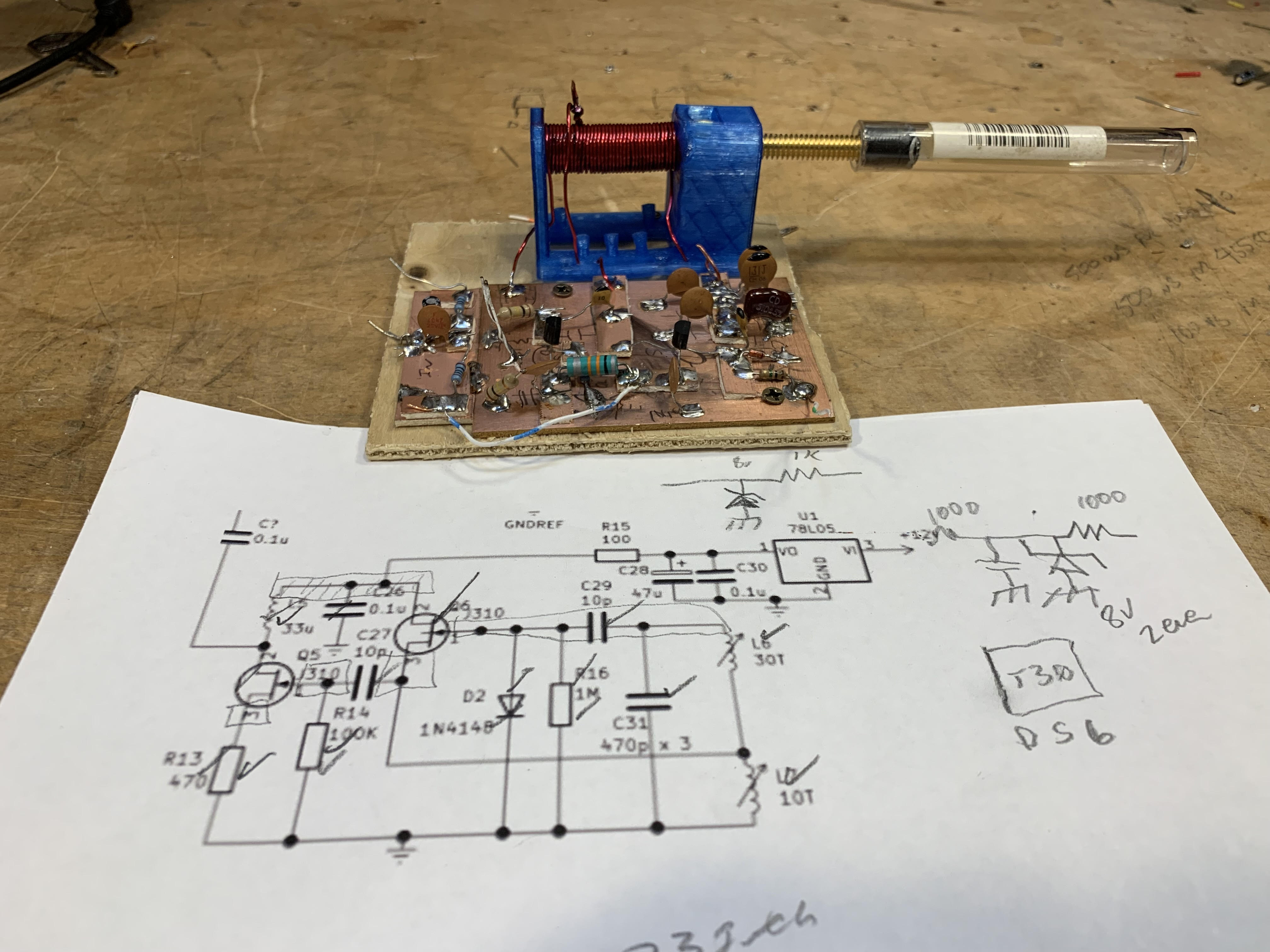
Farhan has a PTO in his Daylight Again transceiver.  This caught the attention of homebrewers around the world.  Walter down in Orlando built one.  Dean KK4DAS and I have built versions also. Dean has a 3D printer and made the coil support used in my version (above).  Thanks Dean! 
I had a little trouble at first because one of the capacitors I had in there was not NP0, so the device drifted a lot.  But once I straightened that out (I put in a Silver Mica cap in its place) the oscillator became very stable. Mine moves about 25 kHz with each turn of the bronze screw -- this is nicely linear tuning.  But I think I will have to use a San Jian counter to keep track of the frequency. The long plastic tube on mine is there to eliminate had capacitance effects. 

One of the guys in the Vienna Wireless Society questioned whether we should really call this a PTO.  After all, bronze has a permeability equal to that of free space. So we are not really changing the permeability.  Frank Harris points out that the bronze screw really acts as a shorted secondary.  What do you guys think?   Is this a PTO, or do we need another acronym to describe it? 

This has been a really fun project.  I never built an oscillator like this before.  I will probably follow up by building the rest of the Daylight Again rig. 

BTW  WA6OTP has a nice PTO design: http://www.wa6otp.com/pto.htm

Thanks again to Dean, and to Farhan.  

Tuesday, November 21, 2023

Mr. Carlson's ART-13 Transmitter (with Dynamotor)


Here we have a really cool video from Mr. Carlson.  In it he reveals (admits!) to what we already know:  HE IS A HAM RADIO OPERATOR.  FB Mr. C!

You can see that he is a true ham, with a true case of THE KNACK, when you see his reaction to the inside view of the ART-13.  He seems to gasp as he notes that there is a lot of "RF goodness" in that box.   There is a vacuum relay, a bread-slicer capacitor, there is even a variometer. And lots of good, big THERMATRONS.  Only a true ham, a true Knack victim can recognize this RF goodness. 

The Dynamotor that goes with this transmitter is really interesting to me.  I have been hearing these things whining in the background (audible noise, not a signal defect) on many early morning (Saturday 3885 kHz) of the Old Military Radio Net.  I can often hear the dynamotor of Buzz W3EMD as he transmits from Rhinebeck, New York.   It was great to see the inside of this device.  

Back in 2017, Hack-A-Day took a look at Dynamotors: 

There are several good ART-13/BC-348 pictures on W3EMD's QRZ page:

I was especially taken by the handwritten frequency chart on the front panel of the ART-13.  This reminded me a lot of the handwritten readout that I have been using on various rigs, including (most recently) the 15-10 SSB transceiver. I hope Paul focuses on this paper-and-pencil frequency chart;  it is nice to step away a bit from the glowing numerals of San Jian. 

Mr. C points out that the ART-13 was the transmitter that was paired up with the BC-348 receiver.  He will be working on both in the weeks ahead. 

Thanks Mr. Carlson. 73 OM. 

Friday, January 1, 2021

Glowing Numerals for the Lafayette HA-600A (With Jeweled Movements)


I really like this receiver.  I have strong sentimental ties: it was my first SW receiver.  But the frequency readout situation was kind of rough -- depending on where you put the Main Tuning cap, your Band Spread dial could be WAY off.  

China to the rescue!  Specifically the very nice San Jian PLJ-6 frequency counter boards.  I have used these in several projects.  I like them a lot. I get mine on e-bay.  They are very cheap.  Here is the manual with specs: 


As I did with my BITX20, I put mine in an Altoids-sized box.  I got to use my Goxawee rotary tool with circular metal blade to cut the rectangular hole.  Hopefully future efforts will yield neater results, but the flying sparks were fun;  they made me feel like one of those car-part  "fabricators" on cable TV. 

To tap the VFO frequency, I just put a bit of small coax at the point where the 10 pf cap from the VFO circuit enters the first mixer.  I ran this cable to the unused "Tape Recorder" jack on the back of the Lafayette -- this connects to the input of the counter.  I attached 11 volts from the power supply to an unused terminal on the accessory jack of the Lafayette -- this powers the counter.

Having a counter on the VFO proved very illuminating -- in more ways than one.  I measured the Center Frequency (CF) of my IF to be at 456 kHz.  I set the PLJ-6 to display the VFO frequency MINUS 465 kHz.   For AM broadcast signals, this worked fine:  I'd tune the signal for peak S-meter reading.  This meant that the carried was right at the CF.  

For SSB, things were a bit different.  I set the BFO knob  to be RIGHT AT 465 kHz when the dot is in the center position.  With the BFO there, I could tune in SSB signals.  The suppressed carrier would be right at the center of the IF passband, with the audio information above or below the suppressed  carrier frequency.  But it didn't sound good this way -- it sounded better if I would tune an LSB signal 2 kHz down from the center, then adjust the BFO down about 2 kHz.  This put most of the the audio in the peak portion of the IF filter(s) curve.  Doing it this way means that I have to remember that the number displayed on the PLJ-6 is 2 kHz down from the actual suppressed carrier frequency of the transmitting station.  I can live with that.  

I am going to leave the Lafayette on the corner of my workbench so that I can easily tune in hams  and SW broadcast stations.  Having modified the product detector and added the digital frequency readout makes listening to this receiver even more pleasing.  The jeweled movements are as smooth as ever. 

So 2021 is off to a good start on my workbench.  HNY to all!  

Friday, April 28, 2023

High-School Students Successfully Avoid THE SHELF OF SHAME -- Update on the Direct Conversion Receiver Project

One of the first finished receivers

Dean KK4DAS, Mike KD4MM, and I had a good day at the local high school yesterday, even after a month of spring break and other absences.  We thought this might have been our last session at the school this year, so we strongly encouraged the students to GET THE RECEIVERS DONE.  We told them about the Shelf of Shame, and warned them not to half-way finish something that would gather dust at the bottom their parents' closet.  They were close to success!  It was time to finish the project. 


We warned them not to be perturbed if the receiver doesn't work the first time they power it up.  This is not "plug and play."  The receiver would likely need some trouble shooting, or at least some peaking and tweaking.  We noted that we often have to sort of coax a signal out of a newly built receiver. 

We soon had the students come forward with two projects that were ready for final testing.  Sure enough we found problems with both.  The solutions provided a lot of educational fun. 

The first group had not yet built the diplexer -- we advised them to skip over the diplexer for the moment -- just connect the output of the mixer to the input of the AF amplifier.  We can't let the perfect be the enemy of the good!  Build the diplexer later, but for now, get the receiver going.  They did, and a few minutes later they were receiving signals from Mike KD4MM's transmitter (on the other side of the lab). 

Then a second group came forward.  We put a San Jian frequency counter on the PTO output.  Uh oh.  Trouble.  Gibberish!  A wonderful troubleshooting session ensued.  With the student, we found that the signal was good at the output of the oscillator transistor, but NOT at the output of the buffer.  At first we suspected that the buffer was bad, but it was not.  Then we lifted the connection to the mixer and suddenly the buffer output was good.  So the problem was in the mixer!  When we disconnected the input transformer of the mixer from the diode ring, THE PROBLEM WAS STILL THERE.  So the problem was clearly in the input transformer.  Dean gave us a replacement transformer.  Soon all was right with the rig, and this group joined the ranks of the successfully completed receivers.   

I think that seeing that two groups had finished helped motivate the others.  Our announcement that successful completion would lead to a "Certificate of Completion" also helped.  But most of all, I think the natural desire to finish the job and avoid the "Shelf of Shame"  was pushing the students forward. 

Other news: 

-- Our stage-by-stage award program continued.  Last time we awarded "The Torry"  for the first successful bandpass filter;  this time we awarded "The Audy" for the first successful audio transformers. 

The Audies

-- We told the students that their work has been entered in a Hack-A-Day contest.  Most of the info and files on the project can be found on the Hack-A-Day site.  Check it out:  

https://hackaday.io/project/190327-high-schoolers-build-a-radio-receiver

-- We also told the students about Walter KA4KXX's very generous offer of a reward for the first students to check into the Florida Sunrise net.  (We had to make it clear that this offer is completely extracurricular and unconnected in any way from the school .)  The students were clearly intrigued.  Sunrise Net may get some new check-ins! 

-- We provided instructions on how to build a simple 1/4 wave reception antenna.  We also did a video.  


We had thought that this would be our last session at the school,  but at the students' request we will be back with them next week for another session.  We think there are at least five more receivers approaching the finish line.