Here is the Wikipedia on Sputnik 1: https://en.wikipedia.org/wiki/Sputnik_1
I didn't know how badly Korolev had been injured while in the Gulag.
The transmitter had 1 watt at 20 and 40 Mhz.
Here is the Wikipedia on Sputnik 1: https://en.wikipedia.org/wiki/Sputnik_1
I didn't know how badly Korolev had been injured while in the Gulag.
The transmitter had 1 watt at 20 and 40 Mhz.


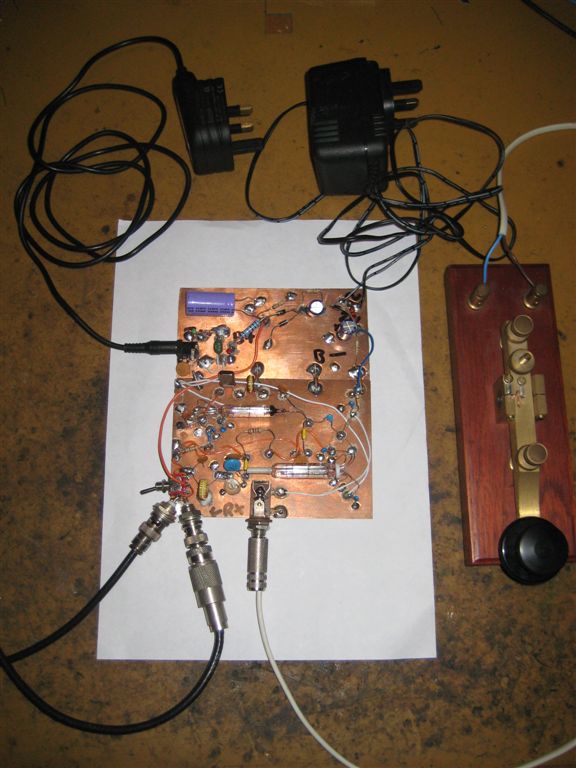 The Chief Designer, Michael, AA1TJ, alerted us to this wonderful post on Roger, G3XBM's blog:
  Kettering Group, UK
"Someone brought out a shortwave radio, and soon a beeping noise filled the room. A Russian scientist, Anatoli Blagonravov, confirmed it was Sputnik. "That is the voice," he said dramatically. "I recognize it." John Townsend Jr., one of the scientists at the party, recalled watching Blagonravov: "I knew him quite well, and I could tell that he was a little surprised and quite proud. My reaction was 'Damn!'"
And so an abstraction now had a voice. It also had a name - Sputnik.
Many of those at the party adjourned to the Soviet Embassy's rooftop, attempting to view Sputnik with the naked eye. Several of the American scientists drifted over to the American IGY headquarters in Washington, where they began speculating on what impact the satellite would have. They feared that the American people would be disappointed.
It also dawned on them that they had better start tracking the satellite's orbit. They got in touch with the American Radio Relay League in West Hartford, Connecticut, asking its 70,000 members-all "ham" radio operators-to lend a hand and help track the Sputnik. In less than twenty-four hours, reports on the satellite were coming back to the National Science Foundation, where a temporary control room had been established. Eventually, these hams and other amateur and professional trackers would consider themselves part of a great international fellowship known as ROOSCH, or the Royal Order of Sputnik Chasers."
That's right guys...ROOSCH...the Royal Order of Sputnik Chasers. And to think that fifty four years later a second great international fellowship would rise from the ashes...ROOSCCH, or the Royal Order of Sputnik Clone Chasers! ;o)
(BTW, October 4, 1957 is an important date in American history for a second reason. On that evening the first episode of Leave it to Beaver made its debut.)
 I like the reminder of Sputnik's IGY connection. This is from an article by John Foley. W7ETS, in the October 2007 issue of QST. Be sure to read the translation in the caption.
