I currently teach Canadian amateur radio certification courses.
The Advanced certification (akin to the FCC Extra Class license) has topics nicely showcased with the NorCal 40a transceiver.
Happily, the SolderSmoke DCR project will be included in my next editions of teaching materials (books, zoom presentations, monthly newsletters) once the Canadian question bank revisions are published later this year.
I really learned a great deal from the YouTube videos for each module in the DCR.
Especially appreciated were the recommendations for trimpots and how to use them in the RF filter and the back-to-front build-test procedure for the cascaded audio amplifier.
And these are just 2 of the many precious circuit building strategies learned from the documentation supporting this project.
Kudos to you and Dean and all the people involved at SolderSmoke.
First off, what a great name. It is a real ham radio name. Grote Reber. And he was indeed a ham: W9GFZ. We don't have names like that anymore. But we should.
Second, Grote Reber's mother was also the teacher of Edwin Hubble. Hubble was the guy who discovered that there were OTHER GALAXIES in the universe, and that they were all moving away from each other. That was a BIG discovery! Later, Grote's mom also had her son in her class. Both students were from Wheaton, Illinois.
Lest there be any doubt about Grote's dedication to radio, consider the following. (Much of the following comes from Wikipedia. https://en.wikipedia.org/wiki/Grote_Reber)
When he learned of Karl Jansky's work in 1933,[5][6][7] Grote Reber decided this was the field he wanted to work in, and applied to Bell Labs, where Jansky was working.
In the summer of 1937, Reber decided to build his own radio telescope in his back yard in Wheaton, Illinois. Reber's radio telescope was considerably more advanced than Jansky's, and consisted of a parabolic sheet metal dish 9 meters in diameter, focusing to a radio receiver 8 meters above the dish. The entire assembly was mounted on a tilting stand, allowing it to be pointed in various directions, though not turned. The telescope was completed in September 1937.[8][9]
Here is a really great article from Sky and Telescope magazine (July 1988) about Reber's homebrew radio telescope:
He was limited by the size of locally available 2X4 lumber. Neighbors thought he was trying to control the weather or to bring down enemy aircraft. Between Wheaton and the NRAO site in West Virginia, Reber's telescope spent some time at the National Bureau of Standards site in Sterling, Virginia. I was in Sterling just yesterday. I wonder if there is a plaque or something noting the telesccope's stay in that town. I note that at age 15, Reber had built a ham radio transceiver.
AND THEN HE MOVED TO TASMANIA
He did this because of propagation and low noise conditions. (This reminds me of how we sometimes said that very few people have actually said the words, "And then we moved to the Azores.")
Starting in 1951, he received generous support from the Research Corporation in New York, and moved to Hawaii.[12] In the 1950s, he wanted to return to active studies but much of the field was already filled with very large and expensive instruments. Instead he turned to a field that was being largely ignored, that of medium frequency (hectometre) radio signals in the 0.5–3 MHz range, around the AM broadcast bands. However, signals with frequencies below 30 MHz are reflected by an ionized layer in the Earth's atmosphere called the ionosphere. In 1954, Reber moved to Tasmania,[12] the southernmost state of Australia, where he worked with Bill Ellis at the University of Tasmania.[13] There, on very cold, long, winter nights the ionosphere would, after many hours shielded from the Sun's radiation by the bulk of the Earth, 'quieten' and de-ionize, allowing the longer radio waves into his antenna array. Reber described this as being a "fortuitous situation". Tasmania also offered low levels of man-made radio noise, which permitted reception of the faint signals from outer space.
His Homebrew House in Tasmania
In the 1960s, he had an array of dipoles set up on the sheep grazing property of Dennistoun, about 7.5 km (5 miles) northeast of the town of Bothwell, Tasmania, where he lived in a house of his own design and construction he decided to build after he purchased a job lot of coach bolts at a local auction. He imported 4x8 douglas fir beams directly from a sawmill in Oregon, and then high technology double glazed window panes, also from the US. The bolts held the house together. The window panes formed a north facing passive solar wall, heating mat black painted, dimpled copper sheets, from which the warmed air rose by convection. The interior walls were lined with reflective rippled aluminium foil. The house was so well thermally insulated that the oven in the kitchen was nearly unusable because the heat from it, unable to escape, would raise the temperature of the room to over 50 °C (120 °F). His house was never completely finished. It was meant to have a passive heat storage device, in the form of a thermally insulated pit full of dolerite rocks, underneath, but although his mind was sharp, his body started to fail him in his later years, and he was never able to move the rocks. He was fascinated by mirrors and had at least one in every room.
To Canada -- And a Rejection of the Big Bang
The same July 1988 issue of Sky and Telescope magazine has a good historical vignette of Reber, with a focus on his actvities in Canada late in life (click on the image below). Reber had big doubts about the big bang. Unfortunately this seemed to spill over into scorn and ridicule for those who -- well -- believed in the big bang. We see this at the end of the article. Oh well, even great people sometimes get cranky.
Three cheers for Grote Reber.
I had trouble making the WayBack Machine links to work on my blog. But they seem to work on the Wiki page. So to see them, go to https://en.wikipedia.org/wiki/Grote_Reber Then go to the Reference section and take a look at the second and third items.
August 19, 2025 20 meter SSB in the afternoon. Mike KX4WC/Aeronautical Mobile was enroute to San Juan from Miami, flying through the edges of Hurricane Erin. Also in the QSO was John VY2WW and Mike WA3O. WA3O is a long-time listener to SolderSmoke. He has a water-cooled amplifier and he sent me his Heathkit HW-7 (which I still have).
Mike and I could hear each other through most of his flight. We were both especially strong when he reached his closest point to my location. At this point he was about 50 miles over my north-east horizon:
Amazingly, this was NOT my first contact from the DR with KX4WC/AM. In January 2020 (just beore the pandemic) I was in Samana, and, early one morning Mike flew over the Dominican Republic. Here is an e-mail that I sent yesterday to all three guys who were in this very memorable QSO:
I really liked today's QSO. Mike called me from around 50 miles out. We were both very strong.
The first link describes in detail my 2020 QSO with Mike from Samana, DR. The second describes my Samana station.
On the flight to the Dominican Republic I was listening to Fraser Cain's interview with Dr. Christiaan Brinkerink. I was kind of blown away when they started talking about where the neutral Hydrogen signal would be NOW, after the all of the cosmological red shift. Asked this question, Christiaan kind of casually responds that it would be "just above 7 MHz." He talks about this at 41 minutes and 41 seconds in the video above. He points out that this represents a redshift of about 200. Wow, that is just where our SolderSmoke Direct Conversion receivers tune, and where their PTO/VFOs operate. And we thought Radio Marti was a factor to consider! No wonder Christiaan and his colleagues want to go to the far-side of the moon. They want to get above the ionosphere, but they also want to get the shielding provided by the moon to protect them, I suppose, from signals like those being produced by the 40 meter ham band, and, (to a lesser extent) by devices like our little oscillator.
You can watch Fraser's interview with Christiaan above. It is really interesting and inspirational. Christiaan talks about dipole arrays, RFI, interferometers, sensitivity, signals of "several kHz" in width, dynamic range, and other topics known to us. Christiaan is an "Instrument Systems Engineer" at Radboud University. I think he deserves a ham radio license. Maybe he should build a SolderSmoke Direct Conversion receiver. Fraser should build one too.
Here are a couple of links to articles about this:
Daniel VE5DLD is a teacher in Regina, Saskatchewan, Canada. Back in early 2023 several lucky students joined him in building the SolderSmoke Direct Conversion receiver. We had asked people to build the receiver -- we wanted to test the design before asking the local high school students to build it. Daniel and his students came through for us, and ended up having far more success than we did. Congratulations Daniel! Welcome to the Hall of Fame.
Daniel wrote:
Hi Bill! Yes, I had my own DC Receiver that I use every so often for fun and 3 built by my students. All working. We didn't get any video because we just finished the school year and the kids left, but I've kept in contact with them and they told me they have been able to receive signals from their homes. The kids developed excellent troubleshooting skills gained large amounts of confidence in their ability to fix things. Over the next year, my students told about fixing their gaming consoles and fixing problems in their parent's electronics. They are certainly no longer afraid of opening something up to see what is going on! And that's what makes me the most happy! Yeah, you can just recognize myself and only mention that 3 students were able to build DC receivers.
And yes, the Michigan Mighty Mite was a fantastic gateway to home brewing!
Thanks for thinking of me and my students!
73
Daniel D.
VE5DLD
On June 19, 2023, Daniel wrote:
We got everything going and all 3 students now have receivers capable of inhaling RF. We 3D printed some knobs and hot glued them. We took one outside but didn't hear any signals. Mid afternoon is not good for 40m. We will try again later this week and I'll bring my KX3 to make sure there is a single for them to listen. This issue on that last radio was an improperly installed J310. The angle is was installed hid the problem well! Here are a few pictures of the completed rigs.
Back in 2015, Daniel built a Michigan Mighty Mite. I was pleased to be reminded that I had sent him the crystal. Go CBLA! For more info on Daniel's transmitter see:
Above you can watch and listen to Wayde's receiver as he tunes across 40 meters. It sounds good, even though Wayde is thinking about some improvements.
It was highly appropriate that Wayde's first reception report should be of CHU Canada, the Canadian time signal on 7.850 MHz, a bit above the 40 meter band, but clearly in tuning range for an unmodified SolderSmoke direct conversion receiver. CHU is probably unique in the world in that it is transmitting the carrier and JUST ONE SIDEBAND. It transmits only the upper sideband. This makes it clearly detectable by our receiver. As Dean pointed out to Wayde, all he had to do was "zero beat" the carrier with the PTO signal (tune to the point where they are on the same frequency and the audio tone disappears). Because there is only one sideband, the direct conversion receiver can demodulate it very well. If there had been two sidebands, this would have been a standard AM signal, and our little receiver -- which does very well with SSB and CW -- would have been unable to demodulate the signal without distortion. (For an explanation of why this is, see: https://soldersmoke.blogspot.com/2022/12/but-why-why-cant-i-listen-to-dsb-or-am.html Warning -- this is kind of in the "advanced course" category.)
Here is an overhead shot of Wayde's receiver:
This is a really nice build. The use of what appears to be a kitchen cutting board harkens back to the early days of radio when young hams took the cutting boards from their mothers' kitchens and used them as bases for rigs. This is origin of the term "bread board." Frank Jones continued in this tradition by building most of his rigs on wooden boards. Wade's DC receiver continues in that tradition.
Wade was able to decode some FT8 picked up by this receiver and recorded on his phone:
Congratulations Wade!
----------------------------
For more information on how you too can build the receiver:
When I was 14, I had to make a power supply for a Heath HW-32A. Mine ended up working, but it was nowhere near as nice as Mr. Carlson's BC-348 supply (shown in the video above). I didn't have a sand blaster, nor a drill press, nor much of anything else, really.
But hey, don't real boatanchor hams use Greenlee chassis punches? What's with the drill press and the hole saws?
Note that Mr. C takes care to make sure that the rectifier tube is in the proper angle FOR OPTIMAL VIEWING. That's some serious attention to detail OM. And whoa, DELICATE SURFACE MASKING TAPE from 3M? Respect! Also, era-specific looming material.
His point about the importance of the cardboard washers in the power transformer was really useful. I hadn't thought about that.
Wow, I've been wanting to build a Wilson Cloud Chamber for a long time, ever since I read about one back in the 1970s in C.L. Stong's famous book "The Amateur Scientist." Now this fellow Jim Messier comes along with this amazing video that features a cloud chamber that he built for a few bucks at age 13. I am feeling the pressure. No pun intended.
Back in the day, a reasonable excuse for not building this device was that it was hard to find the dry ice you needed for the cooling. No more! Now, at least in this area, you can get dry ice at your local supermarket (bring thick gloves or else you can burn your hands on this stuff). The heat is on. Well, actually the cold is on.
All of this was sparked by a visit to Jim Messier's amazing YouTube channel, "Our Own Devices." There is a lot of great material there. Check it out and subscribe: https://www.youtube.com/@CanadianMacGyver
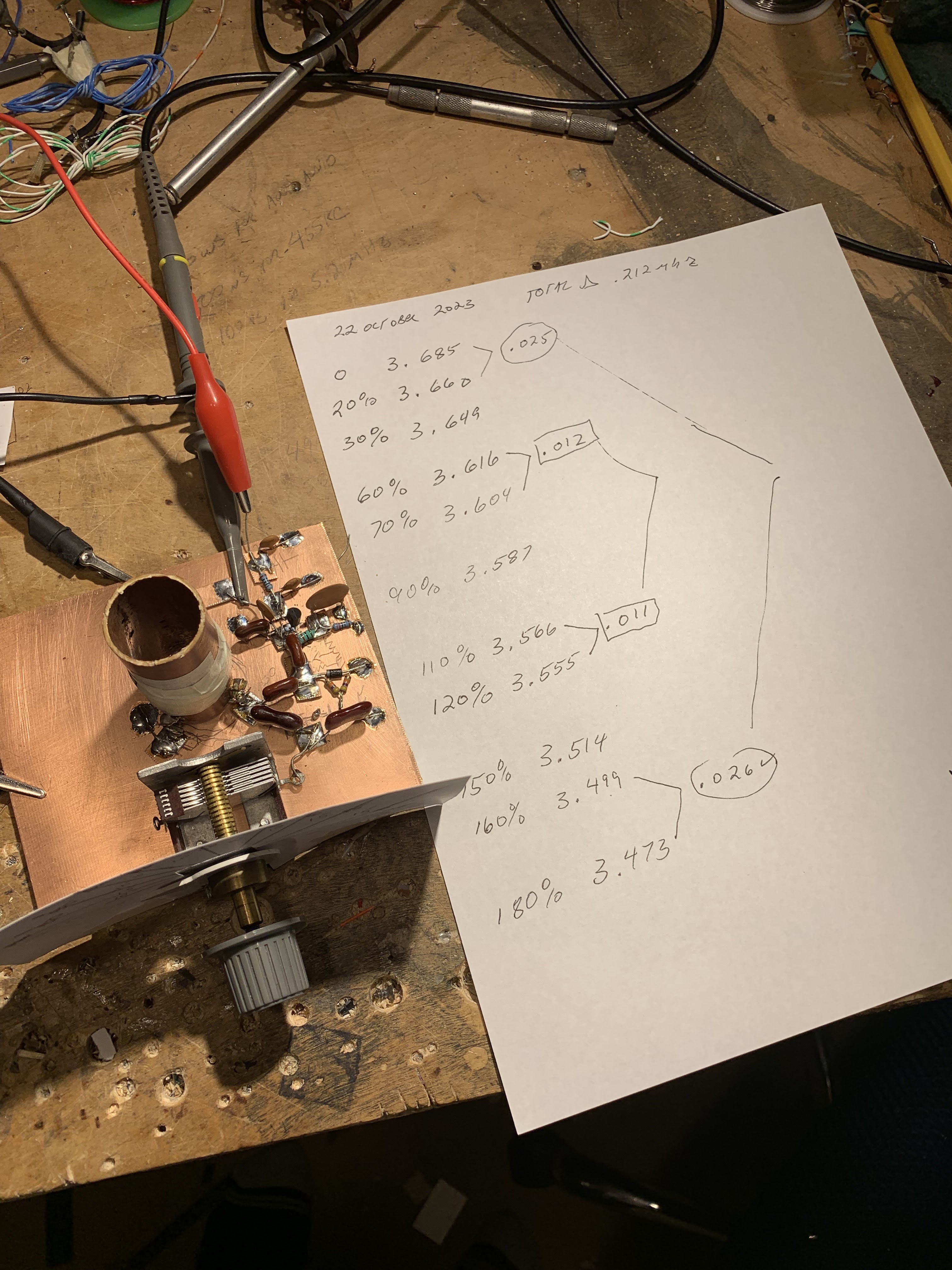
The 15-10 Rig has been performing very well, pulling in a lot of DX contacts on both bands. But there is one thing that has bothered me: The way the transceiver tunes. It can be a bit difficult getting an SSB station tuned in properly. At first I thought this was caused by a lack of lubrication on the variable cap that I've been using (out of an old QF-1), but it turned out that this was not the cause. The problem is something that Pete Juliano has lamented several times: LC style analog VFOs have a tendency to have the frequencies "bunched up" at one end of the tuning range. In other words, the tuning range is far from linear. I was having trouble tuning stations on on the portion of the band where the frequencies were bunched up. I did some quick measurement and found that on this side of the capacitor's tuning range, one turn of the dial would move the frequency about 100 kHz -- that is far too much. On the other end of the capacitor moved only 22 kHz with one turn of the dial (as I recall this is close to the recommended 20 kHz per dial rotation). Clearly I had a lot of the dreaded bunching up. This was what was making tuning difficult.
I had built a pretty standard Colpitts FET VFO. I had a 6.6uH coil, and a 9-135 pF variable cap in series with a 68 pF fixed cap. I was pleased that the VFO worked, and I put it in the circuit. Only later did the bunching up shortcomings become apparent.
I decided to build another VFO, this time paying attention to DIAL SCALE LINEARITY.
I plugged in the frequency range that I needed and the values for my variable capacitor. I calculated Cs which was the combined capacitance of the feedback and coupling capacitors. Finally, I had to make a decision about the nature of my variable cap: was it a Midline-Center Cap or was it a Straightline Capacitance cap. I consulted with Bob and he suggested that it might be somewhere between the two. I got out some graph paper and measured it -- it looks to me like a Straight Line Capacitance cap, with the capacitance varying linearly with changes in in the rotation of the shaft.
It looked fairly linear, so I selected "Straightline Capacitance." Bob's calculator predicted a much better dial scale linearity (see the picture at the top of this blog post).
I then built the oscillator stage in LTSpice using the values called for by Bob's calculator:
It worked well in LTSpice:
So I built it in the real world. I didn't have the exact values for the padder and trimmer caps, so I use values that were close.
Using the frequency counter in my Rigol 'scope, I again measured the frequency change for each movement of the shaft.
Here are the results: You can see that the bunching up has been largely eliminated. Frequency change for a 20 degree (not %) movement at one end of the capacitor's range is essentially the same as it is on the other end of the range.
I will continue to play around with the padder and trimmer cap values to get this VFO where I want it. I may also have to opt for less frequency range in order to get closer to the desired 20 kHz per dial turn value. I will also have to play around with the additional capacitance that will be switched in to move the VFO down a bit to the range needed for the 10 meter band.
The bottom line here is that Bob's bandspread calculator is very useful in figuring out how best to avoid the dreaded bunching up of frequencies that can -- sometimes -- come with the use of analog LC VFOs. The display of Dial Scale Linearity that appears at the end of each calculation is really brilliant, and allow for an instantaneous look at how changes in the various parameters will affect the linearity of tuning. This is a really wonderful tool for the homebrewer.
nTesting
woes. Looked bad. But it was a bad test cable. Duh.
nVFO
(Colpitts) at around 3.5 MHz.
nBuffer
blues: Bad J-310s. Beware!
nVariable
cap from a Heath Q Multiplier
nA
bit of a black art – competing goals. Freq coverage, etc.
nBFO
needed an amp to turn on the diodes in the balanced modulator
nTIA
amps. SIX dual direction TIAs. 18 transistors.
nOn
a pine board (like Frank Jones)
nWill
use the N6QW all discrete AF amp.
nMaybe
an RD16 in the final?
nWill
build a second one for the DR.
Shameless Commerce: Mostly DIY RF and the PSSST kit. Todd K7TFC reports: “The P3ST is on
track for Lee Deforest's birthday release (August 26th). I'm going to send out
another newsletter on July 4th, and I'll give some details on P3ST development.”
Results of Todd’s Survey.
Pete’s
Bench
nFT-8 on the KWM-1!
nPresentation to the ham club.
nWhy the Icom 7300 is the anti-thesis of
homebrew.
MMAILBAG:
-- SPRAT 195 Summer 2023, in the
mailbox. A happy day at N2CQR
-- Armand WA1UQO sent a wonderful book about Faraday and Maxwell… And told
me Jim K8OI was heading to our area. I
met Jim at the VWS Field Day event.
FB. Thanks Armand.
-- Tony G4WIF sent Father’s Day greetings.
-- Alvin N5VZH asking about electrolytics for his 2-B. Hayseed Hamfest!
-- John AC2RL replacements for the IBEW.
We need to start over!
-- Steve “Snort Rosin” Smith WB6TNL was in the area. Sorry I missed him.
-- Joh DL6ID helping us to track down origins of a homebrew receiver
Grayson saw in Berlin.
-- Grayson KJ7UM was in Europe visiting his wife’s relatives. But I think he is back in the USA.
-- Walter KA4KXX sent a QRP HB family portrait.
-- Wouter ZS1KE sent info on surface mount soldering.
-- George Zaff KJ6VU Ham Radio Workbench – re-runs! Recommended audio
processor. Let me know how it sounds.
-- Michael AA1TJ Great to hear
from him.
-- Alan Wolke W2AEW on the toroids
he used in Diode Ring video.
Thanks Alan!
-- Dean KK4DAS, AI and SWR meter project
And new lexicon word:
Hamsplaining.
-- Bob N7SUR -- Let me know we are
semifinalists in the Hack-A-Day prize!
This is so cool. We have been getting reports from Daniel VE5DLD up in Regina, Saskatchewan, Canada. Daniel is a teacher and he has been building the receiver with a group of students.
They have been doing very well. They may end up having more success than we have had here.
This morning Daniel fired up his build of the receiver and it was inhaling 40 meter signals. You can hear the CW and the FT8 and you can also hear shortwave broadcast signals just above the 40 meter frequencies. Congratulations to Daniel! He is now one of very few radio amateurs who has homebrewed a receiver. I think his students will soon do the same.
Daniel's students have built several of the boards and appear to be on the brink of full success.
Their PTOs look very nice.
The AF amps were the most challenging of the boards. Theirs look great. Excellent soldering.
We want the receiver project that we carried out at our local high school to serve has a model for others. After all, we got our inspiration from Farhan in Hyderabad. We want to see this kind of homebrewing continue. All of the information on this receiver is on our Hack-A-Day.io page:
We strongly encourage others around the world to find ways to use this project to teach analog electronics. We think the circuit strikes the right balance between simplicity and usefulness -- when they are done, the students will have a useful receiver capable of worldwide reception.
Please let us know if you are building this receiver; we are especially interested in the use of this receiver in student-focused group-build projects.
This is a really great video on how Mr. Carlson (VE7ZWZ) did troubleshooting on a tube-type receiver. The problem was an intermittent. They can drive you nuts, but Mr. Carlson show us how to stay sane.
-- His use of ordinary observation at the start of the process is very important. He notices a flickering glow in the voltage regulator tube. The flickering coincides with the intermittent noise that he is trying to fix. That is an important clue.
-- He also can see that the grid of one of the AF amplifier tubes is getting way too hot: grid emission. That is another important clue.
-- He checks the grid voltage on the AF amplifier and finds that it is way too low. It is fine on the other side of the resistor that carries the voltage to the tube. But it is close to zero at the grid. This means that the mica capacitors on the grid are suspect.
-- He uses some fairly esoteric test gear -- a homemade device and an an old Heathkit signal tester -- to check his diagnosis. They confirm that the mica caps are the problem. He replaces the caps and the problem is gone. A very satisfying troubleshoot.
Mr. Carlson presents us with a lot of good info:
-- 6K6 tubes were often in fact 6V6 tubes. And 12AX7s were often 6VJ8s! Manufacturers were deliberately re-branding tubes. So we shouldn't be surprised if some of our solid state devices turn out to be a bit different from what was promised. This practice goes way back.
-- I liked Mr. Carlson's final sensitivity test on the receiver -- he just waved his hand near the antenna connection and we could hear the receiver respond. Excellent.
-- Mr. Carlson is very negative about the use of polystyrene caps in oscillator circuits. But we these simple and cheap caps being used to good effect in oscillators in India.
-- The leaky and bad micas were a bit surprising. Carlson speculates that their proximity to heat-producing resistors might have caused the trouble.
Finally, it is interesting to hear the Canadian pronunciation of radio words: Solder with the L pronounced (as in the UK). Farad with the second A long and the final D emphasized (I say it just as the first two syllables of Michael Faraday's last name).
Mr. Carlson (VE7ZWZ) is launching a series of videos on the restoration of some old boatanchor receivers. I have been working on an old HQ-100, so this all resonates well with me.
He asked for viewer input on which of these receivers he should work on first. I voted for the SP-600 because I wanted to see how difficult it really is to change out the infamous Black Beauty capacitors. My second choice was the R-390, but I warned Mr. Carlson that he might need a chassis crane for that one. No kidding. Really.
I look forward to watching the series. Thanks in advance Mr. Carlson.
So there I was, innocently checking the lower end of the tuning range on my now 17 meter SSB Barebones Barbados W4OP receiver. I had it tuned to the bottom of the 17 meter phone band. All of a sudden I hear YV5B in CW. It was obviously a beacon transmission.
I had forgotten about these beacons. Some quick Googling brought me to a very up-dated web site:
The site shows exactly which station is transmitting at any given moment. There is also a very handy map display giving beam headings and distance from your location.
So far, I'm only hearing YV5B and VE8AT. I hope to hear more once the Coronal Mass Ejection is behind us.
Check it out. Leave your receiver on 18.110 MHz. Let us know what you are hearing.
As if being able to get home on Christmas Eve 2021 and then catching the Webb Telescope launch was not enough, Santa had another gift for us: Michael Rainey, AA1TJ, the Homebrew Hero of the Hobbit Hole, was back at it, melting solder. Mike threw together a regen receiver that allowed him to receive a transmission commemorating Reginald Fessenden's historic first transmission of phone signals. I was really pleased to once again be able to read about an AA1TJ radio adventure. Thanks Mike! Here is what Mike heard: http://soldersmoke.com/AA1TJ 920km.mp3
Mike wrote:
My chum, Peter/DL3PB, recently told me that Brian/WA1ZMS would broadcast a commemoration of Reginald Fessenden's mythical (operative word) 1906 Christmas Eve AM transmission. Doesn't that sound like fun?
True to form, I began scratch-assembling my receiver yesterday afternoon just as Brian went on the air. Then again, a two-transistor regenerative radio for 486kHz isn't exactly rocket science. In any case, I was up and listening inside of a half hour.
What did I hear? Static. Just static. As a sanity test I quickly tuned down to 371KHz to find my favorite non-directional beacon, "GW," beaming in loud and clear from Kuujjuarakip.
Kuujjuarakip?
Kuujjuarakip is a tiny settlement of mostly Inuit and Cree inhabitants located up on Hudson Bay. The villages are primarily accessible by air and water so a robust radio beacon is an obvious necessity.
Satisfied that my receiver was working properly, I re-tuned to 486kHz. Back to static. On the bright side, at least there were no commercials. I continued listening intently until Vic called me to dinner. After the dishes were done I slipped back down to my underground radio shack for one last try.
I heard it right away. Beneath the static I heard a weak, out-of-tune, solo violin playing, "Oh, Holy Night." The signal strength varied wildly with ionospheric propagation. When the signal finally climbed high enough above the noise I ripped out the bipolar transistor audio amplifier stage, connecting my headphones directly to the junction field effect transistor detector output terminals. Of course the audio was far weaker now, yet I could easily follow the tune until it eventually faded away. Not bad for an estimated 15 watt ERP AM signal from a distance of 920km. And on 486kHz, no less, just a hop-skip-and a jump from the old 500kHz Maritime CW band; where countless ship radio operators went to send their last SOS.
Returning to the house, I emailed my reception report and included a short recording that I had made of it. Brian replied just after midnight; apparently, equally as stoked
"Yours’ is the best DX ever given your regen RX! Way to go! I just love it."
He went on to tell me that he was born and raised in Vermont, but he'd been working as a radio scientist down in Virginia since 1990. Told me his heart was still here in the Green Mountains and he was touched to learn his meager signal had found its way back there on Christmas Eve. All in all, a night to remember.
If you're still with me I hope you'll listen to the short NPR story in the provided link. It originally aired on the supposed 100th anniversary of this event. It's not just about radio history. It's about belief, memory and the myths we lug around in our heads. I thought it was well done.
Cheers, Mike
Listen to what Mike heard. He says he "merely connected the mic input line of my computer across the headphone terminals. Some of the noise in the recording, - certainly the higher frequency stuff - is a byproduct of the computer. The headphone audio with the computer switched off was much more pleasant." Here it is: http://soldersmoke.com/AA1TJ 920km.mp3


.jpeg)